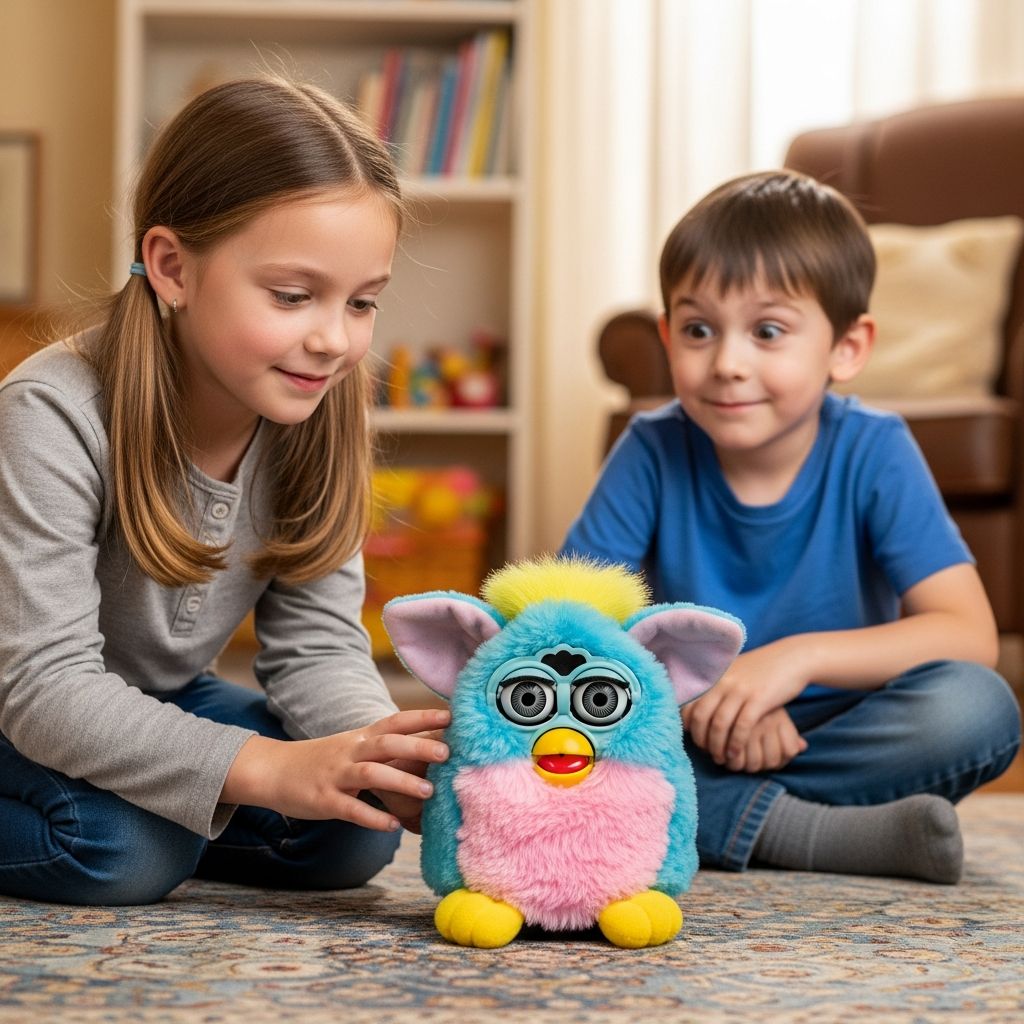
Furby has been puzzling, delighting, and occasionally irritating families since the late 1990s. This fuzzy electronic creature blinks, chats, sings, and reacts to touch and sound, promising a kind of pet-like companionship without the vet bills.
This article offers a parent-centered look at Furby: how it actually behaves in a home, what kind of play it encourages, when it becomes too much, and how to decide whether one belongs in your family’s toy ecosystem.
What Is Furby, Really?
At its core, a Furby is a small, robotic toy with soft fur, big ears, expressive eyes, and an internal computer that lets it respond to your child’s voice and touch.
| Feature | What Kids Notice | What Parents Notice |
|---|---|---|
| Voice reactions & phrases | It talks back, jokes, sings, and uses silly phrases. | It is loud, persistent, and seems to talk non-stop at times. |
| Touch sensors | It responds when petted, tickled, or fed pretend food. | Kids quickly learn how to “trigger” responses for attention. |
| Movement | Blinking, ear wiggles, and body wiggles feel lifelike. | Moving parts can be mesmerizing or grating, depending on the moment. |
| Lights & sounds | Colorful lights and songs feel like a mini party. | Lights and noise can overstimulate younger kids (and adults). |
The original Furby, released in 1998, was powered by a simple microcontroller and a single motor driving its eyes, ears, and mouth, with sensors for touch, sound, and light. Modern versions build on that idea with more phrases and modes, but the experience is similar: a noisy, reactive toy that tries hard to be a companion.
How Furby Behaves in Everyday Play
Marketing blurbs make Furby sound like a smart friend; real life is messier. Here is what most families encounter during the first few days.
- Initial fascination: Kids usually spend the first hours or days trying every trick they can discover—feeding, tickling, shaking (gently, one hopes), and shouting at Furby to see how it reacts.
- Noise everywhere: Expect bursts of chatter, giggles, and songs at volumes that easily cut through a closed door.
- Personality “emergence”: Older models slowly shift from speaking mostly in “Furbish” to more English words, while newer ones cycle through different moods and reactions; this gives kids the sense that Furby “learns” or “grows.”
- Sibling dynamics: Furbies sometimes become the center of joint play (taking it on adventures, putting on shows), and sometimes a source of conflict over who controls it.
- Occasional creepiness: Many parents report that Furby’s voice from a dark shelf, or its sudden activation, feels a bit uncanny—especially at night.
For some families, the toy settles into the role of noisy background character; for others, it becomes the single most loved toy in the house—for a season.
Under the Fur: A Quick Look at the Tech
Understanding how Furby works can make its behavior feel less mysterious and more manageable.
Basic Technology
Across generations, Furby typically includes:
- A small microcontroller (for example, early models used a 6502-based chip) that runs the behavior and “learning” routines.
- Touch sensors on the head, back, and sometimes tummy, plus a microphone to pick up sound and speech.
- Light sensors to respond to changes in room brightness (some Furbies react to being covered or exposed).
- A single motor with cams and gears to move ears, eyelids, and mouth.
- Speakers for voices, music, and sound effects.
Recent models add more phrases, voice-activated modes, and light-up ears, with some supporting several hundred possible responses.
What This Means for Parents
- No real intelligence: Furby sounds clever, but it does not understand in a human sense. It follows pre-programmed patterns triggered by sensors.
- Predictable triggers: Because behavior is tied to specific actions—petting, shaking, clapping—kids quickly learn the “buttons” to press.
- Battery dependence: As batteries weaken, the toy can behave erratically—slurred speech, frozen expressions, or “tired” behavior, which children may interpret as Furby being sick or sad.
Benefits: What Furby Can Offer Kids
Despite the chaos, Furby can genuinely support several types of play and development when used thoughtfully.
1. Imaginative and Social Play
Pretend play is a major driver of early childhood development, helping kids build language, social understanding, and emotional skills. Furby can function as:
- A pretend pet that needs care, food, and attention.
- A character in elaborate stories—school, space missions, tea parties, or make-believe hospitals.
- A “friend” that siblings jointly take care of, sometimes improving cooperative play.
2. Early Responsibility (In a Toy-Sized Package)
While Furby does not truly need care, it acts as if it does, which can be a gentle introduction to responsibility:
- Children remember to turn it off or put it to “sleep.”
- They may ask to change batteries or keep track of accessories like pretend food.
- Parents can tie Furby time to basic routines: homework first, then Furby.
3. Curiosity About How Things Work
Because Furby seems alive but clearly is not, it frequently sparks questions: “How does it know I’m touching it?” “Where is its brain?” These questions can open doors to basic STEM conversations about sensors, motors, and simple programs.
Drawbacks: The Parts That Drive Parents a Little Crazy
For all its charm, Furby has some very real downsides that parents should weigh carefully.
1. Volume and Sensory Overload
Furby’s voice and songs are high-pitched and repetitive, and children may play with it for long stretches. In busy homes, this can contribute to overall noise levels that wear on everyone’s patience. For kids who are sensitive to sounds, the mix of bright lights and constant chatter may be overstimulating.
2. Difficult Transitions and Emotional Attachment
Because Furby reacts emotionally—acting “sad” or “sleepy”—some children become highly attached. Turning it off, changing batteries, or putting it away can trigger tears or anger.
- Preschoolers may see Furby as truly alive, making boundaries tricky.
- Older children usually know better, but may still project feelings onto it.
3. Nighttime Surprises
Parents often report Furby activating unexpectedly from a shelf or toy bin—especially when bumped, jostled, or when batteries run low. Keeping Furby outside the bedroom and learning how to fully power it off are essential for preserving everyone’s sleep.
4. Long-Term Play Value
For some kids, Furby remains a favorite for months; for others, the enthusiasm fades once the main reactions and jokes are familiar. Compared with toys that allow open-ended building or creativity, Furby’s fixed set of behaviors can eventually feel limited.
Age, Temperament, and Family Fit
Furby may delight one family and overwhelm another. Match the toy to your child’s age and temperament, not just their enthusiasm in the store aisle.
Recommended Ages
Manufacturers generally recommend Furby for kids around 6 and up, who are less likely to put small parts in their mouths and more able to handle noisy, unpredictable behavior. In practice:
- Age 3–4: Some preschoolers adore Furby, but many find it too intense; adult supervision and short sessions help.
- Age 5–7: Often the sweet spot—kids are old enough to treat it as a character and young enough to suspend disbelief fully.
- Age 8+: Older kids may enjoy it for silliness or nostalgia, but interest may fade faster unless they are especially drawn to character toys.
Personality Fit: Which Kids Tend to Love Furby?
- Children who enjoy pretend pets, dolls, or stuffed animals.
- Kids who like noisy, high-energy toys and interactive gadgets.
- Young storytellers who naturally create characters and voices.
Kids who are very sensitive to noise, sudden movements, or bright lights may find Furby overwhelming, especially at first.
Practical Tips for Parents Considering a Furby
If you are leaning toward buying one, a few ground rules can make the experience much smoother.
1. Set Expectations Before It Comes Out of the Box
- Explain that Furby is a toy, not a living creature.
- Agree on where Furby can play (for example, not at the dinner table).
- Talk about quiet times when Furby needs to be turned off or put away.
2. Establish a “Furby Zone”
Choose specific rooms—like a playroom or living room—where Furby is allowed. Keeping it out of bedrooms and quiet work areas helps protect sleep and concentration.
3. Learn the Off and Sleep Functions Immediately
- Read the manual to understand how to fully power down Furby.
- Show your child how to help put Furby to sleep rather than simply removing it mid-play.
- Keep spare batteries on hand and treat battery changes as “check-ups” rather than emergencies.
4. Use Furby to Support Skills, Not Compete With Them
Furby can be a reward after homework or chores, or a partner in reading—kids can pretend to read stories to Furby or act out scenes. Framing it as a sidekick rather than the center of the universe helps keep balance.
Is Furby Worth the Money?
Whether Furby is worth its price depends on how your child plays and what you value in toys.
- High value if your child loves character-based play, talks to stuffed animals, and is captivated by interactive gadgets.
- Moderate value if your child tends to rotate through toys quickly but you are comfortable treating Furby as a temporary craze.
- Low value if your household prioritizes quiet, open-ended, or screen-free play with minimal electronic noise.
Cost aside, the more important question is: Will you still feel okay hearing this toy after the 100th repetition of its favorite song?
Comparison: Furby vs. Other Interactive Toys
Parents often compare Furby to other interactive or robotic toys when deciding where to spend limited toy budget.
| Aspect | Furby | Simple Talking Doll | STEM Robot Kit |
|---|---|---|---|
| Main appeal | Character, personality, and noise-filled interaction. | Comfort, scripted phrases, role-play. | Building, coding, problem-solving. |
| Noise level | High and frequent. | Moderate and predictable. | Usually moderate; more beeps than speech. |
| Educational angle | Social-emotional pretend play. | Language practice and narrative play. | Strong STEM and logical thinking. |
| Longevity | Depends on child’s taste for noise and characters. | Often steady but low-key. | Can last years if the child enjoys building and tinkering. |
For families seeking an emotional playmate, Furby may be the best fit. For those focused on STEM learning or calmer play, other options may bring more lasting value.
Frequently Asked Questions (FAQs)
Q: Is Furby safe for young children?
A: Furby is generally designed for children around 6 and up, largely because of small parts and the intensity of noise and movement. Younger kids may enjoy supervised play, but parents should monitor for overstimulation and ensure that loose parts and batteries stay out of reach.
Q: Can Furby improve my child’s social or language skills?
A: Furby can support pretend play, which is linked to language and social development in early childhood, but it should not replace human interaction. Think of it as a playful prop that encourages stories and conversations, not a teaching device.
Q: How do I stop Furby from talking at night?
A: Check the instructions for how to fully power it down and remove batteries if necessary. Keep Furby out of bedrooms, and store it where it will not be bumped. Some models enter sleep mode after a period of inactivity, but movement or sound can wake them again.
Q: What should I do if my child is too attached to Furby?
A: Treat Furby like a favorite stuffed animal: respect the attachment while gently setting boundaries. Create routines for saying goodnight to Furby, involve your child in turning it off, and introduce other toys and activities so Furby is not the only source of comfort.
Q: Is Furby listening to our conversations?
A: Furby uses a microphone to detect speech and sounds so it can respond, but it is not a general-purpose recording device or smart speaker. Recent models are designed as stand-alone toys without internet connectivity, which reduces privacy concerns compared with Wi-Fi-enabled gadgets.
References
- Furby — Robots: Your Guide to the World of Robotics (IEEE Spectrum / Robots Guide). 2023-08-01. https://robotsguide.com/robots/furby
- Discover Original Furby: Features and Review — Acc Grass Roots. 2023-09-15. https://www.accgrassroots.org/discover-original-furby-features-and-review/
- Furby — Electronic Toy — Victoria and Albert Museum Collections. 2019-05-10. https://collections.vam.ac.uk/item/O41202/furby-electronic-toy-tiger-electronics-ltd/
- Furby — Hasbro / Brand History via Wikipedia References. 2023-12-01. https://en.wikipedia.org/wiki/Furby
- Pretend Play and Cognitive Development — Lillard, A. S. et al., Psychological Bulletin. 2013-07-01. https://doi.org/10.1037/a0032933