Every parent has been there: your kid hears a strange noise in a video, at the zoo, or outside the window and turns to you with big eyes and an even bigger question — “What animal makes that sound?” This guide explores surprising, funny animal noises and shows you how to turn them into playful learning moments at home.
Why Kids Are Obsessed With Animal Noises
Animal sounds are often some of the first words children produce, even before many real vocabulary items like names of objects or people. Research in language development shows that repetitive, high-interest sounds help children practice speech and connect sounds with meanings. For kids, roaring, mooing, or ribbiting is more than silliness — it is practice for:
- Imitating new sounds and mouth movements
- Learning how sound relates to a specific animal or picture
- Taking conversational turns (you roar, they roar back)
- Building memory through repetition and routines
Because animal sounds are easy, exaggerated, and emotional, they become a natural bridge from babbling to real words.
Three Big Families of Funny Animal Sounds
To keep things simple (and fun), you can think about animal noises in three big groups when playing with your child.
1. The Loud Crowd: Roars, Bellows, and Booms
These animals shake the room and are perfect for energetic play.
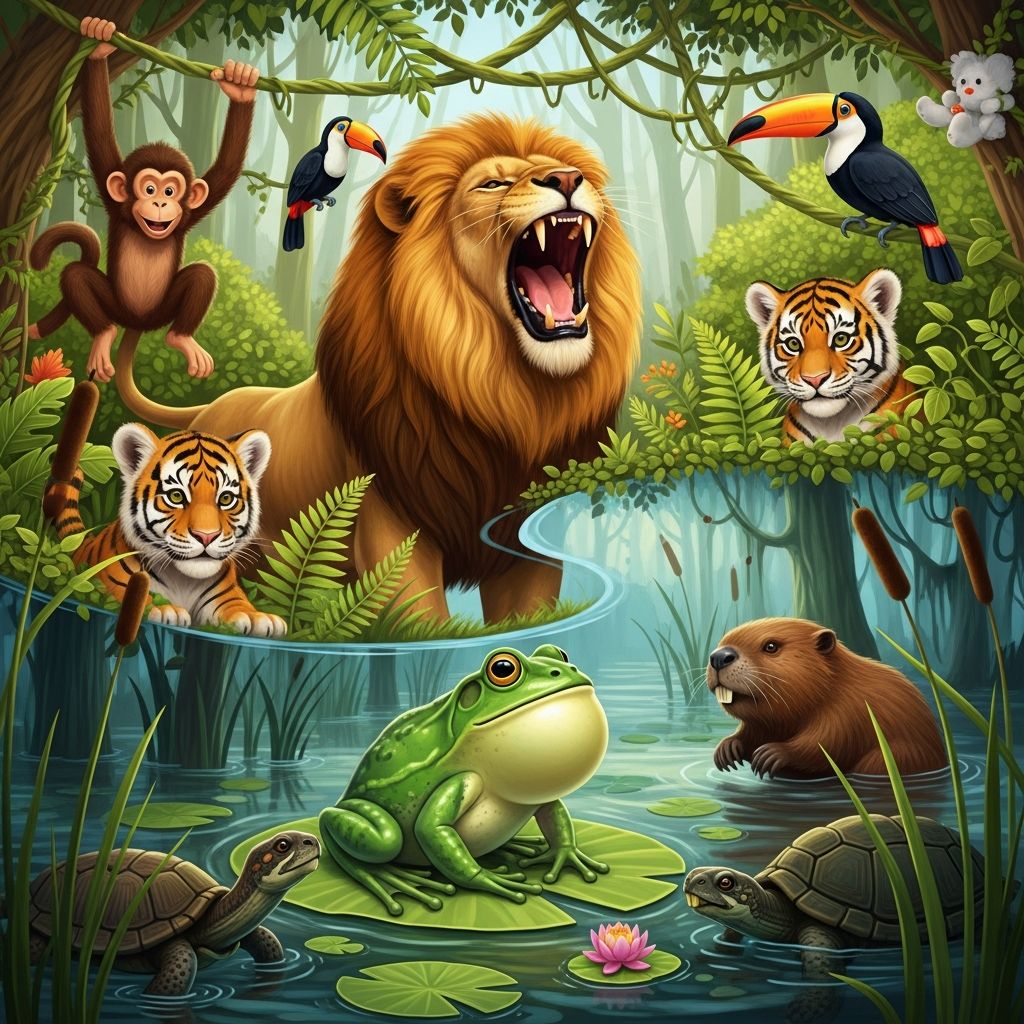
- Lions and tigers — Known for powerful roars, used to warn rivals or show strength.
- Elephants — Famous for trumpeting through their trunks when excited or alarmed.
- Alligators and crocodiles — Can produce low bellows and rumbles, sometimes making water vibrate around them.
These sounds are dramatic and make great material for pretend play: stomping like an elephant, crouching like a tiger, or whispering before a big lion roar.
2. The Chatterers: Chirps, Whistles, and Chatters
Many animals communicate using rapid, musical, or repetitive calls.
- Birds — They sing, chirp, tweet, and trill to attract mates or mark territory.
- Monkeys — Species like marmosets use distinct call types such as trills, twitters, and chatters to keep in touch, warn of danger, or coordinate with their group.
- Dolphins — Communicate using clicks and whistles, which play a role in navigation and social behavior.
These sounds are perfect for calmer, listening-based games: copying short patterns, tapping rhythms, or making “secret codes” with whistles and clicks.
3. The Everyday Noisemakers: Moo, Baa, and Oink
Farm animals may be familiar, but their sounds are still endlessly entertaining for young children.
- Cows — They moo (also called “lowing” in formal English) and communicate with their herd and calves.
- Sheep and goats — Known for the classic baa or bleat, especially recognizable in nursery rhymes.
- Pigs — They oink, grunt, and squeal; kids instinctively love to copy these sounds.
Because many board books and songs feature these animals, they become a reliable “starter set” for animal-sound play with toddlers.
How Animal Sounds Help Kids Learn Language
Playful noise-making may look chaotic, but it is surprisingly rich from a developmental point of view. Early language research emphasizes how interactive sound play supports speech, memory, and social skills.
| Skill Area | How Animal Sounds Help | Example Activity |
|---|---|---|
| Speech practice | Encourages kids to try new vowels and consonants in an easy, playful way. | Saying “moo,” “baa,” and “neigh” in a row and exaggerating the sounds. |
| Vocabulary | Connects words to pictures, toys, or real animals, building word-meaning links. | Pointing to a picture of a duck and asking, “What does a duck say?” |
| Listening skills | Teaches kids to notice differences in pitch, length, and rhythm. | Comparing a lion’s roar to a cat’s meow and talking about which is louder. |
| Turn-taking | Prepares children for conversation by taking turns making sounds. | You moo, your child moos back, then you switch to a new animal. |
| Emotion and expression | Lets kids safely experiment with “scary,” “sad,” or “excited” sounds. | Growling like a pretend tiger and then showing how it calms down. |
Surprising Animal Noises Kids Love to Discover
Beyond the basics, there are many strange, lesser-known animal sounds that fascinate children once they hear them.
Alligators and Crocodiles: Deep Rumbles
Most kids expect reptiles to be silent, so discovering that alligators and crocodiles can bellow or rumble feels thrilling.
- Adult males can produce deep booms that make the water around them vibrate.
- Babies chirp or squeak inside the egg to signal that they are ready to hatch.
- Play idea: Pretend to be “baby crocs” calling to a parent, using tiny squeaks and soft tapping sounds.
Bats: High-Pitched Squeaks
Bats use high-frequency sounds for echolocation, sending out squeaks and listening for the echoes to understand their surroundings.
- Many of their sounds are too high for humans to hear, but some species also make soft squeaks and chatter.
- Play idea: Turn off the lights, close your eyes, and say “ping!” while your child claps when they hear it, pretending to be a bat using sound to find objects.
Whales: Songs of the Deep
Whales are known for long, haunting songs made up of moans, clicks, and whistles. Some species, like humpback whales, produce complex patterns that can last many minutes.
- Their sounds can travel long distances underwater and help with communication and navigation.
- Play idea: Hum a simple “whale song” pattern and let your child copy or invent their own underwater melody.
Insects: Buzzes, Chirps, and Clicks
Insects might be small, but they create a surprisingly rich soundscape.
- Bees and other flying insects buzz; the sound mostly comes from their rapidly beating wings.
- Crickets often chirp by rubbing their wings together, especially at night.
- Play idea: Use a comb or zipper to imitate insect buzzing, then ask your child to guess which “bug” is making which noise.
Animal Sounds Around the World
An interesting twist for older kids is that different languages write animal sounds differently, even when the real noises are the same. Exploring this can be both funny and educational.
- In English, a rooster says “cock-a-doodle-doo”, while in other languages it might be written very differently but sound similar.
- Cows often have similar-sounding words worldwide, usually built with an “m” or “b” plus an “oo”-like sound.
- Frog sounds vary wildly by language – some focus on a “ribbit”-type sound, others highlight croaking or clicking.
You can turn this into a game by looking up how a favorite animal “speaks” in two or three languages and trying out the different versions together.
Simple Games to Play With Animal Sounds
Here are easy, low-prep activities you can do at home using only your voice and a bit of imagination.
1. Guess the Animal
- Make one animal sound at a time (moo, roar, hiss, chirp).
- Your child guesses which animal it is.
- Switch roles and let them create the sounds while you guess.
This builds listening skills and encourages creativity as children invent their own versions of each noise.
2. Sound and Motion Match
- Choose a few animals and pair each sound with a movement (stomping, flapping, hopping).
- Call out or make a sound, and everyone in the room has to move like that animal.
- Make it sillier by mixing them up — flap like an elephant or roar like a mouse.
3. Quiet and Loud Zoo
- Set up a pretend “zoo” in your living room.
- Take turns choosing quiet animals (butterfly, mouse) and loud animals (lion, elephant).
- Practice whisper-level sounds versus big, booming voices.
This game helps kids learn volume control and self-regulation while still enjoying big, expressive noises.
4. Storytime Sound Effects
- Read any picture book that has animals, or even cars and weather.
- Pause whenever an animal appears and ask your child to add the sound effect.
- Encourage variations: a sleepy lion’s roar, a baby duck’s tiny quack, or a scared dog’s whimper.
Interactive reading like this supports language learning and keeps kids engaged longer.
Frequently Asked Questions (FAQs)
At what age do kids usually start imitating animal sounds?
Many children begin copying simple animal sounds between 12 and 18 months, though the exact timing varies by child. Repetitive, playful practice — not pressure — is what matters most.
Are animal sounds considered “real words” for language development?
Yes. Speech-language experts often count consistent animal sounds like “moo” or “woof” as early words because they carry clear meaning and are used on purpose to communicate.
What if my child prefers roaring and growling to talking?
Enjoy the roaring and gently expand it. You can add simple words around the sound, such as “big lion roar,” “little lion roar,” or “lion is sleepy,” helping connect playful noises with everyday language.
Are some animal sounds too scary for toddlers?
It depends on the child. Loud roars or snarls can be overwhelming. If your child looks worried, soften the sound, make it funny, or let them be the one in control of when the scary sound starts and stops.
How can I make animal-sound play educational for older kids?
With older children, you can talk about why animals make specific calls, how sounds travel (in water or air), and how different languages write the same animal noise. You can even explore real recordings from nature or zoo websites and compare them to cartoon versions.
References
- Animal Sounds in English: A Complete Guide to How Animals “Speak” — Preply. 2023-05-15. https://preply.com/en/blog/english-words-for-animal-sounds/
- 18 Common Animal Sounds in English — FluentU. 2022-03-10. https://www.fluentu.com/blog/english/animal-sounds-in-english/
- Deep convolutional network for animal sound classification and source attribution using dual audio streams — Oikarinen et al., PLOS Computational Biology. 2019-10-14. https://doi.org/10.1371/journal.pcbi.1007296
- 10 Animal Sounds in Different Languages — Lingoda. 2021-08-23. https://www.lingoda.com/blog/en/animal-sounds-different-languages/
- List of Animal Sounds — Wikimedia Foundation (data sourced from zoological references). 2023-07-01. https://en.wikipedia.org/wiki/List_of_animal_sounds