When a child starts puberty very early, very late, or has possible problems with their reproductive organs or certain brain areas, doctors may order a blood test that measures follicle stimulating hormone (FSH). This test gives important clues about how a child’s hormone system is working and can help doctors decide what other tests or treatments are needed.
1. Hormones, Puberty, and FSH: The Big Picture
FSH is one of the key hormones that help control sexual development and fertility. It is made in a small gland deep in the brain called the pituitary gland. In children, FSH levels are usually low until the body begins to prepare for puberty.
1.1 What Does FSH Do?
- In girls and people with ovaries
- Helps the ovaries grow and mature eggs (follicles).
- Works with other hormones to start menstrual periods.
- Supports normal menstrual cycles and fertility later in life.
- In boys and people with testes
- Stimulates the testicles to make sperm.
- Plays a role in testicular growth and function.
- Helps support normal fertility in adulthood.
- In all children
- Works together with luteinizing hormone (LH) to drive the changes of puberty.
- Is controlled by signals from the brain, especially the hypothalamus and pituitary.
1.2 How FSH Fits Into the Puberty “Hormone Chain”
Puberty is guided by a carefully timed chain of signals between the brain and reproductive organs.
| Step | What Happens | Main Hormones |
|---|---|---|
| 1. Brain triggers puberty | Hypothalamus starts releasing pulses of a hormone that wake up the puberty system. | Gonadotropin-releasing hormone (GnRH) |
| 2. Pituitary responds | Pituitary gland releases hormones into the blood that travel to the ovaries or testes. | FSH and luteinizing hormone (LH) |
| 3. Reproductive organs react | Ovaries or testes start making sex hormones and (later) eggs or sperm. | Estrogen, progesterone, testosterone |
| 4. Body changes appear | Growth spurt, breast development, pubic hair, testicular enlargement, and periods. | Sex hormones plus FSH and LH |
An FSH level that is higher or lower than expected for a child’s age and stage of development can give doctors clues about where in this chain a problem might be occurring.
2. Why a Doctor Might Order an FSH Blood Test
FSH testing is usually done as part of an evaluation of growth, puberty, or fertility. In children and teens, it is especially useful when puberty seems early, late, or unusual.
2.1 Common Reasons in Children and Teens
- Possible early puberty (precocious puberty)
- Breast development, pubic hair, or underarm hair at an unusually young age.
- Rapid height gain or body odor typical of older kids.
- Menstrual periods starting much earlier than expected.
- Possible delayed puberty
- No breast development in a girl by the age a doctor would expect.
- No testicular enlargement in a boy by the usual age for puberty.
- Very slow progression of puberty changes once they start.
- Concerns about ovaries or testes
- Testes that did not fully develop or are not present.
- Ovarian problems or possible loss of ovarian function.
- Differences in sex development or uncertain sex characteristics at birth.
- Possible pituitary or hypothalamus problems
- Conditions that may affect hormone production in the brain.
- History of brain injury, brain surgery, or certain tumors.
- Multiple hormone issues (for example, growth hormone and thyroid problems together).
2.2 Reasons in Adults (For Parent Awareness)
Although this guide focuses on kids and teens, many parents also learn that FSH tests are used in adults. Doctors may measure FSH to help evaluate:
- Difficulty becoming pregnant or possible infertility.
- Irregular or absent menstrual periods.
- Menopause or early menopause (primary ovarian insufficiency).
- Low sperm count or suspected testicular failure in men.
3. How the FSH Blood Test Is Done
An FSH test is a standard blood draw, similar to other routine lab tests. It is usually quick, and complications are uncommon.
3.1 Before the Test: Preparing Your Child
Your child’s health care team will tell you if any special steps are needed. Depending on other tests being done at the same time, the doctor may recommend:
- Checking about food and drink
- Some hormone tests require fasting (no food or drink except water) for several hours.
- Ask whether your child may eat or drink before the appointment.
- Reviewing medicines and supplements
- Tell the doctor about all prescription and over-the-counter medicines.
- Do not stop any medicine unless the provider specifically advises it.
- Preparing emotionally
- Explain, in simple terms, that a small amount of blood will be taken with a tiny needle.
- Reassure your child that the test is quick and that you will stay with them if allowed.
- Practice calming strategies like deep breathing or counting slowly.
3.2 During the Blood Draw
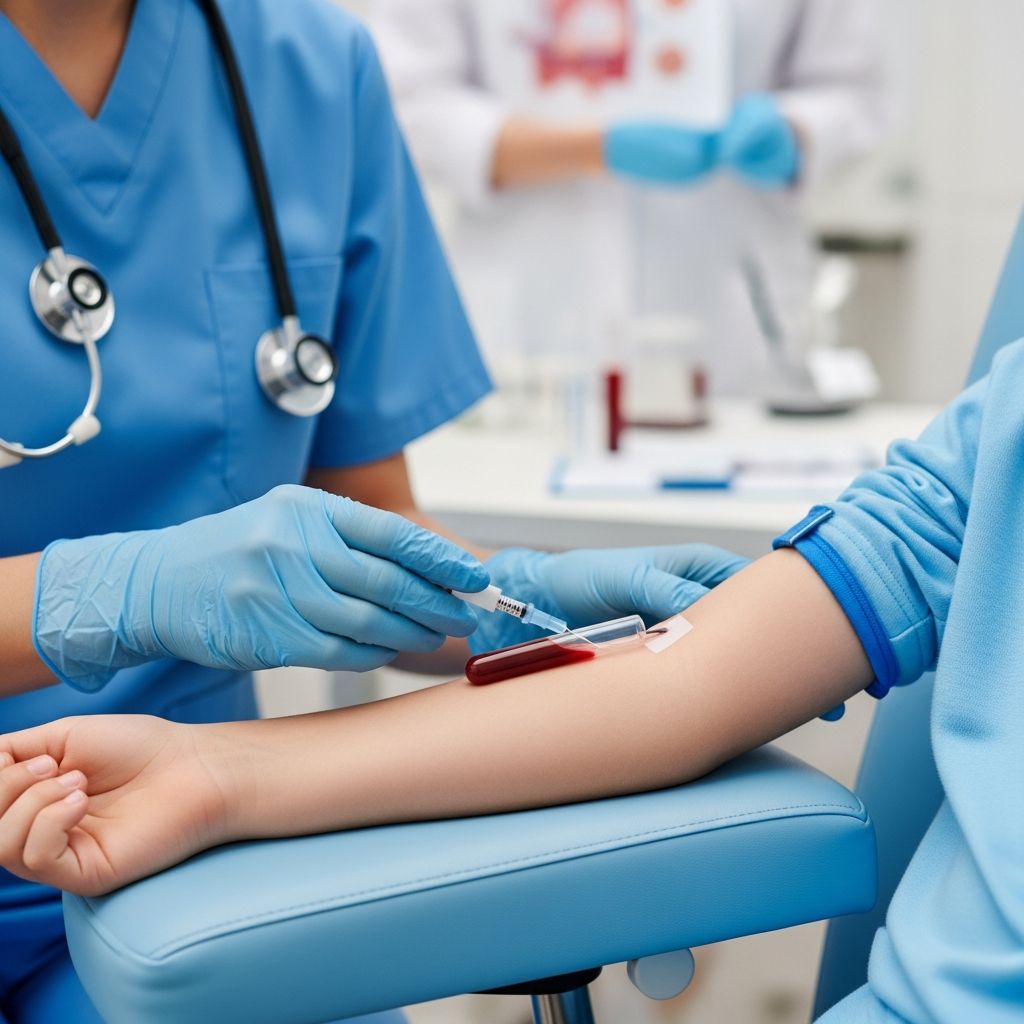
The test is usually done in a clinic, hospital lab, or outpatient lab center by a trained phlebotomist or nurse.
- Your child may sit in a chair or lie on an exam table.
- An elastic band (tourniquet) is placed around the arm to make a vein easier to see.
- The skin is cleaned with an antiseptic wipe.
- A small needle is inserted into a vein, usually in the arm or hand.
- A tube or syringe collects a small sample of blood.
- The needle is removed, and a cotton ball or gauze pad is pressed on the site.
- An adhesive bandage is applied.
The blood sample is then sent to a laboratory, where technicians measure the FSH level (and often other hormones) with specialized equipment.
3.3 How Long It Takes and When Results Are Ready
- The actual blood draw usually takes only a few minutes.
- Total time in the lab may be longer if your child is anxious or if multiple tests are ordered.
- Results are commonly available within a few days, depending on the lab and how complex the testing is.
4. Understanding FSH Results
FSH levels are interpreted differently for children, teens, and adults. Normal ranges vary with age, sex, and stage of puberty, and each lab may have its own reference intervals.
4.1 Typical Ranges by Age and Sex
The table below shows example ranges that some labs use for FSH in blood; your child’s report may include slightly different values.
| Group | Approximate FSH Range* | Notes |
|---|---|---|
| Boys before puberty | 0 to about 5.0 mIU/mL | Levels are generally low before puberty begins. |
| Boys during puberty | About 0.3 to 10.0 mIU/mL | Values gradually rise as puberty progresses. |
| Adult men | About 1.5 to 12.4 mIU/mL | Helps evaluate testicular function and fertility. |
| Girls before puberty | 0 to about 4.0 mIU/mL | Also usually low before puberty. |
| Girls during puberty | About 0.3 to 10.0 mIU/mL | Values increase with ovarian activation. |
| Women with regular cycles | About 4.7 to 21.5 mIU/mL | Varies with the menstrual cycle phase. |
| Women after menopause | About 25.8 to 134.8 mIU/mL | Higher levels are typical once ovaries stop functioning. |
*These numbers are examples only. Always rely on the reference range printed on your child’s own lab report and your provider’s explanation.
4.2 What Higher-Than-Expected FSH Can Mean
An elevated FSH level may signal that the pituitary gland is working hard because the ovaries or testes are not responding normally, or that puberty is starting earlier than expected.
- In children
- FSH higher than expected for age, along with elevated LH and early puberty signs, can suggest central precocious puberty (early activation of the brain’s puberty control center).
- High FSH with underdeveloped ovaries or testes may point toward primary gonadal failure (a problem in the ovaries or testes themselves).
- In adults
- Very high FSH in a woman with missed periods may indicate menopause or early loss of ovarian function.
- High FSH in a man may reflect testicular failure and can be associated with low sperm counts.
4.3 What Lower-Than-Expected FSH Can Mean
Low FSH levels may suggest that the problem is in the hypothalamus or pituitary rather than the ovaries or testes.
- Possible causes include
- Certain pituitary or hypothalamic disorders.
- Severe stress, significant undernutrition, or intense athletic training.
- Some chronic illnesses or genetic conditions.
- In children with delayed puberty, low FSH with low LH may indicate that the brain has not yet started the puberty signal or that something is interfering with it.
FSH is almost never interpreted alone. Doctors look at:
- Other hormone levels (such as LH, estradiol, testosterone, thyroid hormones).
- Growth patterns and height.
- Physical signs of puberty.
- Family history and other medical conditions.
5. Risks, Comfort, and Safety
FSH testing is considered very safe. The amount of blood taken is small, and serious complications are rare.
5.1 Possible Minor Side Effects
- Mild pain or stinging during the needle stick.
- Small bruise at the puncture site.
- Lightheadedness, especially in children who are very anxious or sensitive to needles.
These usually improve quickly and can often be eased by holding firm pressure on the site, giving a drink and snack afterward if permitted, and offering reassurance.
5.2 Helping Your Child Cope
- Use age-appropriate language (for example, “a quick pinch” instead of “shot”).
- Offer a favorite toy, book, or video as a distraction.
- Practice slow breathing together before and during the test.
- Praise your child afterward for their courage.
6. What Happens After the Test
Once the results are available, your child’s health care provider will review them with you and explain what they may mean for your child’s health and development.
6.1 Follow-Up May Include
- More blood tests to check related hormones, such as LH, estradiol, testosterone, thyroid hormones, or prolactin.
- Imaging tests (such as ultrasound of the ovaries or testes, or MRI of the brain) if a structural problem is suspected.
- Growth and puberty tracking with regular height, weight, and development checks over time.
- Referral to a pediatric endocrinologist, a specialist in children’s hormone and growth disorders.
6.2 Possible Treatment Paths
Treatment depends entirely on the underlying cause, not just on the FSH number. Some children need no treatment at all, only observation. Others may benefit from:
- Medication to slow overly early puberty when appropriate.
- Hormone replacement if the ovaries, testes, or pituitary are not making enough hormones.
- Support for nutrition, mental health, or chronic illness that affects growth and puberty.
Your child’s medical team will explain the options and involve you in all decisions.
7. Frequently Asked Questions (FAQs)
7.1 Is an FSH blood test the same as a fertility test?
No. FSH is one important hormone involved in fertility, but by itself it is not a complete fertility test. In adults, it is often combined with other hormone tests and evaluations of sperm or egg function. In children, FSH testing is mainly used to look at puberty timing and hormone system health.
7.2 Will a high or low FSH result always mean something is wrong?
Not always. FSH naturally changes with age and stage of puberty, and it can vary somewhat from one day to another. A value slightly outside a lab’s reference range may still be normal for your child, depending on context. This is why interpretation by a knowledgeable provider is essential.
7.3 Can lifestyle changes improve a child’s FSH level?
FSH itself is mainly controlled by the brain and reproductive organs. However, overall health strongly influences puberty and hormone balance. Good nutrition, healthy body weight, adequate sleep, and management of chronic illness or stress all support normal hormone function, though they do not replace medical treatment when an underlying disorder is present.
7.4 How often will my child need FSH testing?
Some children need only a single FSH measurement, while others require repeat testing to see how hormone levels change over time or in response to treatment. The schedule depends on the reason for testing and on your child’s diagnosis. Your provider will outline a plan that fits your child’s situation.
7.5 When should I ask for a referral to a pediatric endocrinologist?
You can request a referral if your child’s puberty seems very early or very delayed, if you are confused by hormone test results, or if a pituitary, hypothalamic, ovarian, or testicular problem is suspected. Pediatric endocrinologists are specially trained to evaluate complex hormone patterns and guide families through diagnosis and treatment.
References
- Follicle-stimulating hormone (FSH) blood test — UCSF Benioff Children’s Hospitals. 2022-08-10. https://www.ucsfbenioffchildrens.org/medical-tests/follicle-stimulating-hormone-(fsh)-blood-test
- Follicle-Stimulating Hormone — University of Rochester Medical Center Health Encyclopedia. 2023-05-01. https://www.urmc.rochester.edu/encyclopedia/content?contenttypeid=167&contentid=follicle_stimulating_hormone
- Follicle-stimulating Hormone (FSH) Test — Testing.com. 2022-06-15. https://www.testing.com/tests/follicle-stimulating-hormone-fsh/
- Follicle-Stimulating Hormone (FSH) Test — Kaiser Permanente Health Encyclopedia. 2021-11-30. https://healthy.kaiserpermanente.org/health-wellness/health-encyclopedia/he.follicle-stimulating-hormone-fsh-test.hw7924
- Follicle-Stimulating Hormone (FSH): What It Is & Function — Cleveland Clinic. 2023-04-05. https://my.clevelandclinic.org/health/articles/24638-follicle-stimulating-hormone-fsh
- Diagnosing Disorders of Puberty — NYU Langone Health. 2022-03-22. https://nyulangone.org/conditions/disorders-of-puberty/diagnosis