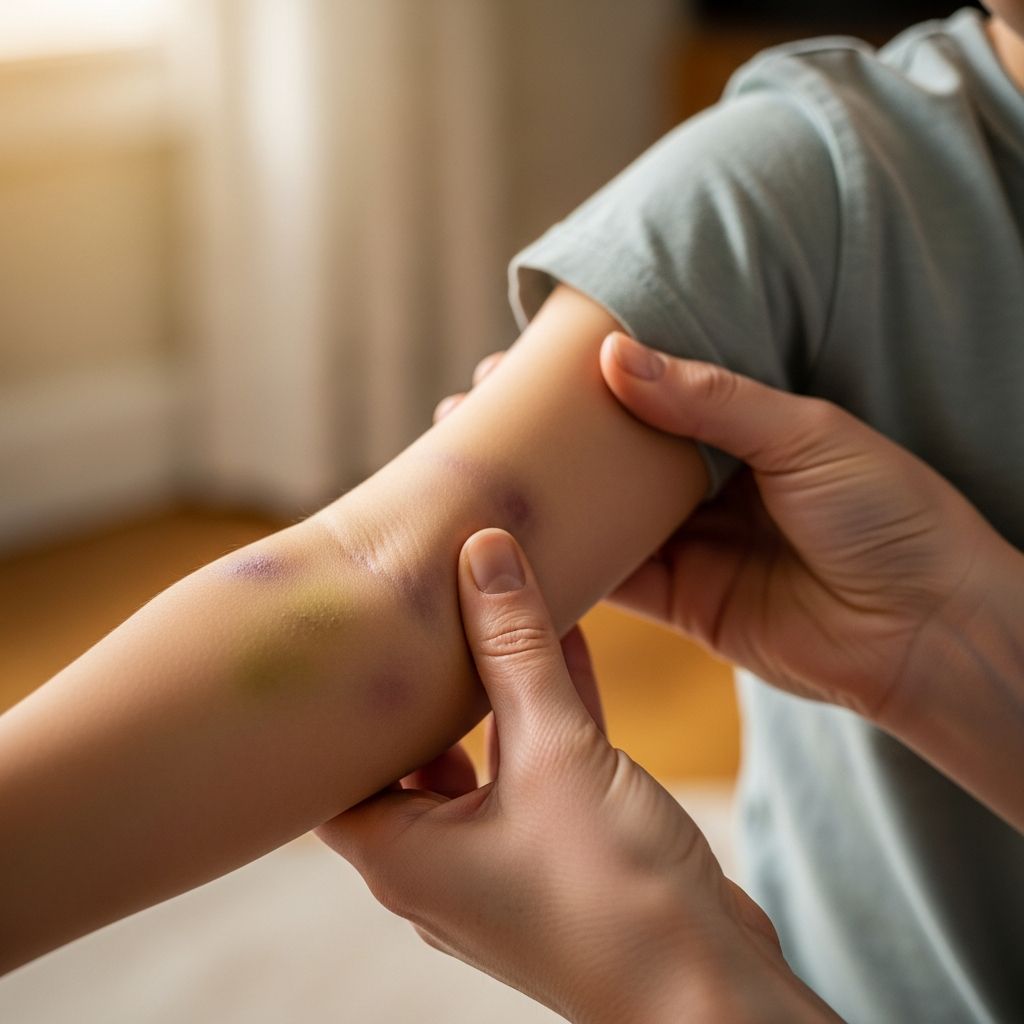
A bump to the arm is one of the most common injuries children experience, especially during active play, sports, and everyday adventures. A forearm contusion is the medical term for a bruise on the area between the elbow and wrist. Most of these injuries are minor and heal on their own, but parents need to know how to care for the bruise and when it could be a sign of something more serious, such as a fracture or muscle complication.
What Is a Forearm Contusion?
A forearm contusion happens when a direct blow or impact damages the tiny blood vessels (capillaries) under the skin or inside the muscle of the forearm without breaking the skin. Blood leaks into nearby tissues, which causes the familiar color changes of a bruise.
- Location: The area between the elbow and wrist, including muscles, soft tissue, and sometimes the bone surface.
- Type of injury: A closed soft-tissue injury—no cut or open wound is required for a bruise to form.
- Typical outcome: Most heal fully with simple home care and do not cause long-term problems.
Common Causes in Kids
Children are naturally active, so bumps and falls are expected. A forearm bruise usually comes from a direct blow, such as:
- Falling onto an outstretched hand or forearm
- Being hit by a ball, bat, or another player in sports
- Hitting the arm on playground equipment, furniture, or doors
- Wrestling or roughhousing with siblings or friends
In healthy children, the same kind of incident that causes a simple bruise could rarely lead to a bone fracture instead, especially if the impact is strong or if the child falls from a height. Parents should always watch for signs that a bone may be injured.
How a Bruise Develops: What You’ll See
The appearance of a bruise changes over several days as the body breaks down the trapped blood and repairs the injured tissue.
- First hours: Swelling and tenderness appear quickly; the skin may look red or slightly purplish.
- 1–3 days: The bruise turns dark blue, purple, or black; swelling often peaks around day two.
- 4–7 days: Color shifts to green or yellow as healing progresses.
- 1–3 weeks: The bruise fades to light brown or yellow and then disappears.
Mild stiffness or soreness around the injured area is common during the first few days, especially with movement.
Typical Symptoms of a Forearm Bruise
Most uncomplicated contusions share similar features:
- Pain in the injured region, usually aching or throbbing
- Tenderness when the area is touched or bumped
- Visible discoloration (blue, purple, or red) under the skin
- Swelling that may feel firm or puffy
- Minor stiffness when bending or straightening the arm
The child may protect the arm, avoid using it, or complain when you help them get dressed or pick them up.
When It Might Be More Than a Bruise
Bruises and fractures can occur from the same kinds of falls and blows. Because children’s bones are still growing, even a seemingly minor injury can sometimes lead to a break. Seek medical care urgently if your child has any of the following warning signs:
- Severe pain that does not improve with rest and pain medicine, or worsens over a couple of hours
- Obvious deformity of the forearm, wrist, or elbow (arm looks crooked, bent, or shortened)
- Inability to move the wrist, hand, or fingers normally, or refusal to use the arm at all
- Numbness, tingling, or weakness in the hand or fingers, which may signal nerve or circulation problems
- Rapidly increasing swelling or very tight, hard tissue around the bruise
- Open wounds, deep cuts, or bone visible through the skin
- Bruising in an infant who is not yet mobile, or any injury that does not match the explanation (requires urgent medical and sometimes safeguarding evaluation)
Call a doctor within 24 hours if:
- The bruise is very large or continues to spread after the first day
- Pain is still significant after 2–3 days despite appropriate home care
- Your child cannot move the arm fully after a week
- Bruises seem to appear easily in many places, or your child has frequent nosebleeds or bleeding gums (possible clotting problem)
Home Treatment: Step-by-Step Care
Most uncomplicated forearm contusions in children can be managed at home using basic first-aid principles. Orthopedic and sports medicine experts commonly recommend the RICE or PRICE approach—Protection, Rest, Ice, Compression, and Elevation—to control pain and swelling.
1. Protect and Rest the Arm
- Stop any sports or rough play immediately to prevent further damage.
- Encourage your child to use the other arm for lifting, carrying, and pushing.
- A soft sling may be used briefly if recommended by a clinician, mainly for comfort.
2. Apply Cold Packs Safely
Cold reduces pain, bleeding, and swelling in the early phase of injury.
- Use an ice pack, bag of frozen peas, or a cold gel pack wrapped in a thin cloth.
- Apply for 10–20 minutes at a time, several times a day, during the first 24–48 hours.
- Never place ice directly on the skin to avoid frostbite.
- Check your child’s skin every few minutes; if it becomes very pale, hard, or numb, remove the cold pack.
3. Gentle Compression
Light pressure from an elastic or soft bandage can limit swelling and provide support.
- Wrap the forearm with a soft bandage, starting below the bruise and moving upward.
- The bandage should feel snug but not tight—fingers should remain warm and pink.
- Loosen the wrap immediately if your child complains of tingling, numbness, or pain below the bandage, or if the hand looks pale or swollen.
4. Elevation
Raising the injured arm above heart level helps the body clear excess fluid and reduce swelling.
- Have your child rest with the forearm supported on pillows so the hand is higher than the heart.
- Encourage elevation particularly during the first couple of days after the injury.
5. Pain Relief Medicines
Over-the-counter pain relievers can make your child more comfortable and help them sleep. Pediatric advice resources commonly recommend acetaminophen or ibuprofen, used appropriately for age and weight.
- Use a dosing chart or follow your healthcare provider’s instructions carefully.
- Do not give aspirin to children or teenagers because of the risk of Reye syndrome.
- If your child takes blood-thinning medicine or has a bleeding disorder, ask a doctor before giving any pain reliever.
Healing Timeline: What Parents Can Expect
Although every child is different, minor arm injuries and bruises tend to follow a predictable recovery pattern.
| Time After Injury | Typical Findings | What Parents Can Do |
|---|---|---|
| First 24–48 hours | Swelling, pain with movement, darkening bruise | Use rest, ice, gentle compression, elevation; give pain medicine if needed |
| Days 2–3 | Pain and swelling often peak; arm may still feel stiff | Continue cold therapy if useful; gradually encourage gentle use of the arm |
| Days 4–7 | Swelling improves; bruise begins changing colors; daily tasks feel easier | Allow normal, light activities as tolerated; avoid contact sports or hard impacts |
| 1–3 weeks | Bruise fades; full function returns; only mild tenderness may remain | Return to regular activities once pain-free and full movement is back |
Activity and Return to Sports
Once pain and stiffness improve, children are usually eager to get back to their usual games and sports. To reduce the chance of re-injury:
- Allow full return to sports only when your child can move the elbow, wrist, and fingers through a complete range of motion without pain.
- Contact sports or activities with risk of falls (e.g., skating, biking, gymnastics) should be delayed until the bruise is nearly gone and strength is normal.
- If your child had a severe contusion, your doctor may recommend a short course of supervised stretching and strengthening exercises before full return to play.
Possible Complications (Rare but Important)
Most simple bruises heal without any lasting issues. However, more serious contusions, especially deep muscle bruises, can occasionally lead to complications.
Large Hematoma
A hematoma is a larger collection of blood within the tissues. It may feel like a firm or squishy lump under the skin and can take longer to resolve.
- Mild hematomas typically shrink gradually over several weeks.
- Very large or painful lumps, or those that don’t slowly improve, should be checked by a clinician.
Compartment Syndrome (Emergency)
Very rarely, rapid bleeding or swelling in a limb compartment can build up pressure and threaten blood flow and nerve function; this is called compartment syndrome and requires urgent surgery.
- Signs include increasing, severe pain (often out of proportion to the injury), pain with stretching the fingers or wrist, numbness, and tense, shiny skin.
- This is a medical emergency—seek immediate emergency care if you suspect it.
Doctor Evaluation: What to Expect
If you take your child to a healthcare professional for a forearm bruise, they will usually:
- Ask how the injury occurred and whether there were any previous injuries to the arm.
- Check for tenderness, swelling, warmth, deformity, and areas of bruising.
- Assess movement at the elbow, wrist, and fingers, and test for normal sensation and circulation in the hand.
- Order an X-ray if there is concern for a fracture, growth plate injury, or other bone problem.
Most forearm contusions will not need further tests. If a fracture or more serious soft-tissue injury is found, the doctor will discuss splinting, casting, or other treatments as needed.
Prevention Tips for Parents
Not all bruises can be prevented, but some simple measures can lower the risk and reduce the severity of injuries.
- Use protective gear: Encourage wrist guards, elbow pads, and appropriate sports equipment for activities like skating, biking, and contact sports.
- Safe play spaces: Keep play areas free from clutter, sharp edges, and unstable furniture.
- Teach fall safety: As children grow, teach them how to land with bent knees and arms close to the body when they fall, rather than reaching out stiff-armed.
- Supervise high-risk activities: Closely watch young children on playgrounds, trampolines, or climbing structures.
- Promote strength and flexibility: Regular physical activity helps build strong bones and muscles, reducing injury risk in sports and play.
Frequently Asked Questions (FAQs)
How do I tell the difference between a simple bruise and a broken bone?
Minor bruises usually cause soreness and visible discoloration but the arm looks straight, and the child can at least move the wrist and fingers a little. A fracture is more likely if there is severe pain, visible deformity, inability to move the arm or hand, or pain that does not improve with rest and pain medicine. In any doubt, especially after a fall or strong blow, have your child examined by a healthcare professional.
How long should I keep using ice on my child’s forearm bruise?
Cold therapy is most effective during the first 24–48 hours after the injury to control pain and swelling. You can apply a cold pack wrapped in a cloth for 10–20 minutes at a time, several times a day, then reduce the frequency as symptoms improve.
When is it safe for my child to return to sports?
Children can usually return to sports when the bruise has largely faded, they have full, pain-free motion of the elbow and wrist, and normal strength in the injured arm. For more severe contusions or if there is any doubt, ask your child’s doctor or physical therapist for clearance.
My child bruises very easily. Should I be worried?
Occasional bruises from normal childhood play are expected. However, if your child frequently develops large bruises from minimal bumps, has nosebleeds or bleeding gums, or there is a family history of bleeding disorders, speak with your pediatrician. Blood tests may be recommended to check clotting function.
Can massage or heat help a forearm bruise?
In the first week after a contusion, experts advise against massage and heat because they can increase bleeding and swelling in the injured tissues. After the acute phase has passed and pain has decreased, your healthcare provider may recommend gentle stretching or heat to support recovery, but this should be guided by a professional.
References
- Forearm Fractures in Children — Christopher A. Cooke, MD. Accessed 2024-05-01. https://www.drchristophercooke.com/forearm-fractures-in-children-orthopaedic-surgeon-sports-medicine-michigan.html
- Muscle Contusion — Ann & Robert H. Lurie Children’s Hospital of Chicago. Reviewed 2023-04-18. https://www.luriechildrens.org/en/specialties-conditions/muscle-contusion/
- Pediatric Arm Injuries — Children’s Hospital Colorado. Accessed 2024-05-01. https://www.childrenscolorado.org/conditions-and-advice/conditions-and-symptoms/symptoms/arm-injury/
- Arm Pain in Children: Care Instructions — MyHealth.Alberta.ca, Alberta Health Services. Reviewed 2021-11-01. https://myhealth.alberta.ca/Health/aftercareinformation/pages/conditions.aspx?hwid=bo1247
- Muscle Contusion (Bruise) — OrthoInfo, American Academy of Orthopaedic Surgeons. Updated 2021-08-01. https://orthoinfo.aaos.org/en/diseases–conditions/muscle-contusion-bruise/
- Soft Tissue Injuries — Children’s Wisconsin. Accessed 2024-05-01. https://childrenswi.org/teaching-sheet/sports-medicine/soft-tissue-injuries
- Muscle Contusion — Cleveland Clinic. Reviewed 2022-06-14. https://my.clevelandclinic.org/health/diseases/25005-muscle-contusion