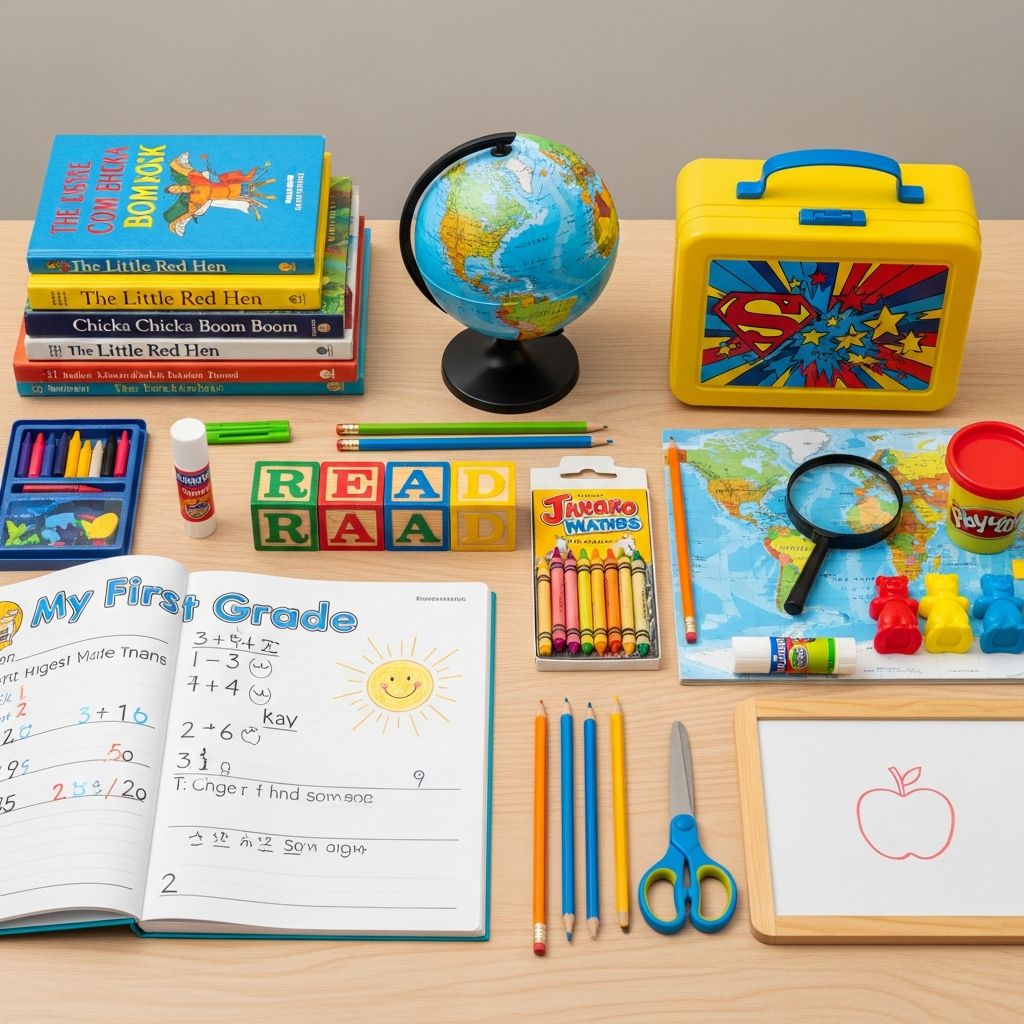
First grade marks a pivotal transition in a child’s education, building on kindergarten foundations while introducing more structured academic skills. Children typically aged 6-7 develop proficiency in reading, basic arithmetic, scientific inquiry, social awareness, and creative expression. These skills align with established state and national standards, emphasizing hands-on learning through play and exploration.
Building Strong Foundations in Language and Literacy
Language arts form the cornerstone of first grade, where students master foundational reading and writing skills. They learn to decode words using phonics, recognize sight words, and comprehend simple texts. According to Common Core standards, first graders read on-level texts with purpose, accuracy, and expression, using context to self-correct. This includes retelling stories with key details and identifying main ideas in informational texts.
Writing progresses from drawing pictures to composing simple sentences. Students use end punctuation, basic spelling patterns, and capitalize the first word in sentences. Speaking and listening skills are honed through discussions, where children speak in complete sentences and create audio recordings of stories with visual aids.
- Phonics and Word Recognition: Blend sounds to read words, including those with common vowel patterns.
- Fluency: Read aloud smoothly with appropriate pacing.
- Comprehension: Ask and answer questions about texts, describing characters and events.
Teachers employ differentiated strategies, integrating play-based activities like shared reading circles and interactive storytelling to engage young learners.
Mastering Mathematics: Numbers, Operations, and Shapes
Mathematics in first grade focuses on four critical areas: addition and subtraction within 20, place value understanding, measuring lengths, and geometric reasoning. Students count to 120, read and write numerals, and fluently add/subtract numbers up to 10 mentally.
Key concepts include representing and solving word problems, understanding tens and ones (e.g., 14 as 1 ten and 4 ones), and composing/decomposing shapes like using triangles to form a trapezoid. Measurement involves iterating units to gauge lengths, such as using paper clips to measure a desk.
| Math Domain | Key Skills | Examples |
|---|---|---|
| Operations & Algebraic Thinking | Add/subtract within 20; solve problems | \(5 + 3 = 8\); “If you have 7 apples and eat 2, how many left?” |
| Number & Operations in Base Ten | Understand place value up to 120 | 23 = 2 tens + 3 ones |
| Measurement & Data | Measure lengths; tell time to hour/half-hour | Use a ruler for non-standard units |
| Geometry | Compose 2D/3D shapes | Two triangles make a rectangle |
Hands-on tools like manipulatives (blocks, counters) support concrete understanding before abstract concepts. By year’s end, students reason about equality in equations like \(8 + 2 = 10\).
Exploring Science: Inquiry and the Natural World
First graders dive into science through observation and experimentation, distinguishing living from nonliving things. They categorize plants and animals, noting needs like air, water, and light for survival. Activities include caring for classroom pets, observing plant growth under different light conditions, and exploring worm farms or bird feeders.
Standards emphasize approaches to learning through play, fostering curiosity and critical thinking. Children investigate patterns in nature, such as day/night cycles or seasonal changes, building foundational STEM skills.
- Observe and describe plant/animal traits.
- Conduct simple experiments (e.g., light’s effect on plants).
- Classify objects as living/nonliving.
Social studies integrate here, teaching community roles, basic geography (maps, neighborhoods), and historical figures through stories.
Social-Emotional Growth and Daily Life Skills
Beyond academics, first grade nurtures social-emotional development. Students learn self-regulation, cooperation, and empathy via group activities and play-based scenarios. Pennsylvania standards highlight constructing knowledge through social interactions, organizing information, and applying it in real-life contexts.
Physical development includes fine/gross motor skills: proper pencil grip for writing, participating in games to build coordination. Health education covers nutrition, hygiene, and safety.
Approaches to learning standards promote persistence, initiative, and problem-solving. Children engage in child-initiated investigations paired with guided instruction.
Arts, Creativity, and Expression
Creative expression enriches the curriculum. Students explore visual arts by creating with colors, shapes, and textures; music through singing, rhythm, and simple instruments; and drama via role-playing. These activities enhance cognitive flexibility and emotional outlets.
First graders respond to artworks, discussing feelings evoked, aligning with holistic development goals.
How Parents Can Support Learning at Home
Reinforce school lessons with daily routines. Read aloud daily, discussing stories; practice math with cooking (measuring ingredients); explore nature on walks, observing plants/animals. Limit screen time, favoring interactive play.
- Establish a reading nook with age-appropriate books.
- Use games for math practice (e.g., board games for counting).
- Encourage journaling simple sentences about daily events.
Communicate with teachers via portfolios or conferences to track progress.
First Grade Milestones Table
| Subject | End-of-Year Expectations |
|---|---|
| Reading | Read grade-level text fluently; retell key details |
| Math | Add/subtract within 20; count to 120 |
| Science | Identify living things’ needs |
| Social | Collaborate in groups; follow rules |
Frequently Asked Questions (FAQs)
What reading level should my first grader be at?
By year-end, children read simple books independently, decoding most words and comprehending main ideas.
How much homework is typical in first grade?
Usually 10-20 minutes nightly, focusing on reading and basic practice to reinforce skills without overwhelming.
What if my child struggles with math facts?
Use visuals/manipulatives; consistent home practice builds fluency. Consult teachers for interventions.
How does play fit into first grade academics?
Play-based learning is integral, embedding math/science in exploration for meaningful retention.
Are arts and PE part of the curriculum?
Yes, they support physical, creative, and social growth alongside core subjects.
This guide draws from official standards to empower parents. Every child progresses uniquely; celebrate efforts and seek support as needed.
References
- Pennsylvania Learning Standards for Early Childhood Grades 1 and 2 — Pennsylvania Key. 2018-03. https://www.pakeys.org/wp-content/uploads/2018/03/Grade1LearningStandards.pdf
- 1st Grade Common Core Standards — Union Riverside School District 86. N/A. https://www.urs86.org/teacher-pages/files/documents/1stGradeCommonCoreStandards.pdf
- DESE Standards Handout First Grade — Massachusetts Department of Elementary and Secondary Education. N/A. https://www.doe.mass.edu/frameworks/pguide/g1.pdf
- Louisiana Student Standards — Louisiana Department of Education. N/A. https://doe.louisiana.gov/school-system-leaders/academic-strategy/louisiana-student-standards
- Common Core State Standards ELA K-5 — Council of Chief State School Officers. 2022-11. https://learning.ccsso.org/wp-content/uploads/2022/11/ELA_Standards1.pdf