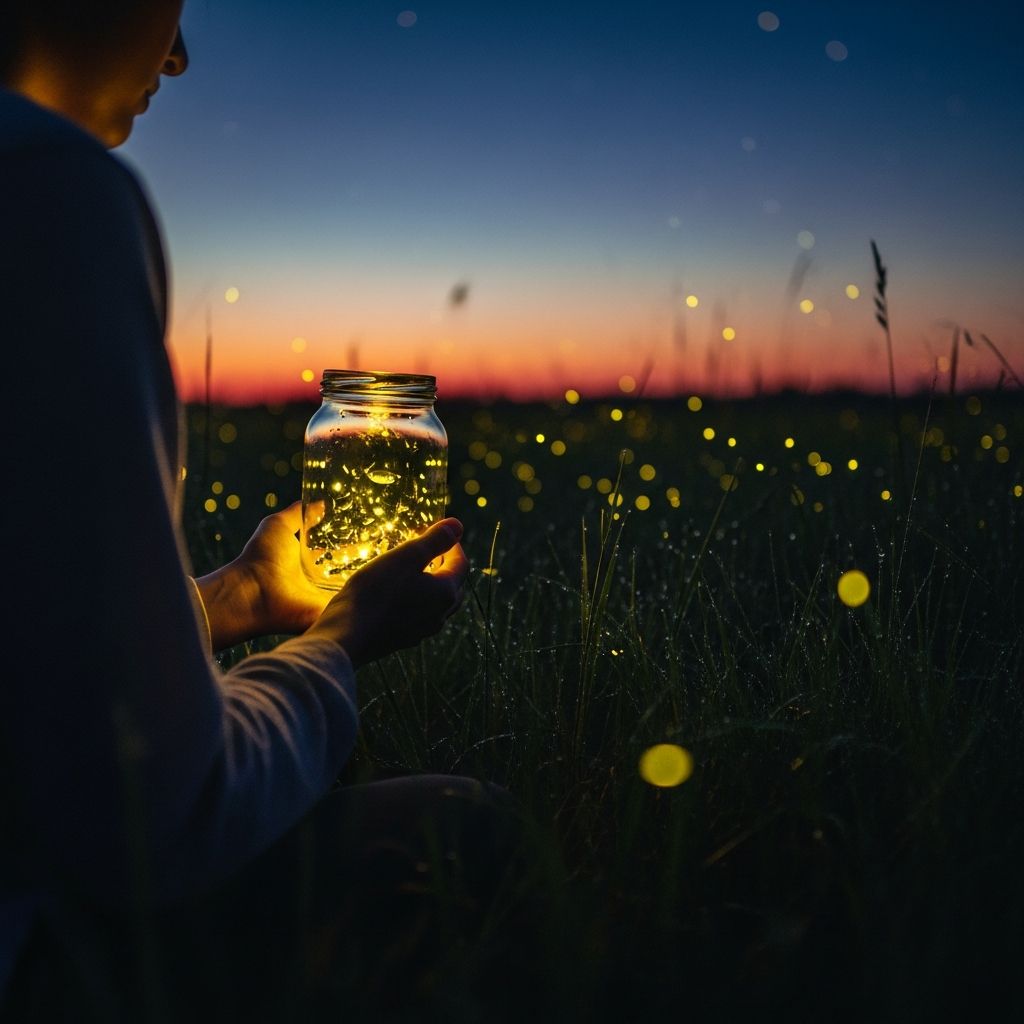
Fireflies, those twinkling jewels of summer nights, captivate children and adults alike with their ethereal glow. These bioluminescent beetles offer a perfect opportunity for family bonding in nature. This guide draws on scientific insights to help you locate prime spots, employ humane catching methods, and ensure these insects thrive for years to come.
Understanding the Magical Biology of Fireflies
Fireflies, scientifically known as beetles in the family Lampyridae, produce light through a process called bioluminescence. This “cold light” originates in specialized organs in their abdomens, where luciferin reacts with oxygen and an enzyme called luciferase, emitting a glow without significant heat. Males typically fly low while flashing to attract females perched on vegetation, each species boasting unique flash patterns for mate recognition.
Their life cycle spans about one to two years, dominated by the larval stage. Eggs, laid in moist soil, hatch in 3-4 weeks into predatory larvae that hunt snails, slugs, and worms using neurotoxins. Larvae overwinter underground or under bark, emerging in spring to pupate for 1-2 weeks before becoming short-lived adults focused on reproduction.
- Egg Stage: Moist soil or leaf litter; glow faintly; 3-4 weeks.
- Larval Stage: 1-2 years; voracious predators in damp areas.
- Pupal Stage: Underground chambers or under vegetation; 1-2 weeks.
- Adult Stage: 2-4 weeks; mating via flashes; females lay up to 500 eggs.
Adults of species like Photinus pyralis rarely feed, prioritizing energy for flashing courtship displays that synchronize in some populations.
Prime Locations for Spotting Firefly Displays
To witness fireflies, seek undisturbed, moist environments near water sources. Meadows, forest edges, marshes, and stream banks provide ideal microhabitats. In the eastern U.S., look for them from late spring to early fall in areas with tall grass, ponds, or rivers flanked by fields.
| Habitat Type | Key Features | Best Regions | Peak Season |
|---|---|---|---|
| Wet Meadows/Grasslands | Tall grass, proximity to streams | Eastern U.S., Canada | June-August |
| Forest Edges/Woodlands | Leaf litter, moist soil | Temperate zones | Late spring-early fall |
| Marshes/Riparian Areas | High moisture, snails/slugs | Near rivers, lakes | Summer evenings |
| Suburban Lawns | Irrigated, undisturbed | Eastern suburbs | Early summer |
Avoid heavily lit urban areas, as artificial lights disrupt flashing signals. Western U.S. fireflies cluster near permanent water like springs, while tropical species synchronize massive displays along rivers.
Optimal Timing for Firefly Encounters
Firefly activity peaks at dusk, around sunset when males begin low flights. In temperate regions, expect displays from 9 PM to midnight on warm, humid nights above 50°F (10°C). Moonless evenings enhance visibility, as full moons dim their glow.
Seasonally, populations surge in early summer after larval emergence. Monitor local weather: rain refreshes moist habitats, boosting activity, while drought suppresses it. Patience pays off—arrive 30 minutes before sunset to settle quietly.
Gear Essentials for Safe Firefly Hunting
Equip lightly to minimize disturbance. Opt for breathable mesh nets over solid ones to avoid injury. Jars should be wide-mouthed, clear glass or plastic with ventilation holes and a damp grass bed for humidity.
- Nets: Long-handled, soft mesh (avoid butterfly nets with rigid frames).
- Containers: Pint-sized jars with lids punched for air; add moist soil/grass.
- Flashlights: Red filters only—white light blinds them.
- Clothing: Long sleeves, bug spray (DEET-free near water), comfortable shoes for uneven terrain.
- Extras: Magnifying glass for observation, field journal for notes.
Skip pesticides; they poison larvae. Choose quiet, dark clothing to blend in.
Step-by-Step Techniques for Gentle Capture
Approach stealthily: crouch low and move slowly. Watch for flash patterns—males glow mid-air, females from grass tops. Use a sweeping motion with the net if needed, but hand-catching works best for perched females.
- Observe First: Sit still 10-15 minutes; let fireflies resume activity.
- Target Low Fliers: Scoop gently from below with cupped hands or net.
- Jar Transfer: Place in prepared jar quickly; avoid squeezing.
- Observe Up Close: Note flash colors (yellow-green common); watch mating attempts.
- Release Promptly: After 20-30 minutes, open jar outdoors—fireflies often fly out willingly.
For children, teach the “cup and release” method: hands form a loose cage. Never keep overnight; adults dehydrate quickly.
Family-Friendly Firefly Activities and Games
Turn hunting into adventure: organize glow chases where kids mimic flashes with glow sticks. Create firefly lanterns from jars with LED inserts for crafts. Host picnics at dusk with firefly-themed snacks like star-shaped cookies.
Educate on conservation through games—count flashes to estimate population health. Draw species flash patterns or photograph (no flash). These activities foster wonder while teaching ecology.
Conservation: Protecting Firefly Populations
Fireflies face threats from habitat loss, pesticides, and light pollution. Undisturbed soil is crucial for larvae; avoid tilling wet areas. Minimize lawn chemicals—larvae prey on pests naturally.
Reduce outdoor lighting; use motion sensors. Support wetlands preservation. In backyards, plant native grasses and water features. Citizen science apps track sightings, aiding research.
Common Myths and Firefly Facts
Myth: Fireflies are flies. Fact: They are beetles with hard wing covers.
Myth: All fireflies glow identically. Fact: Over 2,000 species vary in flash speed/color.
Myth: Catching harms them. Fact: Short-term observation with quick release is safe.
Frequently Asked Questions (FAQs)
Are fireflies harmful to touch?
No, they are harmless. Some secrete bitter blood to deter predators, but it won’t hurt humans.
Why don’t I see fireflies in my area?
They require moisture and darkness. Drought, lights, or habitat loss reduces populations. Check nearby fields or parks.
Can I keep fireflies as pets?
Not recommended. Adults live briefly without proper humidity/food; release them to mate.
Do fireflies bite or sting?
No, they lack venom for humans. Larvae inject prey only.
How can I attract fireflies to my yard?
Plant tall grasses, reduce lights/pesticides, add a pond. Patience takes 1-2 years.
References
- Firefly Life Cycle & Habitat | Lightning Bug Facts — Orkin. 2023. https://www.orkin.com/pests/beetles/fireflies
- Photinus pyralis | INFORMATION — Animal Diversity Web, University of Michigan. 2022. https://animaldiversity.org/accounts/Photinus_pyralis/
- How Fireflies Glow – and What Signals They’re Sending — NC State University News. 2019-07-17. https://news.ncsu.edu/2019/07/how-fireflies-glow-and-what-signals-theyre-sending/
- Firefly Life History — Firefly Atlas. 2024. https://www.fireflyatlas.org/learn/firefly-life-history
- The Illustrious Life of the Firefly — Schlitz Audubon Nature Center. 2021-06-21. https://www.schlitzaudubon.org/2021/06/21/the-illustrious-life-of-the-firefly/
- Fireflies — Mass Audubon. 2023. https://www.massaudubon.org/nature-wildlife/insects-arachnids/fireflies