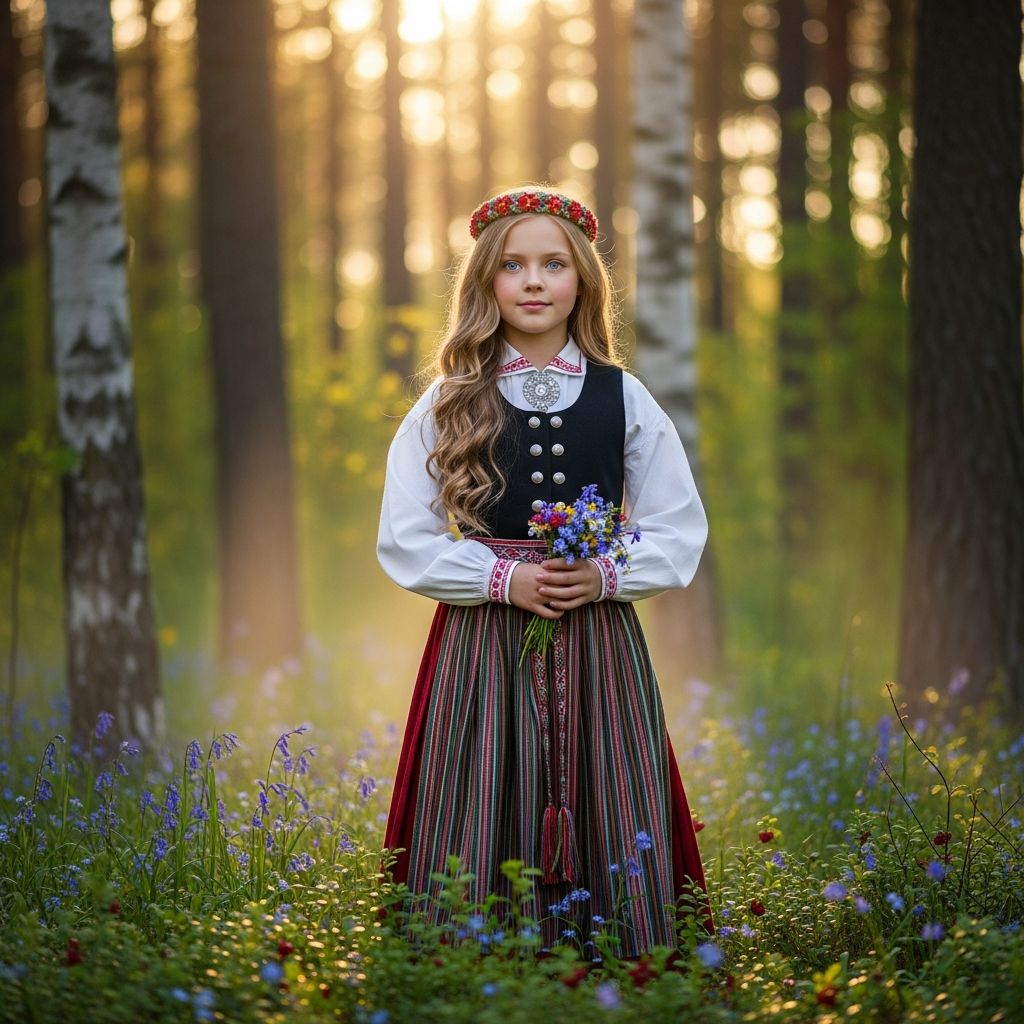
Finnish girl names blend ancient mythology, wild Nordic nature, and modern simplicity into a style that feels both distinctive and easy to love. For parents seeking something fresh yet meaningful, Finland offers a rich naming tradition shaped by the Finnish language, centuries of Christian and folk influence, and deep respect for forests, lakes, and seasons.
Why Finnish Girl Names Stand Out
Finnish names can feel unusual to English speakers, yet they are typically phonetic, balanced, and gentle on the ear. Several traits make them especially appealing for a baby girl:
- Nature connections: Many names evoke forests, snow, lakes, and flowers, mirroring Finland’s landscape.
- Mythic roots: Some names come from the national epic Kalevala and old folk legends.
- Short and melodic forms: Two- or three-syllable names with repeating vowels are very common.
- International variants: Others are Finnish forms of classic European names such as Maria, Sofia, or Kristiina.
This combination of local tradition and global familiarity gives you flexibility: you can choose something clearly Finnish or a softer Nordic twist on a name people already recognize.
The Finnish Language and How Names Are Formed
Understanding a few basics about Finnish helps explain the sound and structure of its girl names. Finnish is a Finno-Ugric language with features that differ from most Indo-European languages.
- Phonetic spelling: Most letters are pronounced consistently, so once you know the sounds, you can usually say a name correctly.
- Double letters: Doubling a vowel or consonant lengthens the sound, changing meaning and rhythm (for example, Anna vs. Ana).
- Vowel harmony: Certain vowels usually appear together, giving Finnish names a smooth, harmonious flow.
- Endings: Many girl names end in -a or -i, which often sound soft and feminine to non-Finnish ears.
These patterns produce names that feel lyrical even to people unfamiliar with the language.
Classic and Timeless Finnish Girl Names
Some Finnish girl names have been popular for generations and are widely recognized across the country. Many of them have religious or European roots but have taken on clearly Finnish spellings and pronunciations.
| Finnish Name | Origin / Root | General Meaning |
|---|---|---|
| Maria | Latin / Hebrew | Associated with meanings like “wished-for child” or “of the sea” |
| Anna | Hebrew via European languages | Linked with “grace”; very common in Finland as first and middle name |
| Sofia | Greek | “Wisdom”; a popular and elegant choice across Europe |
| Kristiina | Latin / Greek | “Follower of Christ”; Finnish form of Christine |
| Emilia | Latin | Related to “to excel” or “strive”; used widely in the Nordics |
| Kaarina | Greek via Scandinavian forms | Variant of Katherine with the meaning “pure” |
These names offer a familiar feel in international settings but still carry a clearly Nordic flavor thanks to their spelling and use in Finland.
Finnish Girl Names Inspired by Nature
Finland is famous for its lakes, endless forests, and snowy winters, and that deep connection to the environment shows up in many girl names.
Common natural themes include:
- Weather and seasons – such as summer, calm weather, or snow.
- Trees and flowers – birch, lilies, rowan trees, and more.
- Light and sky – names hinting at brightness or dawn.
Names in this category often feel poetic even when they are short and simple. They can also work beautifully as middle names if you want to pair a nature word with a more traditional first name.
Examples of Nature-Themed Names
- Lumi – Derived from the Finnish word for “snow,” this name captures the purity and brightness of winter.
- Helmi – Associated with the meaning “pearl” or “gem of the sea,” a lovely choice for sea-loving families.
- Lilja – Meaning “lily,” linked with purity and grace in many cultures.
- Pouta – Related to “fair weather,” calling to mind clear skies and calm days.
- Suvi – The Finnish word for “summer,” evoking warmth and long Nordic days.
- Tyyni – Often translated as “calm,” like a still lake at evening.
Choosing a nature name can be a subtle way to honor a place, a favorite season, or a landscape that matters to your family.
Mythology, Folklore, and Literary Names
Finnish cultural identity has been shaped strongly by the Kalevala, a 19th-century epic compiled from oral poetry, and by other folk legends and literature. These sources helped revive and popularize several distinctive girl names.
Names from myth and story often carry rich backstories and symbolic meanings, which many parents find inspiring.
Examples with Legendary Roots
- Aino – Created for the Kalevala, this name is linked to a tragic yet powerful character; its root word is related to “only” or “the only one.”
- Kyllikki – Associated with a renowned maiden in Finnish poetry, admired for her beauty and desired as a bride.
- Louhi – The formidable female ruler of the northern realm in myth, often portrayed as wise and fearsome.
- Mielikki – A mythological forest goddess connected to healing and the woods, reflecting the spiritual importance of forests in Finnish tradition.
- Anneli – While connected to European roots meaning “grace,” this name appears often in Finnish literature and culture.
These names are not just beautiful; they also offer stories your child can grow up hearing, connecting her to a deeper cultural narrative.
Old-Fashioned and Vintage Finnish Girl Names
Interest in vintage baby names has grown in many countries, and Finland is no exception. Historical research on medieval and early modern Finnish naming shows a mix of local and Christian influences, with some unique forms that feel fresh again today.
Older Finnish girl names tend to have:
- Unusual sound combinations that stand out among modern names.
- Connections to early 20th-century or even medieval records.
- A nostalgic feel that pairs well with contemporary middle names.
Charming Vintage Examples
- Ritva – Used since the early 1900s, linked with the image of a slender birch branch, tying it gently to nature.
- Valo – A word for “light,” sometimes found as a given name and evocative of brightness and clarity.
- Tähti – Related to the word for “star,” offering a celestial twist.
- Adela – An older name used more than a century ago in Finland, with European roots that give it a timeless quality.
- Alvina – Another vintage option once seen in Finnish records, soft and melodic.
These names can be ideal if you want a Finnish connection that feels distinctive without being extremely modern or invented.
Modern Trendy Names and International Hybrids
Like other Nordic countries, Finland today sees a mix of traditional names, international favorites, and modern creative choices. Official population data and name statistics show that names such as Maria, Anna, and Sofia remain prevalent, but newer choices inspired by international trends are also gaining ground.
Modern Finnish parents often:
- Blend a globally familiar first name with a distinctly Finnish middle name.
- Shorten longer traditional names into cute diminutives.
- Choose names that are easy to pronounce abroad.
Examples with Global Appeal
- Eevi – A Finnish variant related to Eve/Evie; linked with the idea of “life” or “living.”
- Ellen – Used in Finland but widely recognized internationally; related to “bright” or “shining light.”
- Emilia – Popular across Europe and Scandinavia, pairing well with many surnames.
- Helena – A classic with Greek roots, understood in many languages and cultures.
- Minna – Used in Finland and linked with meanings related to “might” or “love” in older Germanic forms.
These names let you maintain a Nordic sensibility while ensuring your child’s name feels approachable around the world.
Tips for Pronouncing Finnish Girl Names
If Finnish is new to you, pronunciation may feel intimidating. Fortunately, the rules are consistent, and once you learn them, most names are easy to say.
- Every letter is pronounced: Avoid silent letters. If you see a vowel, you say it.
- Stress is usually on the first syllable: For example, LU-mi or AI-no, not lu-MI or ai-NO.
- Double consonants and vowels are held longer: Anna has a longer n sound than Ana.
- Vowels have clear sounds:
- a – like in “father”
- e – like in “bed”
- i – like “ee” in “see”
- o – like in “or” (shorter)
- u – like in “put” (but more pure)
Learning these basic rules lets you honor the original sound of the name and helps others pronounce your child’s name correctly.
How to Choose the Right Finnish Name for Your Baby
Selecting a baby name is personal and emotional, and adding a Finnish angle gives you extra dimensions to think about. Studies on naming patterns suggest that parents often balance personal taste, family heritage, and social expectations when choosing names.
Consider these points as you decide:
- Family connections: Does your family have Finnish roots, or do you want to honor a relative, place, or shared memory?
- Meaning: Are you drawn to names connected with nature, virtues like wisdom and grace, or mythological power?
- Pronunciation abroad: Will people in your community or country be able to say and spell the name reasonably well?
- Pairing with surnames: Try saying the full name out loud to test rhythm, especially if your family name is long or complex.
- Middle names: You might combine a short Finnish first name with a longer international middle name, or the other way around.
Writing a short list of favorites and saying them over several days can help you see which one still feels right after the excitement settles.
Frequently Asked Questions (FAQs)
Are Finnish girl names difficult for non-Finns to use?
Many Finnish girl names are straightforward once you know that the stress is usually on the first syllable and that double letters are pronounced longer. Short names like Lumi, Aino, Anna, or Sofia tend to be especially easy for international families.
Can I use a Finnish middle name even if I’m not Finnish?
Yes. Parents around the world often choose Nordic or Finnish names to reflect a place they love, a favorite story, or values such as closeness to nature. Using a Finnish middle name is a gentle way to include this connection without making day-to-day pronunciation difficult.
Which Finnish girl names work best internationally?
Names that share roots with other European languages or use simple sounds travel well. Examples include Maria, Sofia, Anna, Helena, Emilia, and Minna, as well as shorter nature names like Lumi or Helmi.
Are Finnish girl names usually religious or secular?
Both exist. Many classics, such as Maria, Anna, and Kristiina, have Christian roots, while others come from nature, folk belief, or literature, such as Lumi, Suvi, Aino, or Mielikki.
Where can I verify the official use and popularity of a Finnish name?
The Finnish Population Information System, managed by national authorities, provides statistics on given names and their frequency, and scholarly work on historical Finnish naming offers insights into older forms and patterns.
References
- 100+ Unique Finnish names and their meanings — Her Finland. 2022-06-01. https://herfinland.com/finnish-names/
- Finnish names (Suomalainen nimikirja) — Lumitar blog (summarizing Finnish name dictionary data). 2013-03-01. http://lumitar.blogspot.com/2013/03/finnish-names-suomalainen-nimikirja.html
- Finnish girl names: the best girls’ names from Finland — Routes North. 2023-04-01. https://www.routesnorth.com/finland/finnish-girl-names-the-best-girls-names-from-finland/
- A Complete List of Finnish First Names and Name Meanings — FamilyEducation. 2022-08-01. https://www.familyeducation.com/baby-names/first-name/origin/finnish
- The beauty of Finnish girl names — Scandicuisine. 2022-03-15. https://scandicuisine.com/finnish-girl-names/
- Finnish Baby Names for Girls — Nameberry. 2023-01-10. https://nameberry.com/list/310/finnish-baby-names-for-girls
- Female names in medieval Finland — Raunamaa, Jaakko; University of Helsinki (Helda Open Books). 2013-01-01. https://helda.helsinki.fi/bitstreams/7b5f6a6a-3168-46b4-9d28-265444537b07/download