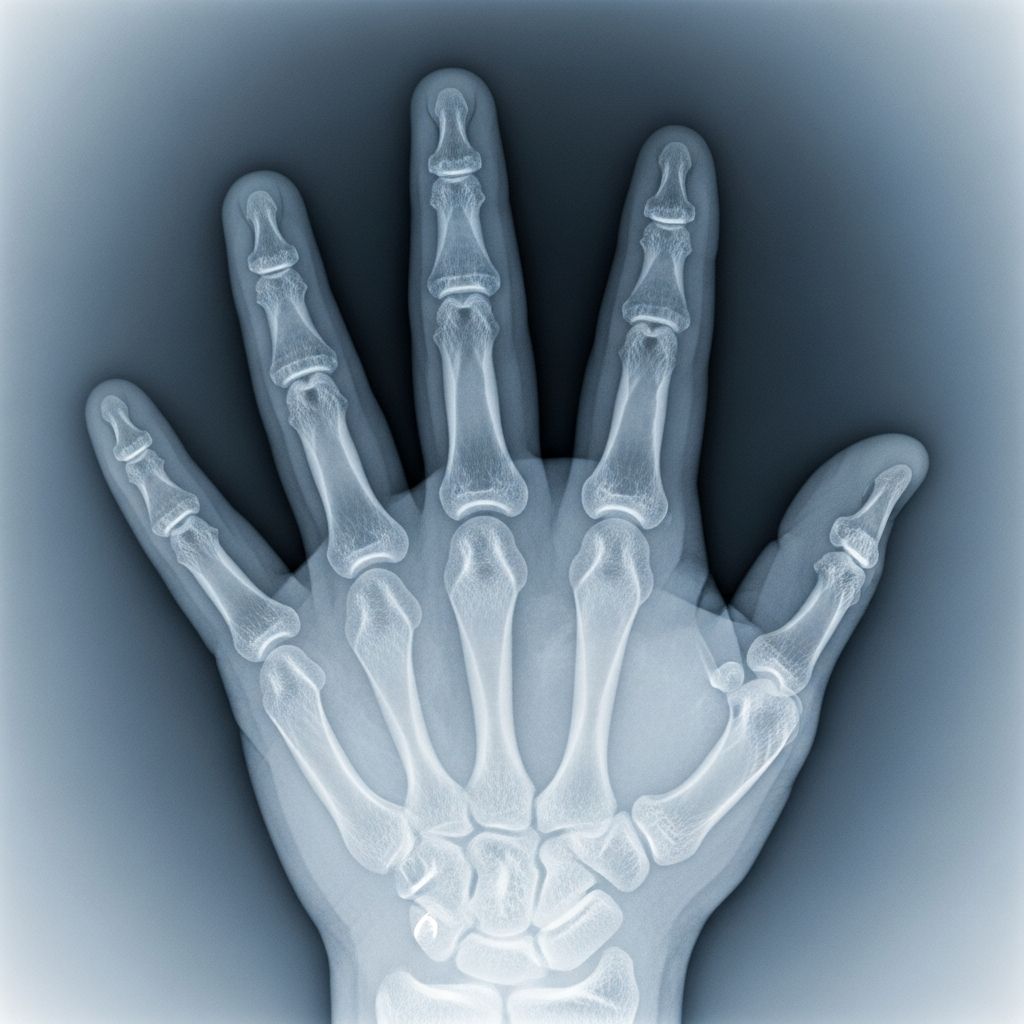
When a child jams, crushes, or bends a finger, one of the first questions parents ask is whether the bone is broken. A finger X-ray is the most common imaging test doctors use to check for broken bones, joint problems, and other injuries in a child’s finger.
This guide explains in parent-friendly terms why finger X-rays are ordered, how the test works, what your child will experience, and what the results can show.
Why Doctors Order a Finger X-Ray
Finger X-rays are a type of hand X-ray focused on one or more fingers and the surrounding joints. They help doctors see bones and some soft tissues in clear detail.
Common reasons in children
- Possible fracture (broken bone) after a fall, sports injury, or door-slamming accident.
- Suspected dislocation when a joint looks crooked or out of place.
- Persistent pain or swelling that does not improve after a few days of rest and ice.
- Deformity such as a bent, twisted, or shortened finger.
- Infection or inflammation involving the bone or nearby joint, especially with fever or redness.
- Follow-up after surgery or casting to check healing of a fracture.
- Foreign object under the skin, such as a deep piece of metal or glass.
What doctors can see on a finger X-ray
On the X-ray image, the radiologist and your child’s doctor can examine:
- Finger bones (phalanges) for breaks, chips, or abnormal shape.
- Joints between the finger bones and where the finger meets the hand.
- Bone alignment to see if the bones line up correctly after an injury.
- Joint space width, which can change with arthritis or damage.
- Growth plates at the ends of bones, which are areas of developing bone in children.
How X-Rays Work (In Simple Terms)
X-rays are a type of energy beam that passes through the body and creates a picture of the internal structures, especially bones.
- Dense structures such as bone absorb more X-rays and appear light or white.
- Softer tissues such as skin, fat, and muscles absorb fewer X-rays and appear darker or gray.
Modern X-ray machines use carefully controlled, low doses of radiation to get clear pictures while keeping exposure as low as reasonably achievable.
Preparing Your Child for a Finger X-Ray
For most children, no special medical preparation is needed before a finger X-ray.
Before you leave home
- Dress your child in comfortable, loose clothing that is easy to roll up or remove from the arm and hand.
- Bring any previous imaging reports or notes from your child’s doctor if you have them.
- Explain in simple language that the test is quick and doesn’t hurt, but they will need to hold still like a statue.
At the imaging center or hospital
- You may be asked to remove rings, bracelets, or metal objects from the hand that could interfere with the image.
- Older kids and teens may be asked if there is any chance of pregnancy, because X-rays are used with extra caution in pregnant patients.
- In many pediatric centers, a parent is allowed to stay in the room wearing a protective lead apron to reassure the child.
Step-by-Step: What Happens During the Test
Finger X-rays are usually done in the radiology department or a dedicated imaging center. The process is typically completed in a few minutes.
Typical sequence of events
- Check-in and verification
Staff will confirm your child’s name, date of birth, the injured finger, and the referring doctor’s order. - Positioning at the X-ray table
Your child will sit or stand beside a table or X-ray plate. The technologist will place the injured hand on a flat surface. - Taking different views
To see the bone from several angles, the technologist may take:- a front view (from above or below the hand),
- a side view (lateral), and
- sometimes an angled view to highlight joints or complex injuries.
- Keeping still
Your child must hold the finger steady during each image, which usually lasts only a second or two. Soft immobilization devices or the parent’s gloved hand may be used to help younger kids stay still. - Radiation protection
A lead apron or shield is often placed over your child’s torso or lap to protect areas not being imaged. - Completion
Once the needed pictures are taken, the technologist checks them for clarity. If they are clear, your child is finished and can go home or back to the clinic.
Comfort tips during the exam
- Encourage your child to focus on breathing slowly while holding the finger still.
- Bring a favorite small toy or story to talk about as a distraction.
- If moving the finger is painful, remind your child that the test will be very short and helps the doctor know how to help it heal.
What the Results Can Show
After the X-ray, a doctor who specializes in reading imaging studies, called a radiologist, will review the images and issue a report. Your child’s main doctor or emergency physician will then explain the findings.
Possible findings on a finger X-ray
| Finding | What it means | Common next steps |
|---|---|---|
| Normal X-ray | No visible fracture or dislocation; bones and joints look typical. | Rest, ice, and observation; sometimes a short splint if pain is significant. |
| Non-displaced fracture | Bone is cracked but pieces are still lined up. | Splint or cast to protect the finger until it heals. |
| Displaced fracture | Pieces of bone are out of alignment. | Reduction (re-alignment) in a clinic or operating room, followed by splinting or casting. |
| Growth plate injury | Damage near the end of the bone where growth occurs. | Close follow-up to ensure normal growth; sometimes additional imaging or surgery. |
| Joint dislocation | Finger joint is out of place. | Gentle reduction and immobilization; repeat X-ray to confirm alignment. |
| Signs of infection or other bone disease | Areas of bone thinning, erosion, or irregularity. | Further tests such as blood work or advanced imaging; antibiotics if infection is suspected. |
Is a Finger X-Ray Safe for My Child?
Medical organizations widely agree that diagnostic X-rays are very low risk when used properly. The benefits of diagnosing a fracture or serious problem usually far outweigh the small potential risks.
Radiation dose and risk
- A hand or finger X-ray exposes your child to a very small amount of radiation, much less than many other types of imaging.
- Radiology teams follow the ALARA principle (As Low As Reasonably Achievable) to minimize exposure, especially in children.
- Protective shields and careful beam positioning help limit radiation to the smallest possible area.
Special situations
- Pregnancy: If your teen might be pregnant, inform the staff. Doctors often consider alternative imaging or extra shielding in this situation.
- Multiple imaging tests: If your child has had many X-rays or CT scans in the past, discuss this with your doctor so they can track total exposure and weigh risks and benefits.
After the X-Ray: What Parents Can Expect
The X-ray itself does not cause side effects. Any discomfort your child feels will almost always be from the original injury, not the imaging test.
Getting the results
- In emergency settings, a doctor may review the images right away and start treatment immediately.
- In clinics or outpatient imaging centers, a final report may be available within a few hours to a couple of days, depending on local procedures.
- Your child’s doctor will explain the findings and create a treatment plan based on the X-ray and physical exam.
Home care after a finger injury
Follow your child’s doctor’s specific instructions. General supportive measures often include:
- Rest: Avoid sports and rough play until cleared by the doctor.
- Ice: Apply wrapped ice packs for short periods to reduce swelling, if recommended.
- Elevation: When possible, keep the hand elevated on a pillow to help limit swelling.
- Splint or cast care: Keep it clean and dry; call your doctor if it becomes loose, wet, or painful.
- Pain control: Use medications only as prescribed or recommended by your child’s doctor.
Helping Your Child Cope With the Test
Many children feel nervous about medical tests, even quick ones like X-rays. A calm, prepared parent can make a big difference.
Ways to reduce fear
- Describe the X-ray machine as a special camera for bones that helps the doctor see what is wrong.
- Assure your child that they will not feel the X-rays and that the machine will not touch or hurt them.
- Practice staying still at home by playing a “freeze” game for a few seconds at a time.
- Ask the technologist if your child can see the bone pictures afterward, which can make the experience more interesting and less scary.
Frequently Asked Questions (FAQs)
How long does a finger X-ray take?
The actual imaging usually takes only a few minutes. Most of the time is spent positioning the finger correctly and making sure your child is comfortable.
Will my child feel anything during the X-ray?
The X-ray itself is painless. Any discomfort comes from holding the injured finger still, which can be briefly uncomfortable if the area is very sore.
Can a finger X-ray miss a fracture?
Some tiny fractures or early growth plate injuries can be hard to see, especially soon after the injury. If pain and swelling stay the same or worsen, your doctor may order a repeat X-ray or another imaging test.
Is sedation needed for a finger X-ray?
Sedation is almost never required. The test is so quick that most children can cooperate with gentle coaching. Rarely, very young or extremely anxious children may need extra help to hold still.
How soon can my child return to sports?
This depends on the type of injury and the treatment plan. Many simple sprains heal in a couple of weeks, while fractures may need several weeks of immobilization. Always follow your doctor’s clearance before returning to sports.
References
- Hand X-Ray: Anatomy, Procedure & What To Expect — Cleveland Clinic. 2022-05-19. https://my.clevelandclinic.org/health/diagnostics/23518-hand-x-ray
- X-ray: Imaging test quickly helps find a diagnosis — Mayo Clinic. 2022-07-08. https://www.mayoclinic.org/tests-procedures/x-ray/about/pac-20395303
- Hand X-Rays: Procedure, Results, and Risks — Healthline. 2018-08-20. https://www.healthline.com/health/hand-x-ray
- X-Ray Finger-Right — CURA4U. 2021-03-01. https://cura4u.com/radiology/x-ray/x-ray-finger-right
- Hand X Ray: Purpose, Preparation & Procedure — Mermaid Beach Radiology. 2021-09-15. https://mermaidbeachradiology.com.au/hand-xray/