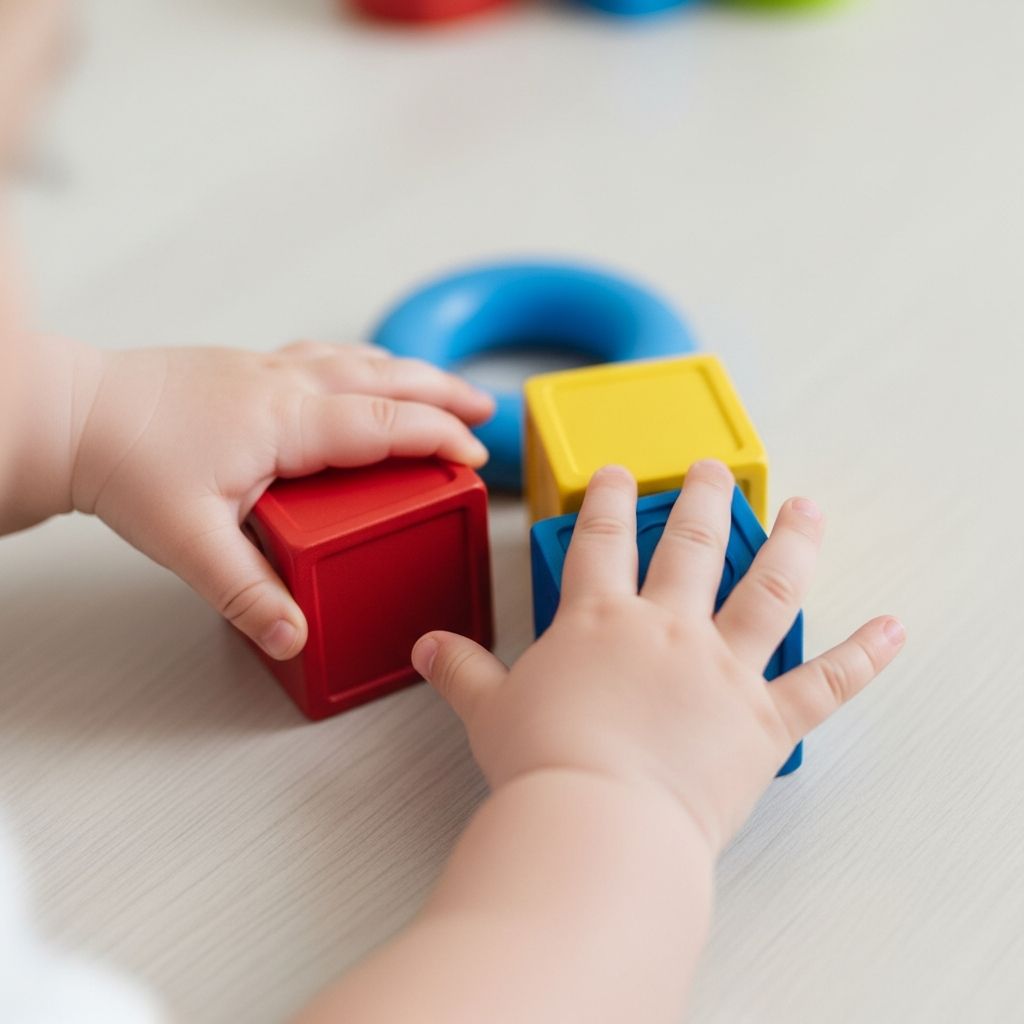
Fine motor skills involve the small muscles in a child’s hands, fingers, and wrists, enabling precise movements like grasping toys, feeding themselves, and eventually writing. These abilities build gradually, supporting independence and cognitive growth. Understanding these milestones helps parents track progress and intervene early if needed.
Foundations of Fine Motor Development in Newborns
In the earliest weeks, infants rely on reflexive movements that evolve into voluntary control. At birth, babies exhibit a reflexive grasp, tightly closing fingers around objects placed in their palms. By 2 months, they briefly hold a rattle in one hand and bring hands to mouth, marking the shift from instinct to intent.
These initial skills stem from neurological maturation and sensory experiences. Tummy time is crucial here, strengthening neck and shoulder muscles to free hands for exploration. Parents can encourage this by placing safe toys just out of reach during supervised play sessions.
- Birth: Reflexive grasp when palm is stroked.
- 1-2 months: Hands open more; swipes at dangling mobiles.
Emerging Reach and Grasp: 3-5 Months
Around 3 months, babies develop voluntary grasping, using a palmar grasp to hold strings or blocks. They reach toward toys while on their backs, coordinating vision with action—known as visually directed reaching. By 4-5 months, they unite hands at midline, play with fingers together, and use pinky/ring fingers for better hold.
This period builds hand-eye coordination. Infants inspect their hands, following objects in arcs. Activities like offering soft rattles promote controlled reach and bilateral use.
| Age | Milestone | Activity Idea |
|---|---|---|
| 3 months | Lifts head, grasps string | Mirror play during tummy time |
| 4-5 months | Hands to midline, holds block | Gently shake high-contrast toys |
Refining Control: 6-8 Months
From 6 months, babies roll to access toys, push up on hands, and use whole-hand palmar grasp for rattles, banging and shaking them in 90-degree arcs. They rake small objects with palms down and transfer items hand-to-hand.
Raking grasp transitions to more precise inferior pincer by 7-8 months, picking up crumbs like Cheerios with thumb/index pads. Pulling strings emerges, fostering cause-effect understanding.
Encourage with safe containers for dropping toys, building problem-solving alongside dexterity.
- 6 months: Rolls to reach, bangs toys.
- 7 months: Belly crawls, rakes grasp.
- 8 months: Hand-knee crawl, pulls to stand.
Precision Builds: 9-12 Months
By 9 months, babies clap hands, wave bye-bye, and isolate index finger. They put toys in containers, scribble with crayons in fisted grasp, and attempt spoons/cups. At 10-11 months, pincer grasp matures for small items; they remove socks and finger-feed.
Standing aids like furniture support one-handed exploration. Shape sorters challenge emerging precision.
Toddler Independence: 12-18 Months
12-14 months bring pincer mastery for pegs, shape sorters, and self-feeding with utensils held fisted. Babies open books, stack 2 blocks, and scribble spontaneously. By 15-18 months, they stack 2-3 cubes, place shapes accurately, hold markers overhand, and walk stairs with aid.
These skills link to language; turning single pages in books (18 months) aids story engagement.
| Skill | 12 Months | 18 Months |
|---|---|---|
| Stacking | 2 blocks | 3-4 blocks |
| Grasp | Pincer for small objects | Finger-feed, turn pages |
| Self-Care | Tries spoon | Drinks from cup |
Running and Drawing: 19-24 Months
Toddlers run, climb stairs step-over-step, stack 4-6 cubes, turn multiple book pages, and draw vertical lines. Ring stackers and backward walking refine balance for hand tasks.
Thumb-tip crayon hold emerges, with imitation of strokes. Limit screen time; prioritize manipulative play.
Preschool Precision: 2-3 Years
At 2-3 years, children balance on one leg briefly, alternate stairs, stack 8-10 cubes, string 2-4 beads, draw circles/horizontals, use utensils proficiently, unbutton large buttons, and snip with scissors. One-hand stabilization (e.g., paper while drawing) shows advanced bilateral coordination.
Hand preference solidifies around 2.5 years.
Mastery and Creativity: 3-4 Years
3-4-year-olds stand on one leg 3-4 seconds, kick balls, lace beads, copy crosses/squares, button/unbutton, cut straight lines, and use tripod pencil grip. They draw people with 6+ parts, write name/letters, showing school readiness.
- Balances longer, jumps.
- Copies shapes, cuts paper.
- Dresses independently.
Activities to Boost Fine Motor Skills by Age
Targeted play accelerates development safely.
0-6 Months
High-contrast mobiles, textured balls, tummy time with props.
6-12 Months
Nesting cups, large beads, finger foods for pincer practice.
12-24 Months
Blocks, chunky puzzles, playdough pinching.
2+ Years
Scissors, beads, tracing letters.
Always supervise; rotate toys for novelty.
Red Flags and When to Consult a Professional
Most children hit milestones variably, but persistent delays warrant evaluation. Watch for:
- 3 months: No reaching or hand opening.
- 6 months: Can’t hold/transfer toys.
- 12 months: No pincer or banging.
- 2 years: Can’t stack 4+ blocks or scribble.
- 3 years: Awkward grasp, no imitative drawing.
Underlying issues like poor muscle tone or vision problems may contribute. Early therapy improves outcomes; consult pediatricians via CDC tools. Prematurity adjusts timelines by gestational age.
Frequently Asked Questions
Why is tummy time essential for fine motor skills?
It builds shoulder stability and hand arches, foundational for grasping and writing. Aim for 15-30 minutes daily.
Can too much screen time hinder development?
Yes; passive screens reduce manipulative play needed for dexterity. Limit per AAP guidelines.
How do gross motor skills influence fine ones?
Core strength from rolling/crawling stabilizes hands for precision tasks.
What if my child skips milestones?
Variation is normal, but track patterns. Use CDC app for monitoring.
Are there gender differences in fine motor development?
No significant ones; individual pace varies more.
References
- Children’s Developmental Milestones: Gross and Fine Motor Skills — Brown Health. Accessed 2026. https://www.brownhealth.org/be-well/childrens-developmental-milestones-gross-and-fine-motor-skills
- Milestones for Fine Motor Skills — Buffalo Hearing & Speech Center. Accessed 2026. https://askbhsc.org/early-childhood-education/developmental-resources/milestones-for-fine-motor-skills/
- Fine motor skills: birth to 2 years — Children’s Hospital of Richmond. Accessed 2026. https://www.chrichmond.org/services/therapy-services/developmental-milestones/fine-motor-skills-birth-to-2-years/
- Developmental Milestones: Fine Motor Skills and Visual Motor — CHOC. 2014. https://choc.org/wp-content/uploads/2014/11/Rehab-Developmental-Milestones-final.pdf
- Fine Motor Developmental Milestones — Lurie Children’s Hospital. Accessed 2026. https://www.luriechildrens.org/en/specialties-conditions/pediatric-occupational-therapy/developmental-milestones/fine-motor-skills/
- Fine Motor Skills Examples and Development by Age — NAPA Center. Accessed 2026. https://napacenter.org/fine-motor-skills-examples/
- CDC’s Developmental Milestones — Centers for Disease Control and Prevention. Accessed 2026. https://www.cdc.gov/act-early/milestones/index.html