Family photos are more than decoration; they are the daily reminder that your messy, busy, wonderful life is worth celebrating. The right picture frames and display ideas can turn shoe-tying snapshots, holiday chaos, and blurry toddler hugs into a warm visual story that makes your home feel unmistakably yours.
This guide walks through choosing frames, planning layouts, integrating kids’ art, and keeping everything looking good without turning your house into a museum. It is written for real families with real clutter, real schedules, and real personalities.
Why Family Photos Belong On Your Walls
Before getting into specific frame types and layouts, it helps to understand what you want your photos to do for you and your family. When you are clear about the role they play, it becomes much easier to decide what to print, where to hang it, and how much effort to invest.
- Connection and belonging: Seeing grandparents, cousins, and old friends on the wall reinforces family history and helps kids feel rooted, even when loved ones live far away.
- Daily gratitude: A playful gallery in the hallway or kitchen can nudge everyone to remember good moments when the day feels long.
- Conversation starters: Guests almost always gravitate toward photos, which makes awkward small talk much easier.
- Personal style: Framing your memories instead of generic art means your decor will never look like a furniture showroom.
Choosing Frame Styles That Match Real Life
There is no single “best” picture frame for every home. Instead, think in terms of lifestyle: how busy your household is, how often you like to redecorate, and how much you enjoy (or dislike) dusting and measuring. Below is a simple table to help narrow down frame styles that may match your real life.
| Frame Style | Best For | Pros | Watch Outs |
|---|---|---|---|
| Simple black or white frames | Busy families, renters, minimalists | Match most decor, easy to replace, work in grids or casual clusters | Can feel flat if everything is identical and there is no texture |
| Warm wood frames | Cozy, traditional, or rustic spaces | Add warmth, pair well with kids’ art and candid photos | Color of wood can clash with certain flooring or furniture |
| Metallic or mirrored frames | Small spaces, glam or modern decor | Bounce light around, feel dressy for weddings and portraits | Show fingerprints, can look too formal for playful snapshots |
| Colorful frames | Playrooms, kids’ rooms, creative households | Highlight kids’ drawings, sports photos, fun vacation shots | Easy to overdo if every frame is a different bright color |
| Collage and multi-opening frames | Smaller spaces or renters who want fewer nail holes | Hold many photos at once, create instant impact | Harder to update individual photos regularly |
Planning A Story, Not Just A Wall
Instead of starting with a blank wall and a pile of frames, begin with a story. Maybe you want a “growing up” hallway that shows your kids over the years, or a “travel and adventures” corner near the entryway. Defining that theme makes choosing and editing photos much faster.
- Pick one main theme per wall: Examples include “our everyday life,” “vacations,” “extended family,” or “wedding and anniversaries.”
- Limit the timeframe: Consider one wall for a single decade, school years, or the time you have lived in your current home.
- Decide the mood: Light and funny? Formal and timeless? A mix is fine, but it helps to know which mood you want to dominate.
Once you have that story in mind, lay your photos on the floor in front of the wall or photograph your frames and arrange them digitally. This lets you play with layout ideas without committing to any nail holes yet.
Where To Put Family Photos (And Why)
Every home has a few spots that are particularly friendly to framed photos. Think about where your family spends time and where guests naturally pause or pass through. These are the places where your photos will actually be seen, not just hung.
- Entryway: A narrow console table with a few leaning frames or a small grid immediately says, “This is who lives here.”
- Hallways: Long hallways are perfect for chronological timelines: first days of school, sports seasons, birthday photos, or height milestones.
- Living room: Over the sofa or behind an armchair is a classic spot for a gallery, especially if you mix in artwork or typography.
- Staircase walls: Staggered layouts along the stairs echo the upward movement and make even small prints feel dramatic.
- Kitchen or dining area: Candid dinner photos, travel food shots, or kids covered in flour while baking look at home here.
- Home office: Place a few quiet, grounding images near your desk: a photo of someone who cheers you on, or a moment that reminds you why you work hard.
Layout Ideas For Every Personality
Different layout styles suit different decorating personalities. Some people love measuring and symmetry; others prefer a casual, layered look. Use the ideas below as a starting point, and then adjust to match your patience level and your wall size.
1. The Simple Grid
A grid uses frames of the same size, color, and orientation arranged in neat rows and columns. It works especially well with black-and-white photos, school portraits, or a series of related images such as baby’s first year or annual family photos.
- Choose between 6 and 12 frames, depending on the wall size.
- Keep spacing consistent (for example, 2–3 cm between frames).
- Use a level or a piece of painter’s tape as a straight guide line.
2. The Casual Cluster
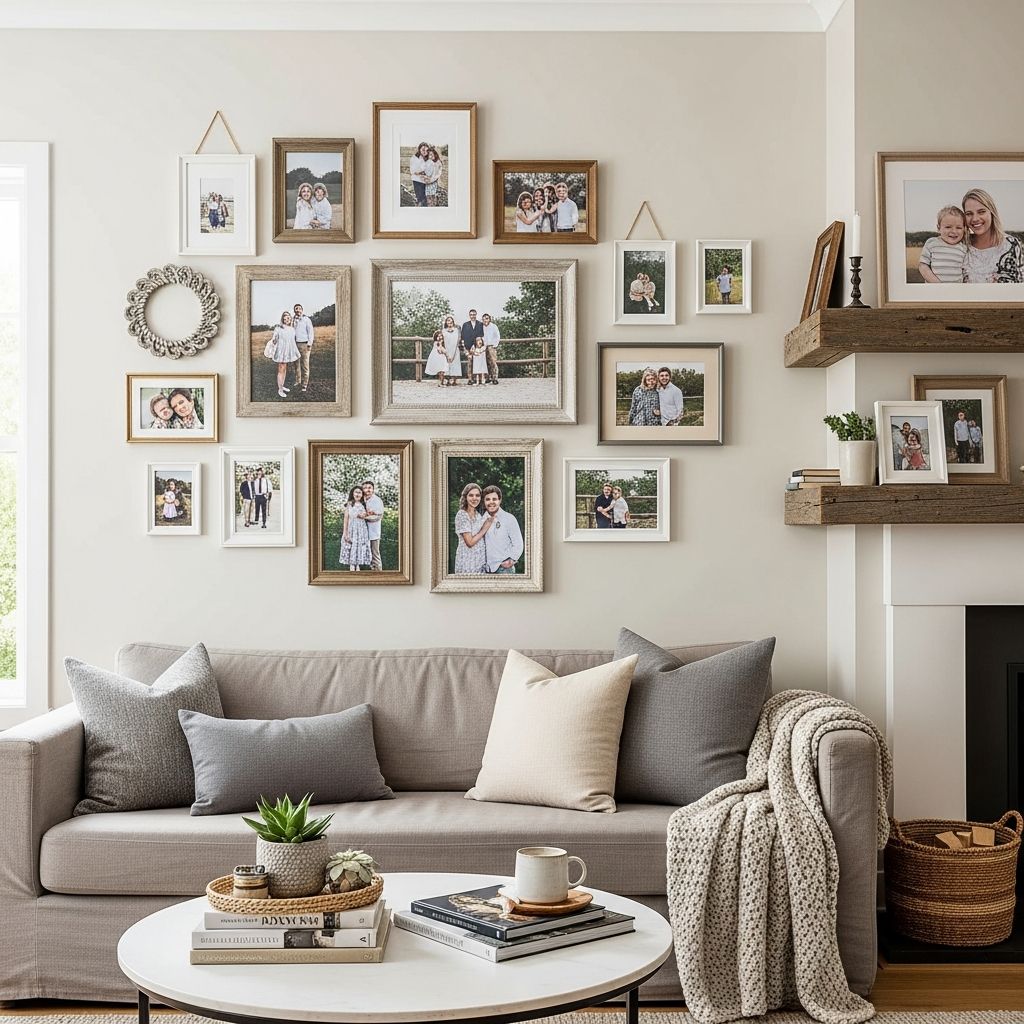
A cluster or “organic” gallery wall uses frames of different sizes and sometimes different finishes. Instead of strict rows, the frames form a loose shape—often an oval, rectangle, or cloud-like silhouette.
- Pick one large anchor piece (a big family portrait or an art print) and arrange smaller frames around it.
- Repeat elements for cohesion: for example, all white mats, or all photos from the same vacation.
- Trace frames onto paper, tape the paper cutouts to the wall, and rearrange until it feels balanced.
3. The Shelf Shuffle
If you dread committing to nails, picture ledges and floating shelves are your best friends. Frames simply lean against the wall, and you can layer prints without making new holes.
- Install one to three long, narrow shelves at eye level or in a staggered stack.
- Combine framed photos with small plants, souvenirs, or books to add depth.
- Rotate pictures seasonally or when the kids complain that their sibling has more photos on display.
4. The Chronicle Corner
Instead of spreading photos throughout every room, dedicate one small area to be your “family archive.” This might be the end of a hallway or a cozy nook near the stairs.
- Display one representative photo per year, per child, or per major trip.
- Place a small label or date in the corner of each mat so you do not forget when it was taken.
- Keep extras in a nearby box or album so kids can flip through the “back catalog.”
Mixing Kids’ Art, Memorabilia, And Photos
Most families have more than just digital photos: there are handprint turkeys, report cards, team badges, ticket stubs, and doodles from restaurant napkins. When framed, these pieces can make a family wall feel alive and personal.
- Rotate artwork easily: Use frames with front-loading panels or clip frames so kids can swap drawings without adult help.
- Pair art with portraits: Place a child’s painting next to a photo of them proudly holding it, or a sports certificate beside a team photo.
- Contain the chaos: Designate one gallery area for children’s creations so every wall does not become a refrigerator door.
Color, Mats, And Print Choices That Flatter Your Photos
Small details like mat color and print tone can dramatically change how polished your frames look. You do not need to become a professional designer, but a few basic guidelines help.
- Use mats to give breathing room: A white or off-white mat around a busy photo calms it down and lets the subject stand out.
- Limit frame colors per wall: Two main frame finishes (for example, black and light wood) usually strike a nice balance between tidy and interesting.
- Mix color and black-and-white intentionally: Consider one wall of color photos and another of monochrome, or convert hectic backgrounds to black-and-white to reduce visual noise.
- Mind the skin tones: Warm frames (gold, walnut) are often flattering around portraits, while cool tones (black, gray, silver) can suit cityscapes or ocean shots.
Practical Tips For Busy Households
Even the prettiest gallery wall is useless if it never gets finished. Families need strategies that allow for half-completed projects, quick updates, and minimal tools. Use the checklist below to keep things realistic.
- Start small: Frame and hang three to five core photos first. Add more over time rather than waiting for the “perfect” collection.
- Batch your tasks: Choose photos one evening, order prints the next day, and hang them on a weekend instead of trying to do it all at once.
- Keep a frame stash: Store a few clean, simple frames in a closet so you can frame school photos or surprise gifts without a special trip.
- Use removable hooks: They are forgiving for renters and indecisive decorators and make small adjustments less painful.
Safety And Preservation Basics
Photos represent irreplaceable memories, so a little care goes a long way toward keeping them safe. You do not have to invest in museum-grade materials for every snapshot, but it helps to know the basics.
- Avoid harsh sunlight: Direct sun can fade prints quickly; place important photos on shaded walls or use UV-protective glass when possible.
- Keep away from moisture: Bathrooms and steamy kitchens can warp mats and frames; choose metal or sealed frames if you must hang photos there.
- Back up digitally: Scan printed photos or keep digital originals organized so a broken frame does not mean a lost memory.
- Dust gently: Use a soft cloth instead of sprays, which can seep into frame corners and stain mats.
Making Room For Everyone In The Frame
In many homes, certain people show up more often on the walls—usually the main photographer or the kids who pose happily. Being intentional about who appears in frames can quietly communicate that everyone’s story matters.
- Count faces: Every so often, glance around and check whether each person in the household appears somewhere. If not, print a candid or selfie that includes them.
- Include non-traditional “family” members: That might be close friends, neighbors, or the dog that behaves better than most of the humans.
- Show real life: Do not limit yourself to posed holiday cards. Muddy shoes after a hike or flour-dusted noses on baking day often become the most beloved photos.
Quick Ideas To Refresh Your Frames Without Starting Over
If your gallery wall has looked the same for years, you may not need all new frames. Often, a few small changes can make everything feel new again.
- Swap a few old photos for new prints while keeping the layout the same.
- Repaint a set of mismatched frames in one unifying color.
- Add one oversized frame to anchor a group of smaller ones.
- Introduce a single, simple art print or quote to break up a wall of faces.
- Move an entire arrangement to a different room to see it with fresh eyes.
Frequently Asked Questions About Family Picture Frames
How high should I hang family photos?
A reliable rule is to keep the center of the main photo or grouping at roughly eye level for an average-height adult. When hanging over a sofa or console, leave a gap of about the height of your hand between the top of the furniture and the bottom of the lowest frame so the pieces feel connected but not crowded.
Can I mix black-and-white photos with color photos on the same wall?
Yes, mixing both can look great if something else ties the arrangement together, such as consistent frames, matching mats, or a clear theme like “vacations” or “grandparents.” If the wall starts to feel busy, group black-and-white photos in one area and color photos in another rather than alternating them randomly.
Is it outdated to use collage frames?
Collage frames are still useful, especially for small spaces, renters, or people who like the look of many photos but do not want to hang a dozen separate frames. To keep them feeling current, choose simple, clean-lined designs and avoid overloading a single wall with multiple collages.
How many photos are too many on one wall?
There is no strict limit, but if your eye does not know where to rest, the wall might be overcrowded. A helpful guideline is to choose one or two “hero” images that are larger and then surround them with smaller supporting photos, leaving a bit of negative space so each image can breathe.
What if my frames and furniture do not match?
Perfect matching is not required. It is more important that there is some repetition: perhaps all frames are black while furniture varies, or frames differ but mats are all white. If the room feels chaotic, pick one element—frame color, mat color, or photo tone—to unify the space.
Turning Everyday Moments Into Your Favorite View
Framed family photos do not have to wait for perfectly staged portraits or milestone events. The after-school snack at the counter, the grandparents waving on a video call screenshot, or the last-minute vacation selfie can all become art when given a simple frame and a thoughtful place on the wall.
Choose a small story to tell, gather a handful of photos that make you smile every time you see them, and give them a proper home. When you walk past those frames in the middle of a hectic day, you will be grateful that you did.