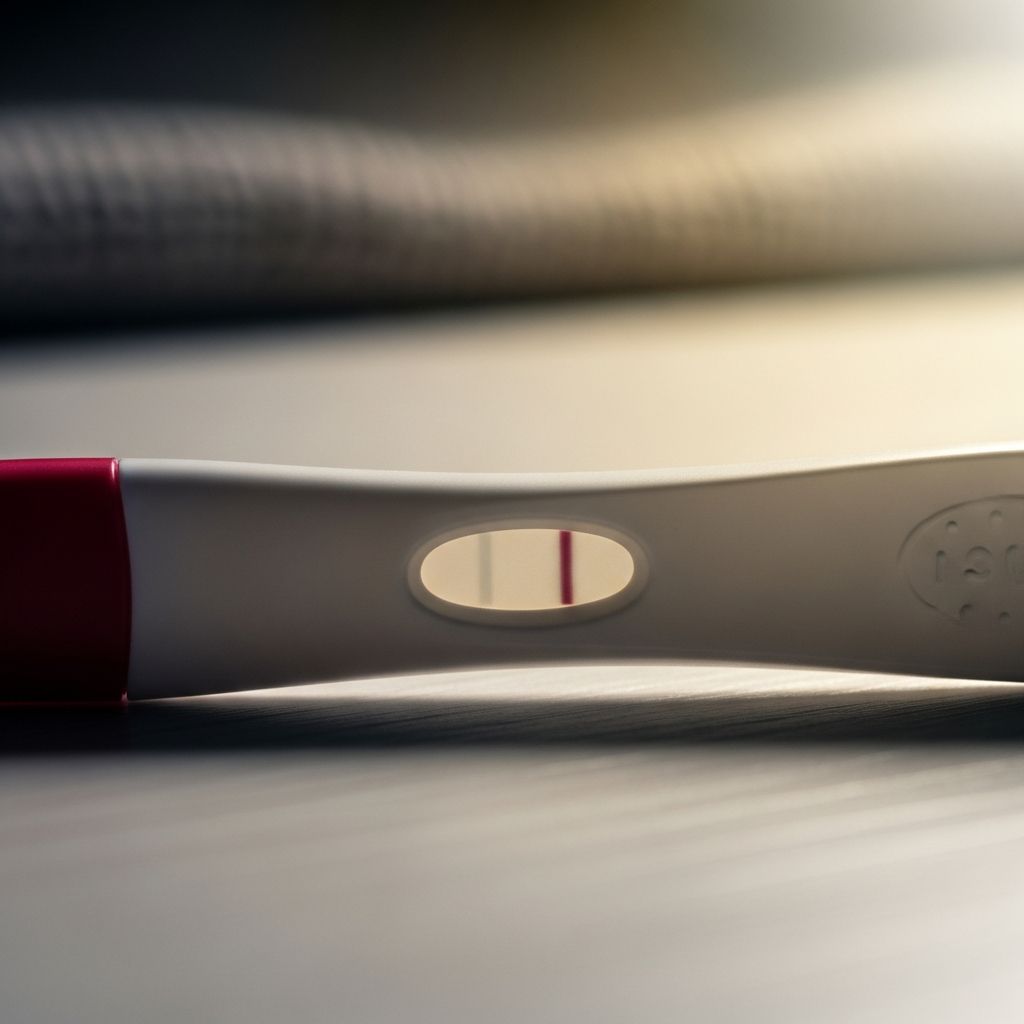
A faint line on a home pregnancy test typically indicates the presence of human chorionic gonadotropin (hCG), the hormone produced during pregnancy, suggesting you may be in the very early stages of pregnancy when levels are still low.
These tests detect hCG in urine, and even a subtle line means the hormone is present, though concentrations might not yet be high enough for a bold result. Understanding this phenomenon requires knowledge of how tests work, common causes, and proper follow-up actions.
How Home Pregnancy Tests Detect Pregnancy
Home pregnancy tests operate on a simple immunoassay principle: they use antibodies to bind with hCG molecules in your urine, triggering a color change on the test strip to form a line.
The intensity of this line correlates directly with hCG concentration; darker lines appear with higher levels, while faint ones occur when hCG is detectable but minimal. Most tests claim over 99% accuracy when used correctly after a missed period, but early testing often yields fainter results.
hCG production begins shortly after implantation, roughly 6-12 days post-ovulation, doubling every 48-72 hours in early pregnancy. This rapid rise explains why retesting after a couple of days usually shows a stronger line if pregnant.
Primary Reasons for Seeing a Faint Positive Line
The most common explanation for a faint positive is testing too early, before hCG has accumulated sufficiently.
- Early Testing: Sensitive tests can detect hCG 6 days before your missed period, but levels are low, leading to faint lines.
- Diluted Urine: Excessive fluid intake before testing reduces hCG concentration; first-morning urine is ideal for its potency.
- Test Sensitivity: Not all kits are equal—some require higher hCG thresholds, producing fainter lines on low-level samples.
These factors combined make faint lines a frequent early-pregnancy hallmark rather than an error.
Distinguishing True Positives from Evaporation Lines
An evaporation line is a colorless or grayish mark appearing after the recommended reading time (usually 3-10 minutes), caused by urine drying on the strip—it’s not hCG-related and indicates no pregnancy.
True faint positives are colored (pink or blue, matching the control line) and appear within the time frame. Always adhere to instructions: check results promptly to avoid confusion.
| Feature | True Faint Positive | Evaporation Line |
|---|---|---|
| Color | Pink/Blue (test dye) | Colorless/Gray |
| Timing | Within 3-10 min | After 10 min |
| Cause | hCG detection | Urine evaporation |
| Meaning | Likely pregnant | Not pregnant |
This table highlights key differences for quick identification.
Less Common Causes of Faint Lines
Beyond early pregnancy, faint positives can stem from medical scenarios requiring professional evaluation.
- Chemical Pregnancy: An early miscarriage before 5 weeks, where implantation occurs but doesn’t progress; residual hCG causes faint lines amid light bleeding.
- Ectopic Pregnancy: Fertilized egg implants outside the uterus (often fallopian tube), producing hCG but posing serious risks like rupture—symptoms include pain and spotting.
- Recent Pregnancy Events: After miscarriage, birth, or abortion, hCG lingers up to 60 days, potentially yielding faint positives.
- Fertility Treatments: Medications like hCG injections for ovulation induction mimic pregnancy hormones.
- Rare Conditions: Perimenopause or certain tumors can elevate hCG slightly.
False positives are rare outside these contexts, as hCG is pregnancy-specific.
Optimal Testing Strategies for Reliable Results
To minimize ambiguity, follow evidence-based practices drawn from clinical guidelines.
- Use first-morning urine for maximum hCG concentration.
- Test on or after the first day of your missed period for 99% accuracy.
- Select FDA-approved tests with clear instructions; digital versions display ‘Pregnant’ or ‘Not Pregnant’ to eliminate line interpretation.
- Retest in 48 hours—hCG doubling should darken the line if viable.
- Avoid excessive liquids beforehand.
If lines remain faint or symptoms arise, consult a healthcare provider for blood tests, which quantify hCG precisely (detectable from 10 mIU/mL).
When to Consult a Healthcare Professional
Seek immediate care if a faint positive accompanies severe pain, heavy bleeding, dizziness, or shoulder pain—these signal ectopic pregnancy or other urgencies.
Even without symptoms, schedule prenatal confirmation around 4-6 weeks for ultrasound viability checks. Blood tests distinguish low but rising hCG (normal) from stagnant levels (potential loss).
Professionals can rule out rarities like molar pregnancies or ovarian cysts producing hCG.
Understanding hCG Dynamics in Early Pregnancy
hCG, secreted by placental cells post-implantation, peaks around 8-11 weeks then stabilizes. Early faint lines reflect this trajectory: levels start at 5-50 mIU/mL, surging to 100,000+ by week 10.
Tracking via serial tests or apps aids reassurance, but only medical monitoring confirms health.
Variations exist; slower rises may indicate multiples or issues, underscoring professional input.
Emotional Aspects and Next Steps After a Faint Positive
A faint line often sparks excitement mixed with doubt—normal given the stakes. Journal symptoms, track cycles, and share with a partner or support network.
Prepare for positivity: start prenatal vitamins with folic acid (400-800 mcg daily) if planning pregnancy. Avoid alcohol, smoking, and consult on medications.
If negative follow-up, consider cycle irregularities warranting gynecological review.
Frequently Asked Questions About Faint Pregnancy Test Lines
Does any faint line mean I’m pregnant?
Yes, if colored and within the time frame, it detects hCG, indicating pregnancy—retest to confirm rising levels.
How faint is too faint to count?
No line is too faint if visible and colored per instructions; visibility signifies hCG presence.
Can medications cause faint positives?
Fertility drugs with hCG can; others like birth control do not.
What if the line fades on retest?
Possible chemical pregnancy or testing error—see a doctor for blood hCG.
Are digital tests better for faint lines?
Yes, they provide word results without line interpretation.
This comprehensive guide empowers informed decisions. Always prioritize healthcare consultation for personalized advice.
References
- Meaning of Faint Line on a Pregnancy Test — Clearblue. 2023. https://www.clearblue.com/pregnancy-tests/faint-line
- Faint Positive Home Pregnancy Test: Am I Pregnant? — Healthline. 2023. https://www.healthline.com/health/pregnancy/faint-positive-home-pregnancy-test
- Faint Line on a Pregnancy Test: What Does It Mean? — Natural Cycles. 2023. https://www.naturalcycles.com/cyclematters/faint-line-on-a-pregnancy-test
- What Causes a False Positive or Negative Pregnancy Test? — Life Options. 2023. https://www.life-options.org/post/what-causes-a-false-positive-or-negative-pregnancy-test
- 8 Possible Causes for a False-Positive Pregnancy Test — CCRM IVF. 2023. https://www.ccrmivf.com/news/false-positive-pregnancy-test/
- Pregnancy Test: When To Take, Types & Accuracy — Cleveland Clinic. 2023-10-28. https://my.clevelandclinic.org/health/diagnostics/9703-pregnancy-tests