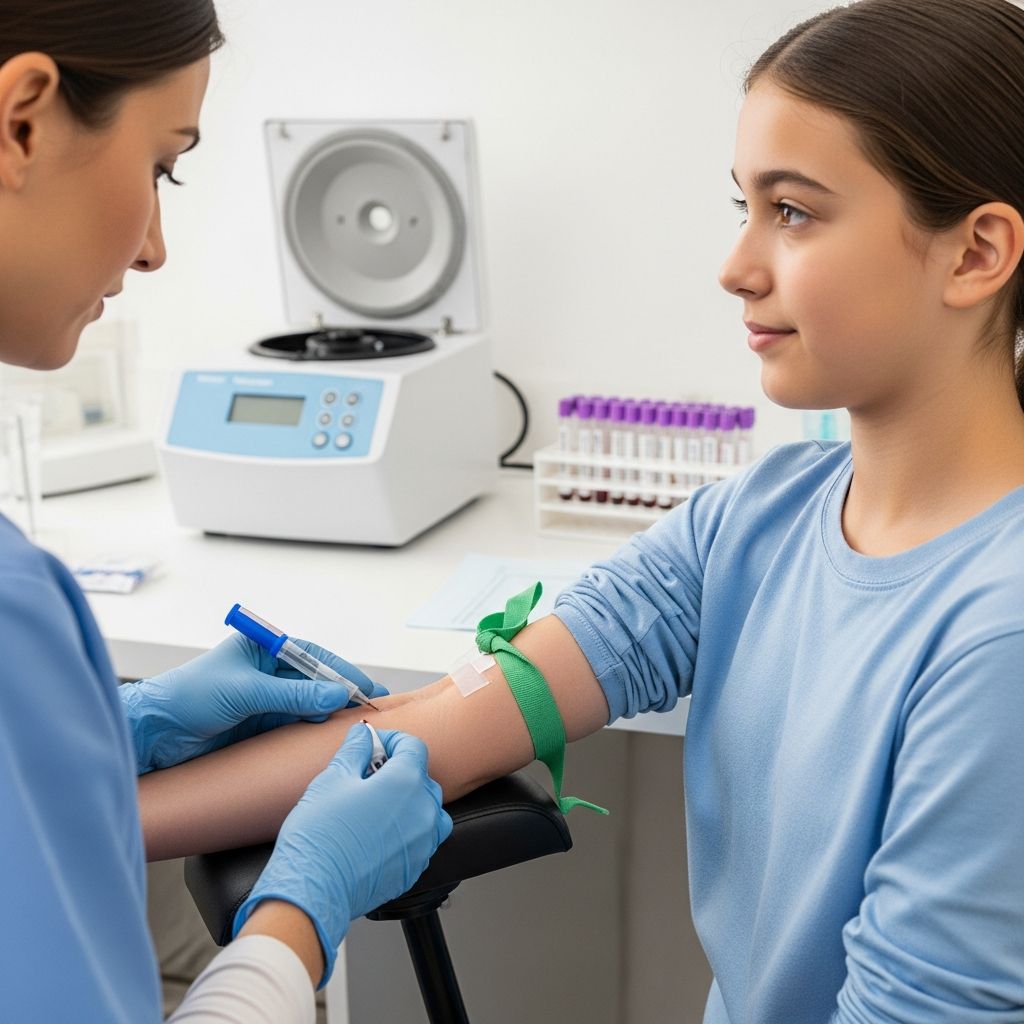
Estradiol is one of the main estrogen hormones in the body. It plays a key role in growth, puberty, and reproductive health for girls, and is also important in smaller amounts for boys. When doctors want to better understand how a child or teen is developing, they may order an estradiol blood test to measure how much of this hormone is in the bloodstream.
This guide is designed for parents and caregivers. It explains why estradiol is important, when a blood test might be needed, what happens during the test, and what results can help doctors learn about your child’s health.
Estradiol in Growing Bodies: The Basics
Estradiol is the most active form of estrogen in humans and is crucial for normal development during childhood and adolescence. While it is often associated with girls and women, it is present in all bodies, just at different levels.
What Estradiol Does
- Guides puberty – helps start and coordinate the physical changes of puberty, especially in girls.
- Shapes reproductive organs – supports growth and function of the uterus, fallopian tubes, vagina, and breasts in girls.
- Supports bone strength – helps build and protect bone density, lowering the risk of weak bones later in life.
- Influences body composition – affects how and where the body stores fat, especially in girls.
- Plays a role in brain and mood – interacts with brain chemistry and may influence mood and sleep.
Where Estradiol Comes From
| Group | Main Sources of Estradiol | Typical Level Pattern |
|---|---|---|
| Girls before puberty | Ovaries (very low activity), adrenal glands | Low and fairly stable |
| Girls in puberty | Ovaries (rapidly increasing hormone production) | Levels gradually rise; may fluctuate with early cycles |
| Boys | Testes and adrenal glands (smaller amounts) | Lower than in girls, but still measurable |
Because estradiol levels change with age and stage of puberty, doctors always interpret a child’s results with these factors in mind.
Why a Doctor Might Order an Estradiol Blood Test
An estradiol test measures the amount of this hormone in a blood sample. Doctors use the results along with your child’s medical history, physical exam, and sometimes other tests to understand how the hormones that control growth and puberty are working.
Common Reasons for Testing in Children and Teens
- Early puberty (precocious puberty) – when physical puberty signs start much earlier than expected, such as breast development in a girl before age 8 or testicular enlargement in a boy before age 9.
- Delayed puberty – when puberty has not started by the usual age or is progressing more slowly than expected.
- Irregular or absent menstrual periods – in teens who have started menstruating but have cycles that are very irregular or have stopped for several months.
- Unusual vaginal bleeding – such as bleeding in a child who is not yet in puberty, or heavy or prolonged bleeding in a teen.
- Possible hormone-related conditions – for example, suspected ovarian problems in girls or certain testicular or adrenal issues in boys.
How Estradiol Fits into the Big Picture
Estradiol is part of a hormonal chain that includes the brain, pituitary gland, and ovaries or testes. Doctors often order estradiol alongside other tests, such as:
- Follicle-stimulating hormone (FSH) and luteinizing hormone (LH), which are produced by the pituitary gland and signal the ovaries or testes to make hormones.
- Other estrogen tests or related hormones if a broader hormone profile is needed.
Looking at these hormones together helps doctors figure out whether a problem is coming from the ovaries or testes, the pituitary gland, or another part of the hormone system.
Preparing Your Child for an Estradiol Blood Test
Most children feel nervous about needles. A little preparation can make a big difference. Estradiol blood tests are usually done in a lab, clinic, or hospital outpatient area.
Before the Appointment
- Ask about timing – for teens who already have periods, a doctor may prefer the blood sample on a particular day of the menstrual cycle, because estradiol can change from day to day.
- Check instructions – in most cases, no fasting is required, but always follow any instructions your child’s health care provider gives.
- Explain in simple terms – let your child know:
- a small needle will go into a vein in the arm or hand,
- it may sting or pinch for a short time,
- the test helps the doctor understand how their body is growing.
- Plan comfort strategies – bring a favorite toy, book, or music, and decide whether your child wants to look away or watch during the blood draw.
Helping with Anxiety and Pain
- Encourage slow, deep breathing or counting during the blood draw.
- Ask whether a numbing cream or spray is available, especially for very anxious children.
- Stay calm and speak reassuringly; younger kids often mirror a parent’s mood.
What Happens During the Estradiol Blood Test
The test itself is quick and usually takes just a few minutes.
Step-by-Step Overview
- Check-in and identification – staff confirm your child’s name and the ordered test.
- Positioning – your child sits in a chair or on an exam table; younger children may sit on a caregiver’s lap.
- Cleaning the skin – the person drawing blood cleans an area on the arm or hand with an antiseptic wipe.
- Applying a tourniquet – a stretchy band is placed around the upper arm to make the vein easier to find.
- Blood draw – a thin needle is inserted into a vein, and blood flows into a tube attached to the needle.
- Needle removal and bandage – once enough blood is collected, the needle comes out, and a cotton ball or gauze pad with tape or a bandage is placed on the site.
Children may feel a brief pinch or stinging, but the discomfort usually passes quickly. Some kids don’t feel much at all.
After the Blood Draw
- A small bruise or mild soreness at the needle site is common and usually fades within a few days.
- Keep the area clean and dry for several hours; you can remove the bandage later in the day.
- Your child can usually return to normal activities right away, including school and sports.
Understanding Estradiol Test Results
Estradiol levels are reported as a number with a unit of measurement (often picograms per milliliter, or pg/mL). The “normal” range depends on your child’s age, sex, and stage of puberty, and sometimes on the lab that performs the test.
Factors Doctors Consider
- Age – hormone levels that are normal for a 16-year-old might be abnormal for a 7-year-old.
- Stage of puberty – whether your child is prepubertal, just entering puberty, or further along.
- Sex assigned at birth – typical estradiol ranges are different for girls and boys.
- Other hormone test results – such as FSH, LH, and sometimes thyroid or adrenal hormones.
- Symptoms and exam findings – physical signs of puberty, growth pattern, weight changes, or other health issues.
What Higher Estradiol Levels Can Indicate
Higher-than-expected estradiol levels for a child’s age and puberty stage may suggest:
- Early or fast-moving puberty (precocious puberty).
- In rare cases, hormone-producing tumors in the ovaries, testes, or adrenal glands.
- Exposure to external sources of estrogen, such as certain medications or creams.
In teens who already menstruate, higher estradiol can also appear at specific points in the menstrual cycle and may still be normal.
What Lower Estradiol Levels Can Indicate
Lower-than-expected estradiol levels may be linked to:
- Delayed puberty – when puberty has not begun or is moving very slowly.
- Ovarian insufficiency or other ovarian problems in girls, leading to missed or irregular periods.
- Issues with the pituitary gland, which normally signals the ovaries or testes to make hormones.
- Significant weight loss, eating disorders, or excessive exercise in teens, which can sometimes reduce estrogen production.
It is important to remember that one test result rarely tells the whole story. Doctors often repeat testing or add other studies to confirm what is going on.
Possible Next Steps After the Test
Once your child’s estradiol results are available, the health care provider will usually discuss them with you at a follow-up visit or by phone or secure message. Next steps depend on what the results show and why the test was ordered.
Monitoring Without Immediate Treatment
In some situations, especially when results are only slightly outside expected ranges, a doctor may recommend:
- Watchful waiting with periodic checkups.
- Repeating hormone tests after a few months to see if levels change.
- Tracking growth, weight, and puberty signs over time.
Further Evaluation
If results are more clearly abnormal or your child has significant symptoms, the doctor may:
- Order additional blood tests for hormones such as FSH, LH, thyroid hormones, or adrenal hormones.
- Recommend imaging tests, such as ultrasound of the ovaries or testes, or an MRI of the brain and pituitary in some cases.
- Refer your child to a pediatric endocrinologist, a doctor who specializes in hormone and growth problems.
Treatment Options
Treatment decisions are highly individual and depend on the cause of the hormone imbalance. Possible treatments may include:
- Medications to slow early puberty if it is moving too quickly and could affect final adult height or emotional well-being.
- Hormone therapy to support puberty or menstrual cycles if the body is not making enough hormones.
- Targeted treatment for underlying conditions, such as thyroid or pituitary disorders, ovarian or testicular problems, or adrenal gland issues.
Your child’s health care team should explain the goals, benefits, and possible side effects of any proposed treatment and work with you to decide on the best plan.
How Parents Can Support Their Child
Hormone testing and talk about puberty can feel overwhelming for children and teens. A supportive approach at home can help them cope better with both the tests and any treatments.
Talking About Hormones and Puberty
- Use clear, age-appropriate language to explain what hormones are and why the test is needed.
- Reassure your child that everyone’s body develops at its own pace and that needing tests does not mean they did anything wrong.
- Encourage questions and let your child be part of discussions with the doctor, especially older children and teens.
Emotional Support
- Acknowledge that medical tests and puberty changes can be stressful or embarrassing.
- Offer privacy when needed but stay available for conversation and support.
- Consider involving a counselor or psychologist if your child shows ongoing anxiety, sadness, or social withdrawal related to their development or medical care.
Frequently Asked Questions About Estradiol Blood Tests
Is an estradiol blood test dangerous for my child?
The test is considered very safe. The main risks are minor, such as brief pain at the needle site, a small bruise, or rarely lightheadedness. Serious complications from blood draws are extremely uncommon when performed by trained staff.
How long does it take to get estradiol test results?
Many laboratories can process estradiol tests within a few days, but timing varies. Your child’s doctor or the lab can give a more specific estimate.
Can food, exercise, or time of day affect my child’s estradiol level?
Estradiol is influenced more by age, puberty stage, and menstrual cycle than by short-term changes such as meals or daily activity. In most cases, no special preparation is required, but always follow your health care provider’s instructions.
Will one abnormal estradiol result mean my child definitely has a hormone problem?
Not necessarily. Hormone levels can fluctuate, and labs use different reference ranges. Doctors usually interpret estradiol alongside other hormone tests, symptoms, and physical exam findings. Sometimes tests need to be repeated before making a diagnosis.
Who should explain my child’s estradiol results to us?
Your child’s primary doctor, pediatrician, or pediatric endocrinologist is the best person to interpret the results. They can put the numbers in context, answer questions, and discuss options if follow-up is needed.
References
- Estrogen Levels Test — MedlinePlus, U.S. National Library of Medicine. 2023-02-15. https://medlineplus.gov/lab-tests/estrogen-levels-test/
- Estradiol Test: Purpose, Procedure, and Risks — Healthline Media. 2022-10-17. https://www.healthline.com/health/estradiol-test
- Estrogen Test — Kaiser Permanente Health Encyclopedia. 2021-06-01. https://healthy.kaiserpermanente.org/health-wellness/health-encyclopedia/he.estrogen-test.hw6200
- Estradiol — StatPearls, NCBI Bookshelf. 2023-07-10. https://www.ncbi.nlm.nih.gov/books/NBK549797/
- Why Would You Have Your Estradiol Levels Checked? — Progyny Fertility Education. 2021-05-20. https://progyny.com/education/estradiol/