Valentine’s Day is the perfect excuse to slow down, head into the kitchen, and turn flour, sugar, and a little imagination into edible love notes. Instead of focusing on fancy desserts that feel intimidating, this guide shows you how to create simple “hug and kiss” cookies that kids can help make, customize, and share with the people they love most. The ideas below are crafted to be approachable for busy families, from first-time bakers to seasoned cookie pros.
Why “Hugs & Kisses” Cookies Make Valentine’s Day Special
“Hug and kiss” cookies are more than just sweets; they are tiny, tasty symbols of affection that children can understand and proudly give away. Each cookie can represent a hug (O) or a kiss (X), which makes them playful, visual reminders of connection. When children help bake and decorate, they see that love is something you do, not just something you say.
Because the designs are simple, kids of different ages can participate: little ones can press shapes, while older kids practice piping icing or writing short messages. The result is a tray of imperfect but heartfelt treats that feel far more meaningful than anything that comes out of a store-bought box.
Planning Your Valentine Baking Session
Before you preheat the oven, a bit of planning helps the day feel fun instead of chaotic. Start by deciding how many people you want to bake for—your own household, classmates, neighbors, or extended family—and roughly calculate how many cookies you will need. Then, choose one base dough recipe that everyone enjoys, such as classic sugar cookies or a simple cocoa cookie dough.
For family baking, think in stations: one area for rolling and cutting dough, another for cooling, and a third for decorating. This structure allows each family member to rotate tasks, keeps mess somewhat contained, and gives even the youngest helpers a clear role. Having everything in place before kids arrive in the kitchen also shortens waiting times and reduces frustration.
Essential Tools and Ingredients
You don’t need professional baking equipment to make charming Valentine’s Day cookies. In most cases, standard kitchen tools and a few heart- or letter-shaped cutters are enough. If you do not have specialty cutters, simple circles and rectangles can still be turned into “X” and “O” designs with icing or chocolate.
- Basic tools: mixing bowls, measuring cups and spoons, whisk, spatula, rolling pin, baking sheets, parchment paper, cooling racks.
- Optional tools: letter-shaped cookie cutters, small heart cutters, piping bags or zip-top bags, small round decorating tips.
- Core ingredients: flour, sugar, butter, eggs, baking powder or baking soda (depending on recipe), vanilla extract, pinch of salt.
- Decorating extras: powdered sugar, food coloring, chocolate chips or chocolate candies, sprinkles, sanding sugar, small candy hearts.
Creating the Perfect Cookie Canvas
The best decorated cookies start with a dough that holds its shape and bakes evenly. A simple sugar cookie or shortbread-style dough works beautifully, because it stays relatively flat and provides a smooth surface for icing. Choose a recipe that is not overly soft so that the cut-out shapes keep their sharp edges while baking.
When making dough with kids, let them help with safe, low-risk steps like adding pre-measured ingredients or stirring with a sturdy spoon. After mixing, chilling the dough in the refrigerator for at least 30 minutes makes it easier to roll and reduces spreading in the oven. If you are tight on time, prep dough earlier in the day—or the night before—to keep the activity focused on cutting and decorating.
Shaping Hugs (O’s) and Kisses (X’s)
Once the dough is chilled, lightly flour the countertop and rolling pin, then roll the dough to a consistent thickness—usually about the thickness of two stacked coins. Thicker cookies are softer and more forgiving, while thinner cookies bake quickly and can be more crisp; choose the style your family likes best.
To create the “O” shapes, use round cookie cutters or the rim of a drinking glass for the outer circle, then a smaller cutter or bottle cap to remove the center. For the “X” shapes, use an X-shaped cutter if you have one, or cut thin strips of dough and cross them to form X’s. Press gently to seal the intersection so the pieces bake as one cookie instead of separating.
Fun Variations on the Theme
Once you master basic X and O cookies, it is easy to introduce variations that keep kids engaged and let them experiment. A few small changes in flavor or color can transform the same dough into a whole new batch of treats.
- Chocolate hugs: Add cocoa powder to part of the dough to create chocolate “O” cookies and keep the “X” cookies vanilla for contrast.
- Confetti kisses: Stir rainbow or red and pink sprinkles into the dough before rolling for speckled “X” cookies that look festive even before icing.
- Citrus twist: Grate a little orange or lemon zest into the dough for a bright flavor that balances the sweetness of icing.
- Marbled love: Gently knead together small portions of colored and plain dough for a marbled effect that looks impressive with very little effort.
Simple Decorating Techniques Kids Can Master
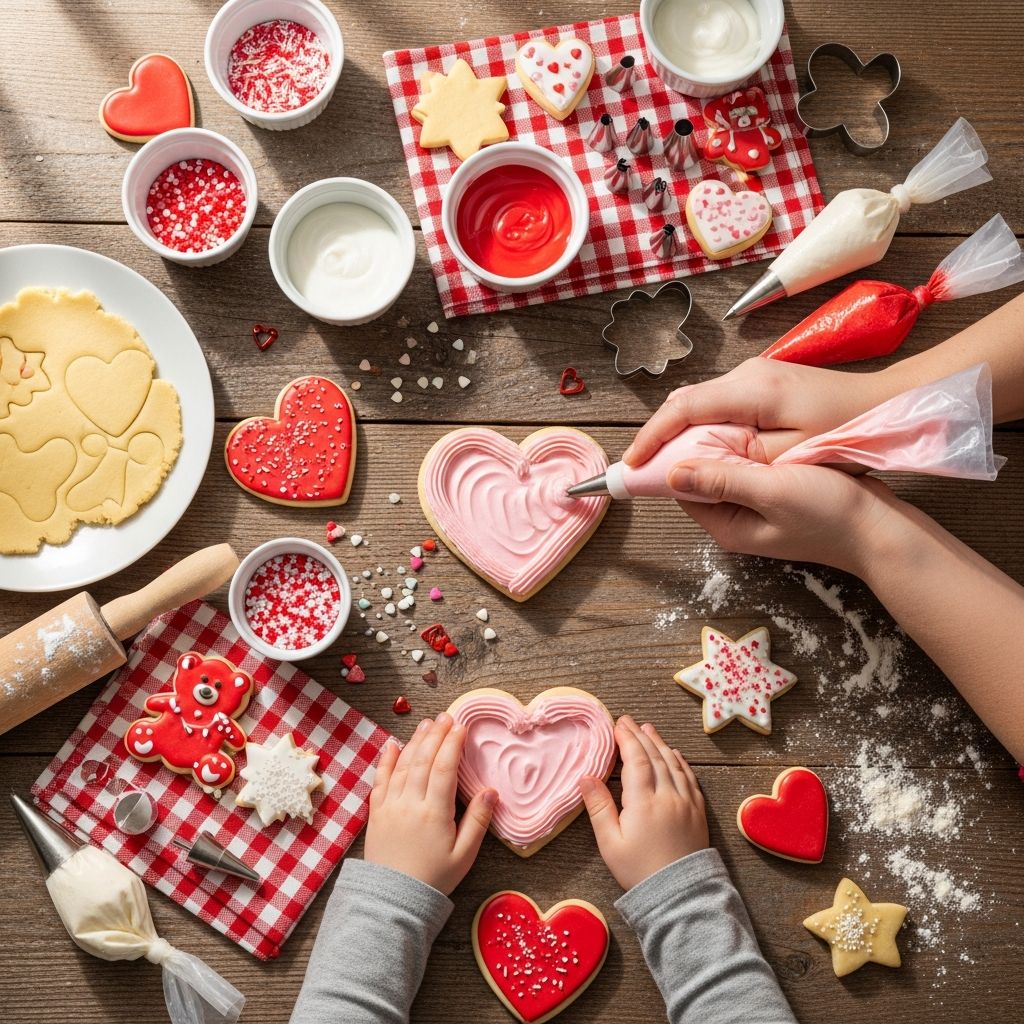
Decorating is the highlight for most children, and it doesn’t have to be complicated to look delightful. Start with a basic icing made from powdered sugar mixed with a tiny splash of milk or water and a bit of vanilla. Thin it to a consistency that slowly drips off a spoon but still holds a line when piped.
Divide the icing into small bowls and tint each with food coloring—pale pink, bold red, and soft white all feel perfectly on-theme for Valentine’s Day. Offer a limited but fun selection of toppings so kids can focus: sprinkles, mini chocolate chips, and candy hearts are usually enough. Encourage them to experiment with patterns like polka dots, stripes, and outlines instead of aiming for identical cookies.
Design Ideas for Hugs & Kisses Cookies
If kids feel unsure about how to decorate, giving them a few visual prompts can spark creativity without forcing strict rules. For “O” cookies, the ring shape invites designs that highlight the center, while “X” cookies naturally lend themselves to crisscross patterns and contrast.
| Cookie Shape | Design Idea | How to Create It |
|---|---|---|
| O (Hug) | Glitter Ring | Outline the ring with icing, then dip or sprinkle colored sugar only on the outer edge, leaving the inner circle plain. |
| O (Hug) | Filled Heart Center | Flood the ring with light-colored icing, then place a candy heart or heart sprinkle at the bottom of the inner circle. |
| X (Kiss) | Half-and-Half | Ice one diagonal stroke in one color and the intersecting stroke in a contrasting color for a bold pattern. |
| X (Kiss) | Polka Dot Kiss | Cover the X with a solid color, then add small dots with a different icing color along each arm. |
| Any Shape | Message Cookie | Use a thin piping tip to write short phrases like “XO” or initials on cooled, iced cookies. |
Kitchen Safety and Stress-Free Participation
The key to a low-stress baking day is to match each task to a child’s age and comfort level. Younger children can wash hands, line baking trays, sprinkle toppings, or gently press cutters into rolled dough. Older kids can help measure ingredients, crack eggs with supervision, or carefully transfer cookies to the baking sheet.
Keep hot pans and sharp tools under adult control whenever possible. Establish simple ground rules, such as “only grown-ups open the oven” and “we taste after hands are washed and tools are put down.” By treating these rules as part of the fun kitchen ritual, kids learn important safety skills without feeling scolded or excluded.
Turning Cookies into Meaningful Gifts
One of the most rewarding parts of making Valentine’s Day cookies is giving them away. A small bag or box of “hugs and kisses” can brighten the day of teachers, grandparents, neighbors, or friends who may not expect a homemade surprise. Encourage children to think about who might need some extra kindness—a shy classmate, a helpful neighbor, or someone who lives alone.
Presenting cookies can be as simple or elaborate as you like. Plain paper lunch bags, decorated with hand-drawn hearts, are just as charming as store-bought treat boxes. Add a short note that explains the idea: “Here are some hugs and kisses you can eat!” This helps children connect the baking experience with empathy and thoughtfulness.
Creative Packaging and Presentation Ideas
Thoughtful packaging turns ordinary cookies into keepsake-level gifts without much extra work. Look around your home before running to the store; often, you already have items that can be repurposed for Valentine’s Day gifting.
- Mason jars of love: Layer cookies in a small jar, tie a ribbon around the lid, and attach a tag explaining that each cookie is a hug or a kiss.
- DIY cookie envelopes: Fold cardstock or construction paper into envelope shapes, tuck a cookie into a food-safe bag, and slide it inside like a greeting card.
- Heart-lined boxes: Place a sheet of parchment paper and a few paper hearts at the bottom of a small box before stacking cookies, for a simple but charming look.
Making the Day Feel Like a Tradition
What turns a one-time project into a family tradition is repetition and storytelling. Consider taking a photo of your cookie trays each year and noting something special that happened while baking. Over time, your family will look back and see how their skills—and their designs—evolved.
You can also build a small ritual around the cookies, such as sharing them during a family movie night or delivering them together after dinner. The goal is for children to associate Valentine’s Day not with pressure to give the “perfect” card, but with a warm memory of flour-dusted counters and shared laughter.
Frequently Asked Questions About Valentine’s Hug & Kiss Cookies
How far in advance can I bake the cookies?
Most sugar-style cookies stay fresh for about three to five days when stored in an airtight container at room temperature. If you prefer to work further ahead, you can freeze undecorated cookies for several weeks, then thaw them fully before adding icing and decorations. This approach lets you spread the workload across more than one day.
Can I use store-bought dough?
Yes, store-bought dough can be a great shortcut, especially if the goal is a relaxed activity rather than a from-scratch baking lesson. Look for doughs that are labeled for cut-out cookies or that hold their shape well when baked. You can still customize with flavor extracts, zest, or sprinkles and focus more energy on decorating and packaging.
What if I don’t own cookie cutters?
You can improvise with common household items. Use the rim of a glass for circular “O” cookies and a knife or pizza cutter to slice thin, even strips that can be arranged into X shapes. After baking, pipe or drizzle icing in X and O patterns on any simple shape to reinforce the hug-and-kiss theme.
How do I prevent cookies from spreading too much?
To help cookies keep their shape in the oven, be sure the dough is well chilled and avoid placing cutouts on warm baking sheets. If your kitchen is very warm, chill the cut shapes on the tray for a few minutes before baking. Measuring flour carefully and not over-softening butter also reduces excess spreading.
How can I involve very young children?
Toddlers and preschoolers can participate in low-pressure steps like pouring pre-measured ingredients, pressing a cookie cutter into rolled dough with help, or sprinkling decorations onto iced cookies. Offer them a small section of dough or a single cookie at a time to decorate, and keep the experience short, positive, and playful rather than focusing on neatness.
Making Valentine’s Day Sweetly Simple
Homemade “hug and kiss” cookies show children that meaningful celebrations don’t depend on elaborate gifts—they grow out of shared time, shared effort, and shared treats. With a little planning and a willingness to embrace sticky fingers and uneven icing, your family can create a Valentine’s Day tradition that everyone looks forward to, year after year. The cookies may disappear quickly, but the feeling of connection they build has a way of lingering long after the last crumb is gone.