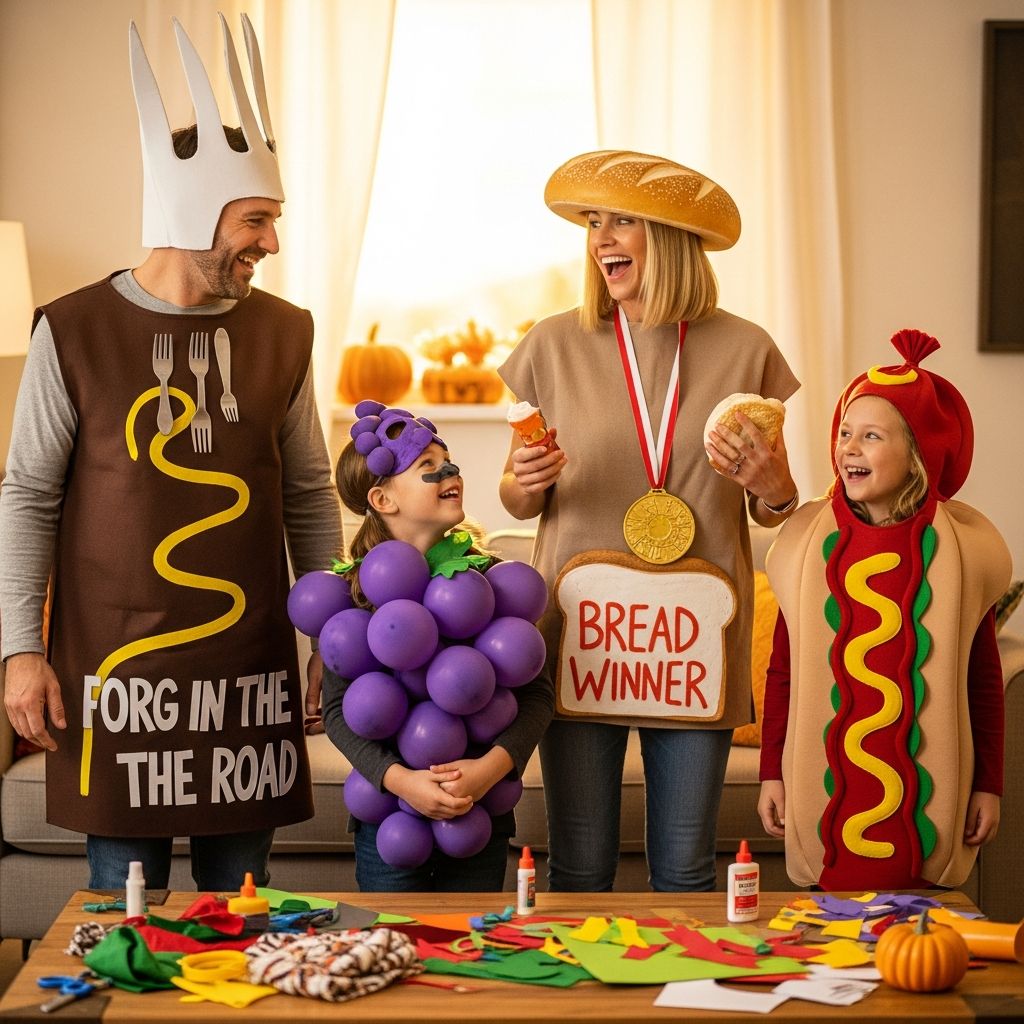
Some parents want perfectly coordinated, Instagram-ready costumes. Others just want their kids to have fun and make it out the door with everyone at least partly dressed. Dad-joke-inspired DIY family costumes live exactly in that sweet spot: silly enough to delight kids, low-pressure enough for tired adults, and cheap enough for real-life budgets.
This guide shows you how to transform simple puns, wordplay, and classic dad jokes into easy DIY family costumes that feel more like a shared inside joke than a performance. No sewing degree, no perfectionism, and no all-nighters required.
Why Dad-Joke Costumes Work So Well for Families
Parents often feel pressure around holidays to create magical, memory-worthy experiences, and costumes can become one more stressful task instead of a fun activity. Research on family rituals shows that shared traditions and playful routines are linked to better child well-being and stronger family bonds, even when those traditions are simple or imperfect.
Dad-joke costumes naturally support that kind of connection:
- They invite laughter, not judgment – The whole point is that they are corny, so there is no pressure for flawlessness.
- They are collaborative – Kids can help come up with jokes and visual gags, building their creativity and sense of ownership.
- They’re usually low-cost – Most ideas start with clothing you already own plus a few craft supplies.
- They’re developmentally great for kids – Humor and pretend play are linked with social and emotional development.
From Joke to Costume: A Simple 4-Step Method
You do not need to be a designer to turn wordplay into a visual costume. Use this straightforward process.
| Step | What You Do | Example |
|---|---|---|
| 1. Pick a joke | Choose a short, kid-appropriate pun or dad joke your family actually finds funny. | “What do you call cheese that isn’t yours? Nacho cheese.” |
| 2. Find the visual hook | Circle the words you can literally draw or wear: animals, foods, objects, actions. | Cheese slices, nacho chips, snack bowls, cheesy grins. |
| 3. Assign roles | Match each family member (and pets!) to one visual element or character. | Kid: giant nacho chip; Parent: cheese block; Baby: salsa jar. |
| 4. Build it from basics | Start with clothing you already have, then add cardboard, felt, markers, and tape. | Yellow T-shirts + cardboard triangles painted like chips. |
Core Ingredients for Easy Dad-Joke Costumes
Instead of dozens of complex tutorials, it is more helpful to stock a small “costume toolkit” and reuse the same tricks across different ideas.
Everyday Clothing as a Base
Begin with pieces your family already owns:
- Plain T-shirts or sweatshirts in bold colors
- Jeans, leggings, or sweatpants
- Button-down shirts, especially plaid (great for “farmer,” “lumberjack,” or “dad” characters)
- Simple dresses or oversized shirts that can be layered
This approach keeps kids comfortable and reduces meltdowns—children are more likely to enjoy events when clothing allows them to move easily and matches the weather.
Low-Stress Craft Supplies
With a few inexpensive materials, you can pull off many different themes:
- Cardboard boxes and cereal boxes for signs, props, and wearable “sandwich boards”
- Construction paper or colored cardstock for bold shapes and letters
- Felt sheets for reusable pieces that will not tear quickly
- Fabric glue, safety pins, or double-sided tape instead of sewing
- Washable markers and paint pens for quick details and faces
- Elastic bands or string for hanging signs around necks or shoulders
Simple, Reusable Accessories
- Baseball caps, beanies, and crowns
- Sunglasses for “cool” or “spy” jokes
- Plain aprons and lab coats for “chef,” “scientist,” or “mad inventor” bits
- Reusable tote bags that can double as costume pieces and candy bags
Types of Dad-Joke Family Costumes
Instead of copying a single example, think in categories. Once you understand the pattern, you can improvise endlessly.
1. Pun-Based Group Costumes
These costumes rely on a phrase with two meanings. Your family dresses as the literal version of the joke.
Typical structure:
- One parent or older child wears the “explanation” (a sign or word that makes the joke clear).
- Others wear the visual pieces (objects, foods, or characters from the phrase).
Ideas you can adapt:
- “Ceiling fans” – Adults wear shirts labeled “Go Ceiling!” while kids carry tiny cardboard ceilings (plain squares) they are “rooting” for.
- “Social butterflies” – Kids get wings and antennae; parents wear shirts with simple drawings of icons like chat bubbles or envelopes.
- “Cereal killers” (gentle version) – Children carry empty cereal boxes with silly faces drawn on them; the “killer” is just a giant spoon and an over-the-top dramatic expression.
2. Visual Groaners (No Words Needed)
Sometimes the joke is entirely in the image. These costumes are ideal for younger kids who cannot read yet but still love being “in on” something funny.
- Mismatch mayhem – Everyone wears extremely mixed-up clothing (polka dots with stripes, socks over shoes). The “dad joke” is that when someone asks, you say, “We’re fashionably late to getting dressed.”
- Exaggerated props – Parent wears normal clothes but carries a comically large cardboard remote, battery, or sock. You become the “Lord of the Lost Items.”
- Upside-down day – Arrows, letters, and faces drawn upside-down on shirts, with hair styled high using hats or headbands.
3. Everyday Objects with a Twist
Dad jokes love comparing people to things: “You’re my little sunshine,” “You’re my rock,” “You’re a snack.” These can easily become affectionate, goofy costumes.
- Family snack pack – Each person is a different simple snack (apple, popcorn, juice box, cookie). The official line: “We’re just a bunch of smart snacks.”
- Household heroes – One is a sponge, one a broom, one a laundry basket, one a remote. Collectively: “The League of Household Chores.”
- Weather report – One person is the sun, one is clouds, one is rain, another is a rainbow. Together, you can say, “Our forecast: 100% chance of candy.”
Planning with Real Life in Mind
Success is not about complexity; it is about fitting your family’s energy, budget, and time.
Match the Costume to Your Schedule
Use this quick rule of thumb:
- One evening available: Use T-shirts + paper or cardboard signs only.
- One weekend: Add simple felt pieces, headbands, and painted cardboard props.
- Two weeks or more: Let kids help paint, glue, and decorate in short sessions so it becomes a fun project, not a rush.
Prioritize Comfort for Kids
Children are more likely to enjoy family events when clothing is comfortable, safe, and allows movement. Keep these principles in mind:
- Avoid tight elastic around faces and necks.
- Leave arms and legs mostly free so kids can run and use the bathroom easily.
- Skip anything scratchy or heavy if your child has sensory sensitivities.
- Layer for the weather: costume over base layers for cold climates, or rely on lightweight T-shirts and hats in warmer areas.
Safety Considerations (Without Killing the Joke)
Even the silliest costumes need a few serious checks. Health and consumer authorities consistently highlight choking hazards, flammability, and visibility as top Halloween safety concerns.
- Visibility: Prefer face paint and hats over full masks; if you use masks, make sure eye holes are large and unobstructed.
- Tripping hazards: Keep capes, cardboard pieces, and fabric no longer than your child’s ankles.
- Lights and reflectors: Add reflective tape or glow sticks if you will be outdoors after dark.
- Skin-friendly materials: Use non-toxic, kid-safe paints and adhesives on anything that touches skin.
Keeping the Focus on Fun, Not Perfection
Parents sometimes underestimate how little it takes to create a powerful memory. Studies on family rituals note that consistency and shared enjoyment matter more than production value or novelty.
To protect everyone’s sanity:
- Accept crooked lines and messy paint – It proves kids helped.
- Let kids make decisions – Even if their color choices make no sense, they will remember that their ideas mattered.
- Document the joke – Take a quick photo or short video of someone explaining the costume to the camera. That explanation becomes part of the memory.
Sample Idea Map: Building Your Own Concepts
Use this mini “brainstorming recipe” at the kitchen table with your kids. Fill in the blanks together.
- Step 1: Write down 3–5 things your family loves (foods, animals, characters).
- Step 2: Add silly descriptions to each (“fancy pizza,” “sleepy dinosaur,” “introvert superhero”).
- Step 3: Turn each description into a joke title: “The Society of Sleepy Dinosaurs,” “Superheroes Who Are Off-Duty,” etc.
- Step 4: Decide what each member wears based on one word from the title.
By the end, you will have a completely personalized dad-joke costume with a story your family invented together.
Frequently Asked Questions (FAQs)
What if my kids do not understand the dad joke?A: That is fine—many jokes land better with adults than kids. For younger children, focus on costumes that also make visual sense (like food, animals, or weather), and treat the pun as a bonus for grown-ups.
Q: How do we handle kids who refuse to match the family theme?
Build the joke around their choice instead of forcing them into yours. If one child insists on being a dragon, the rest of the family can be various “problems a dragon causes” (burnt toast, missing socks, smoke alarm) or “dragon support team.”
Are DIY costumes really cheaper than store-bought ones?
They usually can be, especially if you start with clothes you own and recycle cardboard and paper. The main expense tends to be accessories and craft supplies, which you can reuse in future years.
How far in advance should we start?
If you are using mostly paper, markers, and cardboard, a week is plenty. If you want painted props or multiple glued pieces, starting two weekends before the event leaves time for trial and error without late-night stress.
What if one parent hates dressing up?
Put that parent in the “meta” role: the announcer, narrator, or person holding a sign that explains the joke. A simple T-shirt with a small label (like “Narrator” or “Designated Driver”) still keeps them in the group while honoring their comfort level.
References
- Family Routines and Rituals — American Academy of Pediatrics. 2018-01-01. https://publications.aap.org/pediatrics/article/140/Supplement_2/S119/34130/Family-Routines-and-Rituals
- Why Family Rituals Matter — Child Mind Institute. 2022-10-10. https://childmind.org/article/why-family-rituals-matter/
- The developmental origins of humor in infancy — The British Psychological Society / British Journal of Developmental Psychology. 2018-03-01. https://bpspsychub.onlinelibrary.wiley.com/doi/10.1111/bjdp.12214
- Choosing Safe Toys and Halloween Costumes — American Academy of Pediatrics. 2021-10-01. https://www.healthychildren.org/English/safety-prevention/at-play/Pages/Choosing-Safe-Toys.aspx
- Halloween & Costume Safety — U.S. Consumer Product Safety Commission. 2023-10-01. https://www.cpsc.gov/Safety-Education/Safety-Education-Centers/Halloween