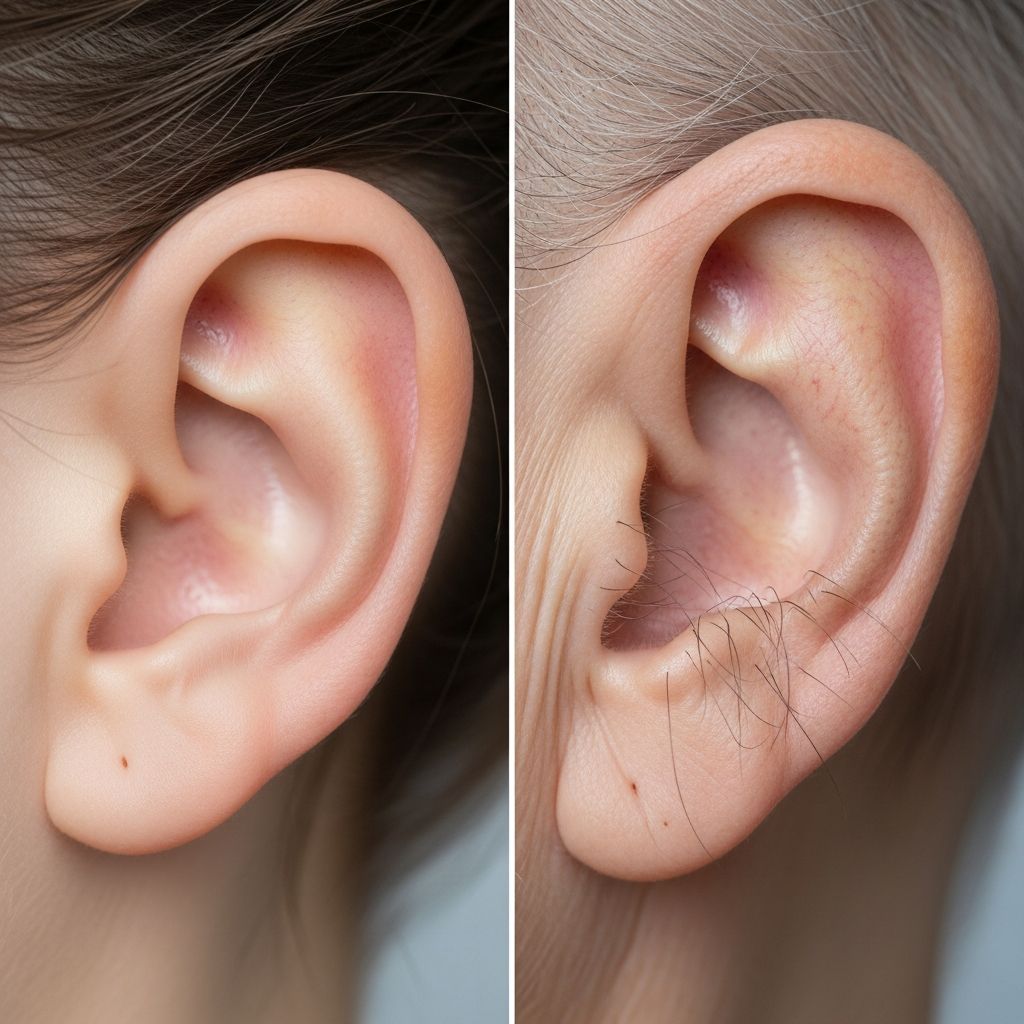
Noticing new hairs sprouting from your ears can be surprising, even a little unsettling. For many adults, especially men, ear hair seems to appear suddenly in midlife and then grow thicker and longer each year. While this change is usually harmless, it can raise questions about hormones, aging, and even heart health. This guide explains why ear hair increases, when it might matter medically, and how to manage it safely.
What Exactly Is Ear Hair?
In medical terms, prominent or excessive hair on or around the ears is often called auricular hypertrichosis, meaning increased hair growth on the pinna (outer ear) or in the ear canal. Hair in this area can be:
- Fine vellus hair – thin, light-colored, often barely visible.
- Terminal hair – thicker, darker, coarser hair that is more obvious.
Most people have some vellus hair on the ears. What tends to bother people as they age is the shift toward more terminal hair that sticks out of the ear canal or appears along the outer ear edges.
Why Ear Hair Seems to Explode With Age
Ear hair is not a sign that your body suddenly “decided” to grow hair in a new area. The follicles were there all along; their behavior changed over time. Several factors play a role:
1. Hormonal Changes and Sensitivity to Androgens
The main explanation involves androgens, a group of hormones that includes testosterone. Androgens influence where and how much terminal hair grows on the body.
- During puberty, rising androgen levels turn many vellus hairs into terminal hairs on the face, chest, and underarms.
- As men grow older, the total level of testosterone may gradually decline, but hair follicles in some sites (like nose and ear) can become more sensitive to androgens.
- This increased local sensitivity may cause existing follicles in the ear to produce thicker, darker hair.
Cleveland Clinic notes one widely accepted theory: as men age, ear and nose follicles respond more strongly to testosterone and begin to sprout more noticeable hair, even though serum testosterone may not be increasing.
2. Genetics and Family Patterns
Genes strongly influence where body hair appears and how dense it becomes. Health sources point out that hormonal changes and genetics together help determine increased outer ear hair, especially in older men.
- Some families have a clear pattern of men developing prominent ear hair in midlife.
- In certain populations, particularly in parts of South Asia, coarse hair along the outer ear (“hairy pinnae”) is more common.
- Rare genetic conditions such as Cantú syndrome also involve unusually heavy hair growth on and around the ears, though these are typically recognized in childhood.
If your father, uncles, or grandfathers had thick ear hair as they aged, you are more likely to notice the same change.
3. Medications and Medical Conditions
In some cases, ear hair growth can be influenced by specific drugs or underlying disorders:
- Medications that stimulate hair growth, such as minoxidil, can occasionally cause excessive hair around the ears, even leading to partial canal blockage in severe cases.
- Some rare syndromes involving generalized hypertrichosis (excessive hair growth over the body) may include ear hair as one feature.
For most people, however, age-related and genetic factors explain the vast majority of increased ear hair.
Is Ear Hair a Health Problem or Just Cosmetic?
In everyday practice, ear hair is usually a cosmetic concern. Many people choose to trim or remove it purely for appearance. That said, there are a few circumstances where ear hair may be associated with other issues.
Possible Heart Disease Associations
Several studies, mainly in men, have explored whether certain ear features might be linked to cardiovascular risk. These include:
- Hair growth on the ear (outer ear or canal)
- Diagonal earlobe crease (a wrinkle running diagonally across the earlobe)
An Iranian study found that both ear hair and a transverse groove on the earlobe were associated with a higher likelihood and severity of coronary artery disease (CAD), even after accounting for other risk factors. According to their analysis, people with ear hair had several-fold higher odds of having CAD than those without, in that particular patient group.
More recently, other research has examined earlobe creases and heart disease or atrial fibrillation, again suggesting a possible connection but also calling for more study before using ear signs as diagnostic tools.
Key points to understand about these findings:
- These are associations, not proof that ear hair causes heart disease.
- Some studies have found a relationship, others have not, and results may vary by population.
- Traditional risk factors—such as smoking, high blood pressure, cholesterol, diabetes, and family history—remain far more important for evaluating heart risk.
For now, most experts treat ear hair as, at most, a potential visual cue that might warrant a closer look at your overall cardiovascular risk, rather than a diagnostic sign on its own.
When Ear Hair Can Affect Ear Health
Although ear hair itself is not dangerous, it can contribute to certain ear problems:
- Swimmer’s ear (otitis externa) – Excess hair can narrow the canal and trap moisture, which may increase the risk of outer ear infections.
- Ear canal blockage – In rare cases, extremely dense hair (for example, during intense hair-growth treatment) can obstruct the canal and interfere with hearing.
- Folliculitis and irritation – Inflamed hair follicles in the ear can cause painful bumps or localized infection.
If you notice pain, swelling, discharge, or hearing changes along with significant hair in the canal, it is important to see a clinician rather than trying to fix the problem yourself.
Comparing Ear Hair in Men and Women
Ear hair can occur in anyone, but it is much more common and more prominent in men.
| Feature | Men | Women |
|---|---|---|
| Typical age of onset | Often midlife and older | Usually later and milder, if present |
| Hormonal influence | Higher lifetime testosterone, follicles more androgen-sensitive | Lower androgen levels, less terminal hair transformation |
| Common concern | Noticeable canal and outer ear hairs, cosmetic worry | Occasional fine hair, rarely as thick or dense |
Women may notice some increase in facial and ear hair after menopause as estrogen levels fall and relative androgen influence rises, but ear hair still tends to remain finer and less dense compared with men.
Safe Ways to Remove or Reduce Ear Hair
If ear hair bothers you, there are several safe and effective options to manage it. The best method depends on where the hairs are (outer ear vs. canal), your skin sensitivity, and your comfort level.
1. Trimming: The Safest First-Line Option
For most people, careful trimming is the simplest and safest approach, especially for hair at the ear opening or outer ear.
- Use blunt-tipped grooming scissors or an electric trimmer designed for ears and nose.
- Work in good lighting and a mirror; avoid trimming blindly inside the canal.
- Focus on hair that protrudes or is clearly visible rather than cutting too deep.
Trimming does not change how fast hair grows or how thick it becomes; it only shortens the visible length.
2. Depilatory Creams (With Caution)
Hair-removal creams dissolve the hair shaft at the skin surface. Because the ear canal skin is thin and sensitive, these products should never be placed deep inside the ear.
- Only consider using on the outer ear, and test a very small area first.
- Avoid letting cream run into the canal.
- Discontinue immediately if you feel burning, pain, or see redness.
Given the risks, many clinicians prefer trimming or professional removal over creams for the ear region.
3. Waxing and Threading
Waxing or threading can remove multiple hairs at once and keep the area clear for several weeks. However, these methods pull hair from the follicle and can irritate or damage delicate skin.
- Always have ear waxing or threading performed by a trained professional familiar with the anatomy of the ear.
- These techniques should be limited to the outer ear, not the canal.
- People with diabetes, poor circulation, or immune issues should be especially cautious due to higher infection risk.
4. Laser Hair Removal and Electrolysis
For those seeking a longer-term solution, laser hair removal or electrolysis may be options for outer ear hair.
- Laser targets pigmented hair follicles to reduce growth over multiple sessions.
- Electrolysis uses a tiny probe to destroy individual follicles.
- Both should be done by licensed specialists, with a clear plan to avoid the ear canal.
These methods tend to be more expensive and time-consuming but can significantly reduce the need for regular trimming.
Methods to Avoid Inside the Ear Canal
The ear canal and eardrum are extremely delicate. Certain methods carry unnecessary risks if used inside the canal:
- Home waxing kits designed for other body areas.
- Sharp blades or razors, which can cut the canal or eardrum.
- Unsupervised laser devices or heated tools.
If you feel you need hair removed from inside the canal rather than just at the opening, it is safer to consult an ear, nose, and throat (ENT) specialist.
When to Talk to a Doctor About Ear Hair
Most of the time, increased ear hair does not require medical evaluation. But there are situations where getting checked is wise:
- Sudden, dramatic increase in ear hair growth, especially if it appears with other unusual hair changes elsewhere on the body.
- Ear pain, discharge, hearing loss, or a feeling of blockage along with heavy hair growth in the canal.
- Other cardiovascular risk factors plus prominent ear hair or an earlobe crease, particularly if you have not had recent heart-health screening.
- Use of a hair-growth medication followed by excessive hair around the ears, making you worry about canal obstruction.
A clinician can examine the ear safely, manage any infection or blockage, and decide whether your overall health or medications might be contributing to the change.
Frequently Asked Questions About Ear Hair
Q: Does shaving or trimming ear hair make it grow back thicker?
A: No. Cutting hair only blunts the tip, which can feel stubbier as it grows out, but it does not change the diameter of the hair shaft or the number of follicles. Hair thickness and density are controlled by hormones and genetics, not by trimming.
Q: Is ear hair always a sign of heart disease?
A: No. While some studies have found a statistical link between ear hair (and certain earlobe creases) and coronary artery disease in specific groups, many people with ear hair have completely healthy hearts. It should never replace standard cardiovascular risk assessment or screening.
Q: Can ear hair protect my ears?
A: A small amount of hair at the ear opening may help filter dust and tiny particles, but excessive hair can trap water and debris, increasing the risk of outer ear infections. Balance and cleanliness are more important than trying to keep hair for protection.
Q: Is it safe to pluck ear hairs with tweezers?
A: Occasional plucking of a few outer-ear hairs is generally safe for many people, but it can cause irritation, small breaks in the skin, and folliculitis if overdone. Trimming is usually less painful and lower risk than repeated plucking, especially near the canal.
Q: When should I see a specialist instead of handling ear hair myself?
A: Seek professional care if you experience pain, bleeding, infection, reduced hearing, or feel that hair or wax is blocking your ear. You should also see a clinician before attempting any aggressive or permanent removal techniques inside or near the canal.
References
- Value of Transverse Groove on the Earlobe and Hair Growth on the Ear in Predicting Coronary Artery Disease — Shemirani AH, et al. 2021-07-12. https://pmc.ncbi.nlm.nih.gov/articles/PMC8343484/
- Ear Hair (Hairy Ears): Causes, Meaning & Removal — Cleveland Clinic. 2022-09-07. https://my.clevelandclinic.org/health/diseases/25162-ear-hair
- Ear Hair: Heart Disease, Outer, Ear Canal, and More — Healthline. 2024-03-18. https://www.healthline.com/health/ear-hair
- Ear hair — Summary of clinical considerations. (Based on sourced clinical content; canonical overview only.) 2023-01-01. https://en.wikipedia.org/wiki/Ear_hair
- Cantú Syndrome — MedlinePlus Genetics (NIH). 2021-06-08. https://medlineplus.gov/genetics/condition/cantu-syndrome/
- What To Know About Ear Hair — Nevada Ear + Sinus Institute. 2022-05-10. https://nesilv.com/what-to-know-about-ear-hair/
- Why do ear and nose hair grow more as you age, but head hair grows less? — Nebraska Medicine. 2021-01-19. https://www.nebraskamed.com/dermatology/why-do-ear-and-nose-hair-grow-more-as-you-age-but-head-hair-grows-less