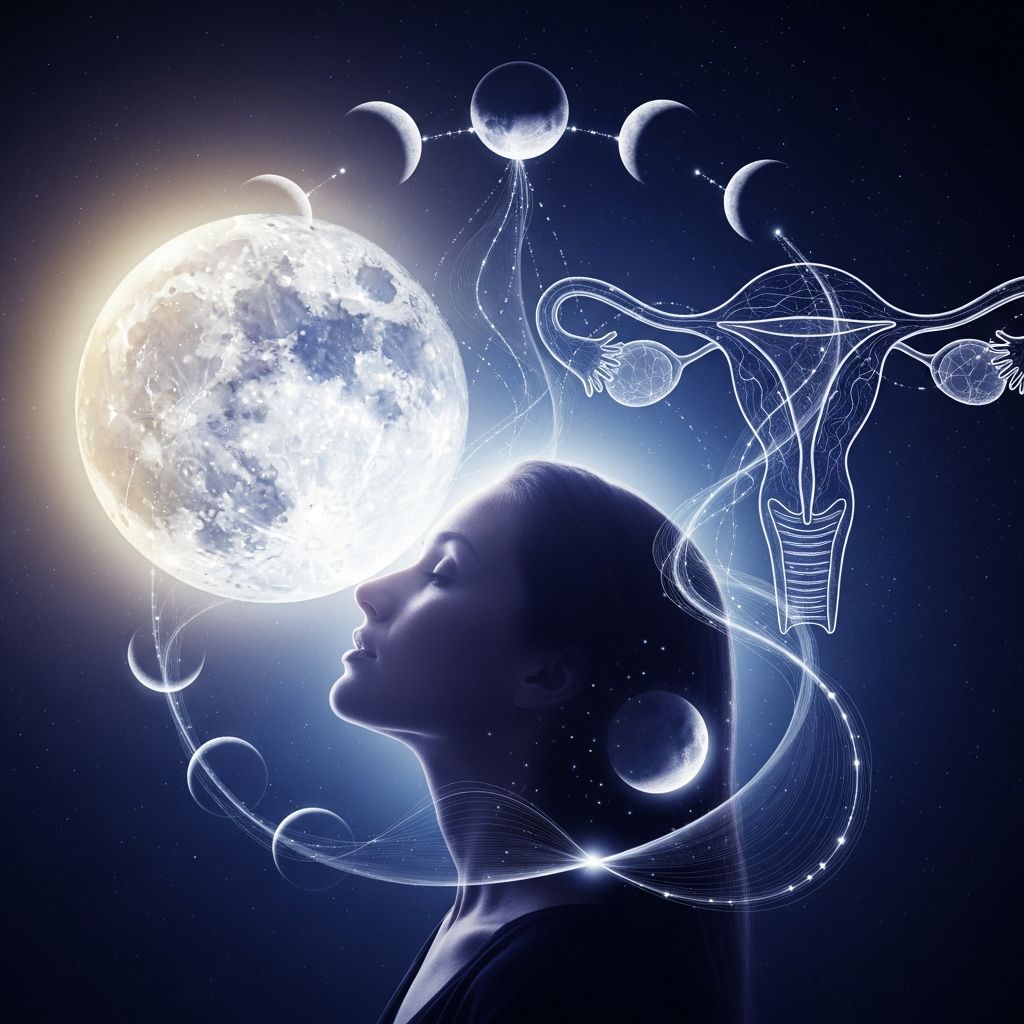
The human body operates on intricate biological clocks, and for centuries, many have pondered if the moon’s celestial dance influences one of women’s most personal rhythms: the menstrual cycle. With both averaging around 29 days, the parallels are striking. Recent research delves into this age-old question, revealing subtle connections shaped by light, gravity, and lifestyle changes.
Historical Perspectives on Moon and Menstruation
Across cultures, folklore has woven tales of the moon guiding fertility and bleeding. Ancient civilizations viewed the lunar phases as harbingers of reproductive events, with new moons signaling beginnings and full moons peaks of energy. These beliefs stem from observable alignments in pre-industrial eras, where natural light dominated nights.
Early scientific inquiry echoed these intuitions. In the 1980s, researchers examined large cohorts to test synchronization hypotheses. One pivotal investigation tracked 826 young women aged 16-25 with regular cycles, finding 28.3% began menstruating near the new moon—far higher than the 8.5-12.6% across other phases, with statistical significance (p<0.01).
Modern Evidence of Cycle Synchronization
Contemporary studies build on these foundations, using vast datasets and advanced analytics. A comprehensive analysis spanning decades showed menstrual onsets clustering bimodally around new or full moons, particularly in cycles matching the 29.5-day synodic lunar month (new to full).
Cycles between 26-36 days demonstrated intermittent alignment, termed ‘entrainment,’ while shorter (<27 days) or longer (>33 days) ones showed only relative coordination—occasional drifts toward lunar rhythms. This suggests an internal biological clock attuned to lunar periodicity, resilient yet subtle.
| Lunar Cycle Type | Duration | Entrainment Range for Menstrual Cycles |
|---|---|---|
| Synodic (new to full) | 29.5 days | 26-36 days |
| Anomalistic | 27.55 days | 24-31 days |
| Tropical | 27.32 days | 23-30 days |
This table illustrates how different lunar cycles could theoretically entrain human ones, highlighting the synodic month’s strongest overlap with average menstruation.
Biological Mechanisms at Play
Melatonin, the hormone regulating sleep and reproduction, emerges as a key player. Laboratory data from three women revealed peak 6-hydroxymelatonin (a melatonin metabolite) levels before and during menstruation, dropping to nadirs at ovulation (p<0.01). Notably, two participants peaked at new moon and troughed near full moon.
Moonlight likely acts as a zeitgeber—an environmental cue syncing internal clocks. In ancestral environments, brighter full moons suppressed melatonin, potentially delaying ovulation, while darker new moons allowed peaks conducive to menses. Gravitational pulls during lunar standstills further amplified effects, with minor standstills syncing to full moons and majors to new moons.
Disruption by Artificial Light
Urbanization has fractured this harmony. A 2021 study posits that once-dominant lunar synchronization waned with electric lighting’s rise, disrupting natural zeitgebers. Clue’s analysis of 7.5 million cycles found no population-wide link, attributing this to light pollution overriding moonlight.
Yet remnants persist. During strong gravitational alignments, like lunar standstills every 18 years, synchrony reemerges. Google Trends data showed ‘period pain’ searches peaking at perihelion (Earth’s closest solar approach), even in lit southern hemisphere summers, implicating gravity over light alone.
Expert commentary tempers enthusiasm: while light-cycle links are convincing, gravimetric claims need larger validation. Age factors in too—younger women under 35 with ~29.5-day cycles sync more readily, diminishing post-35 as cycles shorten.
Clinical Implications and Therapies
Beyond observation, applications arise. ‘Lunar-menses-regulatory therapy’ treated 20 cases of nephropenic secondary amenorrhea, yielding 4 cures, 5 marked improvements, 8 emmenagogue responses, and 3 failures—hinting at lunar-informed interventions.
Period trackers now incorporate lunar phases for users seeking patterns. Women with cycle lengths near 29.5 days might experiment with dimming lights during new moons to test personal synchrony, though evidence remains correlative, not causal.
Debunking Myths and Clarifying Facts
- No universal full moon effect: Unlike lore, studies split—some favor new moons, others full, with no consistent population sync.
- Individual variation rules: Only cycles matching lunar lengths show tendencies; most drift independently.
- Light pollution culprit: Pre-2000 data showed clearer links; modern lifestyles obscure them.
Frequently Asked Questions
Does the full moon trigger periods?
Evidence is mixed. Some 1980s research noted tendencies around full moons for 29.5-day cycles, but large modern datasets like Clue’s 1.5 million users found no link. Synchronization, when present, varies by individual cycle length and light exposure.
Can I sync my cycle to the moon?
Possibly, if your cycle is 26-36 days. Reduce artificial light at night, track phases via apps, and monitor for 3-6 months. However, genetics and health dominate; consult a doctor for irregularities.
Why did ancient cycles sync better?
Without electric lights, moonlight was a potent zeitgeber. Studies suggest this faded post-industrial revolution, confirmed by weakening pre-2000 vs. recent data.
Is gravity or light the main factor?
Both, per recent models. Light cues directly; gravity via geophysical effects during standstills. Trends in period pain searches support this, even in bright areas.
Practical Tips for Lunar Awareness
Harness this knowledge mindfully:
- Track your cycle alongside moon phases using reliable apps.
- Dim bedroom lights during new moons to mimic ancestral conditions.
- Note personal patterns—new moon bleeds? Full moon energy surges?
- Combine with sleep hygiene for hormonal balance.
- Seek professional advice for cycle disruptions; lunar links are supplementary.
While not deterministic, lunar rhythms offer a poetic lens on biology. As research evolves, this interplay may inform wellness strategies, bridging cosmos and corpus.
References
- The regulation of menstrual cycle and its relationship to the moon — PubMed. 1986. https://pubmed.ncbi.nlm.nih.gov/3716780/
- Why women’s periods once synced with the moon – and what changed — News-Medical.net. 2025-09-30. https://www.news-medical.net/news/20250930/Why-womene28099s-periods-once-synced-with-the-moon-e28094-and-what-changed.aspx
- Expert reaction to study looking at the correlation between menstruation, the moon and artificial light — Science Media Centre. 2024. https://www.sciencemediacentre.org/expert-reaction-to-study-looking-at-the-correlation-between-menstruation-the-moon-and-artificial-light/
- Moon Phases and Menstruation: What Science Really Says — Samphireneuro. Undated (recent). https://www.samphireneuro.com/en-us/blog/moon-phases-and-menstruation-cycle-myth-to-avoid