The Secret Code Inside You
Imagine your body is like a giant, living instruction manual. Every part of you — your eyes, your hair, your fingers, even the way you grow — is built and controlled by a special code. That code is called DNA, and it’s inside nearly every cell in your body.
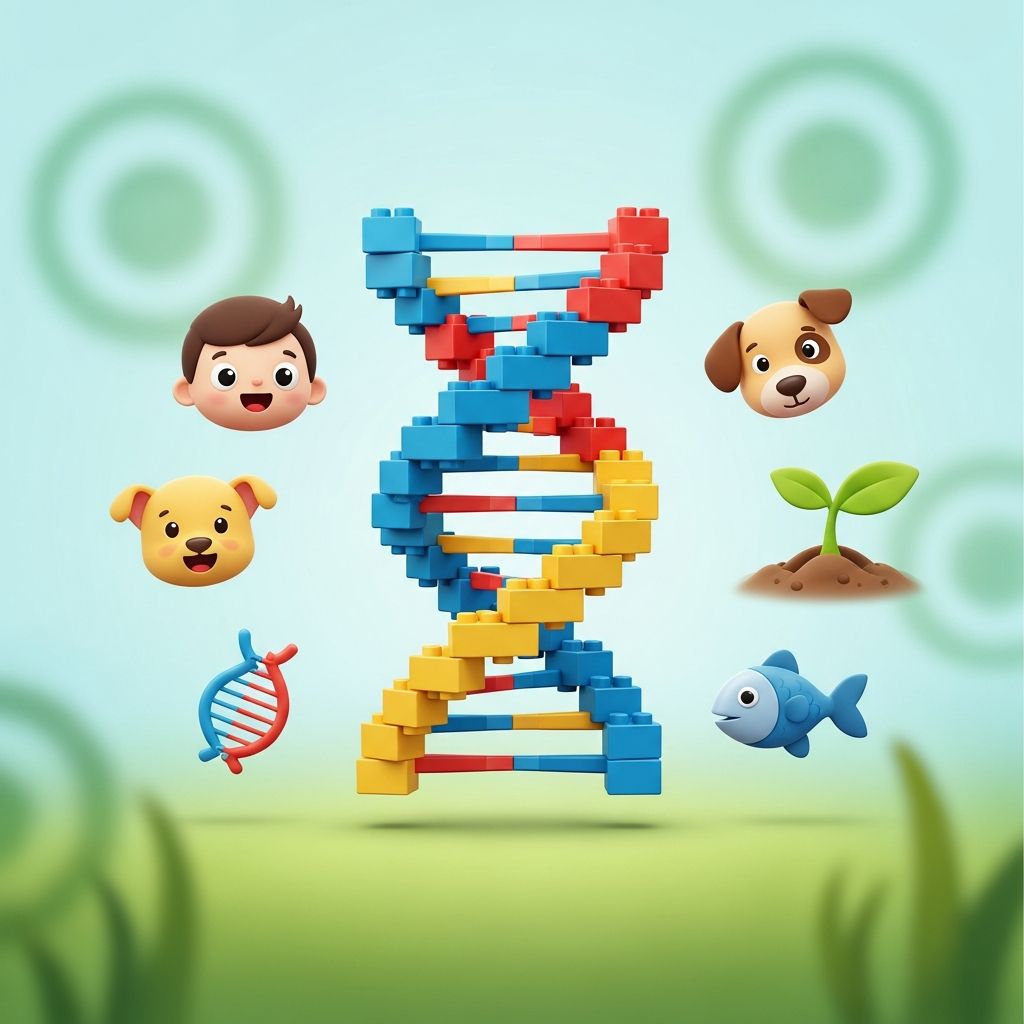
DNA stands for deoxyribonucleic acid (say: dee-ox-ee-rye-bo-new-klee-ik ay-sid). That’s a mouthful, so scientists just call it DNA. It’s like a tiny, twisted ladder that holds all the information needed to build and run a living thing — whether it’s a human, a dog, a tree, or even a tiny bacterium.
Where Is DNA Found?
DNA lives inside the cells that make up your body. You have trillions of cells, and almost every one has a copy of your DNA. Most of that DNA is packed into a special area in the cell called the nucleus (say: new-klee-us), which is like the cell’s control center.
Inside the nucleus, DNA is wrapped up tightly into structures called chromosomes (say: kro-mo-soams). Humans have 46 chromosomes in most cells — 23 from your mom and 23 from your dad. These chromosomes are made of DNA and special proteins that help keep the DNA organized and protected.
What Does DNA Actually Do?
DNA is like a recipe book for your body. It doesn’t cook the food, but it tells the body how to make the ingredients — mainly proteins. Proteins are tiny machines that do almost everything in your cells: they help you move, digest food, fight germs, and even help your brain work.
Each section of DNA that gives instructions for making one protein is called a gene (say: jeen). You have around 20,000–25,000 genes in your DNA, each with a specific job. Some genes tell your body how to make eye color, others help your bones grow, and some even help you taste food or smell flowers.
How Is DNA Built?
DNA is made of very small building blocks called nucleotides (say: new-klee-oh-tides). Each nucleotide has three parts:
- A sugar molecule (called deoxyribose)
- A phosphate group
- One of four nitrogen bases: adenine (A), thymine (T), cytosine (C), or guanine (G)
These nucleotides line up in long chains. Two chains twist around each other to form the famous double helix — a shape like a twisted ladder.
The Rules of the DNA Ladder
The sides of the DNA ladder are made of sugar and phosphate. The rungs are made of pairs of bases. But not just any bases can pair up — they follow strict rules:
- Adenine (A) always pairs with thymine (T)
- Cytosine (C) always pairs with guanine (G)
These base pairs are held together by weak chemical bonds called hydrogen bonds. Even though the rules are strict, the order of the bases can change. That’s what makes each person’s DNA unique.
How DNA Makes You Unique
Every person’s DNA is a little different — except for identical twins, who start with nearly the same DNA. The order of A, T, C, and G in your DNA is like a long code that spells out your traits.
For example:
- A certain pattern might tell your body to make brown eyes.
- Another pattern might tell your hair to be curly.
- Some patterns affect how tall you’ll grow or how fast you heal from a cut.
Because you get half your DNA from your mom and half from your dad, you end up with a mix of traits from both of them. That’s why you might have your mom’s smile and your dad’s nose!
How DNA Is Passed from Parents to Kids
When a baby is made, it gets DNA from both parents. Sperm from the father and an egg from the mother each carry 23 chromosomes. When they join, they form a cell with 46 chromosomes — a full set of DNA.
This new DNA mix is what makes each child unique. Even brothers and sisters (except identical twins) have slightly different DNA, which is why they might look and act differently.
How DNA Copies Itself
When your body grows or repairs itself, cells divide. Before a cell splits, it must copy its DNA so each new cell gets a complete set of instructions.
This copying process is called DNA replication. Here’s how it works:
- An enzyme (a special protein) unzips the DNA ladder, breaking the hydrogen bonds between base pairs.
- Each separated strand acts as a template.
- New nucleotides line up along each strand, following the base-pairing rules (A with T, C with G).
- Two new DNA molecules form, each with one old strand and one new strand.
This way, every new cell gets an exact copy of the original DNA.
From DNA to Proteins: The Cell’s Recipe
DNA holds the recipes, but the cell needs messengers to carry those recipes to the kitchen (the ribosomes) where proteins are made. That’s where RNA comes in.
Here’s a simple version of how it works:
- A small section of DNA (a gene) is copied into a molecule called messenger RNA (mRNA).
- The mRNA leaves the nucleus and travels to a ribosome in the main part of the cell.
- The ribosome reads the mRNA code in groups of three bases, called codons.
- Each codon tells the ribosome which amino acid to add to the growing protein chain.
- Transfer RNA (tRNA) brings the right amino acids to the ribosome.
- When the chain is complete, it folds into a working protein.
This whole process is how DNA instructions turn into the proteins that build and run your body.
What Are Mutations?
Sometimes, mistakes happen when DNA is copied. These mistakes are called mutations (say: myoo-tay-shuns). Most of the time, the cell fixes them, but sometimes they stay in the DNA.
Mutations can be:
- Harmless (like a tiny spelling error that doesn’t change the meaning)
- Helpful (they might give an advantage, like better vision)
- Harmful (they can cause diseases or problems with how the body works)
Mutations are also one reason why living things change over time. In nature, helpful mutations can help animals survive better, and over many generations, this can lead to new species.
Fun Facts About DNA
- If you stretched out all the DNA in one human cell, it would be about 2 meters (6.5 feet) long!
- But it’s so thin that you can’t see it without a very powerful microscope.
- All humans share about 99.9% of their DNA — that’s why we’re all humans.
- The other 0.1% is what makes each person unique.
- DNA is found in almost all living things, from bacteria to blue whales.
- Even bananas share about 50% of their DNA with humans!
How Scientists Use DNA
Scientists study DNA to learn about health, diseases, and how living things are related. Here are some cool ways DNA is used:
- Medicine: Doctors can look at DNA to find out if someone has a genetic disease or is at risk for certain health problems.
- Forensics: Police can use DNA from blood, hair, or skin to help solve crimes.
- Family history: People can test their DNA to learn about their ancestors and where their families came from.
- Conservation: Scientists use DNA to study endangered animals and help protect them.
- Biotechnology: Scientists can change DNA in plants and animals to make better crops or treat diseases.
Common Questions About DNA (FAQs)
Can two people have the same DNA?
Identical twins start with nearly the same DNA, but even they can have tiny differences over time. Everyone else has a unique DNA pattern, which is why DNA is so useful for identifying people.
Does DNA change over time?
The basic DNA you’re born with stays mostly the same, but small changes (mutations) can happen. Also, how your genes are used can change based on your environment, diet, and lifestyle.
Can DNA be changed on purpose?
Yes, scientists can edit DNA using special tools. This is called gene editing. It’s being studied to treat diseases, but it’s still very new and must be used very carefully.
Is DNA the same in every cell?
Almost all your cells have the same DNA, but different cells use different parts of it. For example, a skin cell uses different genes than a brain cell, even though both have the same DNA.
Do animals and plants have DNA too?
Yes! All living things have DNA. Animals, plants, fungi, and even tiny bacteria use DNA to store their instructions for life.
Summary: What You Need to Know
DNA is the amazing molecule that holds the instructions for life. It’s shaped like a twisted ladder, made of four bases (A, T, C, G) that pair in a specific way. DNA is found in chromosomes inside the nucleus of cells.
It tells the body how to make proteins, which do almost everything in your cells. You get your DNA from your parents, which is why you share traits with them. DNA copies itself when cells divide, and it’s used to make proteins through a process involving RNA and ribosomes.
Mutations are changes in DNA that can be harmless, helpful, or harmful. Scientists use DNA in medicine, crime solving, family history, and more. DNA is what makes every living thing unique — including you!
References
- What is DNA? — KidsHealth, Children’s Hospital of Orange County. Accessed 2025. https://kidshealth.org/CHOC/en/kids/word-dna.html
- DNA Fact Sheet — National Human Genome Research Institute, U.S. National Institutes of Health. 2023. https://www.genome.gov/genetics-glossary/Deoxyribonucleic-Acid
- Basics of DNA and Genes — Genetics Home Reference, U.S. National Library of Medicine. 2023. https://medlineplus.gov/genetics/understanding/basics/dna/