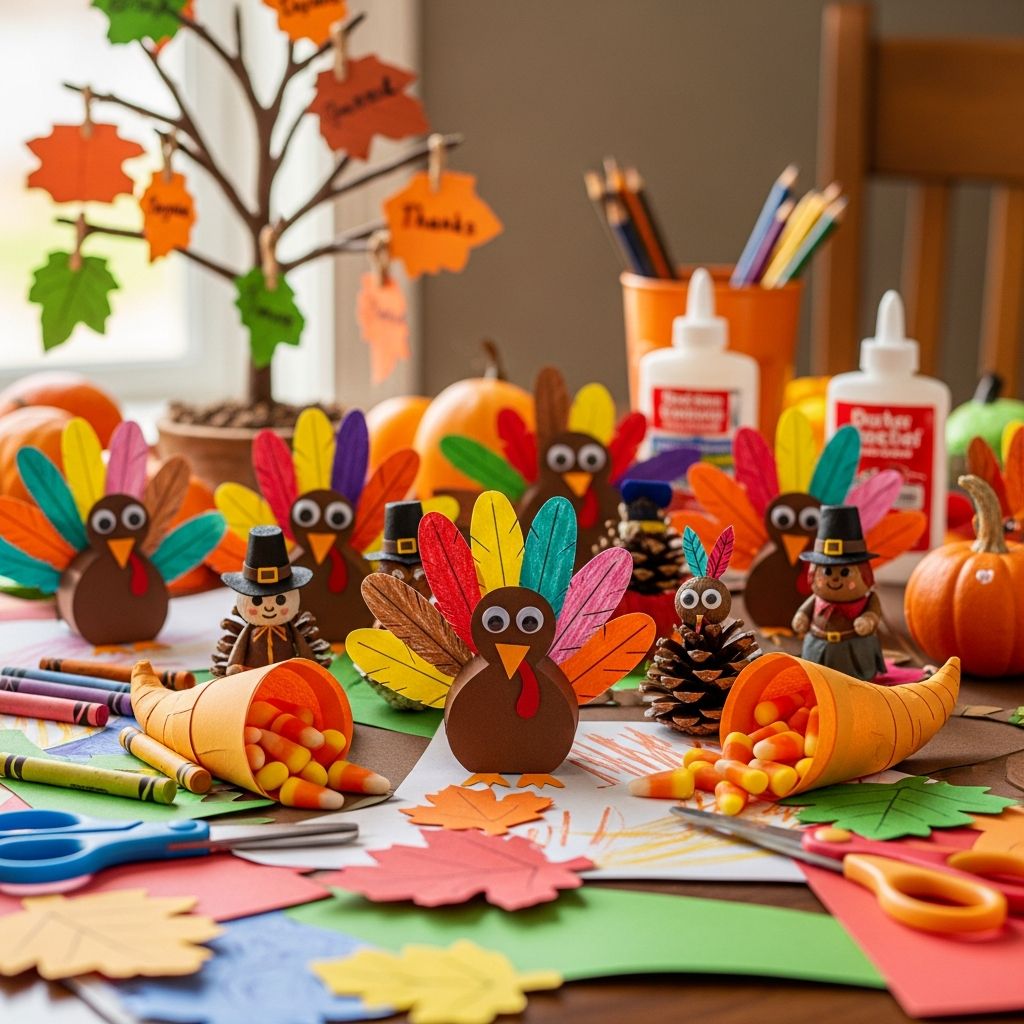
Transforming the kids’ table into a playful, hands-on craft zone keeps children happily occupied while the adults cook, carve, and catch up. With a bit of planning, you can turn that corner of the dining room into the most exciting spot in the house, full of color, imagination, and conversation about gratitude.
This guide shares fresh, easy-to-prep Thanksgiving crafts, games, and decorating ideas made specifically for the kids’ table. All projects use simple supplies, encourage creativity, and can be adapted for different ages, attention spans, and family traditions.
Why a Dedicated Kids’ Craft Table Matters
A thoughtfully designed kids’ table does more than keep small hands busy. It can:
- Support social skills as children talk, share supplies, and help each other.
- Promote creativity and fine motor skills through coloring, cutting, folding, and gluing.
- Encourage gratitude when crafts focus on thankfulness and kindness.
- Reduce mealtime stress for adults by giving kids a clear, fun focus while food is being served.
Hands-on arts and crafts are linked with improvements in attention, motor coordination, and emotional expression in children, making them particularly valuable during stimulating, sometimes overwhelming, holiday gatherings.
Planning the Perfect Thanksgiving Kids’ Craft Zone
Before choosing specific projects, think through the basics so you can enjoy the day instead of constantly troubleshooting glue spills and supply shortages.
Key Questions to Consider
- How many kids will be at the table, and what are their ages?
- Will they craft before, during, or after the main meal (or all three)?
- Do you need no-mess options, or is a little paint and glue okay?
- How long do you realistically need them to stay engaged?
Essential Supplies Checklist
Stock a simple box or tray with flexible materials you can use for multiple projects:
- Construction paper, cardstock, and scrap paper
- Washable markers, crayons, and colored pencils
- Glue sticks and child-safe scissors
- Fall-colored tissue paper or crepe paper (reds, oranges, yellows, browns)
- Paper plates, paper cups, and paper bags
- Stickers, washi tape, and adhesive dots (great if you want to skip liquid glue)
- Real or faux leaves, twine, and string
- Small envelopes or resealable bags for kids to take projects home
Table-Friendly Setup Ideas
- Cover the surface with kraft paper or a disposable tablecloth so kids can draw directly on it.
- Pre-portion supplies into small cups or caddies so kids are not constantly reaching across the table.
- Label areas with simple signs like “Coloring Corner” or “Gratitude Station” to give structure.
- Keep drinks separate from craft supplies to minimize spills and soggy projects.
Low-Mess Table Cover Crafts
Your table covering can double as the first activity. With a little creativity, it becomes a giant canvas that naturally invites kids to participate.
1. Doodle-Friendly Table Wrap
Roll out a long sheet of kraft paper or drawing paper and tape it securely to the table edges. Then, turn it into an open invitation to create:
- Draw large, simple outlines of turkeys, pumpkins, acorns, and leaves for kids to color.
- Write scattered prompts like “I am thankful for…”, “My favorite fall memory is…”, or “Draw your dream dessert.”
- Add a border kids can decorate with patterns, dots, zigzags, or handprints.
Providing a shared surface like this can promote cooperative play and communication, especially when children of different ages are seated together.
2. Built-In Game Board Runner
Use a strip of paper down the middle of the kids’ table as both décor and entertainment:
- Draw a simple board game path with squares from one end of the table to the other.
- Write easy challenges in some squares (for example, “Name a food you love,” “Act like a turkey,” “Tell a joke”).
- Provide buttons, coins, or paper circles as game pieces.
Kids can play in pairs or small groups while waiting for courses to be served.
Gratitude Crafts That Spark Conversation
Thanksgiving is an ideal time to help children articulate what they appreciate in their daily lives. Simple gratitude crafts encourage reflection, which has been linked to greater well-being and positive mood even in school-age children.
3. Personal Thankful Placemats
Instead of standard placemats, let kids create their own reflective place settings.
- Give each child a sheet of cardstock or thick paper roughly placemat-sized.
- Lightly pencil in three sections labeled “People,” “Places,” and “Little Things.”
- Invite kids to draw or write one or more items they’re thankful for in each box.
- Encourage older kids to add a short sentence explaining why.
Laminating or covering finished placemats with clear contact paper can turn them into keepsakes to revisit each year.
4. Leaf Pockets of Thanks
Create small paper “pockets” where children can tuck handwritten notes of gratitude.
- Cut large leaf shapes from colored paper and smaller rectangles for notes.
- Fold a second leaf or small rectangle in half and glue only the edges, forming a pocket on the larger leaf.
- Kids write or draw things they’re grateful for on the small notes and slide them into their pockets.
Hang the leaves on a string between two chairs, or place them around a centerpiece. This offers a visual reminder of positive experiences and relationships, which can help cultivate a habit of gratitude over time.
Simple Turkey-Themed Crafts for All Ages
No Thanksgiving kids’ table feels complete without at least one turkey-themed project. These ideas stay manageable even in a crowded dining room.
5. Stand-Up Paper Cup Turkeys
Turn ordinary paper cups into whimsical turkey friends that can hold crayons, snacks, or utensils.
- Flip the cup upside down as the turkey body.
- Pre-cut cardstock shapes: beaks, wattles, and large tail feathers.
- Kids glue on eyes, beaks, and wattles to the front.
- They decorate the tail feathers with patterns, words, or things they’re thankful for, then glue them to the back of the cup.
These can stay on the table as both décor and functional holders throughout the meal.
6. Story-Starting Feather Rings
Instead of full paper turkeys, focus on the feathers and use them as the basis for storytelling games.
- Cut feather shapes from various colors of paper.
- On each feather, write a fun question or prompt such as “Share a funny family moment” or “Describe your dream pie.”
- Punch a hole at the bottom of each feather and thread them on a binder ring or string.
Pass the feather ring around the table; each child pulls a feather and answers the question. This can break the ice between cousins who do not see each other often.
Nature-Inspired Centerpieces Kids Can Build
Instead of keeping kids away from the centerpiece, invite them to create it. Using natural materials helps connect children with the season and can be calming and sensory-rich when handled gently.
7. Mini Harvest Baskets
Set out small bowls, paper boxes, or berry baskets along the center of the table.
- Provide a mix of pinecones, acorns (for older kids), faux berries, cinnamon sticks, and fabric leaves.
- Invite kids to design their own miniature “harvest baskets” by arranging items as they like.
- Add scraps of ribbon or twine for decoration.
These tiny arrangements become instant centerpieces and can be taken home as favors.
8. Candle-Free Glow Jars
For a cozy, soft glow at the kids’ table without open flames, let them design safe “glow jars.”
- Use clear plastic jars or shatter-resistant cups.
- Provide tissue paper pieces in fall colors and glue sticks.
- Kids cover the outside with tissue shapes, creating a stained-glass effect.
- Adults place battery-operated tea lights inside.
This project adds ambience while avoiding the safety risks of real candles around children.
Quick Games and Printables for Short Attention Spans
Some children will enjoy lengthy craft projects; others will prefer fast-paced activities. Keeping a mix of printed games on hand helps you adapt in the moment.
9. Thanksgiving Conversation Cards
Printed or handwritten prompts can spark meaningful or silly dialogue.
- Prepare small cards with age-appropriate questions, such as:
- “If you could invite any animal to Thanksgiving, which would you choose?”
- “What is one thing you can do to help someone this week?”
- “What food would you invent for a future Thanksgiving?”
Stack the cards in a small bowl in the center of the table. Each child takes turns pulling and answering.
10. Printable Puzzles and Coloring Sheets
Having a folder of ready-to-go printables can be a lifesaver when food is running late or a craft finishes early.
- Coloring pages with turkeys, fall scenes, or gratitude themes
- Simple word searches or mazes for older kids
- Trace-and-color sheets for younger children
Place a small bundle of pages and a few crayons at each seat. Coloring has been shown to help children regulate emotions and focus, which can be especially helpful in stimulating environments like large family gatherings.
Snack Crafts: Edible Creations Kids Can Assemble
Turning snacks into simple crafts lets children play with their food before eating it. Be sure to confirm allergies in advance and keep choking hazards (like whole nuts) away from very young children.
| Idea | Main Ingredients | Best For |
|---|---|---|
| Fruit “Feather” Cups | Clear cups, sliced fruit in fall colors | Mixed-age groups, lighter snacks |
| Build-Your-Own Trail Mix | Dry cereal, pretzels, raisins, seeds | Older kids who can scoop independently |
| Cracker “Cornfields” | Crackers, cheese slices, veggie sticks | Kids who like savory snacks |
11. Colorful Fruit “Feather” Cups
Make a healthier option playful by arranging fruit to resemble turkey feathers.
- Place a small portion of yogurt or dip in the bottom of a clear cup.
- Provide sliced strawberries, grapes (halved for safety), apple slices, or melon sticks.
- Kids stick the fruit pieces upright into the yogurt, creating a fan of “feathers.”
12. Build-Your-Own Harvest Trail Mix
Set out a few bowls of dry ingredients and let children design their own snack blend.
- Offer low-sugar cereals, mini pretzels, pumpkin seeds, and dried fruit.
- Give each child a small cup or bag.
- Use measuring spoons to practice counting and simple math while scooping.
Age-by-Age Kids’ Table Strategy
Different age groups engage with crafts differently. Tailoring activities improves safety and enjoyment.
| Age Range | Good Fits | Tips |
|---|---|---|
| 3–5 years | Coloring, stickers, pre-cut shapes, large crayons | Skip small beads; avoid sharp scissors; offer short, simple tasks. |
| 6–9 years | Cut-and-glue crafts, simple games, gratitude notes | Let them lead decorating; mix quick wins with one longer project. |
| 10+ years | More detailed crafts, puzzle printables, leadership roles | Invite them to help younger kids or design table signs. |
Practical Safety and Comfort Tips
Holiday gatherings can be noisy and chaotic for some children. Thoughtful planning around comfort and safety helps everyone enjoy the day more.
- Use washable materials so spills and smears are easy to remove.
- Choose flameless lighting instead of candles at the kids’ table.
- Offer a quiet corner nearby with books or puzzles for children who need a break.
- Monitor small items like buttons or beads around toddlers.
Public health and safety guidance consistently recommends battery-operated candles in settings where children are present, as they reduce burn risk and fire hazards compared to open flames.
Frequently Asked Questions (FAQs)
Q: How early should I set up the Thanksgiving kids’ craft table?
Aim to have the table ready at least 30–60 minutes before guests arrive. This allows early-arriving children to start an activity right away, easing transitions for shy or energetic kids.
Q: What is a good number of crafts to plan?
Plan 2–3 main activities plus a few easy backups like coloring pages or conversation cards. Too many options can overwhelm kids; a focused selection works better.
Q: How can I involve kids in setting up the table?
Invite them to help place crayons, fold napkins, arrange centerpieces, or hang gratitude leaves. Giving children real responsibilities can increase their sense of belonging and pride in the celebration.
Q: What if some children do not like crafts?
Offer alternative table activities such as simple board games, picture books about fall, or word puzzles. The goal is engagement and inclusion, not forcing everyone to do the same project.
Q: How do I store or display finished crafts after the meal?
Use a tray, basket, or makeshift “gallery” along a wall or mantel. Label it with a sign like “Our Thanksgiving Creations” so kids can proudly show their work to family members before taking it home.
References
- Art Therapy with Children: From Infancy to Adolescence — Malchiodi, C. A., ed. Guilford Press. 2019-02-05. https://www.guilford.com/books/Art-Therapy-with-Children/Malchiodi/9781462539103
- The Role of Gratitude in Children’s and Adolescents’ Well-Being — Froh, J. J. et al., in Handbook of Positive Psychology in Schools, Routledge. 2014-01-21. https://doi.org/10.4324/9780203106525-25
- Nature Play: Guidelines for Outdoor Play and Learning — Natural Learning Initiative, NC State University. 2014-01-01. https://naturalearning.org/resource/nature-play-guidelines-for-outdoor-play-and-learning/
- Candle and Fire Safety for the Winter Holidays — U.S. Fire Administration, FEMA. 2022-11-15. https://www.usfa.fema.gov/about/news/2022_news/holiday-fire-safety.html