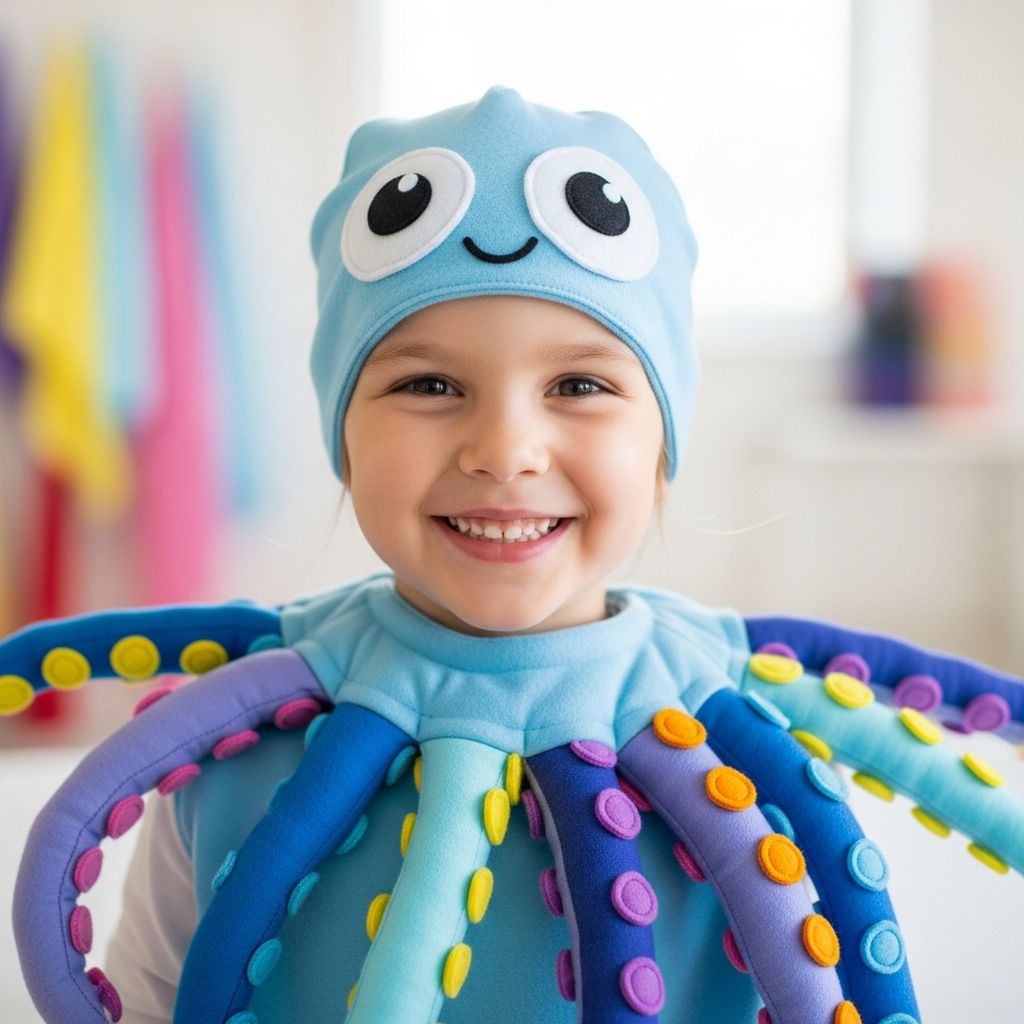
Transform a child into a friendly sea creature with a DIY octopus costume that is light, comfy, and surprisingly simple to put together. This guide walks you through planning, materials, step-by-step construction, and safety tips so you can enjoy the creative process as much as your child enjoys wearing it.
Why an Octopus Costume Works So Well for Kids
An octopus costume is a favorite for dress-up, school events, and Halloween because it is recognizable, colorful, and easy to adapt to different ages. With a few basic supplies, you can create eight playful “arms” that wiggle as your child walks, plus a big cartoon-style head that looks great in photos.
- Comfortable fit: Built on a loose shirt so kids can move and layer clothes underneath.
- Flexible design: Works for many colors, from bright purples to deep ocean blues.
- Budget-friendly: Relies on everyday items like pool noodles, T-shirts, and yarn.
- Quick to assemble: Most of the work can be finished in under an hour, not counting drying time for paint or glue.
Planning Your Under-the-Sea Look
Before you start cutting or gluing, think about how and where your child will wear the costume. Planning ahead helps you choose materials that are safe, weather-appropriate, and easy to manage in crowded spaces.
Key Questions to Decide First
- Will the costume be worn indoors, outdoors, or both?
- Does your child need to walk long distances, such as while trick-or-treating?
- Is the event during cold weather, requiring layers underneath?
- Do you prefer a no-sew project or are you comfortable with basic stitching?
For outdoor activities, it is important that kids do not overheat or have their movement restricted. Public health guidance for children’s Halloween activities emphasizes costumes that allow free movement and good visibility, along with layers for warmth if needed.
Supplies: What You’ll Need for a Basic Octopus Costume
The materials listed here assume you are creating a soft, lightweight costume that uses pool noodles or similar tubes as tentacles. Adjust colors or exact items based on what you already have at home.
| Item | Purpose | Notes |
|---|---|---|
| Oversized T-shirt (adult size) | Octopus body and head | Choose a color that matches your tentacles. |
| 3 foam pool noodles | Tentacles | Cut into 8–9 sections for legs. |
| Thick yarn or cord | Secure tentacles into a “belt” | Must be strong enough to hold weight. |
| Large googly eyes or fabric paint | Face details | Use non-toxic children’s craft products. |
| Elastic (waist length) | Gather bottom of shirt | Optional but makes a rounded “head”. |
| Dark leggings and shoes | Base layer for child | Helps the bright tentacles stand out. |
| Fabric glue or needle and thread | Attaching details | Choose depending on whether you sew. |
Always check product labels for age-appropriate, non-toxic, and washable materials, particularly for adhesives and paints used in children’s crafts.
Step-by-Step: Building the Octopus Body
The shirt forms the upper part of the costume and the “head” of the octopus. These steps describe both a sewing and a no-sew option for the gathered bottom.
1. Choose and Prepare the Shirt
- Select an oversized T-shirt so it hangs lower than your child’s hips.
- Have the child try it on to confirm the neckline is not too wide and sleeves are comfortable.
- Remove the shirt and lay it flat on a clean surface.
2. Create a Rounded Octopus Body
You can add a casing with elastic to gently pull in the bottom edge.
- Turn the shirt inside out.
- Fold the bottom hem up about 2–3 cm to form a channel.
- Sewing option: Stitch along the folded edge, leaving a small opening for elastic.
- No-sew option: Use fabric glue or fusible tape to secure the fold, still leaving a small gap.
- Thread elastic through the channel, adjust the fit so it gently gathers, then tie or sew the ends.
- Close the opening with a few stitches or more glue.
Elastic waistbands and casings like this are common in children’s clothing and can improve comfort when done without excessive tightness.
3. Add the Octopus Face
A playful face makes the costume instantly recognizable to kids and adults.
- Decide if the face will be on the chest or near the neckline.
- For painted eyes, lightly sketch circles with chalk, then fill with fabric paint. Let them dry fully according to the manufacturer’s safety instructions and drying times.
- For glued-on eyes, cut circles from felt or foam and attach with fabric glue.
- Add a simple smile or surprised mouth in a contrasting color.
Creating Soft, Wiggly Tentacles
The tentacles are the star of the costume. Pool noodles are ideal because they are lightweight and flexible, reducing the chance of injury if children bump into each other while playing.
4. Cut the Pool Noodles
- Use a sharp craft knife or serrated kitchen knife on a stable surface.
- Cut each noodle into three equal pieces for a total of nine sections.
- Set one extra piece aside in case you want to replace a damaged tentacle later.
Supervise adults-only cutting and keep sharp tools out of children’s reach, as recommended in standard home safety guidance.
5. String the Tentacles into a Belt
Attaching the tentacles to a belt or yarn “ring” instead of directly to the shirt makes the costume easier to put on and take off.
- Thread a long piece of thick yarn or cord onto a yarn needle.
- About 2–3 cm from one end of each noodle piece, push the needle straight through the foam.
- Continue threading all eight sections, spacing them evenly along the yarn.
- After all sections are threaded, slide them until they form a circle similar to a hula skirt.
- Tie the yarn ends together in a firm knot, creating a belt that fits easily over your child’s hips.
6. Optional: Add Suction Cups
If you want a more detailed look, you can create simple “suction cups” along the underside of each tentacle.
- Cut small circles from white felt or foam.
- Glue them in rows along the inside of each noodle piece.
- Alternatively, use fabric paint to dot circles that resemble suction cups.
Putting the Costume Together
Once the body and tentacles are ready, it is time for a full costume rehearsal.
7. Base Layer for Comfort
- Dress your child in a long-sleeve top and leggings or pants in a dark color.
- Choose breathable fabrics like cotton so children do not overheat during activity.
- If weather is cold, add a thin thermal layer underneath.
8. Add the Tentacle Belt
- Help your child step into the tentacle belt or fasten it around their waist.
- Adjust spacing so tentacles are evenly distributed around the body.
- Check the length: tentacles should not drag on the ground, to reduce tripping risk. Child injury data show that falls are a leading cause of non-fatal injuries, so costumes should not interfere with walking.
9. Top with the Octopus Shirt
- Pull the prepared octopus shirt over your child’s head.
- Arrange it so the gathered bottom sits neatly above the tentacle belt.
- Smooth the shirt so the face is visible and not folded.
Safety, Comfort, and Visibility
Any children’s costume should be checked for safety: no long, dragging pieces; no sharp parts; and nothing that restricts breathing or vision. Pediatric safety organizations consistently advise parents to avoid costumes that pose tripping hazards or block sightlines.
- Check vision: If you add a hood or hat, make sure it does not fall over your child’s eyes.
- Avoid heavy pieces: Foam tentacles should be light. If the belt feels too heavy, remove one or two sections.
- Flame awareness: Keep children away from open flames like candles or fire pits, and choose flame-resistant fabrics when possible.
- Secure loose parts: Tug lightly on glued features to ensure they will not easily fall off and become choking hazards for younger siblings.
Creative Variations: Customize Your Sea Creature
Once you have the basic structure, you can have fun turning your octopus into a unique character. Kids often enjoy adding personal touches, and involving them in decorating can support creativity and imaginative play.
- Rainbow octopus: Use different colored noodles for each tentacle.
- Glow-in-the-dark details: Add glow fabric paint or reflective tape to increase visibility outdoors at night.
- Storybook character: Match tentacle colors to a favorite book or movie octopus.
- Ocean group theme: Dress friends or siblings as jellyfish, fish, sea turtles, or coral to create a full reef scene.
Simple Cleanup and Storage
After the event, you may want to save the costume for future dress-up play.
- Wipe pool noodles with a damp cloth and mild soap if needed.
- Hand-wash or gently machine-wash the shirt according to the fabric care label and paint or glue instructions.
- Store the tentacle belt flat or coiled in a large box so it does not permanently bend.
- Keep smaller pieces (felt eyes, extra suction cups) in a labeled bag so they are easy to find next year.
Frequently Asked Questions (FAQs)
Q: How long does this octopus costume take to make?
Most families can complete the main costume in 30–60 minutes, not counting drying time for paint or glue. If you are adding many details like suction cups or extra decorations, plan for a bit more time.
Q: Can I make this costume without sewing?
Yes. You can form the gathered bottom of the shirt with fabric glue or fusible tape instead of stitches, and you can attach eyes and decorations with fabric-safe adhesive. Just allow full drying time before your child wears the costume.
Q: What if my child is very young?
For toddlers, keep the tentacles shorter so they do not trip, and avoid small detachable pieces that could be choking hazards. Check the costume frequently and supervise closely during wear, in line with general guidance for safe Halloween activities for younger children.
Q: How do I keep my child from overheating in the costume?
Use breathable base layers, avoid thick padding, and limit time in crowded, warm indoor spaces. Health experts recommend dressing children in layers that can be removed if they become too warm during active play or trick-or-treating.
Q: Can this costume be adapted for older kids?
Absolutely. For older children, you can add more detailed facial features, extra shading on the tentacles, or accessories like a matching hat. You can also lengthen the shirt or use a hoodie for a more dramatic head shape.
References
- Halloween Health and Safety Tips — U.S. Centers for Disease Control and Prevention (CDC). 2022-10-20. https://www.cdc.gov/family/halloween/index.htm
- Halloween Safety — American Academy of Pediatrics (AAP). 2022-10-01. https://www.healthychildren.org/English/safety-prevention/on-the-go/Pages/Halloween-Safety-Tips.aspx
- Art and Craft Safety Guide — U.S. Consumer Product Safety Commission (CPSC). 2016-05-01. https://www.cpsc.gov/s3fs-public/5015.pdf
- Clothing for Children — Textile School. 2020-08-25. https://www.textileschool.com/472/clothing-for-children/
- Playground Surfacing and Equipment Injury Prevention — U.S. Consumer Product Safety Commission (CPSC). 2015-11-01. https://www.cpsc.gov/s3fs-public/325.pdf
- Home Use of Knives and Safety Recommendations — Royal Society for the Prevention of Accidents (RoSPA). 2018-06-01. https://www.rospa.com/home-safety/advice/general/knives-in-the-home
- Heat-Related Illnesses in Children — HealthyChildren.org (AAP). 2021-06-01. https://www.healthychildren.org/English/health-issues/injuries-emergencies/Pages/Heat-Related-Illnesses.aspx
- Nonfatal Injury Data — U.S. Centers for Disease Control and Prevention (CDC) WISQARS. 2023-01-01. https://www.cdc.gov/injury/wisqars
- The Importance of Play in Promoting Healthy Child Development — American Academy of Pediatrics. Pediatrics Journal. 2018-09-01. https://doi.org/10.1542/peds.2018-2058