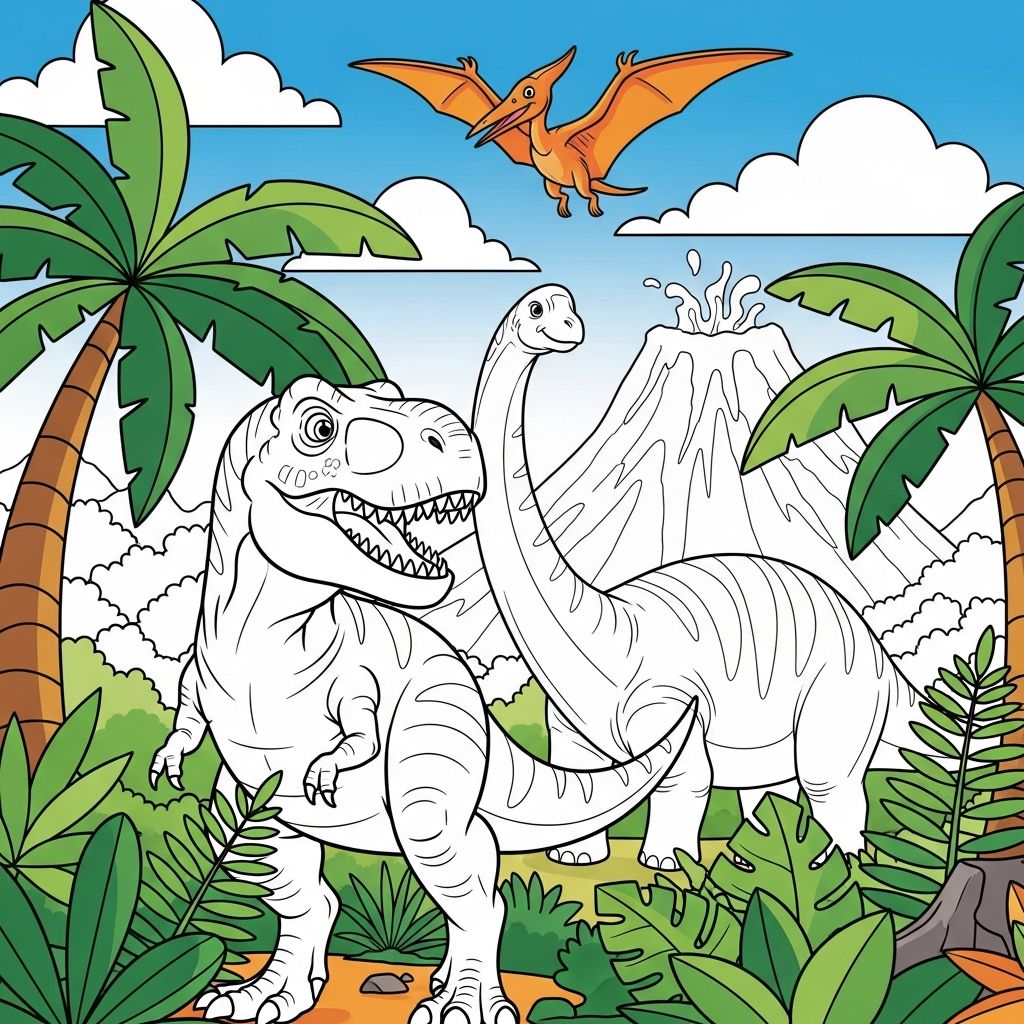
Dinosaur coloring pages are more than a rainy-day distraction. They tap into kids’ natural fascination with prehistoric creatures while quietly building early learning skills, confidence, and creativity. With just a printer, basic art supplies, and a bit of imagination, you can turn simple black-and-white dinosaur outlines into rich, hands-on experiences at home, in the classroom, or at parties.
This guide walks you through the benefits of dinosaur coloring pages, how to download and print them successfully, and dozens of ways to turn finished pages into crafts, decorations, and learning tools.
Why Kids Are Drawn to Dinosaurs
Many children go through a strong “dinosaur phase,” memorizing names, correcting adults, and asking endless questions. Researchers describe these intense interests as a normal, healthy part of development that can support deeper learning and persistence.1 Dinosaurs are especially appealing because they are:
- Mysterious: They lived long ago, so kids can imagine what the world looked like before humans.
- Diverse: Tiny, huge, armored, flying, plant-eating, meat-eating — there’s a dinosaur for every personality.
- Story-friendly: Dinosaurs easily become heroes, sidekicks, or villains in kids’ invented stories.
Coloring pages give kids a safe, creative way to explore this fascination and turn facts into art.
Learning Benefits of Dinosaur Coloring Pages
Coloring may look simple, but it combines fine motor work, visual skills, language, and emotional regulation. Studies of early childhood learning show that drawing and coloring help young children communicate ideas, practice planning, and develop early writing-related skills.2
Here are some of the key ways dinosaur coloring pages support development:
1. Fine Motor Skills and Hand-Eye Coordination
Gripping crayons or colored pencils and staying mostly inside the lines helps strengthen the small muscles needed for writing, cutting, and self-care tasks.
- Tracing outlines of dinosaur bodies, spikes, and tails refines control.
- Adding tiny details such as scales, spots, or patterns encourages precision.
- Switching colors builds hand strength and finger dexterity.
Occupational therapy resources often recommend coloring to support fine motor development and pre-writing strokes in early childhood.3
2. Focus, Patience, and Following Through
Completing a full dinosaur coloring page can take time, especially with detailed scenes or backgrounds. As children work toward finishing:
- They learn to stick with a task for longer periods.
- They experience the satisfaction of seeing a project through from start to finish.
- They practice self-control by slowing down to color carefully.
These early habits of concentration and persistence can transfer to reading, homework, and other structured learning.
3. Creativity and Imagination
Scientists cannot know every color or pattern real dinosaurs had, which gives kids permission to invent.
- Children might choose realistic greens and browns or rainbow stripes and starry spots.
- They can imagine where their dinosaur lives — a jungle, desert, or icy landscape — and color the surroundings to match.
- Older kids may design unique species, blending traits from several dinosaurs.
Research on arts education suggests that creative activities like drawing and coloring help children experiment with ideas and problem-solving in a low-pressure way.2
4. Language, Science, and Early Literacy
Dinosaur coloring pages naturally invite conversation and new vocabulary. As children color, adults can introduce terms like herbivore, carnivore, and prehistoric.
- Reading simple dinosaur fact boxes or labels on printable pages supports word recognition.
- Talking about features (horns, plates, beaks, claws) builds descriptive language.
- Connecting dinosaurs to real fossils and paleontologists introduces basic science.
Informal science experiences like these can help spark long-term interest in STEM topics.4
5. Relaxation and Emotional Regulation
Slow, repetitive coloring motions can be soothing for many children. Coloring gives kids a structured, predictable activity that can:
- Help calm big feelings after an exciting or stressful event.
- Provide a quiet transition between more active play and bedtime.
- Offer a mindful break from screens and noisy environments.
Some mental health professionals use coloring as one of several tools for supporting emotional regulation in children and adults.5
Downloading and Printing Dinosaur Coloring Pages
Many websites offer free dinosaur coloring sheets you can print at home or school. When you find a design you like, a little preparation helps ensure good results.
Steps for Easy Printing
- Download the file (often in PDF or image format) to your device.
- Open it in a PDF reader or image viewer and choose Print.
- Set paper size (commonly US Letter 8.5×11 inches or A4).
- Select Fit to page or Actual size depending on your printer margins.
- Print a test page to confirm alignment and clarity.
For frequent use, consider keeping a folder of printable dinosaur pages on your computer so you can quickly reprint favorite designs when kids want to try new color schemes.
Best Paper Choices
| Paper Type | Best For | Pros | Considerations |
|---|---|---|---|
| Standard copy paper (70–80 gsm) | Crumple-free everyday coloring | Inexpensive, easy to find | Markers may bleed through |
| Heavyweight printer paper (90–120 gsm) | Markers, gel pens, hanging artwork | Less bleed-through, sturdier for crafts | Slightly higher cost |
| Cardstock | Bookmarks, cards, posters | Very durable, ideal for cutting and gluing | May require manual feed on some printers |
Coloring Tools That Work Well
- Crayons: Great grip for little hands, wide color range, durable.
- Colored pencils: Good for details, shading, and older children.
- Washable markers: Bright colors and easy cleanup (check for bleed-through).
- Gel pens: Fun for metallic claws, shiny scales, or glowing eyes.
- Watercolors: Best on heavier paper; can create soft dinosaur landscapes.
Fun Ways to Use Dinosaur Coloring Pages
Once kids finish coloring, the pages don’t have to disappear into a stack. You can turn them into displays, games, or keepsakes that extend play and learning.
At Home
- Dinosaur gallery wall: Use masking tape or string with clothespins to create a rotating display in a hallway or playroom.
- DIY bookmarks: Cut dinosaur characters into strips, laminate (optional), and punch a hole for a ribbon tail.
- Homemade storybooks: Staple several colored pages together; invite your child to dictate or write a simple story for each dinosaur.
- Table placemats: Laminate pages to use as washable placemats for meals or snack time.
- Reward coupons: Let children choose a favorite dinosaur page as a “special time” coupon to color with a caregiver.
In the Classroom or Learning Group
- Science corner posters: Hang different dinosaurs near a globe or timeline to show when and where they lived.
- Vocabulary boards: Add labels like Triceratops, tail, claws, and volcano around colored scenes.
- Sorting and graphing: Have children sort finished pages into “meat eaters” and “plant eaters,” then count and graph the results.
- Partner projects: Pair students to color a shared page, encouraging turn-taking and cooperation.
- Center activities: Keep a bin of printed dinosaur pages, clipboards, and crayons for early finishers.
Dinosaur-Themed Parties
Dinosaur coloring sheets can simplify planning for birthdays and playdates.
- Coloring station: Set out crayons and a stack of different designs as a calm activity between games.
- Decorations: Hang guests’ completed pages like banners around the party space.
- Party favors: Roll several blank pages with a small crayon pack and tie with ribbon for each child to take home.
- Icebreaker game: Ask each child to color “their” dinosaur and introduce it to the group with a name and favorite food.
Simple Craft Ideas Using Dinosaur Coloring Pages
With scissors, glue, and a bit of imagination, dinosaur coloring sheets can be transformed into 3D crafts and pretend-play props.
Dinosaur Diorama
Create a miniature dinosaur world inside an old shoe box.
- Color and cut out several dinosaurs and plants.
- Line the inside of the box with colored paper for sky and ground.
- Glue dinosaurs to folded paper tabs so they stand up.
- Add pebbles, leaves, or cotton-ball “clouds” for texture.
Dino Masks and Wearables
- Masks: Print larger dinosaur head images, color, cut out eye holes, and attach string or elastic.
- Tail belts: Cut a long, colored tail, tape or staple it to a strip of cardstock, and fasten it around the waist.
- Claws: Roll colored triangles into cones and tape them over fingers for dinosaur “claws.”
Cards, Posters, and Scrapbook Pages
- Greeting cards: Fold cardstock in half and glue a cut-out dinosaur on the front with a handwritten message.
- Growth chart: Tape a row of dinosaur pages beside a door and mark your child’s height over time.
- Memory scrapbooks: Save a few favorite pages each year to see how coloring skills and interests grow.
Choosing Dinosaur Pages by Age and Skill Level
Matching the level of detail to a child’s stage keeps coloring enjoyable instead of frustrating.
Toddlers and Young Preschoolers
- Look for large, simple dinosaur shapes with thick outlines.
- Offer chunky crayons or washable markers that are easy to grip.
- Focus on free exploration rather than staying in the lines.
Older Preschoolers and Early Elementary
- Choose pages with a bit more detail, like plates, horns, or simple backgrounds.
- Encourage children to use at least two or three colors per dinosaur.
- Invite them to tell a short story about the scene as they color.
Tweens, Teens, and Adults
- Pick intricate designs with patterns, realistic shading areas, or complex scenes.
- Experiment with colored pencils, blending, and fine-tip pens.
- Use coloring as a relaxing, screen-free break or companion to podcasts and audiobooks.
Printable vs. Digital Dinosaur Coloring
Some coloring pages are meant to be printed; others can be colored on a tablet or computer. Each option has benefits.
Advantages of Printable Pages
- Support hand strength, grip, and real-world coordination.
- Provide a break from screens and digital notifications.
- Can be displayed, gifted, or used in crafts and games.
- Easy to share in classrooms, libraries, and group settings.
Advantages of Digital Coloring
- No need for physical storage or printing supplies.
- Undo buttons reduce frustration for perfection-seeking kids.
- Useful for travel or times when paper and crayons are not practical.
Families can combine both options: printable pages for hands-on fine motor work and occasional digital coloring for convenience. Health and education organizations generally recommend limiting recreational screen use for young children, so printable pages play an important role in keeping creative time balanced.6
Frequently Asked Questions (FAQs)
Q1: What age are dinosaur coloring pages best for?
Dinosaur coloring pages can be adapted for almost any age. Toddlers enjoy big, simple outlines, preschoolers and early elementary children like friendly cartoon dinosaurs, and older kids or adults may prefer realistic or highly detailed designs.
Q2: How can I make coloring more educational?
Say dinosaur names aloud, point out special features, and talk about what each dinosaur might eat or where it may have lived. You can also pair coloring with a children’s book or a short educational video about fossils and prehistoric life from a trusted science source.
Q3: What if my child doesn’t want to stay in the lines?
For young children, coloring is mainly about exploration. Instead of insisting on neatness, you can model careful coloring on your own page and gradually encourage more control as your child gets older and shows interest.
Q4: How do I store or organize all the finished pages?
You can use a three-ring binder with plastic sleeves, a large art portfolio folder, or take photos of artworks before recycling some pages. Keeping a small, curated collection highlights progress without overwhelming your space.
Q5: Are printable dinosaur pages okay for kids who struggle with screen time limits?
Yes. Printable pages are a non-screen alternative that still feels engaging and fun. They can be a helpful part of a daily routine that balances active play, rest, and limited, high-quality digital media.
References
- DeLoache, J. S., & Chiong, C. (Eds.). Early Childhood Digital and Media Literacy. — The Joan Ganz Cooney Center at Sesame Workshop. 2009-01-01. https://www.joanganzcooneycenter.org/wp-content/uploads/2010/03/ec_digital_media_literacy.pdf
- Hopperstad, M. H. “Young Children’s Drawing: The Significance of the Context.” — International Journal of Early Childhood (Springer). 2010-10-15. https://doi.org/10.1007/s13158-010-0018-4
- American Occupational Therapy Association. “Fine Motor Skills: What You Need to Know.” — AOTA. 2020-06-01. https://www.aota.org/practice/children-youth/resources/fine-motor-skills
- National Research Council. Taking Science to School: Learning and Teaching Science in Grades K-8. — National Academies Press. 2007-01-01. https://doi.org/10.17226/11625
- Curry, N. A., & Kasser, T. “Can Coloring Mandalas Reduce Anxiety?” — Art Therapy (Routledge). 2005-01-01. https://doi.org/10.1080/07421656.2005.10129441
- World Health Organization. “Guidelines on physical activity, sedentary behaviour and sleep for children under 5 years of age.” — WHO. 2019-04-24. https://www.who.int/publications/i/item/9789241550536