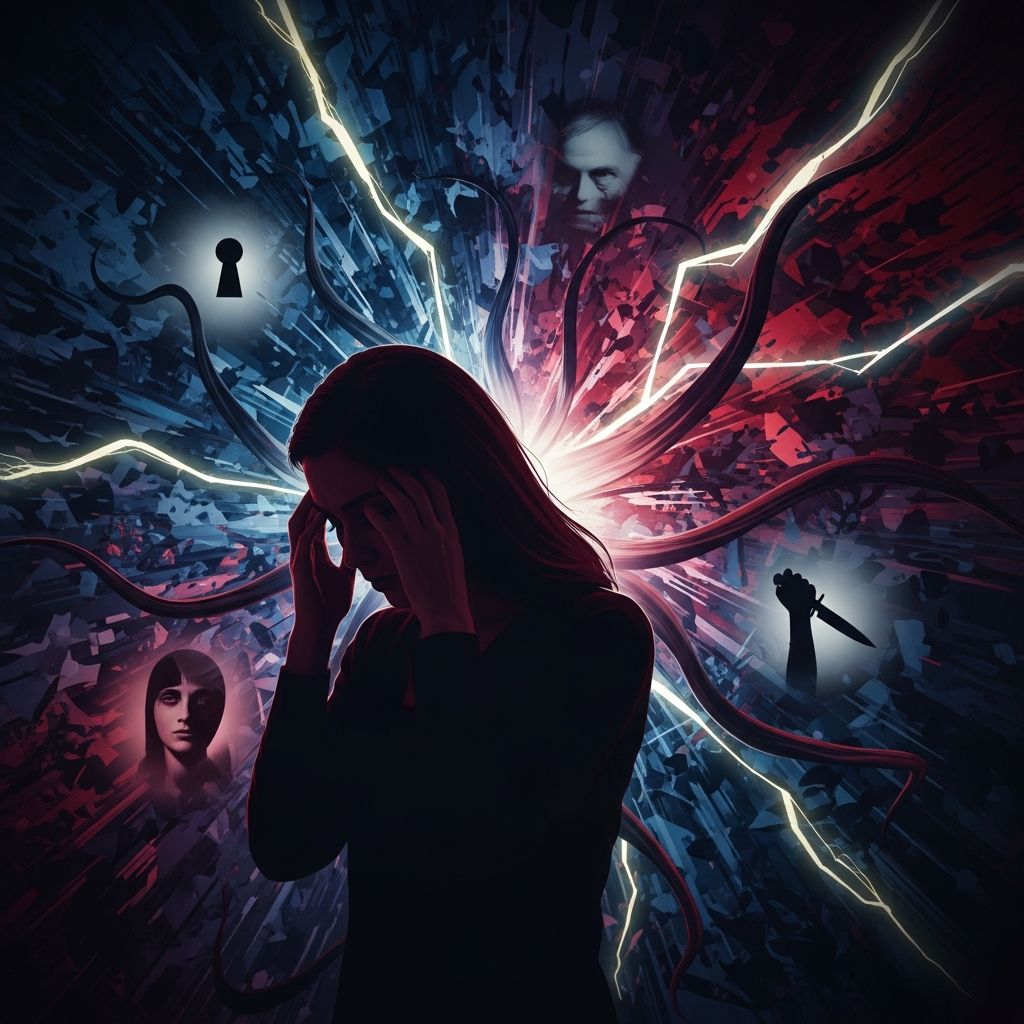
“Deadly Illusions” arrived on Netflix promising a slick, sexy thriller about a bestselling author, a too-perfect nanny, and the dangerous overlap between imagination and reality. Instead, it delivered a chaotic cocktail of soap opera melodrama, psychological horror, and mystery that left many viewers arguing about what they had just watched. This messiness is exactly what makes the film worth dissecting: not because it is a flawless thriller, but because it reveals how modern streaming movies try to mash together familiar tropes into something that feels new.
The Premise: A Writer, A Nanny, And A Dangerous Imagination
At the center of “Deadly Illusions” is Mary, a wildly successful novelist whose life appears stable and controlled. She has a comfortable home, a devoted husband, and two young children. The illusion of stability cracks when financial pressure pushes her back into writing another high-stakes thriller, forcing her to revisit the darker parts of her imagination that she claims change who she is when she writes.
To protect her work time and preserve her picture-perfect family life, Mary hires Grace, a soft-spoken, almost unrealistically wholesome nanny who seems plucked straight out of an old-fashioned storybook. Grace cooks, cleans, takes the kids to the park, and glides around the house with an almost eerie politeness. The tension of the film builds from the gap between how innocent Grace appears and how dangerous Mary’s mind insists she might be.
- Mary’s identity as an author is more than a job; it is a psychological trigger she cannot fully control.
- Grace’s hyper-innocent persona is deliberately exaggerated, inviting suspicion from the moment she appears.
- The household becomes a stage where fantasy scenes and supposedly real events constantly overlap.
Thriller DNA: Familiar Tropes In A New Package
“Deadly Illusions” borrows heavily from the DNA of 90s erotic thrillers and domestic suspense dramas. The film features a seemingly perfect family, an alluring outsider who disrupts the order, and a protagonist whose perception is slowly eroded by obsession and paranoia. On paper, this setup should be a sure win for viewers who enjoy cat-and-mouse mind games and simmering sexual tension.
Instead of committing to a single tone, the movie swings between pulpy fantasy, prestige-tinged psychological drama, and soap-style melodrama. It offers steamy moments between Mary and Grace that may or may not be fantasies, ominous hints of violence, and a murder mystery that erupts almost out of nowhere. These ingredients are recognizable, but the way they are shuffled together gives the film an almost dreamlike instability.
| Element | How It Appears In The Film | Intended Effect On Viewers |
|---|---|---|
| Unreliable perception | Scenes that may be Mary’s fantasies present as if they are real, with no immediate clarification. | Keep viewers off-balance and questioning every interaction. |
| Sexual tension | Intimate moments between Mary and Grace blur professional boundaries and personal desires. | Charge the domestic setting with danger and taboo. |
| Intrusive outsider | Grace moves from helpful nanny to potential threat at the center of the family’s collapse. | Turn ordinary childcare into something ominous and unstable. |
| Psychological breakdown | Mary’s stress, creative pressure, and guilt manifest in hallucination-like sequences. | Question whether the true danger is external or inside Mary’s own mind. |
| Violent eruption | A grisly murder and a knife attack shatter the film’s slow-burn pacing. | Shock viewers into reassessing earlier “quiet” scenes under a more sinister light. |
Fantasy Versus Reality: The Film’s Central Confusion
One of the boldest—and most frustrating—choices in “Deadly Illusions” is its refusal to clearly separate fantasy from reality. Certain encounters between Mary, Grace, and Mary’s husband unfold like vivid dreams, only for the film to later suggest they may have never happened. The camera offers no visual tell, no filter, no shift in style to signal when the audience has left the realm of facts and stepped into Mary’s mind.
This ambiguity is thematically appropriate: the film is about a writer drowning in her own imagination. Yet in practice, the lack of clear boundaries can feel less like purposeful complexity and more like narrative chaos. Viewers who enjoy piecing together clues may relish the challenge, while others may feel cheated by the absence of stable ground.
- The boundary between Mary’s manuscript and the events on-screen is intentionally porous.
- Scenes of seduction and betrayal may function as dramatizations of Mary’s fears, not literal events.
- The finale hints that even the apparent resolution might be another layer of illusion.
Trauma, Identity, And The Nanny Figure
Beneath the glossy surface, “Deadly Illusions” touches on heavy themes: childhood trauma, dissociative identity, and the long-term effects of abuse. Grace is not just a random intruder; she carries a fractured past that surfaces in unpredictable ways. The film uses her as a vessel to explore how unresolved trauma can splinter a person into conflicting selves—one calm and compliant, another volatile and predatory.
The nanny role itself becomes loaded with symbolism. She is at once caregiver, surrogate mother, fantasy object, and possible killer. By exaggerating Grace’s innocence and then pairing it with eruptive violence, the story suggests that domestic roles can hide extreme psychological damage. Unfortunately, these ideas are only partially developed, leaving important questions about mental illness and responsibility largely unresolved.
- The film attempts to connect Grace’s behavior to a history of abuse without offering careful context.
- Her personality shifts are treated as both a horror device and a mystery-solving clue.
- The narrative flirts with compassion for Grace but frequently falls back on sensationalism.
Mary As Author And Character: When Creation Bites Back
Mary is more than a distressed protagonist; she is also a creator whose work has seeped into her daily life. She warns that she becomes someone else when she writes, suggesting that her author persona is ruthless, obsessive, and perhaps morally flexible. The movie plays with the idea that the same instincts that make her books compelling might also make her dangerous in real life.
The film’s world sometimes feels like Mary’s story universe has leaked outward. Clues from her fictional manuscripts mirror the real investigation; a weapon from her book appears in a horrific crime; and the final scenes imply that the line between the woman writing and the woman acting may have vanished completely. Whether this is meant as metaphor, twist, or misdirection is left deliberately ambiguous, forcing viewers to debate whether Mary is a victim of her own imagination or its hidden villain.
Style Over Logic: Why The Movie Is So Divisive
“Deadly Illusions” is divisive largely because it prioritizes mood, surprise, and heightened emotion over airtight logic. The pacing jumps from slow, domestic scenes to sudden bursts of violence. Character decisions often serve the next twist more than coherent psychology. Rather than building a clean, solvable mystery, the film leans into unresolved questions and surreal imagery, especially in its closing minutes.
For some audiences, this approach is maddening: they expect clues that add up and motivations that track logically from start to finish. For others, the film functions as a campy, unpredictable ride—something to watch with friends and dissect afterward, laughing at its extremes while still being drawn in by its audacity. In the age of streaming, where attention is a scarce resource, this kind of exaggerated, meme-ready storytelling can be a feature, not a bug.
- Those seeking tight plotting and subtle character work may end up frustrated.
- Viewers who enjoy outrageous twists and psychological spectacle may find it addictively watchable.
- The movie’s flaws fuel online discussion, turning confusion into a kind of communal entertainment.
Audience Takeaways: What Sticks After The Credits
Long after the closing shot, what lingers from “Deadly Illusions” is not a neatly resolved story but a series of provocative images: a nanny who may not be who she appears, a writer who may not trust her own mind, and a murder scene that seems ripped straight from a fictional outline. The film’s power rests less in answers than in the way it invites viewers to argue over what actually happened.
In that sense, the movie mirrors the experience of reading or writing an unreliable thriller novel. Every scene becomes a potential red herring; every character can be reinterpreted on a second viewing. Whether this ambiguity feels like depth or simply like narrative sloppiness depends heavily on each viewer’s expectations, tolerance for loose ends, and appetite for camp.
Who Is “Deadly Illusions” For?
Despite its uneven execution, “Deadly Illusions” occupies a specific niche: it is designed for viewers who enjoy domestic thrillers, psychological puzzles, and a dash of melodramatic excess. It is not interested in being clinically accurate about mental health nor rigorously grounded in procedural realism. Instead, it leans into impressionistic storytelling and heightened emotion.
If you approach it as a polished but imperfect paperback thriller brought to life—complete with improbable coincidences, exaggerated personalities, and shock-value scenes—the film can be entertaining. Viewers expecting a meticulously constructed psychological drama, however, may find themselves rolling their eyes as often as they lean forward.
- Fans of campy thrillers may enjoy its “so wild you have to talk about it” quality.
- Casual viewers looking for background entertainment might appreciate its glossy style and dramatic spikes.
- Those sensitive to shallow portrayals of trauma or mental illness should approach with caution.
Practical Viewing Tips
To get the most out of “Deadly Illusions,” it helps to adjust expectations before pressing play. This is not a puzzle-box film that rewards forensic analysis of every shot; it is more akin to a fever dream that borrows thriller logic when convenient and discards it when it gets in the way of a juicy twist. Watching with that mindset can transform frustration into a kind of playful engagement.
Consider treating the story like a case study in how streaming thrillers are constructed: which scenes seem designed primarily for shock, which choices are clearly engineered for social media chatter, and where the script hints at deeper themes it never fully explores. In doing so, the movie becomes not only a piece of entertainment but also a lens into how modern genre films court attention in an overcrowded content landscape.
- Watch with friends and compare theories about what was real versus imagined.
- Pay attention to how the film uses Mary’s profession as a writer to justify narrative leaps.
- Notice how quickly the tone shifts from domestic calm to erotic fantasy to violent horror.
Frequently Asked Questions About “Deadly Illusions”
Is “Deadly Illusions” based on a true story?
No. “Deadly Illusions” is a work of fiction that uses familiar thriller and psychological drama conventions. While it touches on themes like trauma and dissociative identity, its events and characters are not drawn from a specific real-life case.
Why is the ending of “Deadly Illusions” so confusing?
The ending is deliberately ambiguous, blurring the line between Mary’s perspective and objective reality. By echoing images from earlier in the film without clear explanation, the final scenes encourage multiple interpretations rather than providing a definitive answer about who is responsible for the violence.
Is the movie an accurate portrayal of mental illness?
“Deadly Illusions” uses mental illness primarily as a narrative and suspense device rather than as a subject for careful, realistic exploration. Viewers should not approach it as an educational depiction of trauma or dissociative identity; its portrayals are stylized, simplified, and often exaggerated for dramatic effect.
Who will enjoy watching “Deadly Illusions” the most?
Viewers who appreciate over-the-top thrillers, moral ambiguity, and twist-heavy stories are the most likely to enjoy it. Those who prefer grounded, psychologically consistent narratives or sensitive treatments of mental health may find its approach unsatisfying or problematic.
Is “Deadly Illusions” worth watching if I usually dislike ambiguous endings?
If ambiguous endings tend to frustrate you, “Deadly Illusions” may feel incomplete, because many of its biggest questions remain unanswered. However, it can still be an interesting watch as a case of style-driven storytelling, especially if you approach it more for its mood and performances than for a neatly resolved plot.