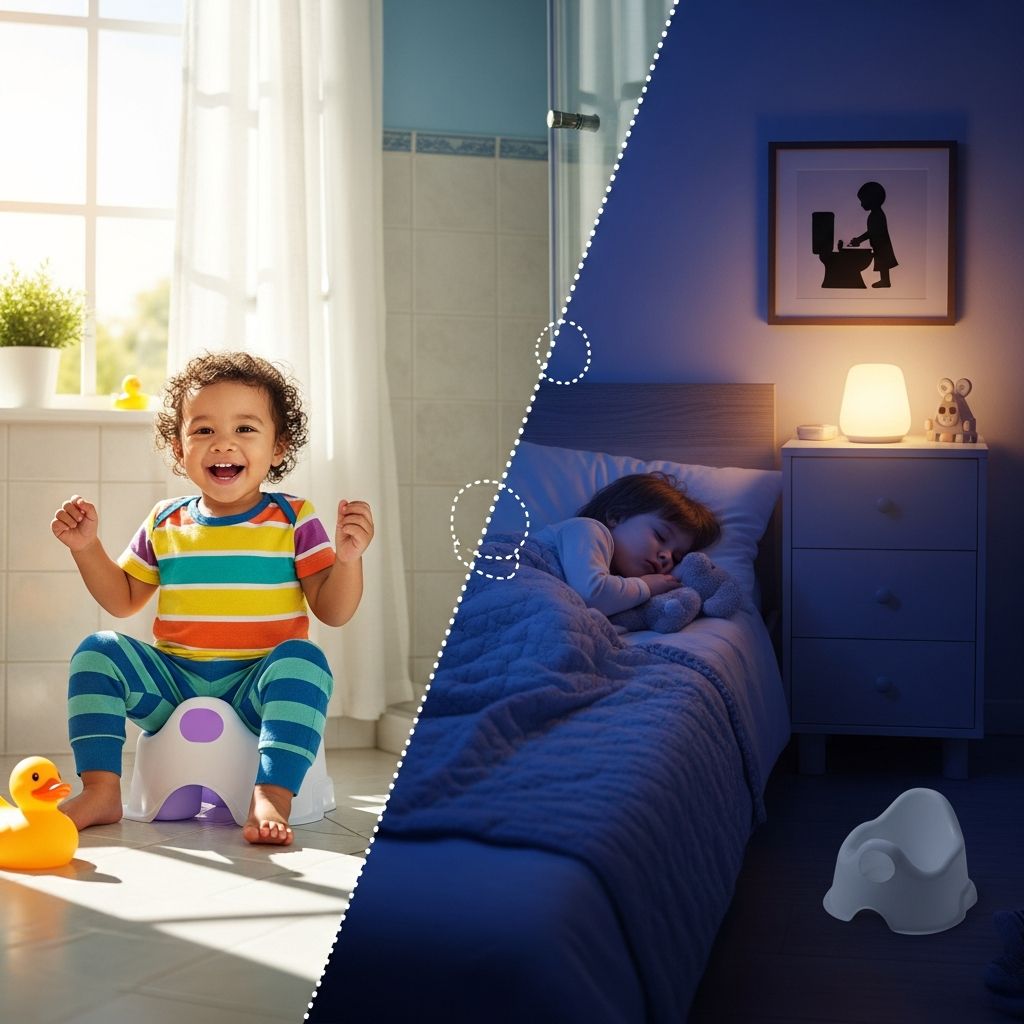
Many parents expect potty training to be a single milestone, but staying dry in the daytime and staying dry all night actually depend on very different skills and stages of development. Understanding this difference can dramatically reduce frustration and help you support your child with more realistic expectations.
Daytime Control vs. Nighttime Dryness: The Core Difference
During the day, potty training is largely about teaching and practice: children learn to notice body signals, communicate their needs, and reach the toilet in time. At night, however, dryness depends much more on physical development, especially the brain’s ability to respond to a full bladder while the child is asleep.
Because of this, it is very common for a child to be fully trained in the daytime and still have wet nights for months or even years. The gap between these two milestones is normal and does not mean that anyone has done something wrong.
| Aspect | Daytime Potty Training | Nighttime Dryness |
|---|---|---|
| Main focus | Learning habits and routines while awake | Body’s ability to stay dry during sleep |
| Child’s state | Alert, able to respond to signals | Asleep, not consciously controlling bladder |
| Parent role | Teaching, reminding, supervising | Protecting sleep, setting up the environment, observing patterns |
| Timeline | Often earlier and more predictable | Often later and more variable |
| What success depends on | Practice, routine, communication | Physical maturity, sleep patterns, bladder capacity |
Understanding Daytime Potty Readiness
Daytime potty training works best when a child has reached a basic level of physical and emotional readiness. Rather than fixating on age, it helps to watch for signs that your child can notice and respond to what their body is doing.
These signs do not all need to appear at once, but the more of them you see, the smoother daytime training is likely to be.
Common Signs Your Child May Be Ready During the Day
- Stays dry for stretches of around two hours or more, showing that the bladder can hold a reasonable amount.
- Seems aware of wet or soiled diapers and may ask to be changed or show discomfort.
- Can follow simple instructions such as “Let’s go to the bathroom” or “Pull down your pants.”
- Shows interest in the toilet, potty chair, or in what older children or adults are doing.
- Can walk steadily to the bathroom and sit safely on a potty or toilet seat.
When these pieces are in place, you can begin to introduce a gentle, consistent daytime routine, with the understanding that skills will still develop gradually.
Building a Calm and Consistent Daytime Routine
A predictable routine helps children feel safe and confident during potty training. The goal is to turn bathroom trips into a normal part of the day rather than a high-pressure test they can fail.
Short, frequent opportunities to use the potty work better than waiting until a child is obviously desperate, upset, or already having an accident.
Daytime Potty Training Strategies
- Start with practice times: Offer the potty at natural transition points such as after waking up, after meals, before going outside, and before naps.
- Dress for success: Use easy-to-pull-down clothing like elastic-waist pants instead of complex buttons or overalls.
- Use simple language: Choose a few consistent words or phrases for pee, poop, and the toilet, and stick with them.
- Stay neutral about accidents: Calmly help your child change, and treat accidents as information rather than misbehavior.
- Celebrate effort, not perfection: Praise your child for sitting on the potty, trying, and telling you when they need to go, even if the timing is off.
As your child becomes more reliable during the day, you may notice a natural reduction in wet diapers at night, but this shift often takes time.
Why Nighttime Dryness Often Comes Later
Nighttime dryness is less about training in the classic sense and more about how your child’s body develops over time. During sleep, the brain needs to recognize that the bladder is full and either slow down urine production, hold it longer, or wake the child enough to get to the toilet.
Some children are able to do this soon after they master daytime skills, while others continue to wet the bed for years despite being completely reliable when awake. Deep sleep, smaller bladder capacity, and family history can all contribute to a longer journey.
Signs Your Child May Be Approaching Nighttime Readiness
- Diapers or pull-ups are consistently dry or only slightly damp after sleep, especially on several mornings in a row.
- Your child sometimes wakes up and asks to use the toilet in the middle of the night.
- Daytime accidents are rare, and your child willingly uses the toilet without resistance.
- Your child expresses interest in sleeping without a diaper or pull-up and seems motivated to try.
These clues suggest that your child’s body is starting to manage bladder control during sleep, but small setbacks and occasional wet nights are still very normal.
Setting Up for Nighttime Success Without Sacrificing Sleep
When you decide to experiment with nights out of diapers, the aim is to protect sleep for the whole family while giving your child a chance to practice staying dry. The emphasis should stay on comfort, reassurance, and practical preparation.
Rather than waking your child constantly or turning the night into a series of tests, focus on smart setups and gentle routines that make accidents easier to handle.
Practical Nighttime Setup Tips
- Protect the bed: Use a waterproof mattress cover and, if possible, layer sheets and protectors so you can quickly pull off the top set after an accident.
- Keep supplies handy: Store clean pajamas, underwear, and extra sheets near the bed so changes are quick and low-stress.
- Make the bathroom accessible: Use a small nightlight in the hall and bathroom, and consider a potty chair in the bedroom if the toilet is far away.
- Bathroom before sleep: Build a relaxed pre-bed bathroom trip into the bedtime routine, without pressure for a specific result.
- Respond calmly to accidents: Speak softly, help your child clean up, and avoid scolding or long lectures in the middle of the night.
This approach lets your child experiment with nighttime dryness in a way that respects both their body’s pace and everyone’s need for rest.
Balancing Fluids, Sleep, and Toilet Trips
Parents often wonder how much to limit evening fluids or whether to wake their child for bathroom trips. There is no single rule that fits all families, but a few guiding principles can help you find a balance that feels humane and sustainable.
The key is to support healthy hydration and good sleep while giving your child a fair chance of reaching the toilet with a reasonably full, but not overloaded, bladder.
Healthy Evening Habits
- Spread fluids throughout the day: Encourage regular drinks earlier so your child is not guzzling large quantities right before bed.
- Offer sips, not big cups, in the hour before sleep: This is usually enough to satisfy thirst without flooding the bladder.
- Avoid using drinks as a delay tactic: If your child often asks for water to stall bedtime, set clear limits while still respecting genuine thirst.
- Consider whether to do a scheduled wake-up: Some families try a single, gentle toilet trip before the adults go to bed, but frequent wake-ups can fragment sleep and are not necessary for every child.
If your child seems exhausted or overly cranky, prioritize restoring solid sleep first and return to nighttime training attempts when everyone is more rested.
Emotional Support: Protecting Your Child’s Confidence
Accidents can be embarrassing for children, especially once they are old enough to notice that peers may not have the same struggles. How adults respond has a major influence on whether the child sees nighttime wetness as a shameful failure or simply as a phase of growing up.
The goal is to separate your child’s worth from their bladder and to show that love and acceptance are not conditional on dry sheets.
Encouraging a Positive Mindset
- Use matter-of-fact language and avoid labels such as “baby” or “big kid” tied to whether the bed is dry.
- Let your child help with small cleanup tasks only if it feels empowering, not punishing (for example, placing wet pajamas in the laundry basket).
- Normalize the experience by emphasizing that many children take extra time to stay dry at night and that bodies all grow at different speeds.
- Focus praise on progress you can see, like telling you when they feel the urge, waking to use the toilet, or calmly cooperating with changes.
When children feel safe and supported, they are more likely to stay engaged and cooperative throughout the longer journey of nighttime dryness.
Common Challenges and Practical Responses
Most families will hit at least a few bumps during potty training. Understanding common scenarios can help you choose responses that are calm, consistent, and grounded in how development usually works.
Below are some typical situations and gentle ways to handle them.
Typical Potty Training Hurdles
- Dry days, frequent wet nights: Accept that nighttime is following its own timeline; consider using overnight training pants for a while longer while still praising daytime skills.
- New accidents after a stressful event: Major changes like a new sibling, a move, or starting school can temporarily disrupt both daytime and nighttime control; respond with extra reassurance rather than new rules.
- Child resists the potty: Back off slightly, keep a predictable but low-pressure routine, and let your child have a say in small choices such as which potty seat or underwear to use.
- Parent frustration builds: When tempers are running high, it is usually a sign that expectations need adjusting; taking a short break or returning to pull-ups at night can protect both your relationship and your child’s self-esteem.
There is no single perfect path, and it is common to shift plans several times as your child grows and your family circumstances change.
When to Consider Talking to a Professional
Most bedwetting and uneven progress between daytime and nighttime control fall within the wide range of normal development. Still, there are times when checking in with a health professional can provide reassurance or uncover a medical issue that deserves attention.
Reaching out is not a failure; it is simply another way of supporting your child’s overall well-being.
Situations That May Warrant Extra Support
- Daytime accidents begin to increase suddenly after a long period of dryness, especially if combined with pain, urgency, or changes in mood.
- Nighttime wetting continues well into the school years and is causing significant distress for the child or affecting social activities like sleepovers.
- Your child has other symptoms such as unusual thirst, weight changes, or constipation that might be related to bladder or bowel function.
- You feel overwhelmed, guilty, or unsure how to proceed despite trying several reasonable strategies.
A pediatrician or other qualified professional can help rule out medical causes, suggest additional strategies, and reassure both you and your child that support is available.
Frequently Asked Questions About Daytime and Nighttime Potty Training
How far apart can daytime and nighttime training be?
There can easily be a gap of months or years between solid daytime potty skills and reliable nighttime dryness. This gap does not mean that your approach is wrong; it reflects the fact that nighttime control depends heavily on sleep patterns and physical growth rather than on direct teaching.
Should I train nights and days at the same time?
Some families experiment with both at once, while others focus on daytime first and wait for clear signs of nighttime readiness. It is perfectly acceptable to keep using diapers or pull-ups at night after daytime training is complete, especially if it protects your child’s sleep and your own sanity.
Is it okay to go back to diapers or pull-ups at night?
Yes. Returning to night protection after a trial period is not a step backward but an adjustment based on what your child’s body is currently ready for. You can still encourage pre-bed toilet trips and celebrate any dry nights that happen along the way.
Do nighttime accidents mean my child is being lazy?
No. During sleep, children are not making conscious choices about whether to get up and use the toilet. Wet nights are usually a sign that the body is not yet ready to stay dry for that long rather than a lack of motivation or effort.
Will rewards or punishments speed up nighttime dryness?
External rewards may help some children remember daytime routines, but they cannot force a sleeping body to develop faster. Punishments or shaming comments are more likely to increase anxiety and secrecy than to improve bladder control.
How can I protect my child’s confidence if bedwetting continues?
Keep conversations private and respectful, involve your child in solutions such as choosing bedding or pajamas, and emphasize that bodies grow and change at different rates. Make it clear that love and acceptance are not linked to whether the bed is dry.
Bringing It All Together
Successful potty training is less about rigid timelines and more about reading your child’s cues, respecting their developmental pace, and creating routines that feel safe and predictable. Daytime and nighttime dryness are related milestones, but they do not have to happen simultaneously to count as progress.
With patience, clear communication, and realistic expectations, most children eventually master both skills in their own time. Your calm, steady presence is one of the most powerful tools you have on this journey.