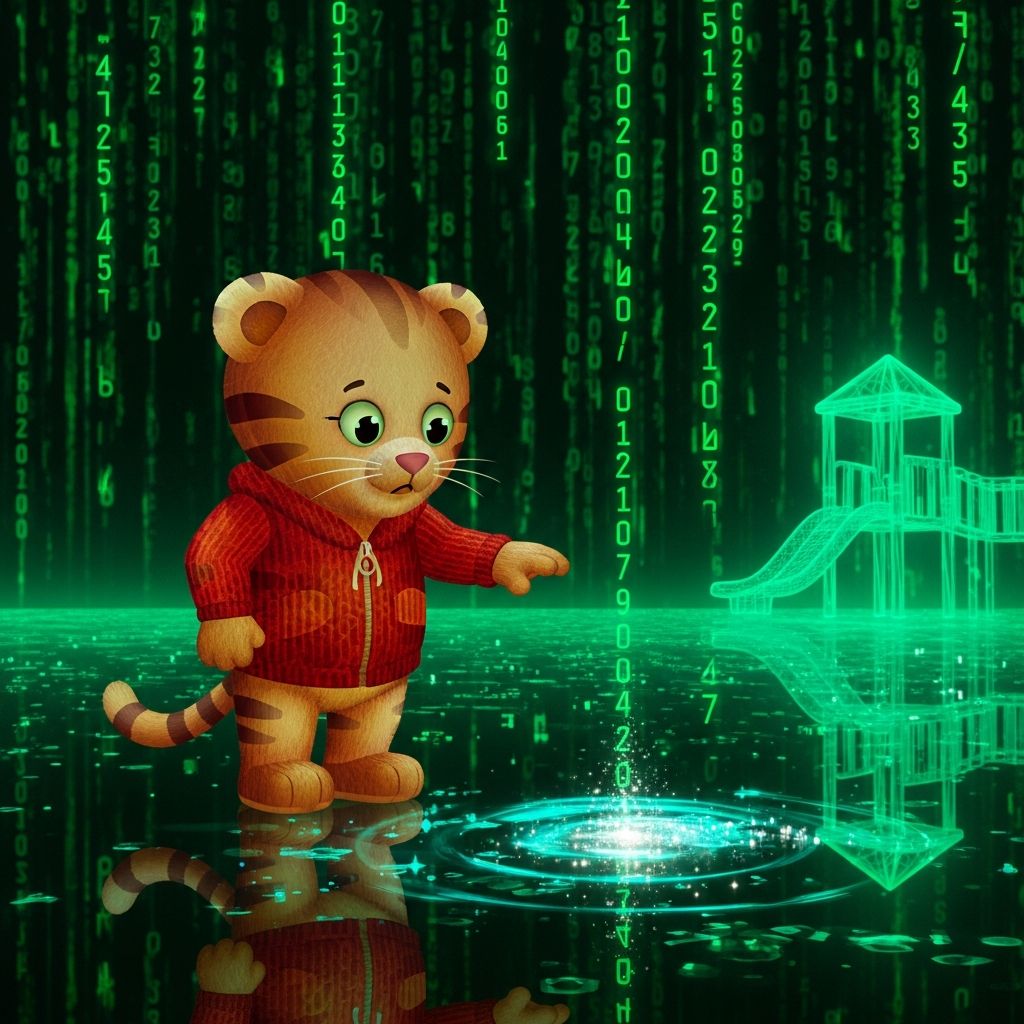
Parents sit on the couch, half-distracted, half-exhausted, while a tiny tiger in a red hoodie explains how to handle big feelings for the 400th time. At some point, it stops feeling like a children’s show and starts looking suspiciously like a carefully coded simulation where every meltdown, song, and neighborly visit has already been scripted.
This article playfully explores the idea that Daniel Tiger’s Neighborhood operates like a preschool version of the Matrix: a soft, brightly colored world where the rules are consistent, the glitches are musical, and the same life lessons echo over and over until they finally overwrite your kid’s emotional operating system — and maybe yours too.
The Neighborhood as a Closed Little Universe
On the surface, Daniel’s world looks simple: one trolley, a few familiar homes, a castle, a clock tower, and a small collection of endlessly patient adults. Zoom out, though, and the neighborhood starts to resemble a closed simulation with just enough characters and locations to keep the story running — but never enough to overwhelm a three-year-old.
Episodes rarely leave this tight loop of spaces, which creates a sense of comfort and predictability for kids, and a slight eerie sameness for adults who are watching their fifteenth re-run in a row. The neighborhood’s design is less like a sprawling town and more like a carefully controlled sandbox environment.
- Characters move between a tiny set of locations that cover all major preschool scenarios: home, school, playground, doctor, and grocery store.
- Every environment feels like a stable level in a video game, always waiting for the next emotion-based quest.
- The trolley functions like a scene-loading screen, ferrying Daniel between distinct zones of the simulation.
Repetition as Emotional Programming
One of the defining features of the show is repetition. The same short musical strategies appear across episodes: little jingles for waiting, sharing, potty-training, and calming down. They loop so frequently that they start to operate like tiny software patches for your child’s developing brain.
From a kid’s perspective, this is genius. Each episode installs or re-installs a piece of behavioral code until it sticks. From a tired parent’s perspective, it can feel like the simulation is updating the firmware of everyone in the room — including the adult whose inner monologue is now sung in Daniel Tiger’s voice.
How the Songs Function Like Code
- Consistency: The same jingle appears in different contexts, teaching kids that one strategy can apply in many situations.
- Compact length: Each song is short enough to remember, almost like a verbal hotkey for emotional regulation.
- Instant recall: Parents can invoke the “code” in the wild by humming it during a tantrum, effectively triggering the built-in script from the show.
Over time, kids learn to self-activate these mini-programs. They are not simply singing along; they are loading coping mechanisms that have been rehearsed inside a safe, predictable environment.
Why Every Problem Resolves in Under 30 Minutes
The show’s core promise is deceptively simple: no matter how big the feelings are, everything will be okay by the end of the episode. Conflicts never sprawl across seasons. Friendships strain but never truly fracture. Parents get frustrated but never lose control or hold grudges.
This is not how real life works, and that is precisely the point. For preschoolers, a world where problems are permanent would be terrifying. The show optimizes for emotional safety over realism, building a simulation in which every crisis has a clean resolution and a tidy moral.
Benefits and Limitations of Perfect Resolutions
| Aspect | Benefit for Kids | Potential Drawback |
|---|---|---|
| Fast resolutions | Reassures children that big feelings are temporary. | May underplay how long real-life repair sometimes takes. |
| Always-kind adults | Models patience, empathy, and gentle guidance. | Can give kids unrealistic expectations of adult reactions. |
| Predictable outcomes | Helps anxious kids feel safe and oriented. | Limits exposure to ambiguity and uncertainty. |
| One lesson per story | Makes it easier to understand the takeaway. | Oversimplifies situations that are complex in real life. |
Parents quickly learn that while the simulation resets after each episode, the behavior that kids pick up does not. A toddler who has watched Daniel navigate jealousy may imitate the jealous part more enthusiastically than the eventual apology.
Parents as Careful NPCs in a Gentle Simulation
One of the most striking elements of the show is its portrayal of parents. Grown-ups rarely yell, act impulsively, or respond in ways that are unfair. Instead, they are composed guides who turn every outburst into a teachable moment with nearly supernatural patience.
Adults in Daniel’s world function like benevolent non-player characters (NPCs) whose primary mission is to support emotional development. They exist to provide validation, language for feelings, and gentle boundaries, all without ever snapping, storming off, or threatening screen-time consequences.
Why the NPC Parents Matter
- They model the ideal of responsive, empathetic parenting that many real-world caregivers aspire to.
- They provide a stable emotional backdrop so the focus stays on the child’s inner experience.
- They demonstrate that kids can express big feelings without fear of rejection.
For adults watching along, though, the gap between this simulated patience and the messy reality of parenting can feel enormous. When a cartoon tiger handles a house full of sand with saintlike calm, the show can unintentionally highlight just how human the viewer truly is.
Glitches in the Code: When Lessons Backfire
Any good simulation has glitches, and in Daniel’s universe, some of them show up when kids copy the wrong part of the episode. Children may be quicker to imitate stomping, whining, or dramatic declarations than they are to replicate the calm-down strategy that follows.
These little glitches are not flaws in the show so much as reminders that kids are experimental users. They test every behavior they see, especially the loud and theatrical ones, long before they understand the context or consequences.
Common “Simulation Glitches” Parents Notice
- Children repeat emotional catchphrases with gusto but skip the reflection and repair phases.
- Kids may cling to specific songs as excuses rather than tools, such as chanting waiting lyrics while not actually waiting.
- Favorite episodes can reinforce particular obsessions, fears, or complaints instead of resolving them.
These moments reveal an uncomfortable truth: no matter how carefully designed a kids’ show may be, children still interpret it through their own impulses and curiosities. The simulation can be perfectly written, but its users are delightfully unpredictable.
Why the Matrix Metaphor Fits So Well
Comparing Daniel Tiger’s world to the Matrix is obviously a playful exaggeration, but the metaphor holds in surprising ways. There is a neat logic to the neighborhood, a tight set of rules, and a small cast of characters whose roles reinforce a stable emotional system.
Instead of glitching green code and grim dystopia, this simulation trades in pastel colors, snack time, and affirming songs. Yet the feeling is similar: you are watching a world with far fewer variables, where cause and effect are deliberately simplified.
Key Parallels to a Soft Simulation
- Fixed environments: The same houses, playgrounds, and trolley routes appear endlessly, like closed game levels.
- Predictable scripts: Emotions follow a pattern: trigger, song, support, resolution.
- Guides instead of villains: There are no true antagonists; the “adversary” is usually a feeling to be understood.
- Reset after every episode: Each story resolves cleanly, allowing the world to start fresh next time.
Thinking of the show as a kind of emotional simulation can help adults understand why the stakes feel low for grown-ups but enormous for kids. For the child, each scenario is a high-intensity training mission in the art of being a person. For the parent, it is déjà vu on loop.
What The Show Teaches Parents, Too
While the explicit audience is preschoolers, the series quietly instructs caregivers as well. The language that adult characters use offers scripts for responding to tantrums, jealousy, sibling rivalry, and everyday power struggles.
Parents may find themselves borrowing the show’s phrasing in tense moments, because it provides a ready-made template when their own patience is running low. The simulation, in this sense, does not just train kids; it nudges grown-ups toward a slower, more reflective style of interaction.
Subtle Lessons Aimed at Adults
- Take a breath before responding, even when your instinct is to react immediately.
- Describe the child’s feelings out loud, so they feel recognized instead of dismissed.
- Break down overwhelming situations into small, manageable steps with clear language.
This two-layer design — direct lessons for kids, indirect modeling for adults — is one reason the show resonates beyond its target age group. Viewers are not just watching a story; they are being invited into a specific style of emotional culture.
Living with a Tiny Tiger in Your Head
After enough episodes, many parents notice that Daniel’s strategies leak into everyday life. The songs surface in the grocery aisle, in the preschool parking lot, and during bedtime struggles. What started as background noise becomes a mental soundtrack.
This is where the Matrix joke starts to feel a little too accurate. When your automatic response to a tantrum arrives in the form of a Daniel Tiger jingle, it can seem as though your own parenting firmware has been patched by a cartoon tiger.
Signs You Have Fully Entered the Tiger Simulation
- You hum show songs to yourself at work while waiting for coffee or meetings.
- You and your partner reference specific episodes as shorthand for complex parenting situations.
- Your child quotes the show’s lines back at you with the confidence of someone citing legal precedent.
Rather than resisting this influence entirely, many parents choose to embrace the parts that actually help: the reminders to slow down, to name feelings, and to assume that most misbehavior is really a tangle of needs and frustrations.
FAQ: Parents, Preschoolers, and the Tiger-Sized Simulation
Is it a problem that the show isn’t realistic?
For very young viewers, the simplicity is a feature, not a flaw. Preschoolers benefit from clear cause-and-effect storytelling, where emotions are big but safe and adults are consistently kind. As kids grow, parents can gradually introduce more nuanced conversations about how real life sometimes unfolds differently.
Why do kids copy the annoying parts more than the lessons?
Children are drawn to high-energy, dramatic behavior because it looks fun and powerful. The quieter moments of reflection and repair are harder to imitate. Over time, repetition and patient coaching help kids connect the full arc: that big feelings are valid, but what matters is what they do next.
How can parents make the most of the show?
Instead of using the series as pure background noise, caregivers can occasionally reference the strategies in everyday situations. Asking a child to remember what Daniel did when he was frustrated or scared can turn passive watching into active learning, reinforcing the emotional skills practiced on-screen.
Can adults push back against the “perfect parent” image in the show?
Absolutely. The patient grown-ups on-screen are best seen as aspirational models, not performance standards. Many parents find it helpful to tell kids, in age-appropriate language, that real caregivers sometimes feel overwhelmed or make mistakes, and that repairing those moments is part of being a family.
What if the show makes a particular behavior worse?
If a specific episode seems to fuel more whining, stomping, or copying of unhelpful behaviors, there is no harm in rotating it out of the viewing schedule for a while. Families can curate episodes that focus more on the strategies their child is currently ready to learn and practice.
Stepping In and Out of the Neighborhood
Thinking of Daniel Tiger’s Neighborhood as a cozy simulation highlights just how intentionally crafted it is. The show creates a world where big feelings are welcome, mistakes are safe to make, and every problem has a path to repair — even if that path is paved with very catchy songs.
For adults, living inside this carefully coded reality for a few episodes a day can feel surreal, even claustrophobic. But it also serves as a gentle reminder that children genuinely need a simplified training ground before they are ready to handle the messier, unscripted sequel: real life, beyond the trolley tracks.