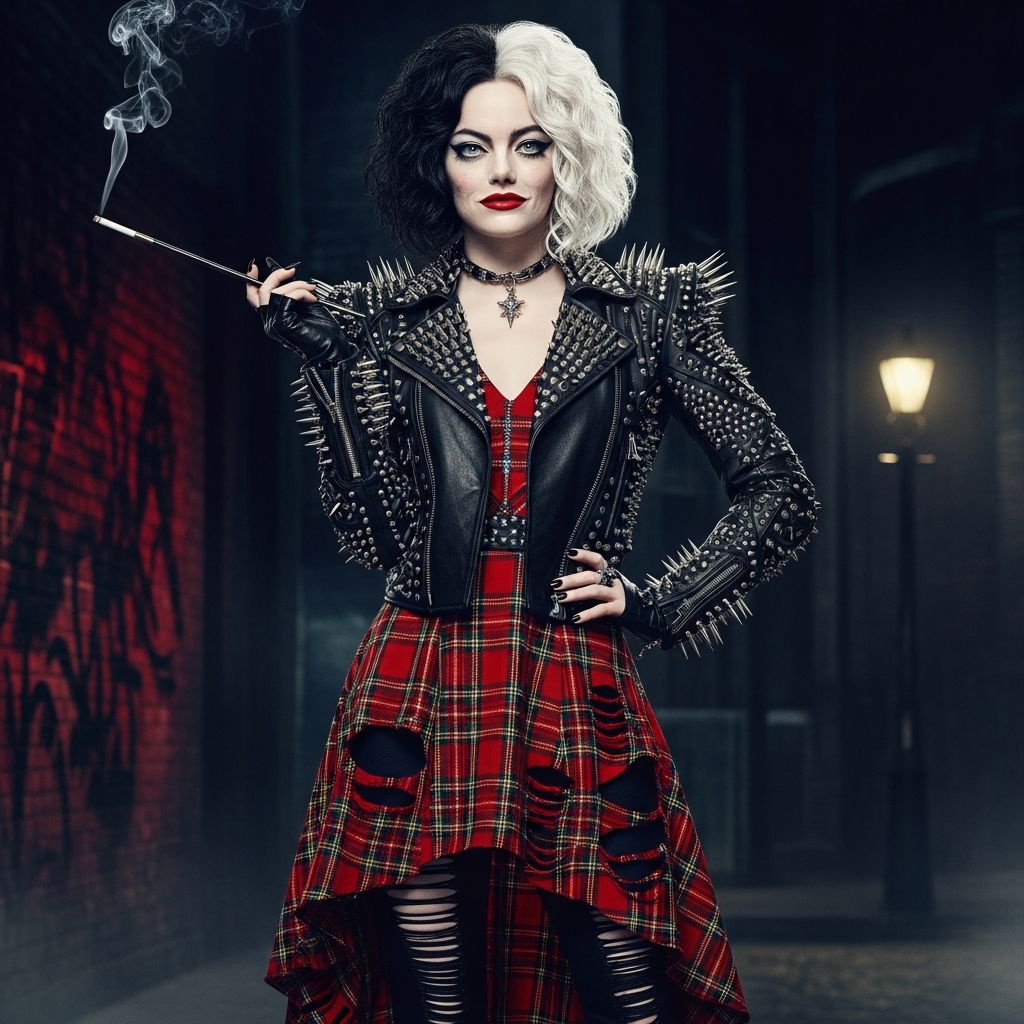
Disney’s Cruella takes one of animation’s most notorious dog-snatchers and rebuilds her from the ground up as a complicated, fiercely stylish antihero, powered by Emma Stone’s fearless performance and a wildly theatrical visual world.
From Cartoon Monster to Complicated Misfit
For decades, Cruella de Vil existed as a shorthand for pure, outrageous evil: the fur-obsessed villain from 101 Dalmatians who happily endangered puppies for a coat. In the live-action origin story, that one-dimensional caricature becomes Estella, a gifted and rebellious outsider whose transformation into Cruella feels both inevitable and unsettlingly relatable.
Rather than asking viewers to excuse Cruella’s worst impulses, the film invites them to understand how a clever, wounded kid in an unforgiving world might learn to weaponize style, spectacle, and cruelty to survive. The question shifts from “How could anyone be that bad?” to “What happens when talent, trauma, and ambition collide with no guardrails?”
The London Punk Scene as Story Engine
Setting Cruella’s rise in 1970s London is more than a costume choice; it’s a narrative engine. The era’s DIY punk energy, anti-establishment attitude, and subcultural creativity mirror Estella’s determination to break into an industry that would rather chew her up than let her in.
In a world of posh fashion houses and rigid class lines, the punk backdrop frames Cruella’s public stunts and guerilla fashion shows as protest as much as performance. Every ripped seam and spray-painted slogan becomes a visual argument that the old rules of who gets to be a “genius” are overdue for demolition.
Emma Stone’s Take on a Legendary Villain
Emma Stone’s Cruella is equal parts brittle confidence and volcanic instability. Her performance leans into the character’s theatricality—those elongated vowels, that predatory grin—without losing the nervous system of a person who has spent years being underestimated, exploited, and dismissed.
Stone’s version of Cruella works because she plays Estella and Cruella not as two separate roles but as two survival strategies. Estella is the mask worn to navigate a world that demands politeness and obedience; Cruella is what happens when the mask cracks and the raw, hyper-competent anger underneath decides it’s done asking for permission.
Duality, Identity, and the Birth of an Alter Ego
At the core of Cruella is a psychological tug-of-war between who Estella is expected to be and who she suspects she really is. The alter ego of Cruella begins as a performance: a name, a persona, a louder version of herself designed to outshine and embarrass those who hold power over her.
Over time, though, the persona starts to feel less like a mask and more like an awakening. The film quietly asks: when a persona gives you the freedom to claim your talent and your rage, where does performance end and identity begin? The danger is not just in becoming ruthless but in losing any sense of self that isn’t defined by winning.
Fashion as Weapon, Armor, and Language
More than window dressing, fashion in Cruella is a full narrative language. Every look tells you who holds power in a scene, who feels vulnerable, and who is trying desperately to hide it. Runways become battlegrounds. Red carpets become ambush sites.
Cruella’s designs often work on three levels at once:
- As armor, allowing her to stride into hostile spaces insulated by spectacle.
- As weapon, humiliating and overshadowing her rivals in front of their own audiences.
- As autobiography, encoding her trauma, defiance, and wit into fabric, silhouette, and movement.
Visual Storytelling: Color, Contrast, and Chaos
The film’s visual language turns Cruella’s inner conflict into something you can see across a crowded street. Sharp contrasts—black and white hair, stark red against muted backdrops, opulent couture colliding with trash-punk textures—make it feel as if her personality is constantly at war with itself.
Even the way scenes are staged reinforces that tension: Cruella often turns entrances into theatrical coups, arriving from above, bursting out of seemingly ordinary settings, or using motion (a burning dress reveal, a swirling train) to literally pull focus away from everyone else on screen.
Mentor, Mirror, Nemesis: The Power Struggle at the Top
Every origin story needs a catalyst, and Cruella’s comes in the form of a powerful fashion titan who doubles as both mentor and mortal enemy. Their relationship functions like a jagged mirror: each woman sees in the other a version of what she could become—or what she fears she already is.
This dynamic adds moral complexity. When Cruella adopts the same ruthless tactics she once despised, it raises uncomfortable questions about whether she is overthrowing a tyrant or merely auditioning to become the next one. Ambition, in this universe, is not inherently evil, but it is rarely clean.
Found Family vs. Ruthless Independence
One of the film’s most affecting threads is the tension between Cruella’s chosen family and her craving for individual greatness. Her scrappy crew of thieves, misfits, and loyal friends offer her something she has always lacked: unconditional loyalty and a sense of home.
Yet the closer she gets to her goal, the more she treats those same people as tools, not partners. That slow drift—from collaboration to control—is what makes her transformation into a villain feel tragic rather than simply triumphant. Cruella gains a brand but risks losing the only people who ever loved Estella.
How Cruella Redefines the Disney Villain
Disney’s classic villains often embody pure archetypes: greed, jealousy, vanity, hunger for power. Cruella complicates that blueprint by folding class, gender, and creative labor into the mix. Cruella is not just evil because she enjoys being cruel; she is shaped by elitist systems that reward callousness and punish vulnerability.
By letting audiences spend time in her shoes—literally, in her boots, heels, and combat-ready platforms—the film encourages empathy without seeking full absolution. Viewers can understand why she becomes dangerous without needing to excuse every choice she makes.
Table: From Animated Cruella to Live-Action Antihero
The evolution of Cruella across decades shows how changing cultural values influence the way villains are written and filmed.
| Aspect | Classic Animated Cruella | Live-Action Cruella (Emma Stone) |
|---|---|---|
| Core Motivation | Obsession with fur and status, largely unexplained. | Desire to prove creative genius, escape powerlessness, and avenge personal wrongs. |
| Personality Depth | Broadly comedic, over-the-top villain with minimal backstory. | Layered antihero with trauma, ambition, loyalty, and cruelty constantly colliding. |
| Design and Style | Simple, iconic coat and cigarette holder; exaggerated gestures. | Dozens of elaborate fashion looks; style functions as story, not just decoration. |
| Relationship to Audience | Figure of fear and ridicule; clearly “the bad guy.” | Figure of fascination; audience may both root for and recoil from her. |
| Theme Emphasis | Simple morality tale about greed and cruelty. | Explores identity, class, creative ownership, and the cost of reinvention. |
Why Audiences Gravitate Toward Antiheroes
Modern viewers are increasingly drawn to antiheroes—characters who do bad things for reasons that feel emotionally understandable. Cruella fits neatly into this trend, offering a protagonist who is charismatic, wronged, and yet alarmingly comfortable crossing ethical lines when it suits her.
The film capitalizes on that tension. It lets audiences revel in Cruella’s theatrical revenge schemes and fashion coups while quietly challenging them to ask whether they are cheering for justice, spectacle, or simply the thrill of watching someone burn it all down.
Family Viewing: What Parents Might Want to Know
While Cruella is branded under the Disney umbrella, its tone skews darker and edgier than many animated classics. The film includes scenes of emotional cruelty, revenge, and morally ambiguous behavior that may be intense for younger children.
For families, the movie can serve as a springboard for conversations about ambition, forgiveness, and the line between standing up for oneself and hurting others to get ahead. Parents can help kids parse the difference between admiring Cruella’s creativity and recognizing the harm her more ruthless decisions cause.
SEO-Friendly Takeaways for Film Fans
- Emma Stone’s Cruella reimagines an iconic Disney villain as a fashion-forward antihero whose origin story blends punk aesthetics with emotional depth.
- The movie uses 1970s London not just as a setting but as a symbol of rebellion, class friction, and creative upheaval.
- Fashion design in the film acts as visual storytelling, turning every gown, coat, and stunt into commentary on status and power.
- Parents and older kids can treat Cruella as a conversation starter about identity, morality, and the cost of success.
- For fans of villain origin stories, the film offers a stylish, character-driven exploration of how pain and talent can twist into something simultaneously impressive and alarming.
Frequently Asked Questions About Disney’s Cruella
Is Cruella suitable for younger children?
The film contains emotionally intense scenes, acts of revenge, and morally gray decisions that may be better suited to older children, teenagers, and adults rather than very young viewers.
Do you need to have seen 101 Dalmatians first?
No prior knowledge is required to follow the story; viewers familiar with 101 Dalmatians will notice nods and references, but newcomers can enjoy Cruella as a standalone character drama and fashion spectacle.
Is Cruella portrayed as a hero or a villain?
Cruella is best described as an antihero. The film encourages empathy by exploring her backstory and pain, but it does not gloss over the damage she causes as she embraces her more ruthless side.
What makes Emma Stone’s performance stand out?
Stone blends sharp comedic timing with simmering vulnerability, making Cruella both larger-than-life and recognizably human. Her performance anchors the film’s tonal shifts between dark humor, drama, and high-camp theatrics.
Why is fashion so important in the story?
Fashion is Cruella’s primary language of power. Her designs allow her to challenge authority, rewrite her social status, and turn trauma into visual statements that no one in her world can ignore.
By reframing Cruella de Vil as a punk-era underdog turned unapologetic antihero, Disney’s Cruella and Emma Stone’s bold performance invite audiences to rethink what makes a villain compelling—and how style, pain, and ambition can fuse into something unforgettable.