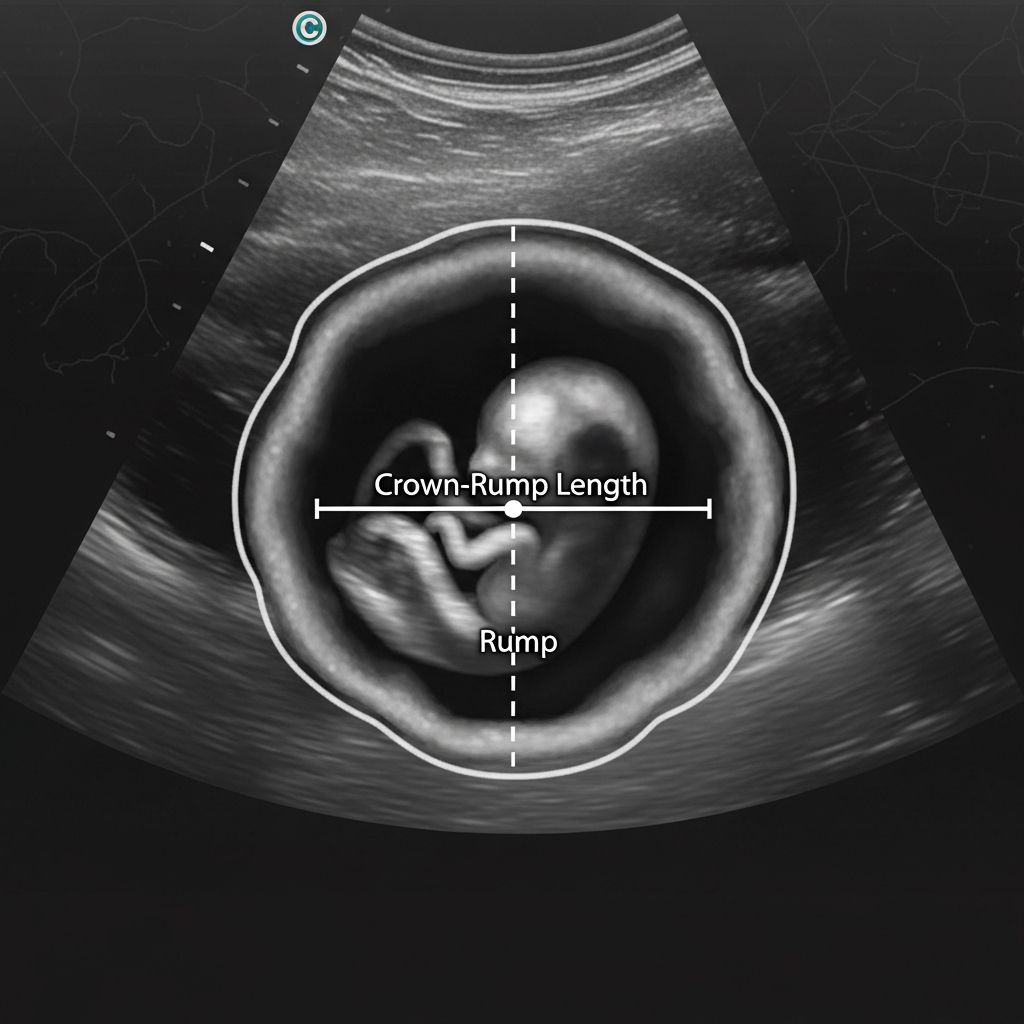
The crown-rump length (CRL) is a key ultrasound measurement taken during the first trimester of pregnancy, capturing the distance from the top of the fetus’s head to its buttocks. This metric provides the most precise way to estimate gestational age and confirm due dates early on.
Understanding the Basics of CRL Measurement
CRL focuses exclusively on the fetal trunk, excluding limbs and the yolk sac, to gauge embryonic growth accurately. Performed between 6 and 14 weeks gestation, it helps clinicians establish a reliable timeline when last menstrual period dates are uncertain.
Experts emphasize that CRL’s reliability stems from the fetus’s curled posture in early stages, allowing a straight-line measurement. As pregnancy advances beyond 14 weeks, the fetus uncurls, making other biometrics like femur length more suitable.
Why CRL Matters for Pregnancy Care
Accurate dating via CRL ensures prenatal tests, such as nuchal translucency scans, occur at optimal times. It also tracks growth velocity, flagging potential issues like intrauterine growth restriction if deviations persist over serial scans.
- Establishes expected due date with ±5-7 days accuracy up to 13 6/7 weeks.
- Monitors developmental milestones, like heartbeat detection around 6 weeks.
- Supports decisions on screening for chromosomal abnormalities.
How CRL Ultrasounds Are Performed
Technicians use transvaginal probes before 10 weeks for clearer images or abdominal probes afterward. The fetus is imaged in sagittal view, with digital calipers marking the crown (头顶) to rump (buttocks base).
Optimal conditions include a neutral fetal position without flexion or extension. Multiple views confirm consistency, reducing errors from movement or maternal factors.
Normal CRL Ranges Week by Week
CRL grows predictably, starting under 1 cm at 6 weeks and reaching over 8 cm by 14 weeks. Charts correlate measurements to gestational age precisely.
| CRL (mm) | Gestational Age (weeks + days) |
|---|---|
| 5 | 6 + 0 |
| 10 | 7 + 1 |
| 15 | 7 + 6 |
| 20 | 8 + 4 |
| 25 | 9 + 2 |
| 30 | 9 + 6 |
| 55 | 12 + 1 |
This table uses the corrected Robinson-Fleming equation for estimates: Gestational age (days) = 8.052 × √(CRL × 1.037) + 23.73.
Calculating Gestational Age from CRL
Clinicians input CRL into validated formulas for age estimation. The INTERGROWTH-21st standards endorse equations like Robinson-Fleming for global consistency.
For instance, a 55 mm CRL equates to about 12 weeks and 1 day, aiding in refining estimated delivery dates.
Potential Abnormalities and Their Implications
Deviations from norms often reflect dating errors rather than pathology. Smaller CRLs may indicate later ovulation; larger ones, earlier conception or multiples.
- Smaller than expected: Common in revised dating; persistent lag raises miscarriage risk.
- Larger than expected: Could signal twins or rare trophoblastic disease.
- CRL ≥7 mm without heartbeat diagnoses non-viable pregnancy.
Serial ultrasounds over weeks clarify trends, as single readings can mislead due to positioning.
Factors Affecting Measurement Accuracy
Several variables influence CRL precision:
- Fetal lie or movement distorting the view.
- Maternal BMI impacting probe penetration.
- Operator experience in caliper placement.
- Equipment resolution for sub-millimeter accuracy.
Guidelines recommend repeating scans if discrepancies exceed 5-7 days.
CRL in Context of First-Trimester Screening
CRL pairs with nuchal translucency (NT) for aneuploidy risk assessment. Tools like Perinatology calculators integrate both for expected NT values.
International standards from INTERGROWTH-21st provide CRL percentiles, enhancing global comparisons.
Advances in CRL Assessment Technology
Modern ultrasound machines automate measurements with AI-assisted calipers, minimizing human error. 3D imaging refines views in challenging cases.
Studies validate CRL up to 85 mm for dating, with ongoing research refining equations for diverse populations.
Practical Tips for Expectant Parents
Prepare for your CRL scan by maintaining a full bladder for abdominal approaches. Discuss results with your provider, as context matters.
Track appointments based on CRL-derived dates to align with milestones like viability scans at 8 weeks.
Frequently Asked Questions
What if my CRL is smaller than expected?
This usually means the pregnancy is earlier than thought from LMP. Follow-up scans assess growth; early restriction is rare in viable cases.
Can CRL be measured too early?
Before 6 weeks, the embryo is tiny (<5 mm), limiting accuracy. Wait until 6-7 weeks for reliable heartbeat and size.
How accurate is CRL for due dates?
Up to 13 6/7 weeks, it’s ±5-7 days, superior to LMP-based estimates.
What CRL indicates pregnancy loss?
A CRL ≥7 mm without cardiac activity confirms non-viability, though timing varies.
Is transvaginal ultrasound needed for CRL?
Yes, pre-10 weeks for better resolution; switches to abdominal later.
Role of CRL in High-Risk Pregnancies
In IVF or irregular cycles, CRL overrides LMP for dating. For multiples, individual CRLs predict chorionicity and growth discordance.
Persistent discrepancies prompt amniocentesis or further imaging.
CRL growth averages 1 mm/day early on, slowing later. Deviations >2 weeks gestation warrant investigation.
References
- What Is Crown to Rump Length? — The Bump. 2023. https://www.thebump.com/a/crown-to-rump-length
- Crown-rump Length Calculator — Omni Calculator. 2024. https://www.omnicalculator.com/health/crown-rump-length
- Crown Rump Length CRL Measurement — Clarius (YouTube Transcript). 2022. https://www.youtube.com/watch?v=rR3cDH-XB2s
- Crown Rump Length and Nuchal Translucency Calculator — Perinatology.com. 2024. https://www.perinatology.com/calculators/Crown%20Rump%20and%20Nuchal%20Translucency.htm
- Methods for Estimating the Due Date — American College of Obstetricians and Gynecologists (ACOG). 2017-05-08. https://www.acog.org/clinical/clinical-guidance/committee-opinion/articles/2017/05/methods-for-estimating-the-due-date
- Crown–rump length measurement: a new age for first‐trimester pregnancy dating — Ultrasound in Obstetrics & Gynecology. 2023. https://obgyn.onlinelibrary.wiley.com/doi/full/10.1002/uog.23692