Laboratory tests can feel intimidating when they are ordered for your child. Knowing why tests are done, what they measure, and how to prepare can make the experience less stressful for you and your child and help you have informed conversations with your child’s healthcare provider.
Why Doctors Order Lab Tests for Kids
Lab tests are tools that give doctors objective information about how a child’s body is working. They are usually ordered for one or more of these reasons:
- Finding the cause of symptoms — for example, testing a child with fever and fatigue for infection or anemia.
- Confirming or ruling out a diagnosis — such as diabetes, kidney disease, or thyroid disorders.
- Checking general health during a routine visit, especially if there are risk factors like family history or chronic conditions.
- Monitoring long-term illnesses such as asthma, inflammatory conditions, or heart disease to see if treatments are working.
- Watching for side effects of medicines that can affect the liver, kidneys, or blood cells.
In many cases, a lab test is only one part of the puzzle. Doctors interpret results together with your child’s symptoms, exam findings, and medical history.
Main Types of Lab Samples in Children
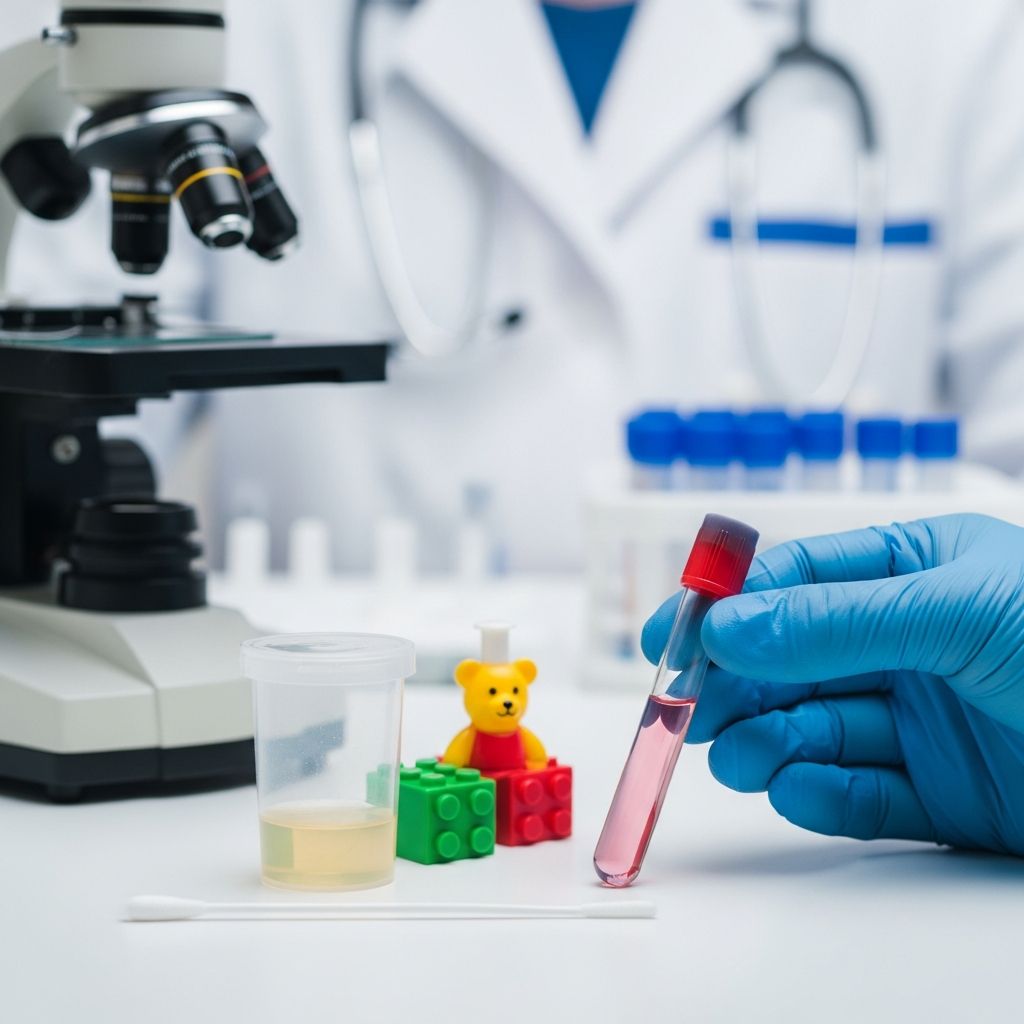
Most pediatric lab tests use small samples of body fluids or, less often, tissue. Common sample types include:
- Blood — drawn from a vein, fingertip, or heel (in newborns); used for many different panels like blood counts, chemistry, and hormone levels.
- Urine — collected in a container, urine bag (for infants), or via catheter in special situations; useful for checking infection, kidney function, and metabolic problems.
- Stool (feces) — a small sample used to check for blood, infections, or problems digesting food.
- Swabs from nose, throat, or skin — used to detect viruses or bacteria such as strep throat or flu.
- Other fluids or tissue — such as spinal fluid or small biopsies; these are less common and usually ordered only when absolutely necessary.
Common Blood Tests Your Child Might Have
Blood tests provide detailed information about cells, minerals, hormones and proteins circulating in the bloodstream. Below are some of the most frequently ordered pediatric tests.
Complete Blood Count (CBC)
A complete blood count measures the major types of blood cells.
- Red blood cells (RBCs) and hemoglobin — carry oxygen; low levels can indicate anemia.
- White blood cells (WBCs) — help fight infections; abnormal counts may suggest infection, inflammation or immune problems.
- Platelets — help with clotting; very low or very high counts can lead to bleeding or clotting concerns.
Doctors may order a CBC if your child has fatigue, frequent infections, bruising, or as part of a pre-surgery evaluation.
Basic and Comprehensive Metabolic Panels
Metabolic panels measure salts, sugars, and chemicals that show how well organs such as the kidneys and liver are functioning.
| Panel | Key Components | What It Helps Assess |
|---|---|---|
| Basic Metabolic Panel (BMP) | Glucose, electrolytes (sodium, potassium, chloride, CO2), blood urea nitrogen (BUN), creatinine | Blood sugar, fluid and salt balance, kidney function |
| Comprehensive Metabolic Panel (CMP) | All BMP items plus liver enzymes, total protein, and albumin | Kidney and liver health, nutrition status, blood sugar, and electrolyte balance |
These tests are often used to evaluate vomiting, poor growth, dehydration, chronic conditions, or medication effects.
Lipid (Cholesterol) Panel
A lipid panel looks at different types of fats in the blood, including total cholesterol, LDL (often called “bad” cholesterol), HDL (“good” cholesterol), and triglycerides.
- In children, this test is often done if there is a strong family history of high cholesterol or early heart disease, or in children with obesity or certain chronic conditions.
- Abnormal results can lead to recommendations for nutrition changes, exercise, and sometimes medication in older children or teens.
Blood Glucose and Diabetes-Related Tests
Blood glucose tests measure sugar in the blood and are essential for diagnosing and monitoring diabetes.
- Random or fasting glucose — a single measurement used to screen or check for high or low blood sugar.
- Oral glucose tolerance test — measures how the body handles a sugar drink over time.
- Hemoglobin A1c — reflects average blood sugar over the prior 2–3 months and helps monitor long-term control in children with diabetes.
Thyroid Function Tests
Thyroid hormones influence growth, metabolism and brain development.
- TSH (thyroid-stimulating hormone) — shows how hard the body is working to stimulate the thyroid.
- Free T4 and sometimes T3 — measure active thyroid hormone levels.
These tests may be ordered if your child has poor growth, weight changes, fatigue, or learning and attention problems that raise concern for an overactive or underactive thyroid.
Blood Clotting (Coagulation) Tests
Coagulation tests help evaluate how well your child’s blood forms clots.
- Prothrombin time (PT) / INR — looks at one part of the clotting pathway, and is especially important for children on blood-thinning medicines.
- Partial thromboplastin time (PTT) — assesses another part of the clotting system.
These tests may be recommended if your child has frequent nosebleeds, easy bruising, a family history of bleeding problems, or before some surgeries.
Urine, Stool, and Other Non-Blood Tests
Urinalysis
A urinalysis is a broad test that examines a urine sample for signs of infection, kidney disease, or systemic problems.
- Appearance and concentration — color and specific gravity show how concentrated the urine is.
- Chemical tests — look for protein, glucose, blood, ketones, and other substances.
- Microscopic examination — can detect cells, bacteria, and crystals.
Doctors often use urinalysis to check symptoms like burning with urination, bedwetting with daytime symptoms, flank pain, or unexplained fever.
Urine Culture
If a urinary tract infection is suspected, a urine culture may be ordered after an initial urinalysis.
- The sample is incubated to see which bacteria grow.
- Results help the doctor choose the most effective antibiotic.
Stool Tests
Stool tests can provide information about digestion and infection.
- Checking for blood in the stool in children with abdominal pain or anemia.
- Looking for bacteria, viruses, or parasites when there is prolonged diarrhea or vomiting.
- Measuring certain chemicals or enzymes in children with suspected malabsorption or food intolerance.
Swab and Rapid Tests
Quick tests using a swab from the throat, nose, or skin help diagnose infections such as strep throat, COVID-19, flu, or respiratory viruses.
- Some tests provide results within minutes in the office.
- Others are sent to a laboratory for more detailed analysis like PCR testing.
How to Help Your Child Prepare for Lab Tests
Good preparation can reduce anxiety and improve the accuracy of certain tests.
Ask About Special Instructions
- Fasting requirements — some tests, like blood sugar or cholesterol, may need your child to avoid eating and drinking (except water) for several hours.
- Medication timing — always ask whether regular medicines should be taken before the test.
- Collection at home — for some urine or stool tests, you may receive a container and written instructions.
Prepare Your Child Emotionally
- Use simple, honest language to explain what will happen, such as “The nurse will use a small needle to take a little bit of blood.”
- Acknowledge feelings and let your child know it is okay to be nervous.
- Bring a favorite toy, book, or comfort item for distraction.
During and After the Test
- Help your child sit still and use deep breathing or counting for distraction.
- Offer praise for their effort afterward, even if they cried or were afraid.
- Follow any after-care instructions, like keeping a bandage on for a short time after a blood draw.
Understanding Lab Reports
Lab reports can be confusing at first glance. Remember that only your child’s healthcare provider can fully interpret the results in context.
- Reference ranges — the “normal range” printed next to each result varies by age, sex, and lab methods; children have different ranges than adults for many tests.
- Slightly abnormal numbers — individual results just outside the reference range are not always a cause for alarm; your doctor will explain whether they are clinically important.
- Trend over time — sometimes the pattern of results over several tests is more meaningful than a single value.
- Follow-up — your child might need repeat tests, imaging, or specialist visits depending on the findings.
Questions to Ask Your Child’s Doctor
To feel more comfortable and involved in decisions, consider asking:
- What specific test is being ordered, and what are you looking for?
- Are there any risks or side effects of the test?
- Does my child need to fast or change medications beforehand?
- How and when will we get the results?
- What might be the next steps depending on different possible results?
Frequently Asked Questions About Lab Tests in Children
Do all lab tests require a needle stick?
No. Some tests use blood from a vein, but others use finger or heel pricks, urine, stool, or swabs from the nose or throat. Your child’s doctor will choose the method that provides accurate information with the least discomfort.
Can lab tests be wrong?
Lab tests are carefully controlled, but no test is perfect. Results can be affected by how the sample was collected, medicines, hydration, or recent illness. This is why doctors consider lab values together with symptoms and may repeat a test if something looks unexpected.
How long do results usually take?
Many common blood and urine tests are available within hours to a day. More complex tests, such as certain hormone levels or genetic tests, can take several days or longer. Your child’s healthcare team can give you an estimate for each specific test.
Will my child need repeat tests?
Repeat testing is common when monitoring chronic conditions, checking medication effects, or confirming unexpected results. Your doctor will explain the schedule and purpose for any follow-up tests.
How can I help my child be less afraid of blood tests?
Staying calm yourself, using age-appropriate explanations, practicing deep breathing, and bringing comfort items can all help. Many clinics also offer numbing creams or distraction techniques; ask in advance what options are available.
References
- Medical Tests — MedlinePlus, U.S. National Library of Medicine. 2023-06-05. https://medlineplus.gov/lab-tests/
- Blood Tests: Types, Results & How They Work — Cleveland Clinic. 2023-01-01. https://my.clevelandclinic.org/health/diagnostics/24508-blood-tests
- Blood Tests — National Heart, Lung, and Blood Institute (NHLBI), NIH. 2022-09-21. https://www.nhlbi.nih.gov/health/blood-tests
- What Are Lab Tests and Their Importance? — University Health. 2022-08-10. https://www.universityhealth.com/blog/understanding-your-labs
- Common Lab Tests — Baxter Health. 2021-11-15. https://www.baxterhealth.org/medical-services/lab-pathology/common-lab-tests/