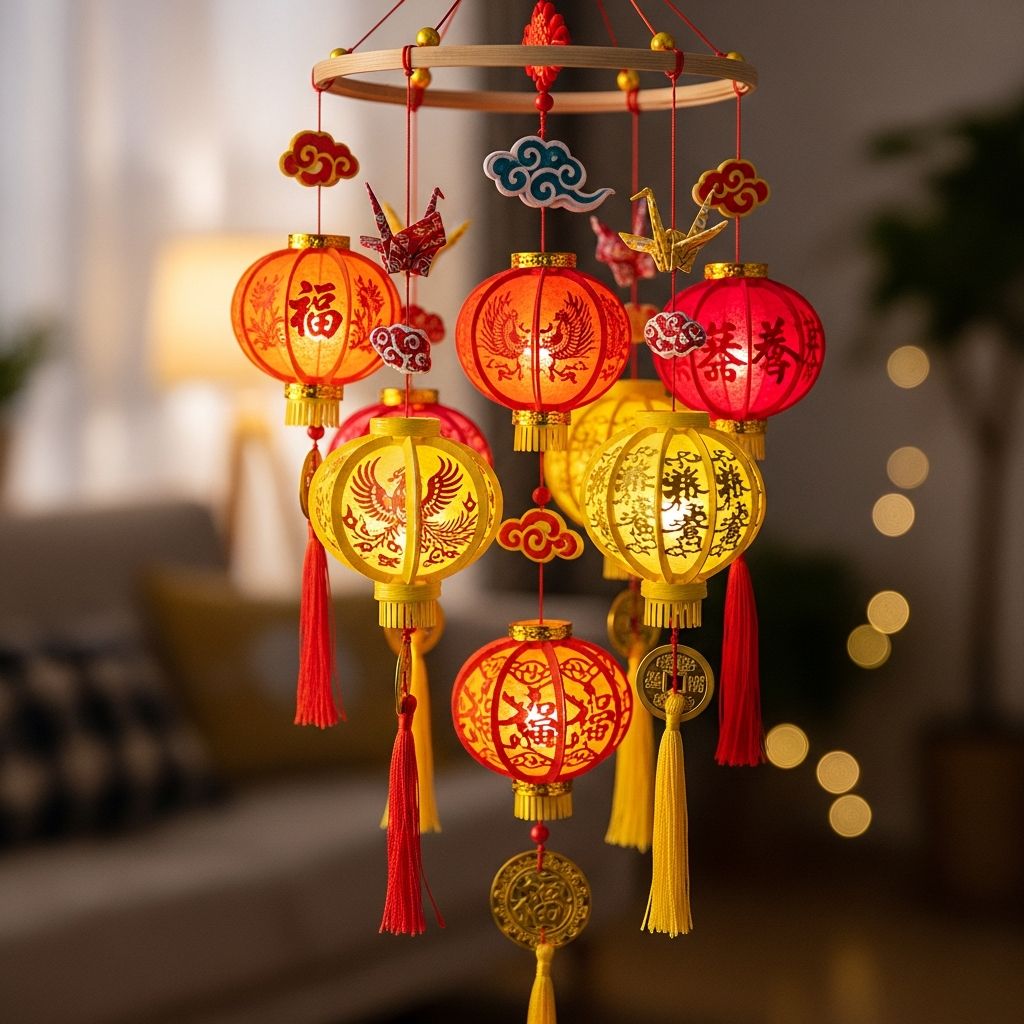
The Chinese Lantern Festival, also known as Yuanxiao, marks the end of Lunar New Year celebrations with glowing lanterns, sweet treats, and time together in the evening light. This guide introduces the festival in kid-friendly terms and walks you through a symbolic mobile craft that turns your family’s wishes into a constellation of hanging lanterns at home.
Understanding the Chinese Lantern Festival
The Lantern Festival is celebrated on the 15th day of the first lunar month, usually in February or early March, and has been observed for roughly 2,000 years. On this night, people light and display lanterns, enjoy performances, and often eat sweet glutinous rice balls called tangyuan that symbolize reunion and wholeness.
| Aspect | What Kids Can Learn |
|---|---|
| When it happens | 15th day of the first lunar month, marking the last big event of Lunar New Year. |
| Key symbol | Lanterns that bring light to the night and represent hope, guidance, and good luck. |
| Typical foods | Round tangyuan, whose shape suggests family unity and harmony. |
| Traditional activities | Lantern displays, riddle games, lion and dragon dances, and fireworks in many communities. |
Origins and Stories to Share with Kids
The precise beginnings of the Lantern Festival are complex, but historians trace it back to the Han dynasty, when lighting lanterns on the 15th day of the first lunar month was connected to Buddhist practices honoring the Buddha. Over time, these religious rituals blended with folk customs and local legends to form the lively festival families enjoy today.
When explaining this to children, it can help to focus on a few kid-friendly themes:
- Light in the darkness: In ancient times, lanterns allowed people to safely gather outdoors at night, turning a dark evening into a shared celebration.
- Gratitude and good fortune: Many people associate the festival with giving thanks and wishing for a lucky, peaceful year ahead.
- Stories of protection: Some legends describe villagers hanging red lanterns and setting off firecrackers to protect their homes or to show respect to powerful deities.
Different regions tell different stories, so you can emphasize that there is not only one “correct” tale. What stays consistent is the sense of community, hope, and light.
Why Create a Lantern Wishes Mobile?
Many people associate the Lantern Festival with lanterns that seem to float upward, carrying wishes into the night sky. Your family might not launch real sky lanterns, but you can still capture the feeling of rising hopes by crafting a hanging mobile that sways gently indoors.
A lantern-themed wishes mobile is meaningful because it:
- Turns wishes into something visible: Children can write or draw their hopes and then see them every day.
- Connects creativity with culture: The project becomes a doorway to discuss Chinese traditions respectfully.
- Invites reflection: As the mobile turns, it’s a quiet reminder of the intentions your family set together.
- Works in small spaces: Even if you can’t hang large lanterns, a compact mobile can fit in a bedroom, hallway, or classroom.
Gathering Materials for Your Lantern Mobile
You can adapt this craft to whatever you have at home. The list below offers options so you can scale it for different ages and skill levels.
Core Structure
- 1 sturdy hoop or ring (craft hoop, embroidery hoop, or a circle made from wire or cardboard)
- String, yarn, or thin ribbon for hanging the lanterns
- One stronger length of cord for suspending the entire mobile
Lantern Shapes
- Colorful paper (construction paper, origami paper, scrapbook paper, or upcycled gift wrapping)
- Thin cardstock or file folders if you want sturdier lanterns
- Scissors (adults should supervise younger children)
- Hole punch or a sharp tool used only by an adult for making string holes
Decoration and Wishes
- Markers, crayons, or colored pencils
- Gold or silver pens for wish writing and detailing
- Stickers or small paper cutouts (stars, moons, clouds, or zodiac animals)
- Optional: tissue paper, sequins, or washi tape for extra shimmer
Safety and Setup
- Clear tape or glue stick
- Child-safe ruler for measuring string lengths
- Adult-supervised step stool or chair when hanging the mobile
Designing Your Lantern Wishes
Before you start cutting paper, spend a few minutes talking about the kinds of wishes people might associate with the Lantern Festival, such as health, peace, strong friendships, or success in the new year.
Choosing Themes for Each Lantern
Give each lantern a focus so your mobile tells a story when you look at it:
- Health and safety: Wishing for everyone in the family to stay well.
- Kindness and friendship: Hoping to be a good friend and meet new ones.
- Learning and curiosity: Setting intentions around school and personal growth.
- Joy and play: Remembering that festivals are also about fun and celebration.
- Gratitude: Instead of a wish, one lantern can name something your family already appreciates.
Younger children can draw pictures that match each theme (a heart for kindness, a book for learning), while older children can write short phrases or full sentences.
Step-by-Step: Building the Lantern Mobile
The steps below describe one straightforward approach. Feel free to simplify or add extra embellishments based on your materials and how much time you have.
1. Plan Your Layout
- Decide how many lanterns you want to hang. A good starting number is between five and ten.
- Think about balance: pair heavier lanterns on opposite sides of the hoop.
- Choose whether all lanterns will be the same shape or a mix of silhouettes inspired by traditional Chinese designs (round, oval, cylinder, or palace-style).
2. Create the Lantern Bases
- Cut rectangles, circles, or other simple shapes from colorful paper.
- For a cylinder look, roll a rectangle into a tube and secure the edge with tape or glue.
- For flat lanterns, you can glue two identical shapes back-to-back over the hanging string later for a double-sided effect.
3. Add Cultural Details Thoughtfully
To connect the craft to real lanterns while staying respectful, you might:
- Use red and gold, colors traditionally associated with happiness and good fortune in many Chinese celebrations.
- Draw simple border patterns, stars, waves, or clouds inspired by motifs you see in photos of lantern displays from reputable educational sources.
- Include the current zodiac animal (if your family knows it) as a recurring element.
4. Write or Draw the Wishes
- Invite each family member to claim one or more lanterns.
- On each lantern, write a short wish or phrase, such as “More laughter at home” or “Courage to try new things.”
- For emerging writers, an adult can label the drawing with a simple word like “JOY” or “HEALTH.”
5. Attach Strings
- Punch a small hole at the top of each lantern, or carefully ask an adult to make one.
- Cut strings in a variety of lengths so the lanterns hang at different heights, echoing a sky full of lights.
- Thread each string through its lantern and tie a secure knot.
6. Build the Mobile Frame
- Tie three or four equal-length cords around your hoop or ring, spaced evenly.
- Gather the loose ends of those cords at the top and knot them together to form a single hanging point.
- Check that the hoop balances; adjust knot positions if it tilts too much to one side.
7. Hang the Lanterns
- Laying the hoop flat on a table, tie each lantern string to the hoop.
- Vary the position: some lanterns can hang closer to the center, others near the edge.
- Gently lift the mobile and see how it hangs; move lanterns around until it feels balanced and visually pleasing.
8. Choose a Display Spot
- Pick a safe place away from open flames, heaters, or busy doorways.
- A corner of the living room, a child’s bedroom, or a classroom reading area all work well.
- If possible, hang it where a gentle draft will let the lanterns slowly spin like they’re floating upward.
Turning the Craft into a Family Ritual
Once your lantern wishes mobile is hanging, use it as more than decoration. You can turn it into a small family ritual during the Lantern Festival and throughout the year.
Ideas for Simple Rituals
- Lantern moment: On the night of the Lantern Festival, dim the lights, stand under the mobile, and take turns reading each wish aloud.
- Check-in nights: Once a month, choose one lantern and talk about whether that wish feels closer, farther away, or has changed.
- Gratitude swaps: When a wish comes true or feels fulfilled, replace it with a gratitude lantern that celebrates what happened.
- Story prompts: Let children pick a lantern and make up a story about a character whose journey is guided by that wish.
Adapting the Craft for Different Ages and Group Sizes
This project can be tailored for toddlers, teens, or mixed-age groups such as classrooms or community gatherings.
For Toddlers and Preschoolers
- Pre-cut basic shapes and let children focus on decorating with crayons and stickers.
- Use sturdy cardstock or lightweight cardboard that can handle more handling.
- Keep the number of lanterns small and the hanging height low enough for them to see.
For School-Age Kids
- Invite them to research a few facts about the Lantern Festival from child-friendly books or trusted educational websites.
- Encourage them to write longer wishes or short poems about light, hope, or friendship.
- Introduce simple geometry by measuring string lengths and planning symmetrical layouts.
For Teens and Group Projects
- Ask participants to explore how festivals of light appear in different cultures, then share their observations.
- Incorporate design challenges, such as engineering a mobile with two levels or creating lanterns in the style of historical dynasties.
- Discuss cultural respect and how to honor traditions without copying sacred symbols or practices out of context.
Safety and Cultural Respect Tips
Even paper-based lantern crafts benefit from a quick review of safety guidelines and cultural context.
Safety Basics
- Keep the mobile well away from candles, stoves, or any open flame.
- Securely anchor the mobile to avoid it falling from the ceiling.
- Store scissors, hole punchers, and step stools out of young children’s reach when not in use.
Respecting the Tradition
- Present the craft as one way to learn about and appreciate the Lantern Festival, not as an exact recreation of traditional practices.
- Use books, museum sites, or educational organizations as references when explaining the festival’s background.
- Remind children that modern celebrations can look different across regions and communities, and that traditions evolve over time.
Frequently Asked Questions (FAQs)
Is this mobile an authentic Lantern Festival tradition?
No. The wishes mobile is a modern, family-friendly craft inspired by the symbolism of festival lanterns and rising light. Traditional Lantern Festival activities focus on displaying lanterns, enjoying performances, solving riddles, and sharing foods like tangyuan rather than mobiles.
Do we need to celebrate Lunar New Year to make this craft?
You do not have to observe the full Lunar New Year season to try the mobile. However, if your family is not part of a culture that traditionally celebrates the Lantern Festival, it is helpful to learn about its history and to introduce the craft as a way of appreciating another culture’s holiday respectfully.
Can we add lights to the lantern mobile?
You can carefully weave a short strand of cool, low-heat LED fairy lights around the hoop to echo the glow of lanterns. Avoid placing any real candles or hot bulbs near the paper, and keep cords out of children’s reach.
How long should we leave the wishes mobile hanging?
Some families keep it up just for the Lantern Festival and the days around it; others leave it hanging as a year-long reminder of their goals and hopes. You can decide together as a family and even set a date to renew or refresh the wishes.
What if our wishes change?
Wishes naturally change as children grow. Invite your family to revisit the mobile and replace lanterns when priorities shift. This turns the craft into an ongoing conversation about growth, values, and the kind of year you hope to create together.
References
- Lantern Festival — Encyclopaedia Britannica. 2024-02-08. https://www.britannica.com/topic/Lantern-Festival
- Lantern Festival History and Traditions | China’s Yuanxiao Holiday — CLI (Chinese Language Institute). 2023-01-10. https://studycli.org/chinese-holidays/lantern-festival/
- Chinese Lantern Festival — Love Paper. 2021-02-15. https://lovepaper.org/chinese-lantern-festival/
- Chinese New Year and Lantern Festival Traditions — Tianyu Arts & Culture. 2022-12-01. https://tianyuculture.us/chinese-new-year-and-lantern-festival-traditions/
- Did You Know? Chinese Lantern Festival — UNESCO Silk Roads Programme. 2020-09-18. https://en.unesco.org/silkroad/content/did-you-know-chinese-lantern-festival-illustration-intercultural-exchange
- About the Lanterns — Chinese Lantern Festival. 2019-06-01. https://www.chineselanternfestival.com/chineselanterns