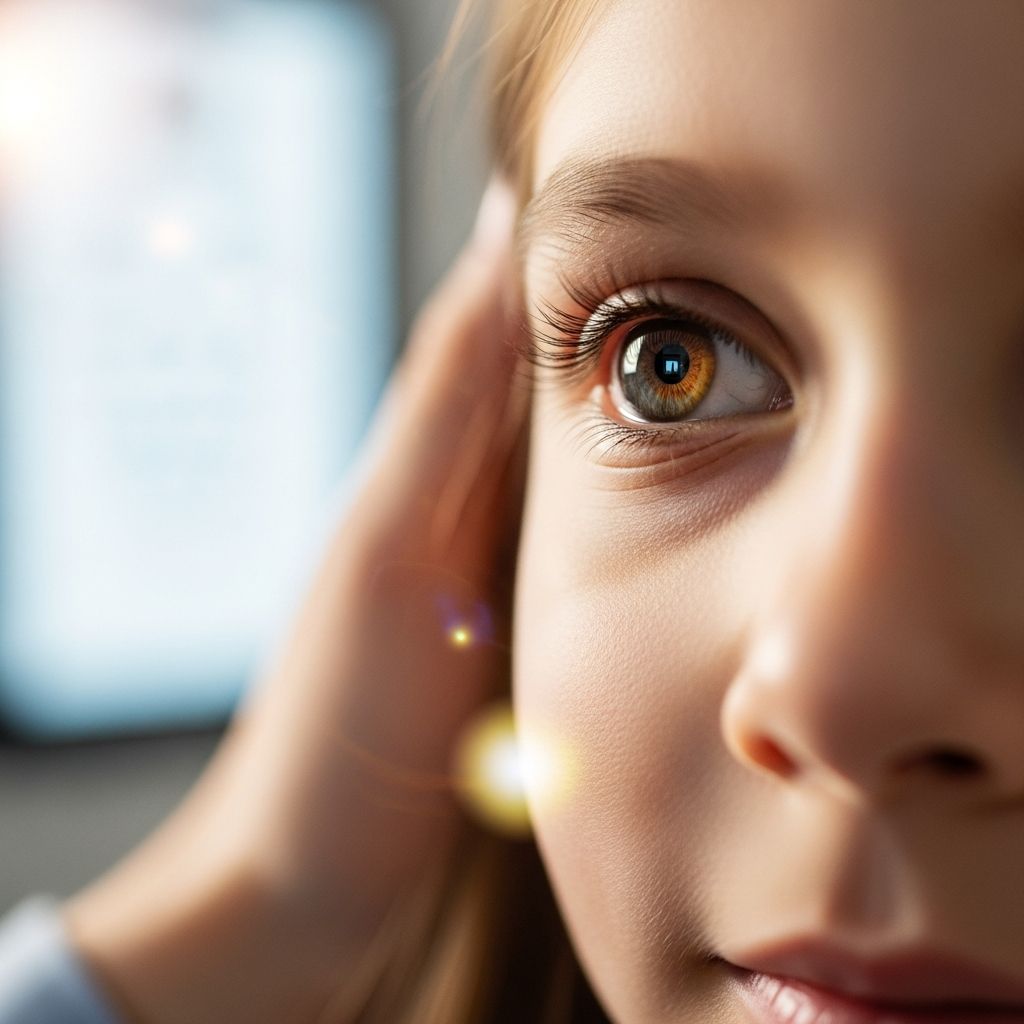
Healthy eyes help children explore, learn, and enjoy the world around them, from recognizing a parent’s face to reading their first book. Understanding how the eyes work and how vision changes as kids grow makes it easier to spot problems early and protect their sight for life.
How Your Child’s Eyes See the World
The eye works like a tiny camera. Light enters through the clear front window (the cornea), passes through the pupil and lens, and lands on the retina at the back of the eye. The retina turns light into signals that travel along the optic nerve to the brain, where they become the images your child sees.
- Cornea and lens: These focus light so that images are clear instead of blurry.
- Iris and pupil: The colored part of the eye controls how much light comes in, like a camera aperture.
- Retina and optic nerve: These send detailed visual information to the brain so your child can recognize faces, shapes, letters, and more.
Good vision depends on all of these parts working together and on both eyes sending balanced information to the brain. If one eye sends a weaker or blurrier picture, the brain may learn to favor the stronger eye, which can lead to long-term problems if not treated.
Vision Development from Birth to the Teen Years
Children are not born with fully developed vision. Sight improves step by step as the eyes and brain learn to work together. Parents who know typical milestones can better tell when something seems off and when to seek help.
| Age Range | What Kids Usually Can Do Visually |
|---|---|
| Birth–3 months | Notice faces up close, prefer high-contrast patterns, begin to track slow movement with their eyes. |
| 3–6 months | Follow objects more smoothly, reach toward toys, start using both eyes together more reliably. |
| 6–12 months | See farther across a room, recognize familiar people at a distance, improve depth perception for crawling and pulling up. |
| 1–3 years | Use hand–eye coordination for stacking, scribbling, and building, name or sort basic colors and shapes. |
| 3–5 years | Recognize many letters and pictures, see clearly at near and far for play and early learning, coordinate eyes and body for running and jumping. |
| 5+ years | Use mature visual skills for reading, writing, sports, and navigating new environments. |
Every child develops at a unique pace, so small differences are common. What matters most is overall progress and whether your child seems to see well enough to explore, interact, and learn at each stage.
Common Vision Problems in Children
Many children have vision issues that can be improved with early care. Some problems affect how clearly your child sees, while others affect how well the two eyes work together.
Refractive errors: Blurry vision
Refractive errors happen when the eye does not focus light exactly on the retina. This makes images appear blurry at certain distances but is usually treatable with glasses or contacts prescribed by an eye care professional.
- Nearsightedness (myopia): Distant objects appear blurry, but close work like reading may still be clear.
- Farsightedness (hyperopia): Near work can be harder to see clearly and may cause eye strain or headaches.
- Astigmatism: Vision can look distorted or smeared at both near and far because the eye’s focusing power is uneven.
Eye alignment and focusing problems
Even if each eye sees clearly, poor alignment or weak focusing can interfere with comfortable, single vision. Early treatment often leads to better outcomes and can prevent permanent vision loss in one eye.
- Strabismus: One eye may turn in, out, up, or down instead of lining up with the other eye.
- Amblyopia (“lazy eye”): One eye sends a blurry or weaker picture to the brain, so the brain begins to favor the other eye.
- Focusing and eye-teaming issues: Some kids struggle to keep both eyes aimed at the same place or to quickly shift focus between near and far.
Other eye health concerns
Some children are born with eye conditions or develop them because of injury, infection, or other health issues. Regular checkups help catch these early, even if your child cannot describe symptoms yet.
- Cloudy areas in the eye, unusual eye movements, or a white reflex in photos instead of the usual red glow merit prompt evaluation.
- Conditions like severe allergies, infections, or trauma can temporarily or permanently affect vision if not treated quickly.
Warning Signs Parents Should Watch For
Young children rarely say “I can’t see well,” because they assume their vision is normal. Instead, they show vision problems through behavior, posture, or school performance. Paying attention to patterns over time can help you decide when to schedule an eye exam.
- Frequent squinting, eye rubbing, or blinking, especially during visual tasks.
- Sitting very close to the TV, holding books or tablets very near the face, or avoiding distance viewing.
- Closing or covering one eye, tilting the head, or turning the face to see more clearly.
- Clumsiness, bumping into objects, or trouble judging distances in sports and playground activities.
- Headaches, eye fatigue, or short attention span for reading or homework.
- Complaints of double vision, shadows around words, or “letters moving” on the page.
In babies and toddlers, parents may notice one eye drifting, a lack of eye contact, or little interest in tracking toys or faces. Any sudden change in vision, severe pain, or visible eye injury should be treated as urgent.
Why Regular Eye Exams Matter
Vision screenings at school or in a pediatrician’s office are helpful but limited. A full eye examination with an eye care specialist checks how clearly your child sees, how the eyes move and focus, and whether the inside of the eye is healthy. Early detection improves the chances that treatment will restore or protect good vision.
- Many early eye problems cause no obvious symptoms, especially in young children.
- Discovering issues before school can prevent vision-related learning problems and frustration.
General guidance often suggests eye evaluations in early infancy, once again in the preschool years, and then regularly during school age, but your child’s doctor can personalize this schedule based on risk factors and any findings.
Daily Habits That Protect Kids’ Eyes
Parents can support healthy vision every day through simple, consistent habits at home and in school settings. These habits help reduce eyestrain, protect against injury, and support long-term eye comfort.
Healthy screen and reading habits
Modern children spend many hours looking at screens and close-up tasks. Long stretches of near work can lead to eye fatigue and may be linked to increasing rates of nearsightedness. Encouraging balanced visual activities helps protect their eyes.
- Promote regular breaks from close work; for example, looking across the room or out a window for a short time after each period of reading or screen use.
- Keep screens and books at a comfortable arm’s length rather than very close to the face.
- Make sure the room is well lit to avoid glare and squinting, but not so bright that light reflects sharply off screens or glossy pages.
Outdoor time and active play
Time outdoors appears to support healthy eye development and reduces long hours spent on close-up tasks. Natural light and the chance to focus at many distances give kids’ eyes a helpful break.
- Encourage daily outdoor play when possible, such as walking, biking, or playground games.
- Limit recreational screen time so there is room in the day for active, visually varied play.
Eye safety and protection
Children’s eyes are more vulnerable to injury and sun damage than many adults realize. Protective habits can prevent accidents and reduce long-term risk.
- Provide sports goggles or protective eyewear for activities with fast-moving balls, racquets, or projectiles.
- Use sunglasses that block a high percentage of ultraviolet (UV) light when outdoors in bright sun.
- Store cleaning supplies, sharp tools, and small projectiles safely out of reach.
Helping Your Child with Glasses or Other Treatments
When children need glasses, eye patches, or vision therapy, they often need extra support from caregivers to stick with the plan. Positive attitudes and practical routines make treatment less stressful for kids and families.
- Let your child help choose frames when possible so they feel comfortable wearing their glasses.
- Establish a simple routine, such as putting on glasses first thing in the morning and placing them in the same safe spot at night.
- Praise your child for wearing their glasses or patch as directed, and explain that these tools help their eyes grow stronger.
Follow-up visits allow the eye care professional to check whether the treatment is working and to adjust prescriptions or strategies as your child grows. Never change or stop treatment on your own without consulting the provider.
Supporting Vision for School and Learning
Clear, comfortable vision supports reading, writing, and participation in class. Even mild vision problems can make learning feel harder, leading to frustration, avoidance, or behavior changes. Partnering with teachers helps you connect school performance with possible visual needs.
- Let teachers know if your child wears glasses, has a history of eye problems, or is being treated for any visual condition.
- Ask teachers to share observations, such as difficulty reading the board, losing place while reading, or frequent headaches.
- Request seating that allows your child to see the board and teacher clearly, especially if they have known vision issues.
If your child struggles in school, discuss both learning differences and possible vision concerns with their health providers. A combination of academic support and eye care often produces the best results.
Frequently Asked Questions About Kids’ Eye Health
Do all children need eye exams if they pass school screenings?
School or pediatric vision screenings are helpful but do not replace a full eye exam. They mainly test how clearly your child can see at one distance and may miss more subtle issues with eye teaming, focusing, or eye health itself. A comprehensive exam checks many aspects of vision that quick screenings cannot cover.
Can too much screen time damage my child’s eyes?
Screens do not usually cause permanent eye damage, but long periods of near work can contribute to eye strain and may be associated with increasing nearsightedness. Breaks, outdoor time, and good lighting help make screen use more comfortable and balanced.
What should I do if one of my baby’s eyes looks crossed?
Occasional drifting in the first few months can be normal as the eyes learn to work together. However, if one eye turns in or out consistently, or if the misalignment seems to be getting worse rather than better, it is important to have your baby evaluated by an eye care professional.
How can I tell if my preschooler needs glasses?
Clues include squinting, moving very close to books or the TV, tilting the head, or avoiding detailed activities like puzzles or coloring. Any of these signs, or concerns raised by teachers, should prompt an eye examination, even if your child cannot yet read letters on a chart.
Will my child outgrow a “lazy eye” without treatment?
Amblyopia, often called “lazy eye,” does not usually resolve on its own. Treatment is most effective when started early, while the connection between the eye and brain is still developing. Glasses, patching, or other therapies prescribed by an eye care professional offer the best chance of improving vision in the weaker eye.
Key Takeaways for Parents
- Vision is a skill that develops over time, and early years are especially important for strong, lifelong sight.
- Many common eye problems can be treated successfully when they are found early, often through regular eye exams.
- Parents play a central role by noticing warning signs, encouraging healthy visual habits, and supporting treatment plans.
By staying informed and observant, you can help ensure that your child sees clearly, learns confidently, and experiences the world in all its detail and color.