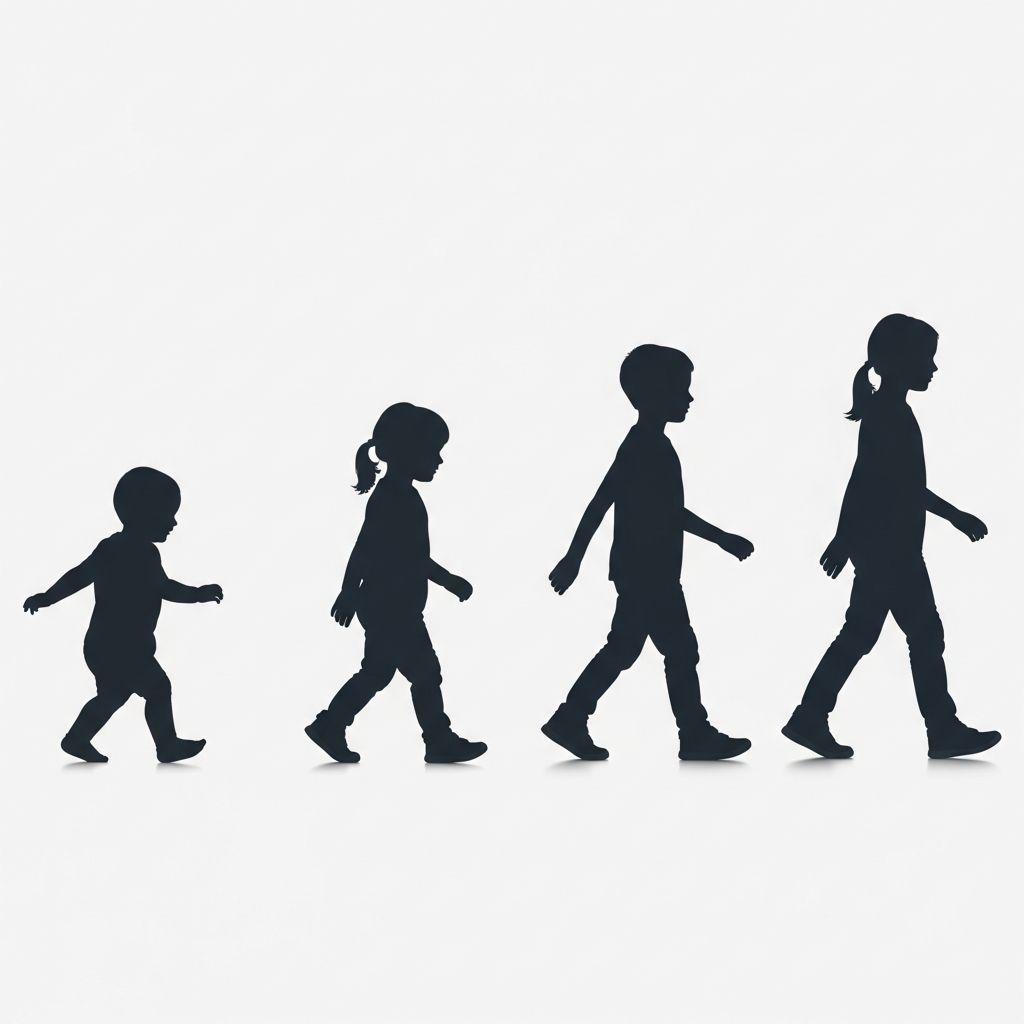
Understanding how children develop their walking style, known as gait, is essential for parents. Gait evolves from unsteady initial steps to efficient, adult-like movement. This progression reflects growth in muscles, balance, coordination, and the nervous system. Most kids start walking independently between 12 and 18 months, reaching a mature pattern by 7-8 years.
Earliest Signs of Locomotion in Infants
Even before birth, babies show stepping reflexes. Newborns display reflex stepping when held upright over a firm surface, mimicking walk-like motions. This persists until 2-3 months, then vanishes as the nervous system matures, reappearing near walking onset. Studies indicate 70-84% of healthy infants show these patterns, though not all use alternating legs.
These early movements build neural pathways for later walking. Around 8-10 months, babies cruise along furniture, transitioning to supported steps. Independent walking typically emerges at 12 months, varying from 8-18 months per WHO data.
Breakdown of the Walking Cycle
A complete gait cycle includes stance and swing phases. Stance (60% of cycle) is foot-ground contact for support; swing (40%) advances the leg forward. Young children start with flat-footed initial contact, progressing to heel strike by 18-24 months.
Mature gait features:
- Narrow base of support
- Heel-to-toe progression
- Reciprocal arm swing
- Appropriate step length and cadence
- Minimal variability between strides
Energy efficiency improves as kids refine these elements.
Key Milestones by Age Group
Gait refines through distinct phases. Here’s a timeline based on developmental research:
| Age/Experience | Characteristics | Key Changes |
|---|---|---|
| 0-3 months | Reflex stepping | Disappears temporarily |
| Birth to 12 months | Cruising, first steps | Broad base, high arm guard, flat feet, short steps, pelvic sway |
| 12-18 months | Early toddler walk | Waddling, arms up for balance, no arm swing |
| 3-6 months walking | Improving stability | Narrower stance, longer steps, less sway |
| 9-12 months walking | Heel strike emerges | Arms lower, heel-toe pattern |
| 2-3 years | Nearly symmetrical | Reciprocal arms, heel first, better balance |
| 4-7 years | Approaching mature | Reduced variability, efficient speed |
| 7-8+ years | Mature gait | Adult-like control, stable posture |
By 3 years, many walk heel-first with swinging arms. Full maturity, with low stride variability, occurs around 7-8 years.
Factors Shaping Gait Evolution
Several elements influence progression:
- Neurological maturation: Central nervous system refines control.
- Musculoskeletal growth: Strength, joint range, body proportions.
- Muscle-fat ratio and postural stability.
- Experience: Practice reduces variability; stride steadiness improves with time walked.
- Sensory input: Proprioception and tactile feedback.
- Environment: Safe spaces encourage exploration.
Studies show stride variability peaks at 4 years, declining by 11. Girls often mature faster due to proportions.
Common Temporary Variations
Some patterns self-correct:
- Bowlegs/knock knees: Normal up to 2-7 years.
- Flat feet: Arches develop by 3-5 years.
- Toeing in/out: Often resolves with growth.
- Frequent falls: Common at 2 years as speed increases.
These reflect bone/joint adaptation to gravity.
When to Monitor for Concerns
While variation is normal, persistent issues may signal problems like cerebral palsy or muscular dystrophy. Red flags include:
- No walking by 18 months.
- Asymmetrical steps (e.g., one foot drag).
- Persistent toe-walking past 3 years.
- Limping, frequent falls after 3 years.
- Wide-based gait beyond 3 years.
- Pain or stiffness.
Early intervention via physical therapy improves outcomes. Gait analysis tools help assess toddlers.
Supporting Healthy Development
Parents play a key role:
- Provide barefoot time on varied surfaces for sensory input.
- Encourage daily activity: walking, running, stairs.
- Use supportive shoes for outdoors; avoid overly rigid ones.
- Model balanced walking; avoid walkers (may delay milestones).
- Ensure nutrition for bone/muscle growth.
- Consult pediatricians for milestones.
Activities like obstacle courses build coordination.
Gait Analysis in Practice
Professionals use observation, video, or mats to evaluate. Therapists target stability, clearance, step length. For delays, orthotics or braces aid alignment. Research emphasizes experience’s role in variability reduction.
Frequently Asked Questions
Is it normal for my 18-month-old to walk with arms up?
Yes, high guard position aids balance early on; arms lower by 2-3 years.
Why does my toddler waddle?
Broad base provides stability; narrows with strength gains.
When should heel strike appear?
Around 18-24 months, fully by 3 years.
Should I worry about flat feet?
Often normal; monitor if persistent pain or gait issues past 5 years.
How much practice for mature gait?
Refinement continues to 7-8 years with daily activity.
Long-Term Implications
Mature gait by school age supports sports, prevents injuries. Monitoring ensures timely help for deviations, promoting lifelong mobility.
References
- Gait Development in the Growing Child — Physiopedia. 2023. https://www.physio-pedia.com/Gait_Development_in_the_Growing_Child
- Little Steps: Understanding Gait Development in Young Children — Pediatric Orthopedics. 2023. https://pediatricorthopedics.com/little-steps-understanding-gait-development-in-young-children/
- Gait Development Fact Sheet — Cerebral Palsy Foundation (cpresource.org). 2023. https://cpresource.org/topic/gait-development-movement-analysis/gait-development-fact-sheet
- Gait Development In Children — North Shore Pediatric Therapy. 2023. https://www.nspt4kids.com/parenting/gait-development-children
- The Development of Gait: Back to the Basics — Surestep (PDF). 2017. https://surestep.net/wp-content/uploads/2017/05/The-Development-of-Gait-Back-to-the-Basics.pdf (Remains authoritative for foundational stages).
- Walking (Gait) Abnormalities — Boston Children’s Hospital. 2025. https://www.childrenshospital.org/conditions-treatments/walking-gait-abnormalities