Bringing Science to Life with Laughter
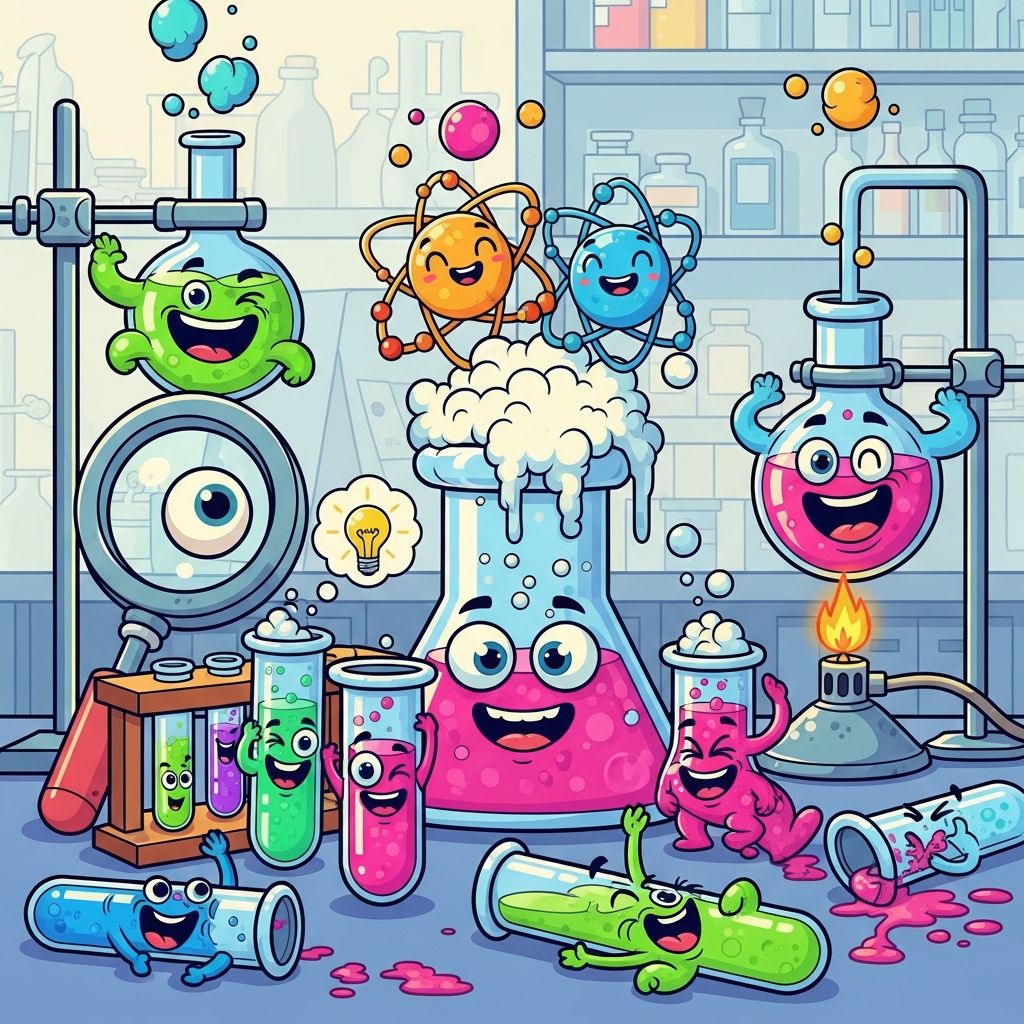
Science doesn’t have to be all equations, lab coats, and serious expressions. In fact, one of the best ways to help children connect with chemistry is through humor. Clever wordplay, puns, and jokes rooted in real scientific concepts can transform a potentially intimidating subject into something light, memorable, and genuinely fun. When kids laugh while learning, they’re more likely to remember what they’ve heard, ask questions, and stay curious about how the world works.
Chemistry, with its quirky elements, strange-sounding names, and fascinating reactions, is a goldmine for playful jokes. From elements like sodium and potassium to concepts like ions, pH, and chemical bonds, there’s no shortage of material that can be turned into a good laugh. The best chemistry jokes for kids are simple enough to understand, clever enough to impress, and educational enough to sneak in a bit of real science along the way.
Why Humor Works in Science Education
Humor isn’t just entertainment—it’s a powerful teaching tool. When children hear a joke that plays on a scientific idea, their brains do a little extra work to understand the punchline. That mental effort helps reinforce the underlying concept. For example, a joke about sodium (Na) or potassium (K) naturally introduces the idea of chemical symbols, even if the child doesn’t realize it at first.
Studies in educational psychology have shown that humor can improve attention, reduce anxiety, and increase motivation in learning environments. When a teacher or parent uses a well-placed joke, it can break the ice, make a difficult topic feel more approachable, and create a positive emotional connection to the subject. In chemistry, where many kids feel overwhelmed by formulas and terminology, a good laugh can be the difference between dread and delight.
Building Blocks of a Great Chemistry Joke
Not all science jokes land well with kids. The best ones follow a few simple rules:
- Keep it simple: Use everyday language and avoid overly complex terms unless they’re clearly explained.
- Use familiar concepts: Jokes about water, air, food, or common elements like oxygen and carbon are more relatable.
- Play with names and symbols: Element symbols (like Na for sodium or K for potassium) are perfect for puns.
- Include a real science idea: The joke should hint at a real concept, like bonding, reactions, or states of matter.
- Make it safe and inclusive: Avoid jokes that could be misinterpreted or that make anyone feel excluded.
When these elements come together, the result is a joke that’s not only funny but also a tiny lesson in disguise.
Elemental Puns That Kids Love
The periodic table is full of names that sound like they were made for jokes. Elements like helium, argon, and sulfur lend themselves to wordplay that’s easy for kids to grasp. Here are a few types of elemental puns that tend to get the biggest laughs:
- Element symbols as punchlines: Jokes that use the chemical symbol as the punchline (like “Na” for sodium) are simple and effective.
- Element names in phrases: Turning element names into silly phrases (like “SArCaSm” from sulfur, argon, calcium, and samarium) makes the periodic table feel more personal.
- Element personalities: Giving elements “personalities” (like helium being light and hard to hold onto) helps kids remember their properties.
These jokes work especially well when introduced alongside a lesson about the periodic table. They turn a list of symbols and numbers into a cast of characters with their own quirks and stories.
Chemical Reactions and Everyday Life
Many chemistry jokes are based on real reactions or everyday situations. For example, jokes about water, salt, or cooking can connect chemistry to things kids already know. A joke about drinking water while studying (“It decreases your concentration!”) ties a simple concept (concentration in chemistry) to a familiar experience (studying).
Other jokes play on common lab scenarios:
- Why did the chemist’s experiment explode? Because oxidants happen.
- What do you do with a sick chemist? If you can’t helium and you can’t curium, you might as well barium.
- Why was the electron so small? Because it has a low charge.
These jokes help demystify the lab and show that even scientists make mistakes and have a sense of humor. They also reinforce ideas like oxidation, ions, and atomic structure in a way that feels natural and fun.
Acids, Bases, and pH Puns
The pH scale is another rich source of chemistry humor. Kids quickly learn that acids are sour, bases are slippery, and the scale runs from 0 to 14. Jokes about pH can be both silly and informative:
- What do you call an acid with an attitude? A-mean-o acid.
- How do you insult someone who’s good-looking? You tell them they’re so basic, they’re a 10 on the pH scale.
- Why do chemists like ammonia? Because it’s pretty basic.
These jokes help kids remember that “basic” in chemistry means alkaline, not boring, and that pH is a measure of how acidic or basic something is. They also introduce the idea that chemicals can have “personalities” based on their behavior.
Atoms, Ions, and Bonds in Joke Form
Atoms and how they connect are central to chemistry, and there are plenty of jokes that play on bonding, ions, and atomic structure. These jokes often use personification to make abstract ideas more concrete:
- Why can’t atoms be trusted? Because they make up everything.
- What did one charged atom say to the other? I got my ion you.
- Why did carbon and hydrogen go on a date? Because they really bonded.
- What did the atom say at the electron sale? One cation’s trash is another anion’s treasure.
These jokes help kids visualize atoms as tiny particles that can gain or lose electrons (forming ions) and stick together (forming bonds). They also reinforce vocabulary like cation, anion, and electron in a way that feels playful rather than forced.
Organic Chemistry and the Alkynes of Trouble
Organic chemistry, with its long chains of carbon atoms and complex molecules, is often seen as the most challenging part of the subject. But even here, humor can lighten the mood. Jokes about organic chemistry often play on the names of compounds and the idea that the subject is full of “alkynes of trouble.”
- Why is organic chemistry so hard? Because it has alkynes of trouble.
- What do you call two diamonds out to dinner? Carbon dating.
- Why did the hamburger have less energy than the steak? Because it’s in the ground state.
These jokes introduce ideas like molecular structure, energy states, and carbon-based compounds in a way that’s accessible and memorable. They also help kids see that even the “hard” parts of chemistry can be approached with a smile.
Lab Life and Chemist Culture
Chemists have their own culture, full of inside jokes and traditions. Many chemistry jokes reflect this culture, from lab safety rules to the love of coffee and periodic table puns:
- How often should you tell a chemistry joke? Periodically.
- How do you insult a chemist? Tell them their jokes have no reaction.
- Why are chemists so happy in the lab? Because they’re in their element.
- Where do chemists put their dirty dishes? In the zinc.
These jokes help kids see chemists as real people who enjoy their work and have a sense of humor. They also reinforce important ideas like the periodic nature of elements and the importance of lab safety (like not licking the spoon!).
Using Jokes in the Classroom and at Home
Teachers and parents can use chemistry jokes in many ways to support learning:
- Icebreakers: Start a lesson with a joke to grab attention and set a positive tone.
- Review tools: Use jokes as a quick way to review concepts at the end of a class.
- Memory aids: Encourage kids to create their own jokes to help remember terms and ideas.
- Family fun: Share jokes at dinner or during car rides to keep science part of everyday conversation.
The key is to keep the tone light and inclusive. Not every joke will land, and that’s okay. The goal isn’t to be a stand-up comedian, but to show that science can be joyful and human.
Sample Joke Table for Quick Reference
| Joke | Science Concept | Why It Works |
|---|---|---|
| Why can’t atoms be trusted? Because they make up everything. | Atoms as building blocks of matter | Simple wordplay that reinforces a core idea |
| What did one charged atom say to the other? I got my ion you. | Ions and electric charge | Memorable pun that ties to vocabulary |
| Why was the electron so small? Because it has a low charge. | Electron size and charge | Connects a physical property to a pun |
| What do you call an acid with an attitude? A-mean-o acid. | Acids and pH | Personifies acids in a funny way |
| Why did carbon and hydrogen go on a date? Because they really bonded. | Chemical bonding | Uses a familiar idea (dating) to explain bonding |
Frequently Asked Questions
Are chemistry jokes appropriate for young kids?
Yes, as long as they’re age-appropriate and focus on simple, safe concepts. Jokes about element names, basic reactions, and everyday science are perfect for elementary and middle school students.
Can jokes really help kids learn chemistry?
Absolutely. Humor increases engagement, reduces anxiety, and helps with memory. When a joke is tied to a real concept, it can make that concept more memorable and easier to understand.
How can I explain a chemistry joke to a child who doesn’t get it?
Start by explaining the science idea behind the joke (like what an ion is or what pH means), then show how the words are being played with. Use simple language and real-life examples to make the connection clear.
Can kids create their own chemistry jokes?
Definitely! Encourage them to think about element names, symbols, and concepts they’ve learned, then challenge them to make a pun or a short joke. This turns learning into a creative activity.
Are there any topics to avoid in chemistry jokes?
It’s best to avoid jokes about dangerous chemicals, explosions, or anything that could encourage unsafe behavior. Focus on safe, everyday chemistry and positive, inclusive humor.
Making Science a Source of Joy
At its heart, chemistry is about curiosity—about asking how things work and why they behave the way they do. Jokes and puns are a way to honor that curiosity while keeping things light and fun. When kids laugh at a chemistry joke, they’re not just having fun; they’re engaging with science in a way that feels personal and meaningful.
Whether you’re a teacher looking for a new way to introduce the periodic table, a parent trying to make homework less stressful, or just someone who loves a good pun, chemistry jokes offer a simple, powerful way to connect with young learners. They remind us that science isn’t just about facts and formulas—it’s also about wonder, creativity, and, yes, a little bit of silliness.
References
- Why Humor Matters in the Classroom — American Psychological Association. 2023-05-15. https://www.apa.org/ed/schools/teaching-learning/humor-classroom
- Periodic Table of the Elements — Royal Society of Chemistry. 2024. https://www.rsc.org/periodic-table
- Teaching Chemistry with Humor and Engagement — Journal of Chemical Education. 2022-08-10. https://pubs.acs.org/doi/10.1021/acs.jchemed.2c00345