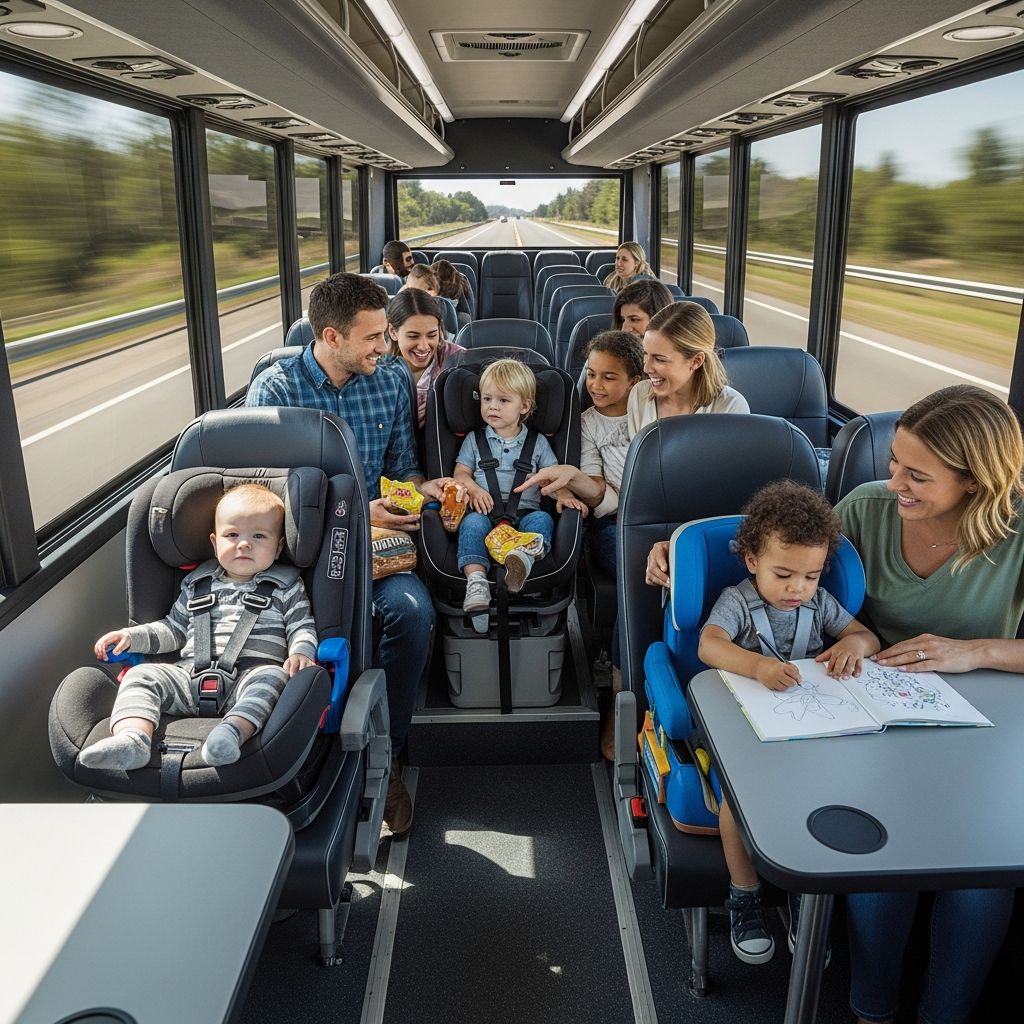
Group travel with very young children can feel like a puzzle: you know how to keep them safe in your own car, but a giant charter bus is a completely different world. This guide breaks down what parents actually need to know — in plain language — so you can make a thoughtful, informed plan instead of a panicked, last-minute one.
Why Bus Travel Feels So Confusing for Parents
Most parents have the car routine down: buckle the baby into a rear-facing seat, tighten the harness, double-check the chest clip, and drive away. On a charter bus, that familiar script falls apart. There might not be seat belts, there may be nowhere to install a car seat, and the bus itself is built around a safety philosophy that looks nothing like your minivan’s crash-test video.
On top of that, group trips — school outings, weddings, family reunions, sports tournaments — often involve schedules, budgets, and organizers who have never really thought about how an 18-month-old is supposed to ride on a 50-passenger coach. Parents are left trying to decode rules, weigh risks, and balance safety with reality.
How Charter Buses Protect Passengers (Without Car Seats)
To understand why car seats are not automatically required or even possible on many buses, it helps to know how full-size coaches are engineered for crashes. Modern motorcoaches are built on the idea of compartmentalization: high, padded seat backs placed close together create a protective shell around riders, distributing crash forces in a different way than a small passenger vehicle.
Because a bus rides high above most cars, weighs many tons, and usually travels at moderate highway speeds, the risk profile is very different from that of a small sedan or SUV. Instead of focusing on individual restraints for every passenger, designers focus on keeping the bus structure intact, preventing rollovers, and creating cushioned “pockets” between seats.
| Feature | Typical Car | Charter Bus |
|---|---|---|
| Primary safety strategy | Seat belts and car seats for each passenger | Large vehicle mass, high seating, and compartmentalized seating |
| Crash energy management | Belts restrain body; car seats spread forces across child’s body | Bus structure resists intrusion; padded, closely spaced seats distribute impact |
| Seat belt availability | Standard in all seating positions | Varies: some buses have none, some lap belts only, some 3-point belts |
| Car seat installation | Assumed and crash-tested with belts or LATCH anchors | Only possible if compatible belts or anchors are present |
This does not mean you ignore safety just because the bus shell is strong. It means you think about risk differently: slips in the aisle, hard stops, loose luggage, and crowd management matter just as much as crash physics for a short charter ride.
Can You Actually Use a Car Seat on a Charter Bus?
The most frustrating answer in parenting appears again here: it depends. A car seat is only useful on a bus if it can be installed correctly and kept secure for the entire trip. That requires specific hardware that not every coach has.
Before you drag a bulky seat across the parking lot, check what you are working with. The same seat that feels like a lifesaver in your car can become a tripping hazard, an unrestrained projectile, or an unused piece of luggage if there is no safe way to strap it down.
Conditions that allow safe car seat use
- The bus has clearly visible lap or lap-shoulder belts in your row.
- The belts are anchored in a way that aligns with your car seat’s installation paths.
- Your child restraint is approved for use with lap or lap-shoulder belts (check the manual).
- You can install the seat tightly enough that it moves less than an inch side-to-side at the belt path.
- There is enough front-to-back room for a rear-facing seat without forcing another passenger into an unsafe position.
When a car seat may not help
- The bus has no seat belts at all in the passenger area.
- The only belts present are incompatible with your specific seat or are too loose or worn to hold it firmly.
- The seat sits too high or deep, causing the restraint to tilt, overhang, or twist.
- The car seat will sit empty most of the trip because your child refuses to stay in it.
- The logistics of hauling and installing the seat multiple times during a tight, multi-stop itinerary will lead to rushed, sloppy installations.
In those cases, it can be safer to treat the bus ride as a different mode of travel entirely and focus instead on seating position, supervision, and overall trip planning.
Legal Gray Areas and What They Mean for You
Parents often assume that if their state requires car seats in personal vehicles, the same laws apply automatically to charter buses. In reality, commercial coaches, transit buses, and school buses are typically governed under separate rules. Many child-restraint laws specifically exclude large buses or do not mention them at all.
This can leave parents in a confusing space: your instincts say your toddler should be harnessed, but the law may not demand it, and the bus may not accommodate it. The absence of a legal requirement does not mean the ride is unsafe; it simply reflects a different safety model and the practical limits of outfitting every seat on every bus for car seat compatibility.
Planning a Trip: Questions to Ask the Bus Company
The single smartest thing you can do before committing to a bus trip with little ones is to clarify details with the charter company. Most of the anxiety around bus travel comes from showing up and discovering surprises — no belts, different bus than promised, no space for strollers, or seat arrangements that don’t work with your group.
Use the following checklist when you request a quote or confirm your booking. You do not need to be a safety expert; you just need clear, specific answers.
Safety and equipment questions
- “Does this exact bus have seat belts at every passenger seat, some seats, or none?”
- “Are the belts lap-only or lap-shoulder?”
- “Have passengers used their own car seats on your buses before?”
- “Do any of your buses have lower anchors (similar to LATCH in cars) for child restraints?”
- “Can we reserve specific rows to keep young children together near the front?”
- “Is there an accessible storage area for strollers, portable cribs, and extra gear?”
Policy and logistics questions
- “Are there rules about lap children or maximum number of passengers per seat?”
- “Are food and drinks allowed, and can we bring spill-proof snacks for toddlers?”
- “What is your policy on restroom breaks and unscheduled stops if a child becomes sick?”
- “Will the same bus stay with us all day, or will equipment change between legs of the trip?”
- “Do you provide written confirmation of equipment (like seat belts) we’re relying on?”
Answers to those questions help you decide whether to bring car seats, whether to request a different bus, or whether to rethink plans entirely if safety compromises feel too large.
Choosing the Safest Seats on the Bus
Even without individual restraints, where and how you seat children affects their risk. Think of the bus interior as a real-world game of “better and worse spots” rather than a uniform environment. Small choices add up to meaningful differences.
Parents and caregivers should plan the seating chart before boarding rather than improvising once the group is crowding the aisle. This keeps kids away from higher-risk areas and gives adults a clear supervision strategy.
General seating tips for young children
- Place babies and toddlers away from the very front row where glass and hard surfaces are most exposed.
- Avoid the last row if possible; rear sections can feel bumpier and noisier, which can unsettle anxious toddlers.
- Seat the youngest children on the aisle side of a row where an adult can easily help, rather than trapping them against the window.
- Keep siblings who tend to roughhouse separated or seated with different adults to reduce in-seat injuries.
- Assign at least one responsible adult to every two to three preschool-age children.
Bus seating strategy table
| Child’s age | Recommended location | Notes |
|---|---|---|
| Under 1 year | Near middle of bus with primary caregiver | Minimize motion and noise; easy access for feeding and soothing |
| 1–3 years | Front-middle section, aisle seat next to adult | Close supervision; quick access to exit and restroom |
| 4–6 years | Clusters with peers but anchored by adults at aisle seats | Mix independence with monitoring |
What to Pack for a Safer, Calmer Ride
Even if you cannot control the presence of seat belts, you control what is in your bag and how prepared you are. Thoughtful packing shifts a bus trip from “white-knuckle endurance test” to “manageable adventure.” For babies and toddlers, comfort and distraction are safety tools: calm kids are less likely to dart into aisles or fight against adults.
Use a small backpack or crossbody bag that you can keep at your feet for essentials; larger items can go in overhead bins or under-bus storage where they won’t become projectiles during sudden stops.
Essential items for babies
- Enough diapers and wipes for the trip plus a generous buffer.
- Changing pad and small disposable bags for dirty diapers.
- Bottles, breast milk or formula, and a way to keep them at safe temperatures.
- Two or three burp cloths and a spare outfit for inevitable spills.
- A lightweight blanket that can double as a nursing cover or window shade.
Essential items for toddlers
- Spill-proof water bottle and non-messy snacks like crackers, puffs, or sliced fruit in containers.
- Favorite comfort object: stuffed animal, small pillow, or blanket.
- Quiet toys: sticker books, magnetic drawing boards, small dolls or cars.
- Child-safe headphones and a pre-loaded device if screen time is part of your travel plan.
- Easy-on, easy-off layers in case the bus is too warm or too cold.
Managing Behavior and Movement During the Ride
On a long bus ride, the main safety risk for toddlers is often not a crash but everyday chaos: running in the aisle, climbing seats, grabbing railings, or startling the driver. Setting clear expectations early helps both children and adults understand the boundaries.
Instead of constant nagging, use simple, repeated rules and model them consistently. Kids adjust surprisingly well when they know the plan and see every adult following it.
Simple bus rules for little kids
- “Feet stay in front of you; bodies stay on the seat.”
- “Hands off the aisle while the bus is moving.”
- “Ask an adult before standing up or changing seats.”
- “Quiet voices so the driver can concentrate.”
- “No food in the aisle and no throwing anything.”
Helping kids settle in
- Start with a short “tour” of their seat area: where their bag goes, where the window is, where an adult will sit.
- Rotate quiet activities every 20–30 minutes rather than letting boredom lead to risky behavior.
- For hesitant riders, rehearse with stories or pretend play about riding a big bus before the trip.
- Use scheduled “stretch breaks” at rest stops so kids know when movement is coming.
Special Considerations: Infants, Nap Times, and Motion Sickness
Not all little passengers have the same needs. A sleepy 8-month-old who naps easily on shoulders is very different from a motion-sensitive 3-year-old who gets queasy on curvy roads. Adjust your plan to your child rather than applying a one-size-fits-all strategy.
If you are traveling as part of a school, camp, or daycare trip, communicate special needs to organizers ahead of time so they can plan seat assignments and schedules around vulnerable riders.
For very young infants
- Try to time at least part of the ride to align with a usual nap period.
- Use a wearable carrier only when the bus is stopped for boarding or disembarking; it should not be relied on as a restraint while moving.
- Feed smaller amounts more often to reduce the risk of large spit-ups on the move.
For motion-sensitive toddlers
- Choose a seat closer to the middle of the bus, which typically feels smoother.
- Encourage them to look out the front or side windows occasionally instead of only at books or screens.
- Keep a small “just in case” kit: resealable bags, wipes, spare shirt, and plastic gloves for adults.
- Talk with your child’s health provider in advance if medication or other specific strategies are being considered.
Coordinating as a Group: Parents, Teachers, and Organizers
Charter bus trips with kids rarely involve a single family. More often they are school events, church outings, extended-family gatherings, or youth activities. That means multiple adults share responsibility, even if only some of them have young children on board.
A little coordination before departure prevents misunderstandings during the trip. Decide who is in charge of what instead of assuming “someone” will handle safety, snacks, and seat assignments.
Roles that make trips smoother
- Trip lead: One adult who communicates with the bus driver, keeps the schedule, and makes final calls on route changes or extra stops.
- Safety lead: An adult who handles headcounts, checks that aisles are clear, and reinforces rules before departure and after stops.
- Kid captains: Adults seated throughout the bus who supervise small clusters of children and become their point of contact.
- Snack coordinator: Someone who manages distribution of food to minimize choking risks and mess.
Sample FAQ: Common Parent Concerns About Charter Buses and Car Seats
Do I have to bring a car seat for my toddler on a charter bus?
In many places, the laws that require car seats in passenger vehicles do not apply to large commercial buses. That means you are often not legally required to bring one. Whether you choose to use a seat anyway depends on the presence and type of seat belts, your child’s age and temperament, and the practicality of installing the seat securely.
Is a bus without seat belts automatically unsafe for my baby?
A bus without passenger belts is not directly comparable to a car without belts. The bus’s large size, height, and structural design reduce certain kinds of crash forces that are more severe in small vehicles. However, the lack of individual restraints does mean you must pay extra attention to supervision, where your child sits, and how you manage movement inside the bus.
Where should my car seat go if the bus does have belts?
If you decide to install a car seat, choose a location away from the first and last rows when possible, and use a seating position with the most compatible belt. Avoid blocking the aisle or emergency exits. Always follow your car seat manual for installation with lap or lap-shoulder belts, and do not use both a belt and lower anchors together unless your manual explicitly allows it.
What if the bus company promises belts but they are not there on the day of the trip?
Ask, in advance, for written confirmation of the equipment you are relying on, and arrive early enough to assess the actual bus. If the equipment is different from what was promised and that difference affects your decision to use car seats or even take that bus, raise the issue immediately with the trip organizer and the company so you can decide whether to proceed, switch buses, or adjust your plan.
How can I lower risk if car seats are not an option?
Focus on seat selection, adult-to-child ratios, aisle safety, clear rules about staying seated, and practical precautions like keeping heavy bags off laps and away from overhead edges. Calm, supervised children and a driver who is not distracted by onboard chaos are major contributors to overall safety.
Balancing Perfect Safety With Real-World Travel
No parent loves the idea of loosening safety standards, especially after years of hearing that car seats are non-negotiable. Bus travel challenges that mindset because the environment simply does not match the one child-safety campaigns are built around. The goal is not to abandon caution but to apply it intelligently in a different context.
By understanding how buses work, asking precise questions, and planning your seating, supervision, and packing strategy, you can transform a confusing, nerve-wracking scenario into a trip that feels thoughtful, measured, and manageable — even with the smallest passengers on board.