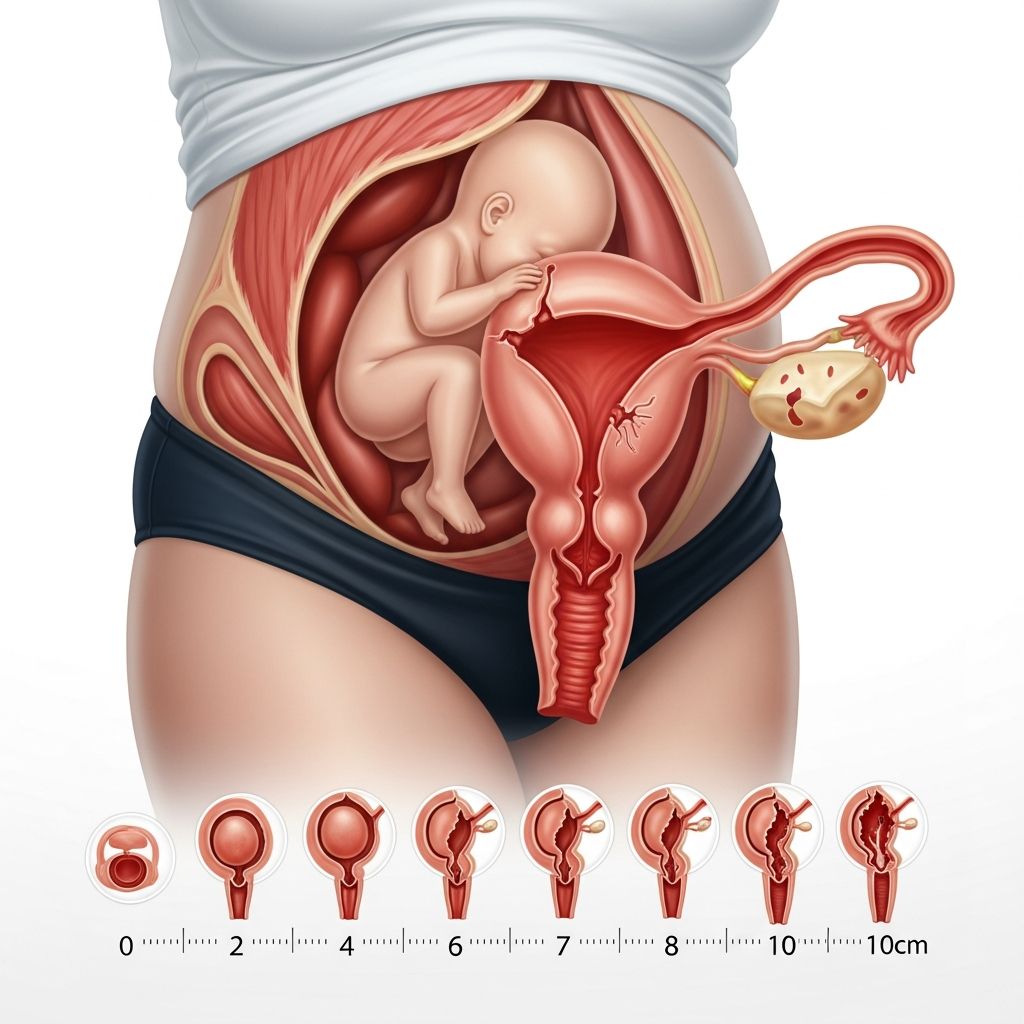
The journey of childbirth involves remarkable changes in a woman’s body, with cervical dilation serving as a primary indicator of labor advancement. This process measures how the cervix, the lower neck of the uterus, opens to allow the baby to pass through the birth canal, progressing from 0 to 10 centimeters. Full dilation at 10 cm marks the transition to pushing. Understanding this helps expectant parents track progress and know when to head to the hospital.
Understanding the Cervix and Its Role in Labor
The cervix acts as a gateway between the uterus and vagina. In non-pregnant states, it remains closed and firm. During late pregnancy and labor, hormones like oxytocin and prostaglandins trigger softening, thinning (effacement), and opening (dilation). Effacement, often expressed as a percentage, describes how much the cervix thins out, from 0% (thick) to 100% (paper-thin). Dilation and effacement typically occur together, enabling the baby to descend.
Healthcare providers assess these via internal vaginal exams, using gloved fingers to gauge the cervical opening in centimeters. Visual analogies help visualize progress: 1 cm resembles a Cheerio, 5 cm a mandarin orange, and 10 cm a bagel. Self-checks are possible but require caution to avoid infection.
Phases of Labor Tied to Cervical Dilation
Labor divides into three main stages, with the first focusing heavily on dilation. Stage 1 spans early, active, and transition phases; Stage 2 involves pushing; Stage 3 delivers the placenta.
Early Labor: 0-6 cm Dilation
This initial phase, known as the latent phase, features mild, irregular contractions every 5-20 minutes, lasting 30-45 seconds. The cervix dilates slowly from 0 to about 6 cm, effacing up to 80-100%. For first-time mothers, it may last 14-20 hours. Symptoms include lower backache, cramping, or bloody show (mucus plug loss). Stay home: walk, hydrate, shower for relief, and time contractions.
Active Labor: 6-10 cm Dilation
Contractions intensify, occurring every 3-5 minutes and lasting 60 seconds, dilating the cervix 1-1.5 cm per hour. This phase signals hospital admission, reducing interventions like epidurals or C-sections. Expect stronger pain, nausea, or pressure.
Transition: 8-10 cm Dilation
The most intense subphase, with contractions every 2-3 minutes lasting 60-90 seconds. Dilation accelerates from 8 cm (apple-sized) to 10 cm (bagel-sized). Lasting 15 minutes to 1 hour, it brings overwhelming sensations, shaking, or vomiting. Support from doulas or partners is crucial.
Cervical Dilation Chart: Visualizing Progress
Use this table to track dilation stages, contraction patterns, and typical durations for first-time births.
| Dilation (cm) | Visual Size | Contraction Frequency | Duration (First Birth) | Key Signs |
|---|---|---|---|---|
| 0-3 | Closed to quarter | 5-30 min apart | Hours to days | Mild cramps, bloody show |
| 4-6 | Oreo to avocado | 3-5 min apart | 4-8 hours | Stronger pain, go to hospital |
| 7-9 | Tomato to donut | 2-3 min apart | 1-3 hours | Intense pressure, nausea |
| 10 | Bagel | Every 2 min | Ready to push | Urge to bear down |
How to Check Cervical Dilation Yourself
While professionals perform exams, partners or midwives may teach self-checks for home monitoring. Wash hands thoroughly, trim nails, and assume a comfortable position like squatting or on hands/knees. Insert two fingers into the vagina toward the cervix (feels like a donut’s edge). Gently stretch fingers to measure the opening in cm; note texture (firm to soft) and effacement (thick to thin). Practice in late pregnancy to familiarize.
- Hygiene first: Prevents introducing bacteria.
- Timing: Check during or between contractions.
- Frequency: Every 1-2 hours in early labor.
- Stop if: Water breaks, bleeding occurs, or discomfort increases.
Accuracy improves with experience, but errors are common. Never force; consult a provider if unsure.
Effacement: The Thinning Companion to Dilation
Dilation pairs with effacement, where the cervix shortens from 3-4 cm thick to fully thinned. Measured in percentages: 50% means halfway thinned. Full effacement (100%) often precedes rapid dilation. In figure illustrations, early cervix is thick and closed; later, it’s thin and open. Track both for holistic progress view.
Factors Affecting Dilation Speed
Progress varies by parity (first birth slower), position, hydration, mobility, and interventions. Walking promotes descent; epidurals may slow dilation. Posterior babies or OP position delay progress. Optimal fetal positioning (anterior head-down) aids faster dilation.
When to Head to the Hospital
Guidelines recommend active labor admission (6 cm, contractions every 3-5 min). Earlier for GBS-positive, multiples, or prior C-section. Call if water breaks, bleeding, decreased fetal movement, or contractions <5 min apart.
Signs of Labor Progress Beyond Dilation
- Regular, intensifying contractions.
- Bloody show or mucus plug.
- Water breaking (clear fluid rush).
- Baby dropping (lightning crotch sensation).
- Urge to push (10 cm signal).
Monitor fetal kicks; non-reassuring patterns warrant immediate care.
Frequently Asked Questions About Cervical Dilation
Can I dilate without contractions?
Yes, late pregnancy dilation (1-3 cm) occurs without labor, especially in multiparas. True labor pairs dilation with regular contractions.
How long after 10 cm does baby come?
Stage 2 varies: 15-30 min to hours. First births average 1-2 hours; coached pushing shortens it.
Is self-checking safe?
Generally yes if hygienic, but risky post-membrane rupture due to infection. Leave to pros if uncertain.
What if dilation stalls?
Common in active labor; walking, nipple stimulation, or AROM may help. Pitocin or C-section if prolonged.
Does effacement hurt?
Not typically; discomfort arises from contractions causing both processes.
Tips for Coping Through Dilation Stages
Early labor: Rest, eat lightly, use heat packs.
Active: Hydrotherapy, breathing techniques, doulas.
Transition: Change positions, vocalize, get counterpressure. Birthing balls, peanut balls aid progress.
Partner roles: Time contractions, offer massages, advocate. Education via classes empowers.
Medical Monitoring and Interventions
Hospitals use continuous fetal monitoring, cervical exams every 2-4 hours. If progress slows (<1 cm/hr active), options include:
- Position changes.
- IV fluids.
- Oxytocin augmentation.
- Amniotomy.
- C-section if arrest.
Evidence favors delaying admission to minimize interventions.
References
- Cervix Dilation Chart: Stages of Labor — Healthline. 2024-09-12. https://www.healthline.com/health/pregnancy/cervix-dilation-chart
- Stages of Labor & Delivery — Beth Israel Deaconess Medical Center. https://bidmc.org/services/pregnancy-birth/labor-delivery/stages-of-labor
- Cervix dilation chart: Stages of labor and what to expect — Medical News Today. https://www.medicalnewstoday.com/articles/322615
- Stages of labor and birth: Baby, it’s time! — Mayo Clinic. https://www.mayoclinic.org/healthy-lifestyle/labor-and-delivery/in-depth/stages-of-labor/art-20046545
- Stages of Labor: What To Expect During Labor & Delivery — Cleveland Clinic. https://my.clevelandclinic.org/health/body/22640-stages-of-labor
- Cervical effacement and dilation — Mayo Clinic. https://www.mayoclinic.org/healthy-lifestyle/labor-and-delivery/multimedia/cervical-effacement-and-dilation/img-20006991