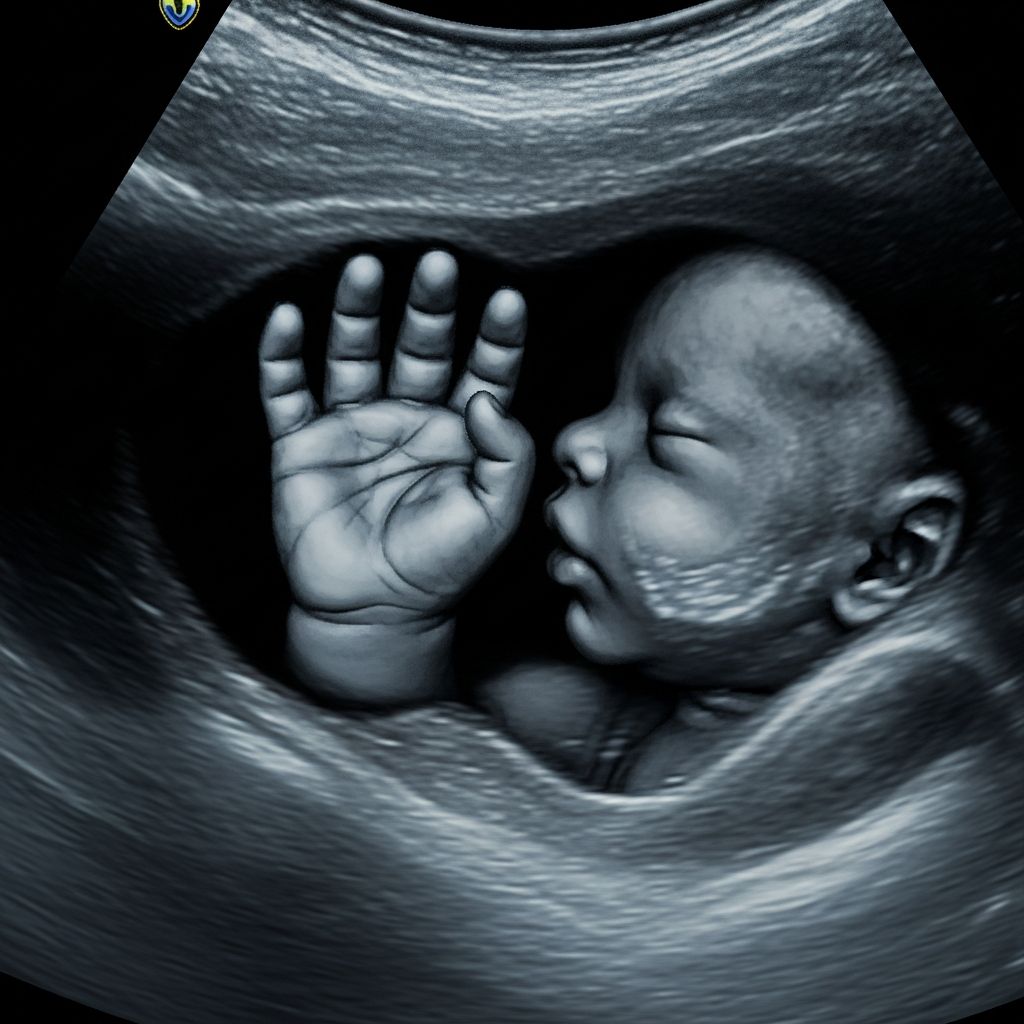
Expectant parents often wonder about their baby’s traits, from eye color to personality. One intriguing discovery from modern science is the ability to forecast a child’s dominant hand—left or right—through routine prenatal ultrasounds. Studies reveal that by observing fetal hand movements around the 18th week of pregnancy, researchers can predict handedness with accuracy rates between 89% and 100%, verified years after birth. This breakthrough not only highlights the innate nature of handedness but also opens doors to early detection of developmental concerns.
The Science Behind Fetal Handedness
Handedness, the preference for using one hand over the other, emerges early in fetal life. Unlike popular myths suggesting it’s shaped by environment or training, evidence points to biological origins rooted in brain asymmetry. The human brain’s hemispheres specialize differently: the left typically controls language and fine motor skills for the right side of the body, explaining why about 90% of people are right-handed.
Researchers in Italy pioneered a method using four-dimensional (4D) ultrasound to capture real-time fetal movements. They focused on precise actions, such as touching the face or eyes, versus gross movements like pressing against the uterine wall. Fetuses at 14, 18, and 22 weeks showed emerging preferences: by week 18, the dominant hand executed precise tasks faster and more accurately.
This prenatal dominance persists. In a study of 29 healthy pregnancies, predictions based on these observations matched the children’s handedness at age nine with near-perfect precision. Factors like movement speed and target accuracy were key predictors.
How Ultrasounds Reveal Hidden Preferences
Standard ultrasounds provide 2D images, but 4D technology adds motion and depth, ideal for studying subtle hand behaviors. During scans, sonographers note if a fetus favors one hand for self-touching or manipulation. Right-hand bias appears in roughly 85% of fetuses, mirroring adult populations.
- Week 14: Early, tentative movements with no clear dominance.
- Week 18: Precision tasks reveal preferred hand—faster reaches to eyes or mouth.
- Week 22: Dominance strengthens, confirming patterns.
These observations require just 20 minutes per session, making them feasible during routine anatomy scans. No special equipment beyond standard 4D ultrasound is needed, potentially integrating into prenatal care.
Brain Development and Hemispheric Dominance
Handedness links to cerebral lateralization, where one brain hemisphere dominates motor control. The left hemisphere governs the right hand in most individuals. Fascinatingly, fetal hand preferences precede visible brain asymmetry, sparking debate: does motor behavior shape the brain, or vice versa?
Studies from as early as 10 weeks gestation detect right-hand preferences in 85% of embryos, stable through childhood. This stability underscores handedness as a prenatal trait, not postnatal learning.
| Gestational Week | Hand Movement Observation | Predictive Accuracy |
|---|---|---|
| 10-14 weeks | Basic grasping, emerging bias | ~85% right-hand preference |
| 18 weeks | Precise self-touching | 89-100% postnatal match |
| 22 weeks | Refined dominance | High confirmation rate |
Health Implications for Left-Handed Babies
While right-handedness dominates, left-handedness (about 10% of people) correlates with certain conditions due to atypical brain asymmetry. Left-handers show higher risks for autism spectrum disorder (ASD), schizophrenia, and depression. Prenatal handedness screening could flag at-risk fetuses for early interventions.
For instance, non-right-handedness links to cerebral differences mirroring those in neurodevelopmental disorders. Early identification might enable therapies to mitigate developmental disparities, though larger studies are needed.
Importantly, ultrasound exposure itself does not influence handedness. A Helsinki trial found no increase in non-right-handedness from prenatal scans.
Practical Advice for Expectant Parents
During your mid-pregnancy anatomy scan (around 18-20 weeks), ask your sonographer about fetal hand use. Phrases like “Is the baby favoring one hand?” can prompt observation. While not diagnostic, this info adds wonder to the experience.
Post-birth, track your baby’s preferences: which hand grasps toys first? By age 2-3, handedness solidifies. Encourage natural development without forcing switches, as suppression can hinder motor skills.
Limitations and Future Research Directions
Current methods shine in small cohorts, but scaling to diverse populations is crucial. Factors like multiple pregnancies or maternal health weren’t deeply explored. Predictive power varies by analysis parameters, from 89% to 100%.
Future work aims at clinical tools for routine use, linking handedness to outcomes like ASD risk. Longitudinal studies will clarify if early knowledge improves interventions.
Common Myths About Handedness Debunked
- Myth: Handedness develops after birth. Fact: Prenatal movements establish it by 18 weeks.
- Myth: Ultrasounds cause left-handedness. Fact: No causal link exists.
- Myth: All left-handers face health issues. Fact: Associations exist, but most thrive.
- Myth: You can train dominance. Fact: Innate traits resist change.
Frequently Asked Questions
Can all ultrasounds predict handedness?
Not yet standard, but 4D scans at 18 weeks enable it with high accuracy in research settings.
Is left-handedness a health concern?
It correlates with some risks like autism, but early monitoring could help—not a definitive predictor.
When does a baby’s handedness become permanent?
Prenatal preferences match 9-year-olds in studies, stabilizing by early childhood.
Should I worry if my fetus seems left-handed?
No—celebrate uniqueness. Discuss with your doctor for context.
Does family history influence fetal handedness?
Genetics play a role, but prenatal scans reveal individual traits directly.
This discovery blends excitement with science, empowering parents with foresight into their baby’s innate traits. As research evolves, prenatal care grows more predictive and personalized.
References
- Science Can Predict if Babies Are Left-Handed Even Before They’re Born — ScienceAlert. 2018-01-03. https://www.sciencealert.com/science-can-predict-left-handed-people-before-they-are-born
- Scientists Can Tell in Womb if Baby Will be Left-Handed — TIME. 2018-01-03. https://time.com/5049822/left-right-handed-babies-research/
- Are you born right/left handed? — Advocate Health Care. 2018-01-04. https://www.ahchealthenews.com/2018/01/04/born-right-left-handed/
- Right and Left-Handedness — Charlotte Lozier Institute. N/A. https://lozierinstitute.org/dive-deeper/right-and-left-handedness/
- Ultrasound can detect if baby will be left-handed — Motherly. 2022-02-07. https://www.mother.ly/life/the-ultrasound-tech-could-probably-tell-if-your-baby-will-be-left-handed/
- Handedness in the Helsinki Ultrasound Trial — Ultrasound in Obstetrics & Gynecology. 2011. https://obgyn.onlinelibrary.wiley.com/doi/10.1002/uog.8962