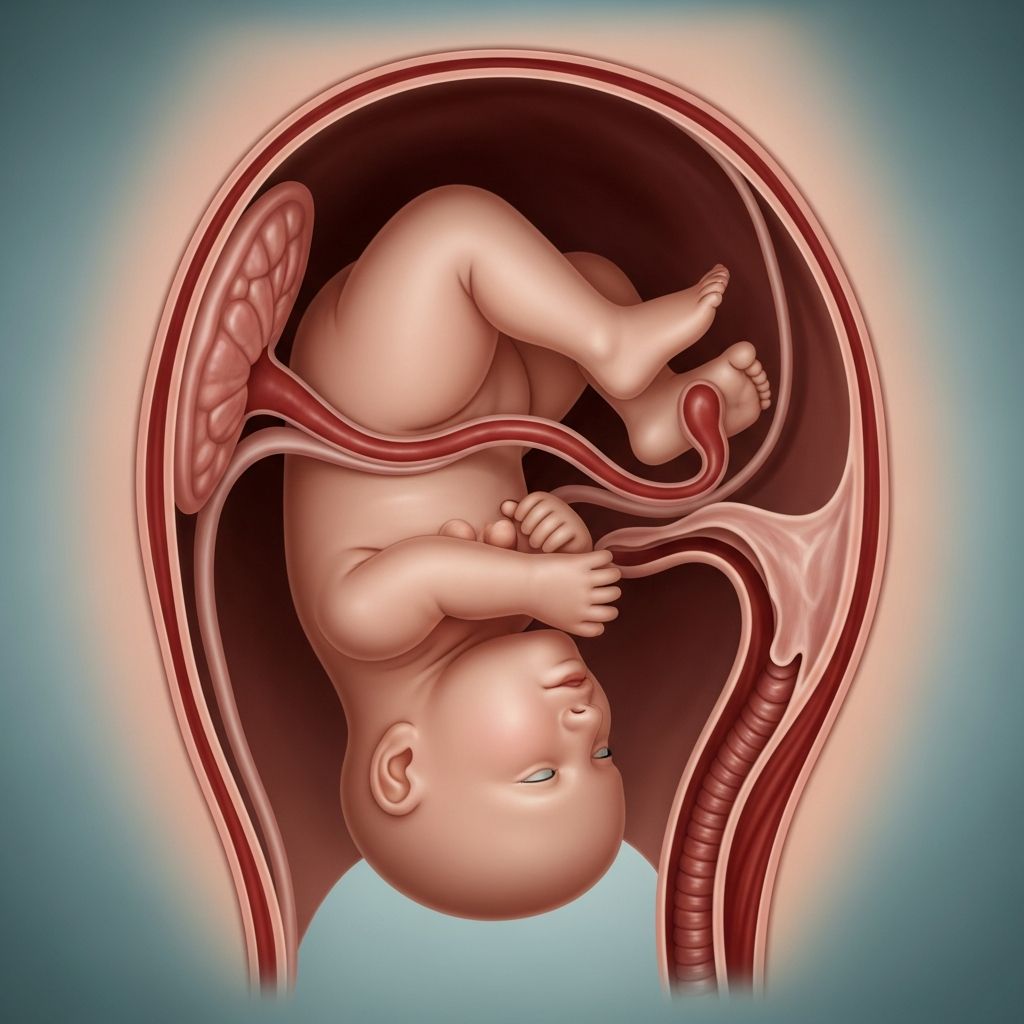
A breech baby position happens when a fetus is oriented with its buttocks or feet toward the birth canal instead of the head, occurring in about 3-4% of full-term pregnancies. This positioning raises specific considerations for labor and delivery, but with modern medical interventions, most outcomes are positive.
Understanding Breech Presentations in Pregnancy
During pregnancy, fetuses naturally shift positions as they grow. By around 36-37 weeks, most settle into a head-down (cephalic) position ideal for vaginal birth. Breech occurs when this doesn’t happen, with the baby remaining bottom- or foot-first. There are three main types:
- Complete breech: The baby’s buttocks point down, with hips and knees flexed as if sitting.
- Frank breech: The most common type, where buttocks are down and legs extend straight up toward the head.
- Footling or incomplete breech: One or both feet are positioned to emerge first, increasing certain delivery risks.
Early in pregnancy, up to 25-30% of babies are breech due to ample space for movement, but this drops significantly as the uterus fills and term approaches. Detection typically occurs via ultrasound around 36 weeks, though midwives may palpate the abdomen earlier.
Factors Leading to Breech Positioning
The exact reasons for breech are often idiopathic, meaning no clear cause, but several risk factors increase likelihood. These include:
- Premature labor or preterm fetuses, as they have more room to flip but less time to settle head-down.
- Multiple pregnancies (twins or more), where space constraints prevent proper turning.
- Amniotic fluid imbalances: too much (polyhydramnios) allows excessive movement, too little (oligohydramnios) restricts it.
- Uterine anomalies like fibroids or bicornuate shape, altering available space.
- Placental issues, such as previa where it covers the cervix.
- Fetal conditions, including certain birth defects, neuromuscular issues, or growth restrictions that limit mobility.
Maternal factors like prior breech births, older age, or hypothyroidism may also play a role, though evidence varies. Importantly, breech itself doesn’t harm the pregnancy but signals potential delivery challenges.
Diagnosing a Breech Baby: Signs and Tests
Healthcare providers assess fetal position through Leopold’s maneuvers—abdominal palpation to feel the head, back, and buttocks. A hard, round shape high in the abdomen suggests a head-up breech, while a softer mass lower down indicates buttocks. Confirmation comes via ultrasound, which precisely visualizes position, rules out anomalies, and checks fluid levels.
Fundal height measurements may hint at issues if inconsistent with gestational age. In late pregnancy, if suspected, prompt imaging ensures timely planning. Routine third-trimester scans in high-risk cases aid early detection.
| Method | Accuracy | Non-Invasive | Best Used |
|---|---|---|---|
| Abdominal Palpation | Moderate (70-80%) | Yes | Preliminary screening |
| Ultrasound | High (95-100%) | Yes | Confirmation & details |
| Fetal Heart Tones | Low | Yes | Supportive only |
Efforts to Turn a Breech Baby Naturally
Many parents explore non-invasive methods to encourage head-down positioning before medical interventions. These draw from anecdotal and limited-study evidence:
- Moxibustion: Burning a herb near acupuncture points to stimulate fetal activity; some studies show modest success rates around 30-50%.
- Chiropractic Webster Technique: Focuses on sacral alignment to improve pelvic space.
- Postural exercises: Forward-leaning inversions, knee-to-chest positions, or swimming to leverage gravity.
- Acupuncture or hypnotherapy: Aimed at relaxation and uterine tone adjustment.
While promising, these lack robust randomized trial support and work best before 36 weeks. Always consult providers to avoid risks like falls.
Medical Intervention: External Cephalic Version (ECV)
ECV is the primary medical approach to manually rotate the baby externally, typically at 37-38 weeks. Performed in a hospital with ultrasound and fetal monitoring, the provider applies firm pressure to the abdomen—one hand on the buttocks to push up, the other on the head to guide down.
Success rates range from 50-65%, higher in multiparous women or with adequate fluid. Medications like tocolytics relax the uterus, boosting efficacy. Contraindications include multiples, placental issues, or fetal distress.
Potential complications, though rare (1-2%), encompass transient heart rate changes, preterm labor, or membrane rupture. Post-ECV monitoring ensures stability, and many proceed to vaginal birth if successful.
Delivery Choices for Breech Babies
Once term arrives, options depend on type, gestational age, provider expertise, and facility capabilities.
Vaginal Breech Delivery
Possible in select cases like frank breech with experienced teams, but risks include cord prolapse (cord slips out first, compressing oxygen supply), head entrapment (body delivers before head dilates canal fully), and birth trauma. Neonatal hypoxia or injury rates are higher than cephalic births. ACOG advises against routine vaginal breech unless skilled personnel and OR access are immediate.
Cesarean Section (C-Section)
The gold standard for most breeches at term, minimizing perinatal morbidity. Scheduled around 39 weeks, it avoids vaginal risks entirely. Recovery involves standard post-op care, with future pregnancies assessed individually.
| Aspect | Vaginal Breech | Planned C-Section |
|---|---|---|
| Perinatal Mortality | 2-5x higher | Low (similar to cephalic) |
| Maternal Morbidity | Moderate | Higher short-term (infection, bleeding) |
| Success Rate | Variable | Nearly 100% |
| Future Pregnancies | No VBAC issues | Scar considerations |
Potential Risks and Outcomes for Breech Babies
While most breech babies thrive, slight elevations in congenital anomalies (e.g., neural tube defects) exist, possibly causal or associative. Delivery risks like brachial plexus injury or cerebral palsy stem from hypoxia if unmanaged. Long-term, no definitive cognitive or developmental deficits link solely to breech positioning with appropriate care.
Maternal risks mirror general labor but amplify with complications like abruption during ECV. Multidisciplinary teams, including neonatologists, optimize results.
Preparation and Support for Breech Pregnancies
Expectant parents should discuss plans early—ideally at 32-34 weeks. Key steps include:
- Choosing providers experienced in breech management.
- Understanding hospital protocols for ECV and backups.
- Packing for potential C-section.
- Monitoring fetal movements daily.
Support groups and doulas familiar with breech provide emotional backing. Post-birth, skin-to-skin and breastfeeding aid bonding regardless of method.
Frequently Asked Questions (FAQs)
Can a breech baby turn on its own after 36 weeks?
Possible but unlikely; spontaneous version drops sharply post-36 weeks due to reduced space. ECV offers better odds.
Is ECV painful?
Discomfort varies—some feel strong pressure, others minimal with relaxation aids. It’s brief, lasting 5-15 minutes.
Does breech mean my baby has a birth defect?
Not necessarily; most are healthy. Anomalies occur slightly more but routine checks rule them out.
Can I attempt vaginal breech with a first-time birth?
Rarely advised due to higher risks; C-section is safer for primiparous women.
What if my breech is diagnosed at 39 weeks?
C-section is typically planned promptly to avoid labor onset risks.
References
- Breech Births — American Pregnancy Association. 2023. https://americanpregnancy.org/healthy-pregnancy/labor-and-birth/breech-presentation/
- Fetal Presentation, Position, and Lie (Including Breech Presentation) — Merck Manuals. 2025-01-01. https://www.merckmanuals.com/home/women-s-health-issues/complications-of-labor-and-delivery/fetal-presentation-position-and-lie-including-breech-presentation
- Breech Baby: What Causes it and What to Expect — Madison Women’s Health. 2024. https://madisonwomenshealth.com/blog/breech-baby-what-causes-it-and-what-to-expect/
- Breech birth — Wikipedia (references primary studies). 2025. https://en.wikipedia.org/wiki/Breech_birth
- If Your Baby Is Breech — American College of Obstetricians and Gynecologists (ACOG). 2024-05-31. https://www.acog.org/womens-health/faqs/if-your-baby-is-breech
- Breech Baby: Causes, Complications, Turning & Delivery — Cleveland Clinic. 2024-08-20. https://my.clevelandclinic.org/health/diseases/21848-breech-baby
- Breech baby at the end of pregnancy — Royal College of Obstetricians and Gynaecologists (RCOG). 2023. https://www.rcog.org.uk/for-the-public/browse-our-patient-information/breech-baby-at-the-end-of-pregnancy/