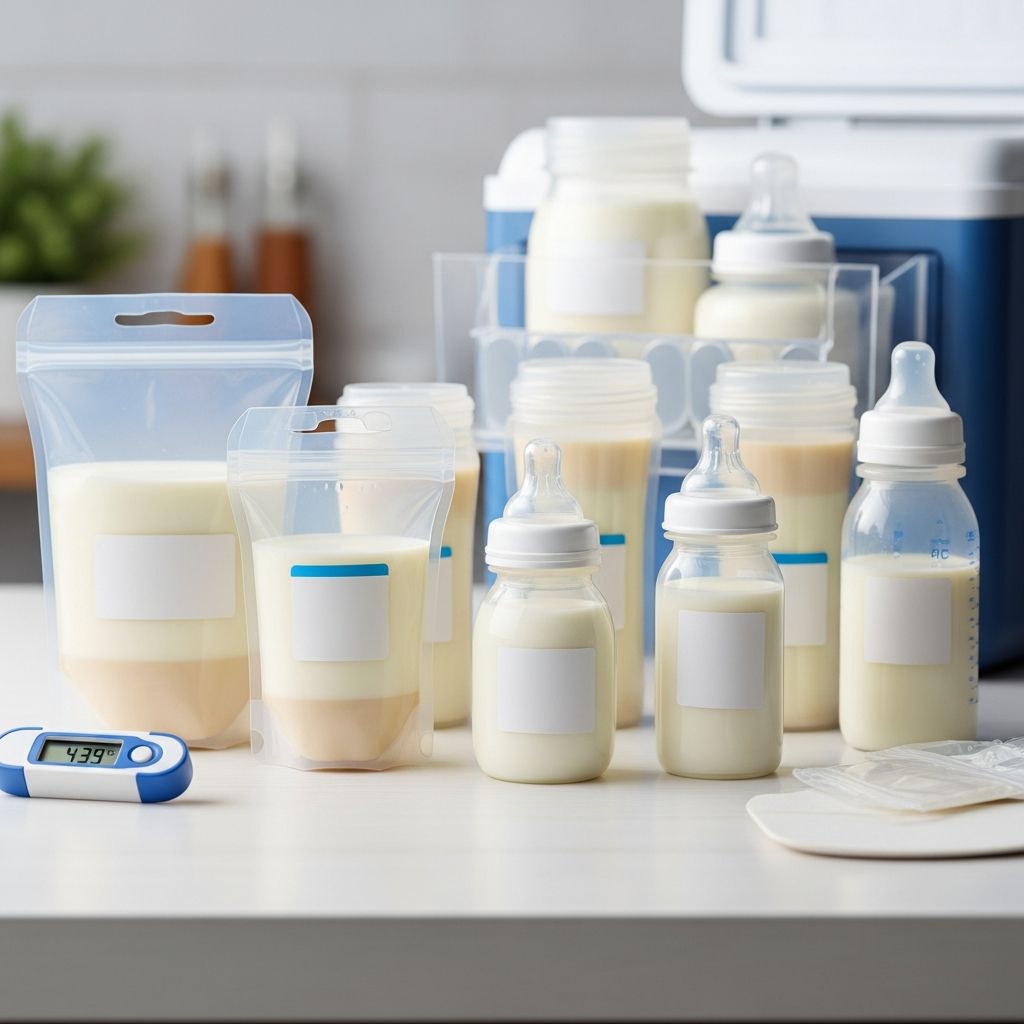
Properly storing expressed breast milk ensures your baby receives the full nutritional benefits while minimizing risks of bacterial growth. Guidelines from health authorities emphasize temperature control, clean handling, and appropriate containers to preserve milk quality for healthy, full-term infants.
Why Safe Storage Matters for Breastfeeding Parents
Breast milk contains antibodies and nutrients that support infant immunity and growth, but it can spoil if not handled correctly. Expressed milk provides flexibility for working parents, caregivers, or situations requiring pumped feeds. Following evidence-based protocols prevents waste and health issues like digestive upset.
Key principles include expressing into sterile containers, labeling with dates, and adhering to time-temperature limits. These practices, adapted from clinical protocols, balance safety with practicality.
Choosing the Right Containers for Milk Storage
Select containers designed specifically for human milk to avoid contamination and chemical leaching. Recommended options include:
- Special breast milk storage bags, which are sterile and freezer-safe.
- Clean, food-grade glass jars with tight-fitting lids.
- BPA-free hard plastic bottles rated for milk storage.
Avoid disposable bottle liners, general plastic bags, or containers with recycle code 7, as they may contain BPA or puncture easily.
Always wash hands thoroughly before pumping or handling milk. Sterilize containers initially and use new ones for each session when possible.
Storage Durations by Temperature
Freshly expressed breast milk has varying safe storage times based on temperature. Cooler conditions extend usability while maintaining quality. Use the table below for quick reference, based on guidelines for full-term, healthy babies.
| Storage Location | Temperature | Duration | Notes |
|---|---|---|---|
| Room temperature (countertop) | Up to 77°F (25°C) | Up to 4 hours (best within 4; some sources up to 6) | Keep covered and cool; discard leftovers within 2 hours of feeding start. |
| Refrigerator | 40°F (4°C) or below | Up to 4 days (some up to 5-8 days at stable 4°C) | Store in back, away from door. Label clearly if shared fridge. |
| Freezer compartment (fridge freezer) | 0°F (-18°C) or colder | Up to 6 months optimal; 12 months acceptable | Back of freezer for stability; quality may decline after 6 months. |
| Deep freezer (separate unit) | 0°F (-18°C) or colder | Up to 12 months | Consistent cold temps preserve nutrients best. |
| Insulated cooler with ice packs | Near fridge temp | Up to 24 hours | Ideal for transport; refrigerate or freeze after. |
These durations incorporate safety margins. For example, one study supports up to 8 days in a fridge at stable 4°C, but 4-5 days is standard for caution.
Practical Tips for Freezing Breast Milk
Freeze milk promptly if not using within fridge limits. Portion into 2-4 ounce (60-120 mL) amounts to match typical feeds and reduce waste.
- Label each bag or container with date, time, and baby’s name (for daycare).
- Leave 1 inch (2.5 cm) headspace for expansion.
- Loosely cap until fully frozen to prevent bursting.
- Store in the back of the freezer, not the door, for steady temperatures.
Avoid storing near raw meats or eggs to prevent cross-contamination.
Thawing and Warming Expressed Milk
Thaw oldest milk first to rotate stock. Never refreeze thawed milk, as this compromises quality and safety.
Thawing methods:
- Refrigerator overnight (safest; up to 24 hours once thawed).
- Under warm (not hot) running water, container sealed.
- In a bowl of warm water, swirling occasionally.
Storage for thawed milk:
| Location | Duration |
|---|---|
| Room temperature | 1-2 hours |
| Refrigerator | Up to 24 hours |
| Freezer | Do not refreeze |
Milk can be served at room temperature, cold from fridge, or gently warmed. Swirl to mix fat layers; do not microwave, as it creates hot spots and destroys nutrients.
Discard leftovers within 2 hours of starting a feed.
Transporting Stored Breast Milk
For on-the-go needs, use insulated coolers with frozen ice packs. Fresh milk stays viable up to 24 hours; previously refrigerated up to 24 hours if kept below 10°C (50°F).
- Wrap ice packs in towels to avoid direct freezing.
- Maintain chain of cold; refrigerate or freeze upon arrival.
- For hospital transport, follow facility-specific rules.
Common Mistakes to Avoid in Milk Storage
Steer clear of these pitfalls to protect your supply:
- Overfilling containers, leading to spills or cracks.
- Using milk beyond recommended times, risking spoilage.
- Forgetting labels, causing confusion in multi-user fridges.
- Thawing in hot water or microwave, which can scald baby.
- Storing in door compartments where temps fluctuate.
Handling Milk for Multiple Babies or Caregivers
If sharing with daycare, label with child’s name and date. Use separate containers per session. Cool fresh milk before combining with same-day refrigerated milk.
FAQs on Breast Milk Storage
Can I mix fresh milk with refrigerated milk?
Yes, if both are from the same day and fresh milk is cooled first. Do not add to frozen milk.
How do I know if stored milk is spoiled?
Check for off smell (sour, rancid), unusual color, or separation that doesn’t remix with swirling. When in doubt, throw it out.
Is frozen milk as nutritious as fresh?
Nutritional value remains high within guidelines, though some antibodies may decrease over 12 months. Use within 6 months for best quality.
What’s the fridge temperature for safe storage?
4°C (39°F) or below; monitor with a thermometer for stability.
Can I store milk in the freezer door?
No, doors fluctuate with openings; use the back for consistent cold.
Updates and Variations in Guidelines
Recommendations evolve with research. UK guidelines extend fridge time to 5 days at 4°C, while US sources stick to 4 days conservatively. Always prioritize primary sources like CDC or ABM for your region.
References
- Pumping and storing breastmilk — Office on Women’s Health. 2023. https://womenshealth.gov/breastfeeding/pumping-and-storing-breastmilk
- Expressing and storing breastmilk — The Breastfeeding Network. 2022. https://www.breastfeedingnetwork.org.uk/breastfeeding-information/continuing-the-breastfeeding-journey/expressing-and-storing-breastmilk/
- Breast milk storage: Do’s and don’ts — Mayo Clinic. 2024-01-15. https://www.mayoclinic.org/healthy-lifestyle/infant-and-toddler-health/in-depth/breast-milk-storage/art-20046350
- Storage and Preparation of Breast Milk — CDC. 2021. https://www.cdc.gov/breastfeeding/pdf/preparation-of-breast-milk_h.pdf
- ABM Clinical Protocol #8: Human Milk Storage Information for Home Use for Full-Term Infants — Academy of Breastfeeding Medicine. 2017 (revised). https://abm.memberclicks.net/assets/DOCUMENTS/PROTOCOLS/8-human-milk-storage-protocol-english.pdf