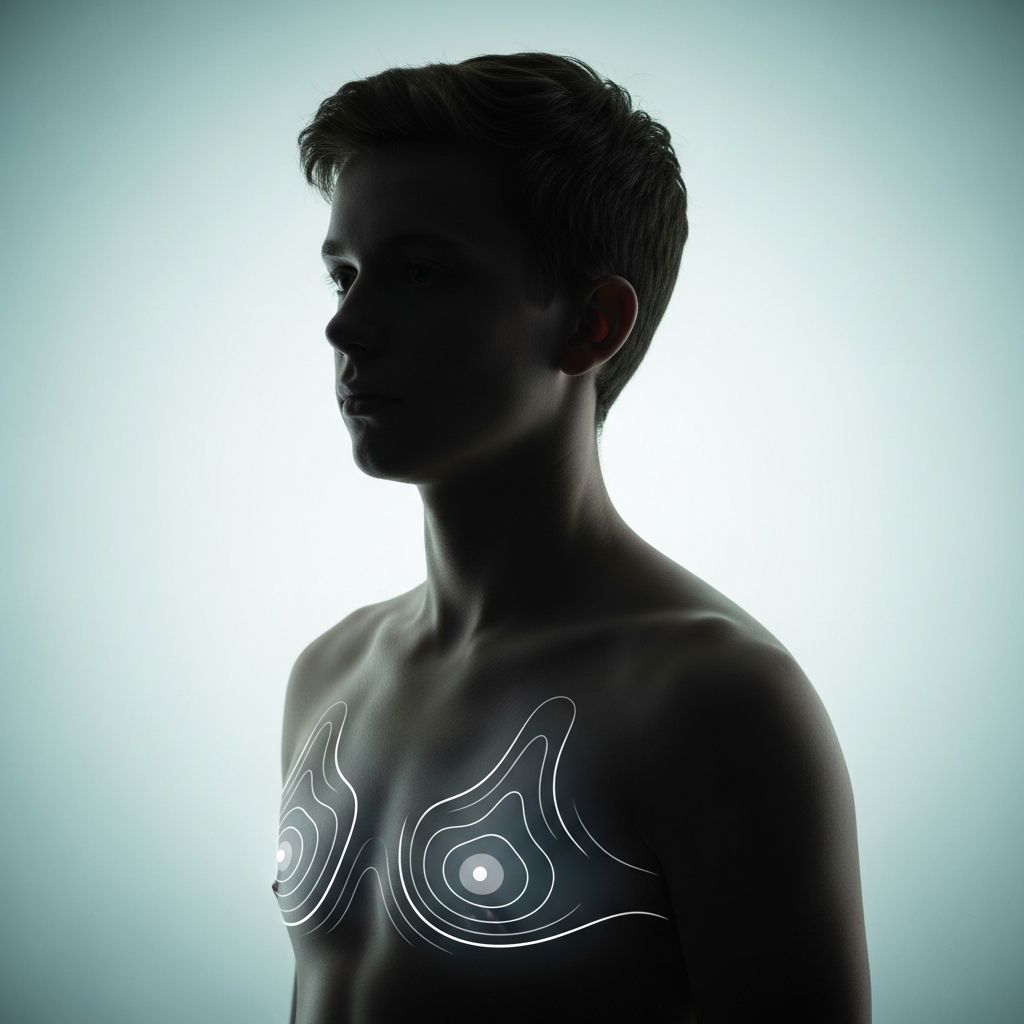
What’s Happening to My Chest?
Many teenage boys notice changes in their chest during puberty that can be confusing or even alarming. You might feel a small, firm lump under one or both nipples, see some swelling, or just feel like your chest looks different. This is actually very common and is usually a normal part of growing up. It’s not a sign that something is wrong with your body, and it doesn’t mean you’re becoming less masculine. Understanding what’s really going on can help reduce worry and make it easier to decide whether or not to talk to a doctor.
Why Breast Tissue Can Develop in Boys
Everyone, regardless of sex, is born with some breast tissue. In males, this tissue usually stays very small and flat. During puberty, hormone levels shift dramatically, and this can cause that tissue to grow temporarily.
The main hormones involved are testosterone (the primary male sex hormone) and estrogen (often thought of as a female hormone, but present in all people). In boys, testosterone drives changes like voice deepening, facial hair, and muscle growth. But estrogen also plays a role in bone development and other processes. For a short time during puberty, the balance between these hormones can tip slightly toward estrogen, which can stimulate the breast tissue to grow. This temporary shift is completely normal and is the most common reason for breast development in teenage boys.
How Common Is This?
Breast tissue changes in adolescent males are far more common than many realize. Studies and clinical observations show that a large percentage of boys experience some degree of breast development during puberty.
- Estimates suggest that around 40–70% of boys will notice some breast tissue growth during adolescence.
- It most often appears in mid-puberty, typically between ages 11 and 14, when hormone levels are fluctuating the most.
- For the vast majority, the swelling is mild and goes away on its own as puberty progresses.
This means that if you’re noticing changes in your chest, you’re definitely not alone. Many of your peers are going through the same thing, even if they don’t talk about it.
What It Feels and Looks Like
Normal pubertal breast development usually has a specific pattern:
- A small, firm, disk-shaped area of tissue forms directly under the nipple and areola (the darker area around the nipple).
- It may be tender or sore, especially when touched or during physical activity.
- It can appear on one side only (unilateral), on both sides (bilateral), or more on one side than the other (asymmetrical).
- The swelling is usually limited to the area around the nipple and doesn’t extend far across the chest.
Over time, this tissue typically becomes less tender and gradually shrinks. In most cases, it resolves completely within 6 months to 2 years without any treatment.
Different Types of Chest Changes
Not all chest enlargement in boys is the same. It’s helpful to understand the main types so you can better describe what you’re experiencing to a doctor if needed.
True Gynecomastia
This is the medical term for actual growth of breast gland tissue due to hormonal changes. It feels like a firm, rubbery disk under the nipple and is usually symmetrical or only slightly uneven. It’s most common during puberty and is usually temporary.
Pseudogynecomastia (Fatty Chest)
In some cases, chest enlargement is due to increased fat deposits rather than glandular tissue. This is more common in individuals who are overweight or obese. Fat tends to feel softer and more diffuse, spreading across a wider area of the chest rather than being concentrated under the nipple. Weight loss and exercise can often reduce this type of chest enlargement.
When It Might Be Something Else
Very rarely, chest changes can be a sign of an underlying medical condition. Signs that suggest it’s worth getting checked by a doctor include:
- Sudden, rapid growth of the tissue
- Hard, irregular, or fixed lumps (not just under the nipple)
- Significant pain that doesn’t improve
- Nipple discharge (especially if bloody)
- Swelling in the armpit (possible lymph node involvement)
- Other unusual symptoms like weight loss, fatigue, or changes in testicles
These are not typical of normal pubertal changes and should be evaluated by a healthcare provider.
When Hormone Imbalance Is the Cause
Puberty is the most common time for temporary hormone-related breast development, but other situations can also cause an imbalance:
- Infancy: Many newborn boys have slightly enlarged breasts due to exposure to maternal estrogen before birth. This usually resolves in the first few weeks of life.
- Older age: Men in later adulthood can develop breast tissue due to age-related hormone changes, certain medications, or health conditions.
- Medical conditions: Rarely, conditions like Klinefelter syndrome (an extra X chromosome), thyroid disorders, liver or kidney disease, or tumors can affect hormone levels and lead to breast growth.
- Medications and substances: Some prescription drugs, recreational drugs (like marijuana), alcohol, and even certain supplements can influence hormones and contribute to breast tissue development.
In most teens, though, the cause is simply the normal hormonal shifts of puberty, not an underlying disease.
How Doctors Evaluate Chest Changes
If you’re concerned about changes in your chest, a doctor can help figure out what’s going on. The evaluation usually includes:
- A discussion about when the changes started, how they’ve progressed, and any other symptoms.
- A physical exam to assess the size, shape, and texture of the tissue, as well as overall pubertal development (voice, body hair, testicle size, etc.).
- Checking for signs of other conditions, such as thyroid enlargement, liver or kidney problems, or testicular abnormalities.
In most cases of typical pubertal breast development, no further testing is needed. If there’s concern about an underlying cause, the doctor might order blood tests to check hormone levels or imaging (like an ultrasound) to look at the breast tissue more closely.
What to Expect Over Time
For the majority of teens, pubertal breast development follows a predictable course:
- It usually appears in mid-puberty (around ages 12–14).
- It may be tender at first but tends to become less sensitive over time.
- Most cases resolve on their own within 6 months to 2 years as hormone levels stabilize.
- Only a small percentage (around 5–10%) of boys are left with persistent, noticeable breast tissue after puberty is complete.
Patience is often the best approach. Trying to rush the process with unproven remedies or extreme dieting is usually unnecessary and can sometimes do more harm than good.
When Treatment Might Be Considered
Most cases of pubertal breast development don’t require any specific treatment. However, there are situations where a doctor might recommend something:
- Lifestyle changes: If excess fat is contributing to chest fullness, losing weight through healthy eating and regular exercise can help reduce the appearance.
- Medications: In rare cases where breast tissue is very bothersome and not resolving, a doctor might consider medications that affect hormone levels, but this is not common in otherwise healthy teens.
- Surgery: For a small number of individuals who have persistent, significant breast tissue that causes distress after puberty is complete, surgical removal of the tissue (reduction mammoplasty) may be an option. This is typically considered only after other causes are ruled out and after growth is finished.
Any treatment decisions should be made in partnership with a healthcare provider who understands adolescent development.
Emotional and Social Impact
Even though breast development in boys is usually normal and temporary, it can still be emotionally difficult. Many teens feel self-conscious, embarrassed, or worried about how others will react. This is completely understandable, especially in a culture where male bodies are often expected to look a certain way.
Common emotional responses include:
- Feeling different from peers
- Worrying about being teased or bullied
- Avoiding activities like swimming, changing in locker rooms, or going shirtless
- Lowered self-esteem or body image concerns
It’s important to remember that these feelings are valid, and you’re not alone. Talking to a trusted adult, counselor, or doctor can make a big difference in how you cope.
When to Talk to a Doctor
It’s always okay to bring up concerns about your body with a healthcare provider. You don’t need to wait until something seems “serious.” A good rule of thumb is to consider seeing a doctor if:
- The swelling is large, very tender, or growing quickly.
- You’re feeling significant distress or anxiety about it.
- You notice any of the “red flag” signs mentioned earlier (hard lumps, discharge, armpit swelling, etc.).
- You’re unsure whether what you’re experiencing is normal or not.
Doctors see this kind of thing all the time and are there to help, not to judge. Getting reassurance and accurate information can be incredibly relieving.
Support and Next Steps
If you’re dealing with breast tissue changes during puberty, here are some practical steps:
- Stay informed: Knowing that this is common and usually temporary can reduce fear.
- Be patient: Give your body time to finish going through puberty; most cases resolve on their own.
- Focus on overall health: Eating well, staying active, and getting enough sleep support healthy development.
- Seek support: Talk to a parent, school nurse, counselor, or doctor if you’re feeling worried or upset.
- Avoid quick fixes: Don’t try unproven supplements, extreme diets, or unsafe methods to “fix” the issue without medical advice.
Remember, your body is going through a lot of changes right now. Temporary breast development is just one part of that process for many boys, and it doesn’t define who you are.
Frequently Asked Questions
Is it normal for boys to have breast tissue?
Yes, all males are born with some breast tissue. During puberty, hormonal changes can cause this tissue to grow temporarily in many boys. This is a normal part of development for a large number of adolescents.
How long does it usually last?
In most cases, pubertal breast development goes away on its own within 6 months to 2 years. Only a small percentage of boys are left with noticeable tissue after puberty is complete.
Can being overweight make it worse?
Yes, excess body fat can contribute to chest fullness because fat cells can produce estrogen. In some cases, what looks like breast tissue is actually extra fat (pseudogynecomastia). Healthy weight management can help reduce this, but it won’t necessarily eliminate true glandular tissue.
Do I need surgery?
Most teens do not need surgery. Surgery is only considered in rare cases where breast tissue is very bothersome, doesn’t go away after puberty, and causes significant distress. This decision is made carefully with a doctor after growth is finished.
Should I be worried about cancer?
Male breast cancer is extremely rare in teens. The vast majority of breast changes in adolescent boys are due to normal hormonal shifts, not cancer. However, any hard, irregular, or rapidly growing lump should be checked by a doctor to be sure.
References
- Gynecomastia in Adolescent Males — National Center for Biotechnology Information (PMC). 2013. https://www.ncbi.nlm.nih.gov/pmc/articles/PMC3706045/
- Enlarged breasts in men (gynecomastia) — Mayo Clinic. 2023. https://www.mayoclinic.org/diseases-conditions/gynecomastia/symptoms-causes/syc-20351793
- Male Sexual Development — University of Texas Medical Branch. https://www.utmb.edu/pedi_ed/CoreV2/Adolescent/Adolescent13.html
- Pubertal Gynaecomastia (breast enlargement in boys at puberty) — British Society for Paediatric Endocrinology and Diabetes. https://www.bsped.org.uk/media/1477/pubertal-gynaecomastia.pdf
- Breast enlargement in males — MedlinePlus, U.S. National Library of Medicine. 2023. https://medlineplus.gov/ency/article/003165.htm