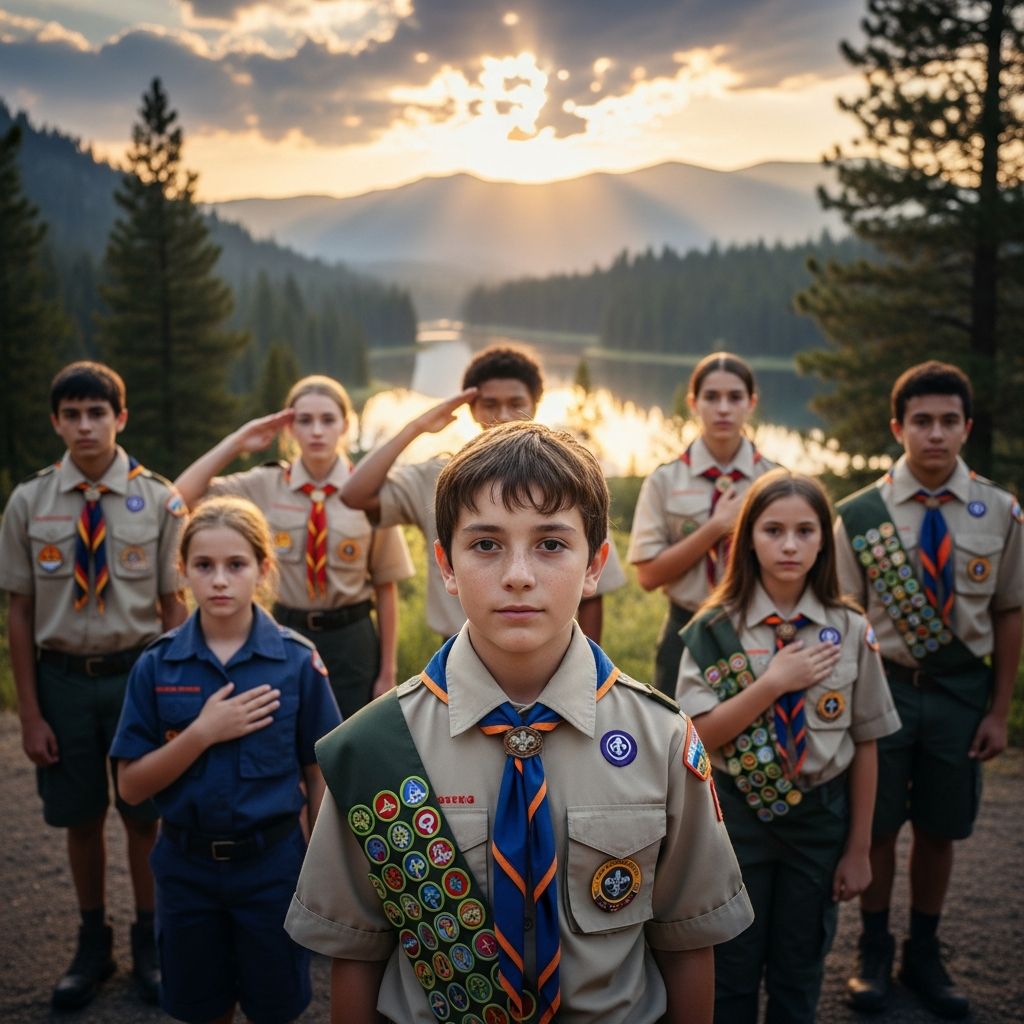
Understanding the Boy Scout Oath: A Foundation for Character
The Boy Scout Oath stands as one of the most meaningful promises a young person can make. Recited by millions of Scouts around the world, this oath represents a commitment to honor, duty, and personal growth. Whether you’re a parent exploring Scouting for your child, a new Scout just beginning your journey, or someone curious about this timeless tradition, understanding the Boy Scout Oath provides insight into the values that have shaped youth character for over a century.
The Complete Boy Scout Oath
The official Boy Scout Oath is:
“On my honor, I will do my best to do my duty to God and my country and to obey the Scout Law; to help other people at all times; to keep myself physically strong, mentally awake, and morally straight.”
While this oath may seem straightforward on the surface, each word carries profound meaning and represents a lifetime commitment to personal excellence and service to others.
The History of the Boy Scout Oath
The Boy Scout Oath has its roots in the early days of Scouting, originating from the vision of Robert Baden-Powell in 1908. In his groundbreaking book “Scouting for Boys,” Baden-Powell introduced the original Scout Promise, which read:
“On my honour I promise that – I will do my duty to God and the King. I will do my best to help others, whatever it costs me. I know the Scout Law, and will obey it.”
Over the decades, the wording has evolved to reflect contemporary language and cultural contexts while maintaining the core principles. The modern oath has been refined to emphasize personal development and practical application of Scout values. Today’s version includes the emphasis on physical strength, mental awareness, and moral character—elements that were always implied but are now explicitly stated.
The Three Promises of the Scout Oath
The Boy Scout Oath traditionally contains three distinct promises, separated by semicolons. Understanding each promise individually helps Scouts grasp the full scope of their commitment.
Promise One: Duty to God and Country
The first promise focuses on spiritual and civic responsibility. When a Scout pledges to do their duty to God and country, they commit to both personal spiritual development and active citizenship. This means:
- Following the teachings of your family and religious leaders to know and serve God according to your faith
- Respecting the sacrifices made by men and women who built and defended America
- Being a good family member and responsible citizen
- Working for your country’s good and obeying its laws
- Following the Scout Law in all your dealings
Duty to God recognizes that spiritual principles form the foundation of strong character, while duty to country encourages Scouts to contribute positively to their communities and nation.
Promise Two: Duty to Other People
The second promise emphasizes service and compassion. Scouts recognize that many people need help, and that small acts of kindness make a significant difference. This promise manifests through:
- Performing a Good Turn daily—helping others without expecting reward
- Offering a cheery smile and helping hand to make life easier for others
- Volunteering service in their communities
- Developing empathy and understanding for people from all walks of life
- Making the world a better place through consistent, intentional service
By committing to help other people at all times, Scouts learn that service is not occasional but a way of life.
Promise Three: Duty to Self
The third promise focuses on personal development across three dimensions: physical, mental, and moral. This multifaceted approach to self-improvement recognizes that strong character requires attention to the whole person.
Keeping Yourself Physically Strong means taking care of your body through proper nutrition, exercise, and healthy habits. Scouts learn that physical fitness enables them to serve others effectively and face life’s challenges with resilience.
Staying Mentally Awake encourages continuous learning and intellectual curiosity. Scouts are encouraged to learn all they can, ask questions, and develop critical thinking skills. This mental alertness helps Scouts make wise decisions and contribute meaningfully to society.
Being Morally Straight represents the ethical foundation of Scout character. It means living your life with honesty, being clean in speech and actions, maintaining strong values, and demonstrating integrity in all situations. Moral straightness is the glue that holds the other aspects of character together.
The Meaning of “On My Honor”
The opening words of the Scout Oath—”On my honor”—carry significant weight. Honor, as defined in the context of Scouting, means a good character and a reputation for honesty and fair dealing. When a Scout says “on my honor,” they communicate to listeners: “I will keep my word.”
Though the concept of honor may evoke images of knights and warriors from medieval times, it remains just as vital and meaningful today. A Scout’s honor represents their reputation of strong character and good spirit. By beginning the oath with this phrase, Scouts acknowledge that they are making a promise based on their personal integrity and that their word can be trusted.
Understanding “Duty”
The concept of duty is central to the Scout Oath. Duty is fundamentally a responsibility to act—an obligation to do something, whether motivated by morality or law. In the Scout Oath, duty is a moral obligation. It is a responsibility that Scouts carry with them at all times, whether wearing their uniform or not, and it forms a key part of what makes someone a true Scout.
This moral duty extends across all three promises: duty to God and country, duty to other people, and duty to self. By understanding duty as a personal moral obligation rather than merely external requirements, Scouts develop a strong internal compass that guides their choices and actions.
The Scout Law: Living Out the Oath
The Boy Scout Oath is intrinsically connected to the Scout Law, which consists of twelve points that provide the practical framework for living according to the oath’s principles. The Scout Law states that a Scout is:
- Trustworthy – Tell the truth and keep promises; people can depend on you
- Loyal – Show that you care about your family, friends, Scout leaders, school, and country
- Helpful – Volunteer to help others without expecting a reward
- Friendly – Be a friend to all and treat others with kindness
- Courteous – Use good manners and show respect for others
- Kind – Show compassion and care for others’ feelings
- Obedient – Follow rules and authority, and be responsible for your own actions
- Cheerful – Maintain a positive attitude and approach tasks willingly
- Thrifty – Respect and protect property, and use resources wisely
- Brave – Face challenges with courage, even when afraid
- Clean – Keep your body and mind healthy, and act respectfully
- Reverent – Respect the beliefs of others and honor your own faith
Each point of the Scout Law represents a goal for every Scout. While it is not always easy to live up to all twelve points, Scouts commit to trying their best every day. The Scout Law transforms the abstract promises of the oath into concrete, practical behaviors and attitudes that guide daily life.
The Scout Salute and Oath Ceremony
When reciting the Scout Oath, Scouts make the three-fingered salute. The Scout stands with their right hand raised level with their shoulder, palm facing forward, with the thumb resting on the little finger’s nail and the other three fingers pointing upward. This distinctive salute serves as both a visual commitment and a sign of membership in the worldwide Scouting movement.
The formal ceremony surrounding the oath recitation emphasizes the seriousness and significance of the commitment. For many Scouts, reciting the oath during their advancement ceremony marks a meaningful milestone in their Scouting journey.
The Scout Motto and Slogan
To complement the Scout Oath, Scouting has also established a motto and slogan that reinforce its core values:
- Scout Motto: “Be Prepared!” – This reflects the Scout’s commitment to readiness, self-reliance, and anticipating challenges
- Scout Slogan: “Do a Good Turn Daily!” – This emphasizes the importance of consistent service and kindness
These phrases, combined with the oath and law, create a comprehensive framework for Scout character development.
Living the Scout Oath: Practical Application
Understanding the Scout Oath is one thing; living it is another. Scouts learn that remembering the oath is important, but it is not enough on its own. Scouts must make a conscious effort to live by the oath at all times, allowing its principles to shape their character and influence their actions.
In practice, living the Scout Oath means:
- Making decisions based on honesty and integrity, even when it’s difficult
- Seeking opportunities to serve others in your community
- Maintaining physical fitness through regular exercise and healthy eating
- Pursuing knowledge and staying curious about the world
- Standing up for what is right and defending the rights of all people
- Respecting beliefs different from your own while remaining faithful to your own values
- Holding yourself accountable to the standards you’ve committed to uphold
The Global Significance of the Scout Oath
While the Boy Scout Oath is specific to the Boy Scouts of America, the principles it embodies are recognized worldwide. Scouting organizations in virtually every country have their own version of the Scout Promise, reflecting local cultures and languages while maintaining the universal principles of duty to God, duty to others, and duty to self.
The World Organization of the Scout Movement has established that all Scout Promises and Laws, regardless of national variation, should reflect these three foundational duties. This global consistency demonstrates that the values embodied in the Scout Oath are truly universal and timeless.
Frequently Asked Questions
What does “on my honor” mean in the Scout Oath?
“On my honor” means you are making a promise based on your personal integrity and good character. When you say this phrase, you’re telling others that your word is trustworthy and that you will keep your commitment.
What are the three promises in the Scout Oath?
The three promises are: (1) Duty to God and country, (2) Duty to other people, and (3) Duty to self. These are separated by semicolons in the oath.
How does the Scout Law relate to the Scout Oath?
The Scout Law provides twelve specific principles that help Scouts live out the promises made in the oath. Together, they form a complete guide for Scout character and conduct.
What does “morally straight” mean?
Being morally straight means living your life with honesty, being clean in your speech and actions, maintaining strong values, and demonstrating integrity in all situations.
Can people of different religions be Scouts?
Yes. The Scout Oath respects all religions, and “God” in the oath can refer to whatever higher power or spiritual principles a Scout believes in according to their own faith tradition.
At what age do Scouts take the Scout Oath?
Different Scouting programs have varying age ranges. However, Scouts typically take this specific oath when they advance to the Boy Scout rank, which is generally around age eleven or twelve.
Conclusion: A Lifetime of Commitment
The Boy Scout Oath represents far more than words recited at a ceremony. It is a personal guide to life that, when truly embraced, makes character stronger and values greater. By following the oath with persistence, attentiveness, and care—much as you would follow the Scout Law—Scouts discover that their lives change for the better. They develop into young adults of strong character, integrity, and service-minded spirit. For over a century, millions of Scouts have taken this oath, and countless lives have been positively shaped by its principles. Whether you’re supporting a young Scout in their journey or reflecting on what the oath means, understanding these powerful promises reveals why Scouting continues to be a transformative force in developing the next generation of leaders and responsible citizens.
References
- Boy Scout Oath, Law, Motto and Slogan and the Outdoor Code — United States Scouting Service Project. http://www.usscouts.org/advance/boyscout/bsoathlaw.asp
- Scout Promise — Wikipedia. https://en.wikipedia.org/wiki/Scout_Promise
- Understanding The BSA Scout Oath: Facts, History, And Meaning — Scout Smarts. https://scoutsmarts.com/scout-oath-facts-history-meaning/
- What are the Scout Oath and Scout Law? — Boy Scouts of America. https://www.scouting.org/about/faq/question10/