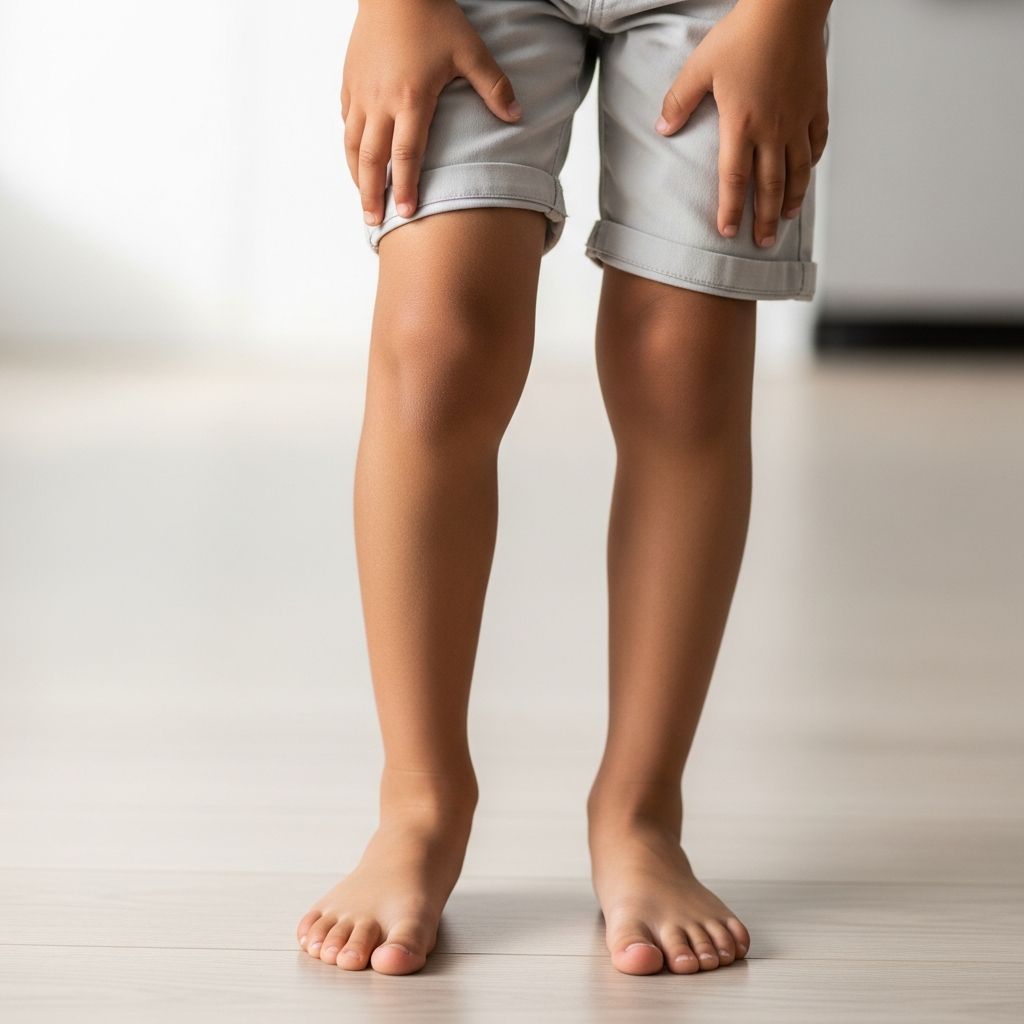
Blount disease is a growth disorder of the shin bone (tibia) that makes a child’s legs curve outward below the knees, creating a bowed appearance that gets worse instead of improving with age. It is different from the normal bowing seen in many toddlers, and it usually needs medical care to protect the knees and joints over time.
What Is Blount Disease?
Blount disease happens when the growth plate at the top of the tibia on the inner (medial) side does not grow normally. This slowed or damaged growth causes the inside of the bone to lag behind the outside, tipping the lower leg into a bow-legged, or genu varum, position.
Doctors often divide Blount disease into two main types:
- Early-onset (infantile) Blount disease: appears in young children, usually before age 4.
- Late-onset (adolescent) Blount disease: appears in older children and teenagers, typically around or after the growth spurt.
Both forms involve abnormal growth of the top of the tibia and can lead to progressive bowing, knee pain, and early arthritis if untreated.
Normal Toddler Bowing vs. Blount Disease
Many parents first notice their child’s bowed legs when the child starts to stand or walk. In most toddlers, this bowing is completely normal and straightens on its own as the legs grow.
| Feature | Normal Bowed Legs | Blount Disease |
|---|---|---|
| Age when noticed | Common in new walkers (around 1–2 years) | Usually clear after age 2 if bowing worsens or persists |
| Progress over time | Gradually improves and straightens by age 2–3 | Bowing becomes more obvious and often worse with growth |
| Location of curve | Gentle curve through whole leg | Sharp angulation centered just below the knee (upper tibia) |
| Side involvement | Often looks similar on both legs | Can affect one or both legs; sometimes worse on one side |
| Need for treatment | Usually none; observation only | Often needs bracing or surgery depending on age and severity |
If a child’s legs are still significantly bowed after age 2, or if bowing quickly worsens, doctors consider Blount disease and other conditions in their evaluation.
Who Is at Higher Risk?
Blount disease can affect any child, but certain factors make it more likely:
- Early walking, especially before 1 year.
- Overweight or obesity in childhood, which increases stress across the medial (inner) knee.
- Family history of Blount disease or severe bowing.
- Ethnic background: higher rates reported in some populations, including African, African American, and Hispanic children.
- Bilateral involvement (both legs) is more common in early-onset disease, while adolescent disease is more often one-sided.
These factors do not cause Blount disease by themselves, but they can increase mechanical load and stress on the inner part of the knee, which may worsen an already vulnerable growth plate.
Common Signs and Symptoms
The earliest and most noticeable sign is usually bowing of the legs below the knee.
- Lower legs curve outward while the thighs may appear relatively straight.
- Bowing may be more obvious when the child stands or walks.
- The curve often worsens rather than improving over months.
Other signs that may appear as the condition progresses include:
- Knee or leg pain, especially with activity in older children or teens.
- Limping or awkward gait (walking pattern).
- Inward turning of the feet (in-toeing) due to rotation of the tibia.
- Difference in leg length if one leg is more affected.
- Early wear of the inner knee joint, which can lead to arthritis later if untreated.
How Doctors Diagnose Blount Disease
Diagnosis combines a careful exam with imaging tests to confirm abnormal growth in the tibia and to measure the severity of deformity.
Medical History and Physical Exam
The provider will ask about:
- When the bowing was first noticed.
- Whether it is changing over time.
- Any pain, limping, or difficulty with activities.
- Birth history, early walking, weight gain, and family history.
During the exam, the doctor will:
- Observe standing and walking from the front, back, and side.
- Measure the angle of the legs and compare both sides.
- Check hip, knee, and ankle range of motion and stability.
- Look for trunk leaning, in-toeing, or limb-length differences.
Imaging Tests
The key test is usually a standing X-ray of the entire lower limb from hip to ankle.
- X-rays show how much the tibia is tilted, the shape of the growth plate, and the overall leg alignment.
- Doctors measure angles (such as the tibiofemoral angle and metaphyseal–diaphyseal angle) to classify severity and plan treatment.
Additional imaging is sometimes used in complex cases:
- CT scans to better understand rotational deformities of the tibia.
- MRI to assess cartilage, the growth plate, and soft tissues when needed.
Blood tests may be ordered if the doctor wants to rule out other causes of bowed legs, such as rickets or metabolic bone disease.
Treatment Goals
The main goals of treating Blount disease are:
- To straighten the legs and restore normal alignment.
- To relieve or prevent pain.
- To protect the knee joint and reduce the risk of early arthritis.
- To allow normal, comfortable walking, sports, and play.
Treatment depends heavily on the child’s age, how advanced the disease is on X-ray, and whether one or both legs are affected.
Non-Surgical Treatment: Bracing
In young children with early-onset Blount disease, bracing is often the first line of treatment.
- Braces usually extend from the thigh to the foot (knee-ankle-foot orthosis).
- They apply a gentle pushing force that encourages the knee to straighten over time by unloading the inner side of the tibia.
- Bracing works best when started before about age 3 and in milder stages of disease.
Key points about bracing:
- Braces may be worn for many hours a day over months to years; some protocols use daytime wear, others nighttime or both.
- Regular follow-up X-rays are needed to check whether the angle is improving.
- If the deformity does not improve or if bowing is severe, surgery is usually recommended.
Surgical Treatment Options
Surgery is more likely to be needed when:
- The child is older (often over age 3–4) at diagnosis.
- Bracing has failed to correct the deformity.
- Bowing is severe, progressive, or associated with growth-plate damage.
- Adolescent-onset disease is present, which typically requires surgery.
Guided Growth (Growth Modulation)
Guided growth, also called hemiepiphysiodesis, uses the child’s remaining growth to gradually straighten the leg.
- Small plates and screws are placed on one side of the growth plate near the knee.
- This temporarily slows growth on that side while the opposite side continues to grow, slowly correcting the angle.
- Once alignment is near normal, the hardware is removed to avoid overcorrection.
Guided growth is generally used in younger patients who still have substantial growth left and in cases without severe growth-plate damage.
Tibial Osteotomy
A tibial osteotomy is a surgical cut in the upper tibia to realign the leg into a straighter position.
- The bone is cut just below the knee and carefully repositioned to correct the bow.
- Plates, screws, or external frames hold the new alignment while the bone heals.
- This method can be used in both children and adolescents, including those who are nearly finished growing.
In very severe or complex cases, surgeons may also perform additional procedures, such as elevating part of the tibial plateau (the upper joint surface) or addressing limb-length differences.
Recovery and Follow-Up Care
After surgery or starting bracing, follow-up care is essential to guide safe healing and to monitor growth.
- Activity restrictions: Children may need to limit sports or high-impact activities for a period while bones and soft tissues heal.
- Weight-bearing: Depending on the type of surgery, the child may use crutches, a walker, or a wheelchair temporarily.
- Physical therapy: Exercises help restore strength, flexibility, and steady walking.
- Regular X-rays: Imaging checks that the correction is maintained and that growth continues in a healthy pattern.
Because Blount disease involves the growth plate, monitoring often continues until the child has finished growing to watch for recurrence or new deformity.
Possible Long-Term Effects
When Blount disease is treated early and effectively, many children go on to walk, run, and play without major limitations. Without treatment, however, the following complications are more likely:
- Persistent or worsening bowing of the legs.
- Uneven leg lengths, which may cause limping or back and hip strain.
- Abnormal loading of the inner knee, leading to cartilage damage.
- Early-onset knee osteoarthritis in adolescence or adulthood.
- Chronic pain and reduced participation in physical activities.
Timely diagnosis and appropriate treatment greatly reduce these risks.
How Parents Can Support Their Child
Beyond medical treatment, families play a key role in helping a child manage Blount disease.
- Keep follow-up appointments for exams and X-rays so doctors can adjust treatment as needed.
- Support brace wear by building it into routines and praising effort, especially in toddlers.
- Encourage healthy weight through nutrition and appropriate activity, which lowers stress on the knees.
- Promote safe exercise like swimming or cycling, which keeps joints moving without heavy impact.
- Ask questions about surgery, recovery timelines, school return, and sports participation.
Working closely with pediatric orthopedic specialists, and sometimes physical therapists and orthotists, helps ensure a coordinated plan tailored to each child.
Frequently Asked Questions About Blount Disease
At what age should I worry if my child’s legs are still bowed?
Mild bowing is very common in toddlers and often corrects by age 2 to 3. If bowing is getting worse, is very pronounced, or persists after age 2, it is reasonable to ask your pediatrician for an orthopedic evaluation and possibly X-rays.
Is Blount disease caused by something I did during pregnancy or infancy?
Blount disease is not known to result from any specific action by parents. It appears to involve a combination of mechanical loading (such as body weight and early walking) and an underlying vulnerability in the growth plate. Managing weight and seeking early care are the main ways families can help.
Can Blount disease get better on its own without treatment?
Normal physiologic bowing improves with time, but true Blount disease generally does not resolve on its own. In fact, the deformity usually worsens as the child grows. Observation alone is sometimes used briefly in very early or mild cases, but most confirmed cases need bracing or surgery to prevent progression.
Will my child be able to play sports after treatment?
Many children treated for Blount disease return to regular sports and play once healing is complete and alignment is corrected. Providers usually recommend a gradual return to impact activities, guided by pain, strength, and X-ray findings. Ask your surgeon for sport-specific timing and restrictions.
Does Blount disease come back after surgery?
There is a risk of recurrence, especially in younger children with more severe deformity or ongoing risk factors like obesity. This is why long-term follow-up through the growing years is important. If recurrence occurs, additional guided growth or osteotomy can often restore alignment again.
References
- Blount’s Disease — American Academy of Physical Medicine and Rehabilitation (AAPM&R) KnowledgeNow. 2023-03-01. https://now.aapmr.org/blounts-disease/
- Beyond Bowed Legs: Diagnosing and Treating Infantile Blount’s Disease — Children’s Hospital of Philadelphia. 2019-07-01. https://www.chop.edu/news/beyond-bowed-legs-diagnosing-and-treating-infantile-blount-s-disease
- Blount’s Disease Symptoms, Causes & Treatment — Cleveland Clinic. 2021-12-14. https://my.clevelandclinic.org/health/diseases/22424-blounts-disease
- Blount Disease — International Center for Limb Lengthening. 2022-05-10. https://www.limblength.org/conditions/blount-disease/
- Blount’s Disease Bowleg Treatment — Hospital for Special Surgery (HSS). 2020-08-18. https://www.hss.edu/health-library/conditions-and-treatments/blounts-disease