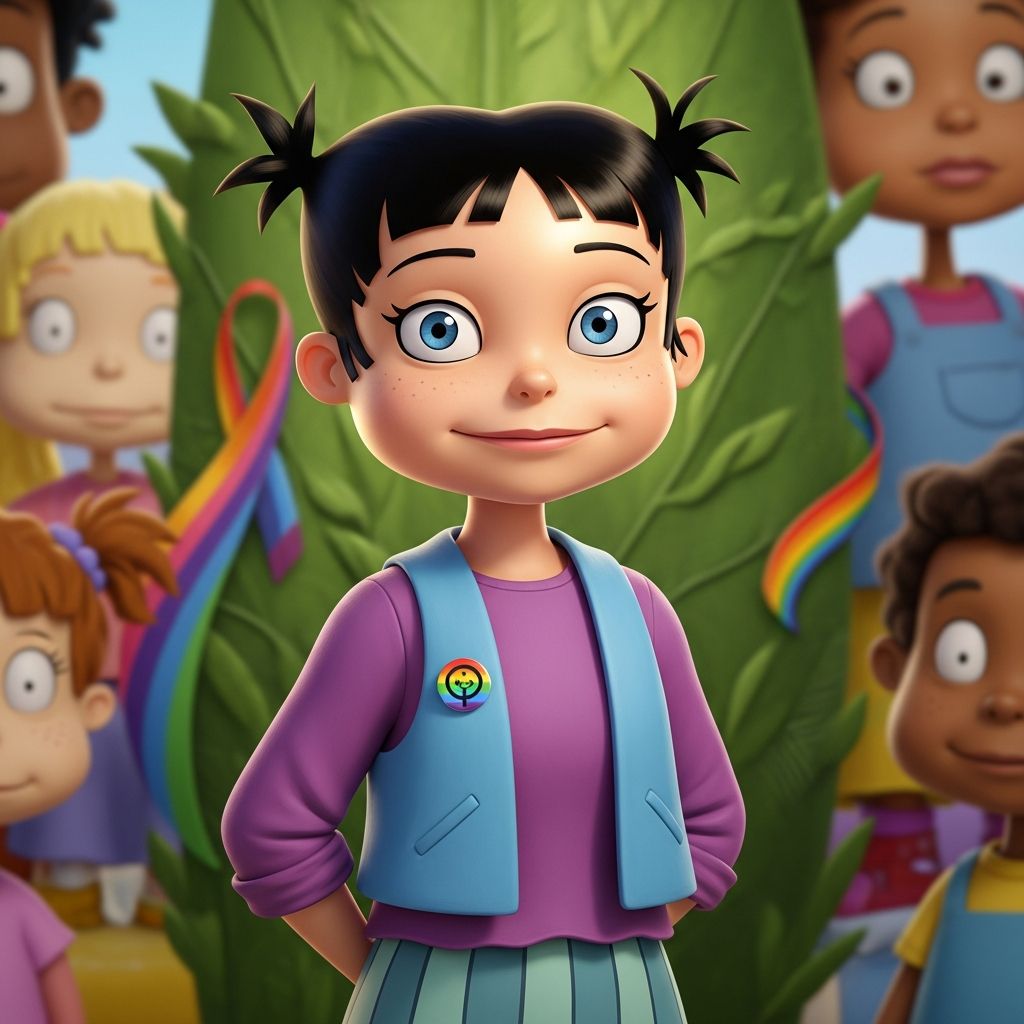
When the Rugrats reboot premiered on Paramount+, longtime fans immediately noticed something different about one of the show’s most memorable adults: Betty DeVille, Phil and Lil’s loud, confident mom, is now clearly portrayed as a gay character. This update reflects not just a creative choice, but a broader cultural shift in how LGBTQ+ identities appear in children’s television.
This article explores what has changed about Betty, why it matters, how it fits into the evolution of kids’ media, and what parents might want to know as they watch the reboot with their own children.
From Subtext to Text: Who Is Betty DeVille?
In the original 1990s Rugrats series, Betty DeVille was portrayed as a sporty, outspoken, feminist mom who wore a gender-neutral sweater, loved athletics, and had a high-energy personality. Many adult fans later read her as queer-coded, even though the show never explicitly labeled her that way.
In the 2021 CGI reboot, Betty’s identity is made more explicit. She is openly written as a gay single mom, with dialogue and details that leave little ambiguity. Entertainment coverage and interviews around the reboot noted that the new version of Betty is canonically queer and that this is treated as a normalized part of the world rather than a special “very important episode.”
What’s Different About Betty in the Reboot?
- Explicit identity: Instead of hints or stereotypes, Betty is casually referred to in ways that clearly establish her as gay.
- Updated personality details: She retains her confident, brash, sports-obsessed traits, but they are no longer framed as a joke or caricature; they are simply part of who she is.
- Different family configuration: The reboot reimagines her home life, presenting her as a single parent rather than as part of a traditional mom-and-dad duo.
These shifts are not about reinventing Betty from scratch, but about aligning her characterization with more open and contemporary representations of LGBTQ+ adults in children’s programming.
Why Betty’s Sexuality Matters in a Kids’ Cartoon
To some viewers, the idea of specifying an adult character’s sexuality in a preschool show may seem unnecessary. But research and policy guidance on LGBTQ+ inclusion in media emphasize that representation can have measurable effects on how young people understand families, fairness, and identity.
Representation and Child Development
Major professional organizations note that children form ideas about gender and relationships from a very young age. The American Academy of Pediatrics explains that kids recognize and internalize social norms early, and that inclusive, supportive environments help reduce stigma and mental health risks for LGBTQ youth and those from LGBTQ families.
When a show like Rugrats includes a gay parent as just one more adult in the neighborhood, it can:
- Expose children to different family structures without dramatizing them.
- Normalize the idea that some kids have two moms, two dads, or one LGBTQ+ parent.
- Signal to kids from LGBTQ+ families that their lives are valid and visible.
Softening Stigma Through Everyday Stories
Studies on media and prejudice suggest that seeing diverse characters in ordinary, positive roles can reduce bias over time. For young viewers, Betty is not a lesson plan; she is the mom who brings snacks, shouts from the sidelines, and cares deeply about her children. Her sexual orientation is one trait among many, which mirrors how kids experience real adults in their communities.
Rugrats in Context: LGBTQ+ Characters in Kids’ Animation
Rugrats is not the first children’s show to feature LGBTQ+ characters, but the decision to update a legacy series is symbolically powerful. Over the past decade, mainstream outlets have documented a rise in queer representation across youth-oriented animation.
| Show | Network / Platform | Type of LGBTQ+ Representation |
|---|---|---|
| Rugrats (2021 reboot) | Paramount+ | Gay single mom (Betty DeVille) as a recurring adult character |
| The Owl House | Disney Channel | Bisexual Latina protagonist; same-gender teenage couple |
| She-Ra and the Princesses of Power | Netflix | Multiple queer relationships, including a central same-gender romance |
| Steven Universe | Cartoon Network | Nonbinary-coded aliens; queer relationships and marriage arcs |
What distinguishes Rugrats is that it is a revival of a widely recognized 1990s property aimed at very young children. Making Betty openly gay is a statement that even the most familiar brands can evolve with the times without losing their core identity.
Adult Characters, Recasting & Modernization
One technical change in the reboot is that many of the adult characters, including Betty, are voiced by different actors than in the original run. Coverage of the series noted that, while most of the baby voice actors returned, the adults’ voices were largely recast to give the show a fresh tone and reflect new creative directions.
- Returning baby voices: The original performers for Tommy, Chuckie, Angelica, and other babies reprise their roles, preserving continuity for longtime fans.
- New adult voices: Parents and grandparents are voiced by a new ensemble, which includes actors known for contemporary comedy and animation.
- Betty’s new portrayal: Her new voice performance supports a more self-aware, openly queer characterization while still honoring her brash energy.
This mix of nostalgia and reinvention is key: the babies feel familiar, while the adults—Betty among them—are modernized to resonate with today’s social landscape.
Why Some Fans Say “Betty Was Always Gay”
For many adults who grew up on the original series, the reboot did not feel like a radical change so much as an overdue acknowledgment. Online commentary often framed the update as the writers “finally saying the quiet part out loud.”
Queer-Coding in the 1990s
In the 1990s, explicit LGBTQ+ representation in kids’ TV was rare, in part because of industry caution and political pressure. Media historians note that queer characters in family entertainment were often coded through mannerisms, clothing, or jokes without ever being explicitly named as LGBTQ.
Betty’s original design—athletic gear, bold personality, a resistance to traditionally feminine norms—fit that pattern for many viewers. Whether or not that was the creator’s intention, audiences often read her as queer-coded, particularly in hindsight.
Canon Versus Interpretation
- Then: Betty’s potential queerness lived in fan interpretation and subtle hints.
- Now: The reboot’s writers and voice actor treat her sexuality as straightforward canon.
This shift from subtext to text is important. Queer-coded characters can offer a sense of recognition to some viewers, but explicit representation is less likely to be erased, misinterpreted, or dismissed. It also signals to LGBTQ adults that their identities are not just a punchline or a secret, but something that can be stated openly in mainstream children’s media.
How Parents Can Talk About Betty With Kids
For many families, the inclusion of a gay character in Rugrats will be a nonissue; children may accept it as just another fact about the characters. Others may see it as an opportunity—or a challenge—to start conversations about different kinds of families. Organizations like GLSEN and the American Psychological Association emphasize that age-appropriate, honest conversations about LGBTQ topics can support empathy and resilience in children.
Simple Ways to Explain Betty’s Identity
- Use everyday language: If a child asks why Betty talks about liking women, a simple answer might be: “Some grown-ups fall in love with men, some with women, and some with both. Betty likes women.”
- Focus on kindness: Emphasize that what matters is that people are kind, caring, and safe, not who they love.
- Connect to real life: If your child knows LGBTQ family members, you can say, “It’s like your aunt and her wife—Betty is gay too.”
- Let kids lead: Answer the question the child actually asked; there is no need to overcomplicate.
Addressing Common Concerns
Some adults worry that mentioning LGBTQ identities is “too mature” for young children. Research and clinical guidance, however, distinguish between sexual orientation as a fact about who someone loves and explicit sexual content, which is not appropriate for preschoolers.
In Rugrats, Betty’s queerness is presented at the same level of detail as other parents’ relationships: casual references, jokes aimed at adults, and background details. There is no graphic or age-inappropriate content attached to her identity.
Balancing Nostalgia With Progress
Updating a beloved 1990s show always risks backlash from those who prefer the original in every detail. Yet children’s media has never been static. Over time, shows have diversified their casts, dropped outdated jokes, and adjusted to new norms.
Why Reboots Take Cultural Risks
- New generations, new expectations: Today’s parents and kids are more likely to know someone who is openly LGBTQ, and many expect those families to be visible in media.
- Industry change: Major studios and platforms now recognize that inclusive storytelling can broaden audiences and reflect social reality.
- Legacy and responsibility: A franchise as widely known as Rugrats carries cultural influence; using that platform for more accurate representation is a deliberate choice.
For fans who grew up with the original, the reboot invites a rewatch through a new lens. The babies are still crawling through big adventures, but the world around them has caught up—at least a little—with the complexities of real life.
What Betty DeVille Represents Going Forward
Betty’s updated identity is one character in one show, but it exists within a larger conversation about how media shapes social understanding. Research on contact theory suggests that even fictional exposure to members of marginalized groups can reduce prejudice over time, especially when those characters are portrayed positively.
In the Rugrats reboot, Betty is not a plot device or a moral lesson; she is woven into the fabric of the babies’ daily lives. For many kids, that quiet normalcy may be the most powerful statement of all.
Frequently Asked Questions (FAQs)
Is Betty DeVille really gay in the Rugrats reboot?
Yes. In the 2021 Rugrats reboot, Betty DeVille is written and discussed as a gay single mom. Interviews and coverage surrounding the show’s launch have described her as explicitly queer, rather than just implied or coded.
Was Betty always intended to be gay in the original Rugrats?
The original 1990s series never stated Betty’s sexual orientation on-screen. Many fans retrospectively interpreted her as queer-coded because of her personality, clothing, and attitude, but those readings existed in fan culture rather than in confirmed canon. The reboot moves that interpretation into explicit text.
Is the Rugrats reboot appropriate for young children?
The reboot, like the original, is designed for a young audience and their families. While it includes updated humor and more diverse characters, the themes remain centered on friendship, imagination, and everyday family life. Betty’s sexuality is presented through casual references, not explicit content, and is comparable in tone to how straight parents are portrayed.
Why are the adult voices different in the new Rugrats?
Most of the original voice actors for the babies returned, but the adult roles—parents and grandparents—were recast for the reboot. This creative decision allowed the series to refresh its tone, incorporate new acting styles, and align updated characterizations (including Betty’s) with performers who could bring those choices to life.
How can I talk to my child about Betty being gay?
Keep the explanation short, honest, and age-appropriate. You might say, “Betty is a mom who loves women instead of men, and that’s just one way to be an adult. What matters is that she loves her kids.” Professional organizations emphasize that simple, nonjudgmental language supports children’s understanding and reduces stigma.
References
- How to Support LGBTQ+ Children and Teens — American Academy of Pediatrics. 2022-06-01. https://www.healthychildren.org/English/ages-stages/teen/dating-sex/Pages/sexual-orientation-and-teenagers.aspx
- Rugrats Reboot Cast & Character Guide: Every Returning Voice Actor — Screen Rant. 2021-05-28. https://screenrant.com/rugrats-reboot-cast-character-guide-actors-returning/
- Disney Confirms First Bisexual Lead Character in The Owl House — BBC News. 2020-08-17. https://www.bbc.com/news/newsbeat-53800364
- Safe Schools for LGBTQ Students — American Psychological Association / GLSEN. 2019-10-01. https://www.apa.org/pi/lgbt/programs/safe-supportive/lgbtq-students
- “Rugrats” Reboot Recasts Adult Voices — Nickandmore!. 2021-03-18. https://www.nickandmore.com/2021/03/18/rugrats-reboot-recasts-adult-voices/