Two-year-old boys are nonstop explorers: climbing, talking more every week, and insisting, “Me do it!” The right toys can turn that whirlwind of energy into confident skills, calmer routines, and joyful family moments.
Understanding Your 2-Year-Old Boy’s Stage
At around age two, many boys are expanding vocabulary, running and jumping more confidently, and experimenting with cause and effect. This is a prime time to introduce toys that challenge their thinking while leaving plenty of room for open-ended play.
Instead of searching for the single “perfect” toy, think in terms of experiences: building, pretending, moving, sorting, and creating. Each of these experiences supports different areas of development, and rotating through them keeps play fresh without overwhelming your child.
What Makes a Great Toy for a 2-Year-Old Boy?
Not every colorful gadget on the shelf deserves a spot in your living room. Use the checklist below to quickly evaluate whether a toy is truly worth bringing home.
Key qualities to look for
- Safe and sturdy: Large pieces, no small detachable parts, smooth edges, and materials that can withstand drops and chewing.
- Open-ended: Toys that can be used in many ways (like blocks or simple vehicles) grow with your child and support creativity.
- Developmentally rich: Look for toys that encourage movement, talking, problem-solving, or pretend play rather than passive watching.
- Simple, not overstimulating: A toy doesn’t need flashing lights and loud music to hold attention. Often, the simpler the toy, the deeper the play.
- Easy to use independently: Two-year-olds love to feel capable. Choose toys they can manage mostly on their own with light supervision.
Development areas to support
| Skill Area | What’s Happening at 2 | Helpful Toy Types |
|---|---|---|
| Gross Motor | Running, climbing, kicking, jumping start to look more coordinated. | Ride-on toys, soft balls, tunnels, toddler-sized sports sets. |
| Fine Motor | Turning pages, stacking blocks, twisting lids, and using simple tools. | Chunky puzzles, stacking toys, peg boards, lacing beads (with supervision). |
| Language | Two-word phrases, naming favorite people and objects, asking simple questions. | Picture books, talking puppets, play phones, story-starter figurines. |
| Social & Emotional | Big feelings, early turn-taking, and emerging empathy. | Dolls, stuffed animals, cooperative games, pretend play sets. |
| Cognitive | Sorting by color or shape, simple problem-solving, and cause-and-effect experiments. | Shape sorters, simple matching games, nesting cups, early building sets. |
Active Play Toys for Endless Energy
Most 2-year-old boys crave movement. When you give that energy a safe outlet, you protect your furniture and help your child sleep and eat better, too.
Movement-friendly favorites
- Ride-on toys: Low, stable ride-ons or balance bikes without pedals help with coordination and confidence. Choose models that can be used indoors or on smooth outdoor surfaces.
- Soft sports sets: Foam or plastic bowling pins, soft bats and balls, or toddler basketball hoops make practicing throwing and kicking safe and fun.
- Crawl tunnels and pop-up tents: Simple tunnel-and-tent combos invite crawling, hiding, and pretend adventures like “camping” or “fort building.”
- Stepping stones or balance beams: Low, wide stepping stones or foam balance beams encourage careful foot placement and body awareness.
To keep active toys from taking over your home, store them in a large bin and rotate only one or two out at a time. This makes it easier to encourage movement without living in a constant obstacle course.
Fine Motor and Problem-Solving Toys
Fine motor skills are the small, precise movements that eventually support feeding, dressing, and later writing. At two, boys often love toys that involve twisting, matching, and stacking.
Simple toys with big benefits
- Chunky wooden puzzles: Look for puzzles with large knobs or thick pieces. Themes like animals, vehicles, or everyday objects are especially engaging at this age.
- Shape sorters: Boxes, buckets, or houses that accept differently shaped pieces encourage both problem-solving and perseverance. Clear shapes like circles, squares, and triangles are easiest to start with.
- Nesting and stacking sets: Cups, boxes, or rings that stack and nest provide endless experiments in size, order, and balance.
- Twist, peg, and pull toys: Peg boards, screw-on blocks, and toys with buttons, toggles, and zippers allow practice with common hand motions in a playful way.
With problem-solving toys, the goal is not to “teach the right answer” but to offer just enough help that your child can feel the satisfaction of figuring things out independently.
Building and Early STEM Toys
Construction toys introduce early science, technology, engineering, and math (STEM) concepts long before your child hears those words. At two, keep building sets simple, sturdy, and easy to grip.
Great first building tools
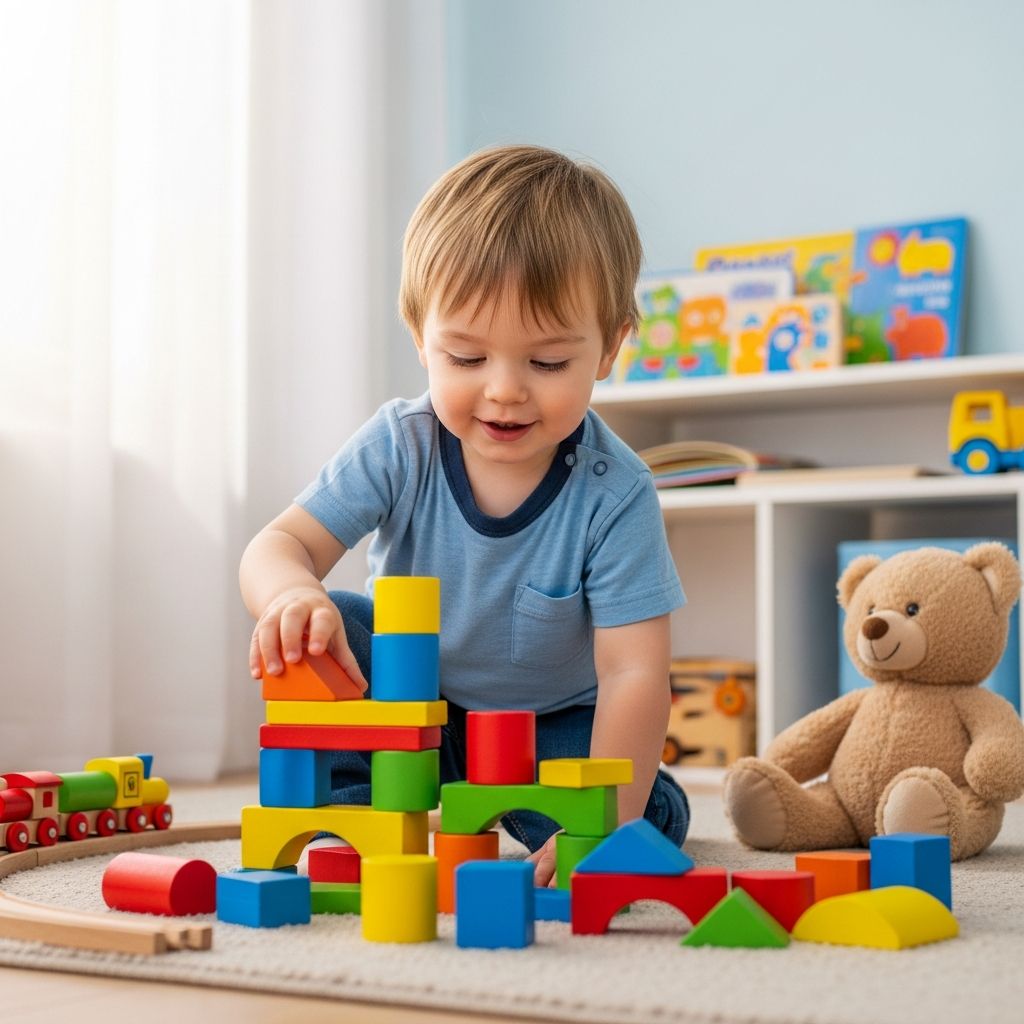
- Large interlocking bricks: Oversized bricks designed for toddlers let 2-year-olds stack towers, build “cars,” and create simple structures without frustration.
- Classic wooden blocks: Smooth wooden blocks in a variety of shapes invite experimentation with balance and symmetry and can easily join in pretend play as houses, roads, or bridges.
- Magnetic tiles (supervised): Larger magnetic tiles labeled safe for young children can be used at a table with close supervision, creating colorful walls, tunnels, and ramps.
- Stacking planks or discs: Simple, identical pieces encourage creativity and teach that there is no single “right” way to build.
Building together is a powerful bonding activity. You can model ideas (“Let’s see how tall we can make this tower”) while still allowing your child to knock down, rebuild, and experiment freely.
Pretend Play, Language, and Social Skills
Many 2-year-old boys are just beginning to act out everyday scenes: feeding a stuffed animal, driving a toy truck, or pretending to talk on the phone. These simple scenarios lay the groundwork for empathy and storytelling.
Imagination-boosting toys
- Play kitchen or tool bench: Scaled-down kitchens, grills, or work benches let toddlers imitate adult tasks safely. Add a few pretend foods or chunky tools and stand back.
- Vehicles with people: Buses, cars, fire trucks, and trains with removable figures encourage your child to invent destinations and conversations.
- Dolls and stuffed animals: Soft dolls and animals can be fed, dressed, and tucked in, giving boys a chance to practice nurturing behavior.
- Dress-up basics: Simple capes, hats, and vests (without complicated fasteners) are enough to spark superhero rescues or firefighter missions.
Pretend play is also a natural moment to introduce social concepts like turn-taking and simple manners. Use phrases like “My turn to stir, then your turn,” to gently model sharing without interrupting the fun.
Books, Music, and Storytelling Toys
Language development surges around age two. Combining toys with songs, rhymes, and stories can help your child connect words to actions and emotions.
Everyday literacy helpers
- Sturdy picture books: Board books with clear images and short, predictable text are ideal. Two-year-olds enjoy naming objects, pointing to familiar characters, and repeating simple phrases.
- Music toys: Small drums, shakers, xylophones, or keyboards designed for toddlers encourage rhythm, listening skills, and body awareness.
- Puppets and soft figures: Hand or finger puppets bring stories to life and make it easier for shy toddlers to “talk” through a character.
- Story cubes or picture cards: Sets of images that can be arranged in different orders prompt you and your child to invent simple narratives together.
Try pairing toys and stories: read about a farm, then play with animal figures; sing a song about buses, then act it out with toy vehicles. This repetition across different activities strengthens understanding.
Quiet Time and Sensory Toys
Even the most energetic 2-year-old boy needs moments of calm. Quiet play and sensory toys can help your child reset after a busy outing or before bedtime.
Soothing options to wind down
- Soft building sets: Foam blocks or plush stacking toys are gentle on furniture and bodies during low-key building sessions.
- Simple matching games: Large-piece memory or picture-matching sets introduce taking turns and focus, especially when played cooperatively rather than competitively.
- Play dough or modeling clay (supervised): Squishing, rolling, and pressing dough is calming and strengthens hand muscles. Offer just a few tools, like a rolling pin and a couple of cutters.
- Water play tables: A shallow tub or table with cups, spoons, and floating toys can be surprisingly peaceful when used in a calm, supervised setting.
Reserve a few of these quieter toys just for specific times—like after lunch or before bed—so they feel special and help signal that it’s time to slow down.
Practical Tips for Buying and Using Toys
A small, well-chosen collection of toys is more valuable than a closet full of clutter. A few simple habits can stretch your budget and keep toys feeling new for longer.
Smart toy strategy
- Rotate regularly: Keep some toys stored away and swap them out every few weeks. Toddlers often return to “old” toys with renewed excitement.
- Follow their interests: If your child loves vehicles, look for open-ended variations like ramps, garages, or construction sets instead of more of the same basic car.
- Check age guidelines: Manufacturer age ranges are not perfect, but they help you avoid toys with choking hazards or features that are too advanced.
- Read safety and material details: Favor non-toxic finishes, sturdy construction, and clear cleaning instructions, especially for toys that go in the mouth.
- Value experiences over trends: Trendy characters fade fast. Classic toy types—blocks, balls, dolls, puzzles—tend to offer a much longer play life.
Involving your child in simple choices (“Do you want to play with blocks or cars?”) increases their sense of control while still keeping toy use manageable and intentional.
Example Toy Mix for a 2-Year-Old Boy
You do not need every category or brand under the sun. The sample mix below shows how a small collection can cover many skills without overwhelming your space.
| Category | Example Type | Main Skills Supported |
|---|---|---|
| Active Play | Ride-on toy, soft ball set | Balance, coordination, strength, confidence |
| Fine Motor | Chunky puzzle, shape sorter | Hand control, problem-solving, visual tracking |
| Building/STEM | Large interlocking bricks, wooden block set | Spatial reasoning, creativity, early STEM concepts |
| Pretend Play | Small vehicle set with figures, play kitchen or tool bench | Language, imagination, social and emotional skills |
| Books & Music | Board books, toddler-safe musical instruments | Vocabulary, listening, rhythm, bonding |
| Quiet & Sensory | Play dough set, foam blocks | Sensory exploration, self-regulation, fine motor strength |
This balanced approach keeps playtime flexible. Your child can choose big-body movement one moment and quiet focus the next, all within a small, thoughtful selection of toys.
Frequently Asked Questions
How many toys does a 2-year-old boy really need?
There is no magic number, but most families find that a handful of toys in each major category—movement, building, pretend play, and quiet activities—is enough. Too many toys out at once can actually shorten attention spans, so focus on quality, variety, and a simple rotation system.
Are electronic toys bad for toddlers?
Electronic toys are not automatically harmful, but they can dominate play if they do all the talking and moving themselves. At this age, non-electronic toys that require imagination, manipulation, and conversation usually offer richer developmental benefits than devices that simply flash and make noise.
What about screen-based toys or tablets for 2-year-old boys?
Some families use limited, supervised screen time, but hands-on play should remain the main activity for 2-year-olds. Physical toys encourage movement, coordination, and social interaction that screens cannot fully replace, so keep digital tools as a small add-on, not a centerpiece.
How do I choose toys if my child is developing differently from peers?
Every child’s timeline is unique. Instead of focusing on the number on the box, think about what your child is doing now—grasping, walking, talking—and choose toys that match those current abilities while offering a gentle challenge. If you have specific concerns, a pediatrician or early childhood specialist can help tailor recommendations.
What are good gift ideas for a 2-year-old boy?
Reliable gift ideas include large building sets, themed vehicle collections, simple sports toys, board books, and pretend play accessories like a doctor kit or tool belt. When in doubt, ask parents what their child loves right now and what types of toys they feel are missing from their current selection.
Helping Your 2-Year-Old Boy Thrive Through Play
The most valuable component of any toy is not the brand name or the number of features—it is the way your child uses it. When a toy invites movement, creativity, problem-solving, and connection with you, it becomes a powerful tool for growth rather than just another object on the floor.
By choosing a small set of thoughtful toys, rotating them regularly, and joining in the fun whenever possible, you give your 2-year-old boy exactly what he needs: space to explore, freedom to try, and the security of knowing you are right there cheering him on.