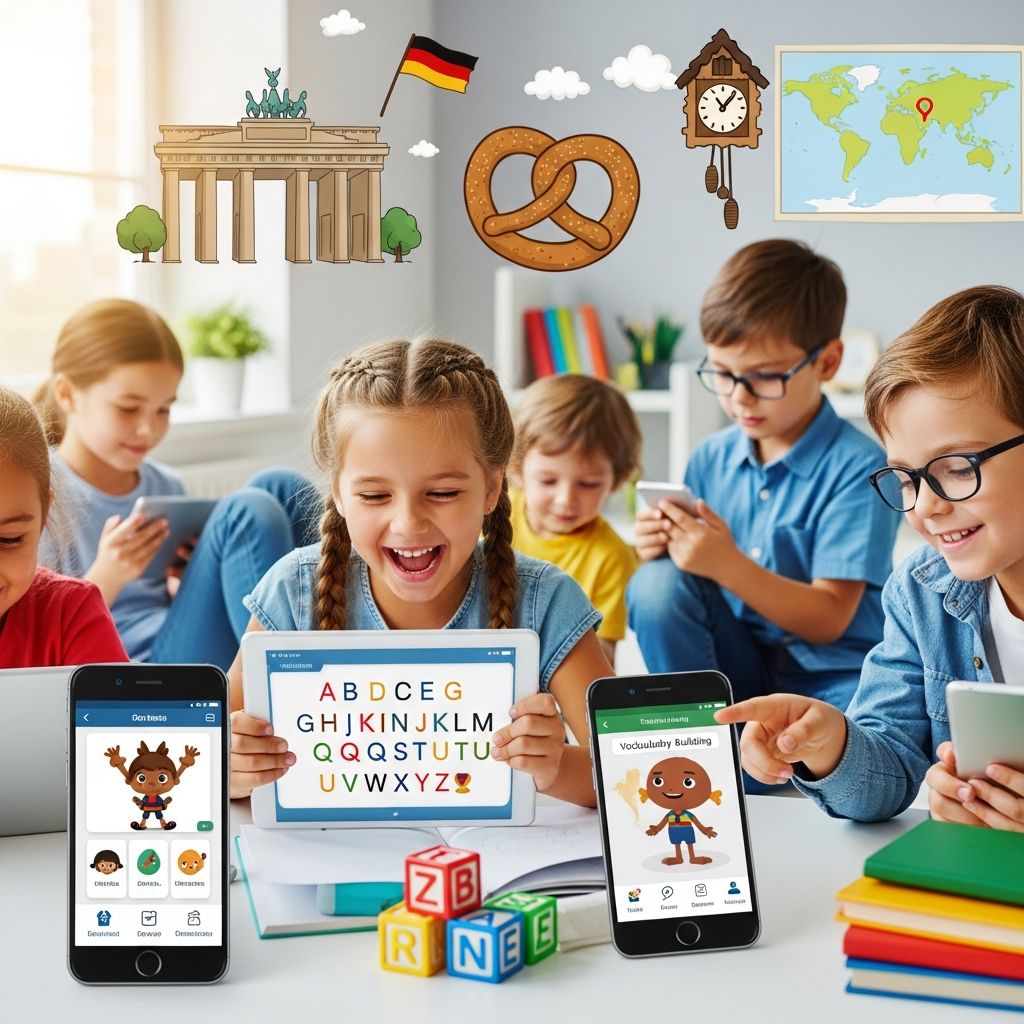
German can be a playful, natural part of your child’s day when the right apps turn vocabulary and grammar into games, songs, and stories rather than worksheets and drills.
This guide walks through the main types of German learning apps for children, key features to look for, leading examples in each category, and practical tips to help parents choose and use these tools effectively.
Why Use Apps to Learn German?
Children’s language apps combine visuals, audio, and interactivity so kids associate new German words with actions and images instead of translations, which supports faster recall and better pronunciation.
Compared with traditional workbooks, apps can offer short, focused sessions, instant feedback, and adaptive difficulty, helping busy families fit German practice into just a few minutes each day.
Key Features of Good German Learning Apps for Kids
Not every app marketed for children offers the same educational value, so it helps to know what to check before downloading or subscribing.
- Clear age range, such as 2–8 years or 8–12 years, so content is developmentally appropriate and not frustrating or boring.
- Play-based learning with games, songs, stories, and challenges that encourage repetition without feeling like drills.
- Balanced skills practice, including listening, speaking, reading, and early writing, rather than vocabulary alone.
- Ad-free or kid-safe environments with strong privacy protections and clear parental controls.
- Progress tracking so parents can see which topics a child has practiced and where extra review might be needed.
Overview of App Types
Children’s German apps generally fall into several broad categories: playful early-childhood apps, school-style course apps, vocabulary and flashcard tools, and immersive or story-based programs.
Many parents combine one or two apps from different categories—for example, a playful game app for daily exposure plus a more structured course app for older children—to create a more complete learning experience.
Play-Based Apps for Young Children
For preschool and early primary ages, apps that use short games, songs, and characters help children absorb German sounds and basic words in a low-pressure way.
These apps usually highlight simple themes such as colors, animals, food, or family, with frequent repetition and minimal text, making them suitable even for pre-readers.
Structured Course Apps for Older Kids
As children approach school age and begin reading more confidently, structured course apps introduce step-by-step lessons organized into units and topics, often similar to adult language programs but with friendlier visuals.
They may include short dialogues, grammar explanations, and review quizzes, helping older kids link spoken German to text and basic sentence patterns.
Vocabulary and Flashcard Apps
Vocabulary-focused apps rely on spaced repetition and quick quizzes to help children remember individual words, phrases, or picture–word pairs.
These tools work well alongside more comprehensive apps or school lessons, especially when children want to strengthen specific topics such as school items, hobbies, or travel words.
Comparison of German Learning App Types for Children
| Type of app | Typical age range | Main focus | Strengths | Possible drawbacks |
|---|---|---|---|---|
| Play-based / game apps | 2–8 years | Basic vocabulary, sounds, listening | Highly engaging, minimal reading needed | Limited grammar or longer sentences |
| Structured course apps | 8+ years | Grammar, reading, dialogues | Clear progression and review tools | Can feel like homework for younger kids |
| Vocabulary / flashcard apps | 7+ years (or with parent help) | Word and phrase retention | Short, focused practice sessions | Less context and communication practice |
| Story / immersion apps | 6+ years | Listening, context, pronunciation | More natural use of language | Progress may be slower to measure |
Benefits of German Learning Apps for Children
When well chosen and supported by parents, German learning apps can enrich a child’s language environment by adding native-speaker audio, visual cues, and interactive responses.
- Apps make practice possible in short sessions—on the way to school, while waiting at appointments, or during a quiet moment at home.
- Children often perceive app-based learning as play, which reduces anxiety and can lead to more frequent and consistent exposure to German.
- Some apps allow offline use, which is helpful for travel or households with limited connectivity.
Potential Limitations and How to Avoid Them
Even the best German learning app for children cannot replace real conversation, so it is important to see apps as a supplement rather than the entire language plan.
- Screen time balance: Set clear limits and combine app use with analog activities such as books, songs, or labeling objects at home in German.
- Lack of speaking practice: Encourage your child to repeat words out loud, respond to characters, or teach you new phrases learned in the app.
- Motivation dips: Rotate between two or three apps or add reward systems to keep practice enjoyable over the long term.
How to Choose the Right German App for Your Child
Choosing the right app involves matching your child’s age, interests, and language goals with the app’s structure and teaching style.
- Check age and reading level: Pre-readers generally need image- and audio-driven interfaces, while older children can benefit from text-based exercises.
- Try free versions first: Many apps offer trial periods or sample lessons, allowing you to gauge engagement and difficulty before paying for a subscription.
- Align with your goals: For casual exposure, playful apps are sufficient, but for school support or exam preparation, a more structured course app may be appropriate.
- Review safety and ads: Prefer kid-safe, ad-free apps or those with transparent policies on data and in-app purchases.
Practical Tips for Parents Using German Apps
Parental involvement can significantly increase the impact of any German learning app, even when parents do not speak the language themselves.
- Set a routine, such as 10–15 minutes of German app practice after homework or before bedtime on several days each week.
- Join the first few sessions to demonstrate interest and help your child navigate menus or understand instructions.
- Repeat new words around the home—for example, using German terms for everyday objects or simple phrases like greetings and thanks.
- Monitor progress dashboards to see which topics your child enjoys most and where extra offline practice might help.
Integrating Apps with Other Learning Resources
Apps work best as part of a simple home language plan that may include storybooks, children’s songs, short videos, or contact with German-speaking relatives or tutors.
For example, you might use a game-based app for new vocabulary, then reinforce those words in a picture book or children’s song, and finally encourage your child to use them in simple sentences during daily routines.
Frequently Asked Questions
How much screen time is appropriate for German learning apps?
Guidelines for digital learning suggest short, focused sessions—often 10–20 minutes at a time for younger children—combined with plenty of offline play and interaction.
Rather than focusing only on total minutes, consider the quality of engagement: a brief, enthusiastic German practice session is more valuable than a long, distracted one.
Can children really become fluent in German using only apps?
Apps are powerful tools for building vocabulary, listening comprehension, and early reading, but fluency usually requires real conversations with parents, teachers, peers, or tutors.
Think of German apps as a foundation that prepares children to understand and use the language when they encounter it in real-life situations, classes, or trips.
Do parents need to speak German to support their child?
Parents do not need to speak German to help; they can still encourage consistent practice, show interest, and reinforce habits like repeating out loud and reviewing new words.
Over time, many parents pick up basic vocabulary alongside their children, which can turn practice into a shared family activity.
Are in-app purchases and ads a concern in kids’ German apps?
Experts recommend ad-free, kid-safe apps for younger users, as advertisements and aggressive in-app purchase prompts can distract children and raise privacy issues.
Before you subscribe, check store listings and reviews to ensure that parental controls are clear and that any purchases are protected by passwords or device restrictions.
How long does it take for children to see results?
Children often begin repeating individual German words and simple phrases after a few weeks of short, regular practice sessions, especially in highly interactive apps.
More robust skills—like understanding basic sentences or following short stories—typically develop over months of consistent exposure supported by songs, books, and conversation.
Final Thoughts for Parents
Choosing the best app to learn German for your child is less about finding a single perfect program and more about matching your child’s age, personality, and goals with an engaging, age-appropriate tool.
With a bit of planning and regular, playful use, German learning apps can become a natural part of daily life and a stepping stone toward confident communication in a new language.