Seven is a magical age for reading. Children are moving from sounding out every word to reading with growing confidence, and the right books can turn this new skill into a genuine love of stories and learning. Instead of chasing every new recommendation, parents can focus on understanding what makes a book truly work for a 7-year-old and how to match titles to their child’s unique interests and abilities.
Understanding Reading at Age Seven
By age seven, most children are in the early stages of independent reading, but their emotional understanding and imagination are often far ahead of their technical skills. A book that looks “too easy” on the surface may still be perfect if it delivers humor, adventure, or comfort in a way that keeps them turning pages.
At this age, reading ability varies widely between children, even within the same classroom, so the goal is not to keep up with others but to give each child books that feel achievable and exciting rather than intimidating.
Key Signs a Book Fits Your 7-Year-Old
There is no single perfect level or format for every child, but a few simple checks can help you decide whether a book is a good match right now.
- The child understands the first page or two without frequent help.
- Sentences are short enough that they do not lose track of meaning midway through.
- The font is clear, with enough space between lines and margins.
- Illustrations (if present) support understanding rather than distracting from the text.
- After a short reading session, the child can explain who the main character is and what is happening.
Balancing Challenge and Comfort
The best reading diet for a 7-year-old usually blends “just right” books with a mix of easier and more challenging titles. Easier books build fluency and confidence, while slightly harder books keep them stretching their skills in manageable ways.
If a book feels too difficult to read alone, you can turn it into a read-aloud, letting your child handle a page, a paragraph, or even a single character’s dialogue while you read the rest.
Formats That Work Well at Seven
There is a huge range of book types that can appeal to a 7-year-old, and most children enjoy moving between formats depending on mood and energy. Offering variety helps reading feel like a flexible, fun activity rather than a rigid assignment.
Early chapter books
Early chapter books bridge the gap between picture books and full novels. They usually have short chapters, relatively large print, and illustrations on many pages.
- Simple but engaging plots, often centered on school, family, pets, or gentle fantasy.
- Recurrent characters that allow children to grow attached over several books.
Illustrated storybooks
Some 7-year-olds still love picture-heavy stories, especially when the language is richer or more complex. These books are ideal for shared reading at bedtime or on lazy weekends.
- Detailed artwork that adds layers to the plot and invites discussion.
- Longer page length or more sophisticated vocabulary balanced by visual support.
Graphic novels and comics
Graphic novels and comics can be a powerful gateway to reading, particularly for visual thinkers or children who struggle with large blocks of text. Panels, speech bubbles, and expressive art provide context clues that support comprehension.
- Fast-moving stories that feel similar to watching a show but require active reading.
- Accessible entry points for reluctant readers who are still building stamina.
Nonfiction for curious minds
Many 7-year-olds are intensely curious about how the world works. Age-appropriate nonfiction can satisfy this curiosity while expanding vocabulary in science, history, nature, and technology.
- Short sections, sidebars, and labeled diagrams that invite browsing.
- Topics such as animals, space, sports, weather, and inventions that link to their questions.
Matching Books to Personality and Interests
Children read more when books reflect what they already love. One 7-year-old might happily devour stories about soccer leagues, while another prefers fairy kingdoms or clever mysteries. Listening to what excites them is just as important as checking reading level.
When you are unsure where to start, use your child’s favorite films, games, or activities as clues and look for books that echo those settings, themes, or types of humor.
Interest-based book ideas
| Child’s interest | Good book features |
|---|---|
| Animals and pets | Stories told from an animal’s viewpoint, rescue tales, vet or zoo settings. |
| Science and space | Simple experiments, space adventures, fact-filled picture books with diagrams. |
| Sports and movement | Team stories, underdog victories, funny mishaps at practice or tournaments. |
| Fantasy and magic | Short quest stories, friendly dragons or fairies, school-of-magic settings. |
| Mysteries and puzzles | Detective clubs, missing objects, codes or visual clues to solve along the way. |
Looking for Positive Themes and Role Models
Books for 7-year-olds can gently explore big ideas while still feeling light and fun. Themes such as friendship, kindness, problem-solving, and resilience help children make sense of their own experiences.
Good stories at this age often show characters making mistakes, apologizing, trying again, and discovering that their actions affect others, all in ways that feel reassuring rather than preachy.
Ensuring Diversity and Representation
Children benefit from seeing both “mirrors” (characters like themselves) and “windows” (characters with very different lives). A thoughtfully chosen home library can quietly introduce them to a wide range of cultures, families, and abilities.
Look for books where children of different backgrounds are shown as heroes, explorers, scientists, artists, and everyday kids, not just side characters or stereotypes.
Checking Content for Sensitivity and Age Appropriateness
Seven-year-olds are often ready for more complex plots and mild suspense, but many are still sensitive to intense fear, loss, or unfairness. Descriptions that seem mild to adults can feel overwhelming from a child’s point of view.
When in doubt, skim or pre-read. Pay special attention to scenes involving violence, cruelty, or scary creatures, as well as how conflicts are resolved and whether the story returns to a sense of safety by the end.
Simple content-check questions for parents
- Does the story resolve in a way that feels safe and hopeful?
- Are any frightening scenes brief and clearly framed as fiction?
- Is teasing, bullying, or name-calling challenged rather than rewarded?
- Are adults or older characters generally trustworthy, or is everyone portrayed as cruel?
Building a Daily Reading Habit
Even the best book will not have much impact if it only comes off the shelf once a month. Seven is an ideal age for weaving short reading sessions into everyday routines so that books become as normal as snacks and playtime.
Consistency matters more than length. Ten to fifteen minutes of focused reading every day can do more for fluency and comprehension than an occasional long marathon session.
Simple ways to fit in reading
- Keep a small basket of books near the breakfast table for a calm start to the day.
- Establish a bedtime reading ritual, alternating between you reading aloud and your child reading a few paragraphs.
- Bring a book in the car or on public transport instead of relying only on devices for entertainment.
- Use “waiting moments” at appointments or restaurants as quick reading opportunities.
Supporting Struggling or Reluctant Readers
Not every 7-year-old is eager to read independently, and that is completely normal. Pressure and comparisons can quickly turn reading into a source of anxiety, so the focus should stay on comfort and small successes.
Children who find text overwhelming may respond better to short, funny books, joke collections, illustrated facts, or stories with lots of repetition and predictable patterns.
Encouraging without pressuring
- Celebrate effort rather than speed or difficulty level.
- Allow your child to reread favorite books, even if they seem “too easy.”
- Invite them to read signs, menus, or game instructions in everyday life.
- Consider reaching out to teachers or reading specialists if you see ongoing frustration or avoidance.
Making the Most of Read-Aloud Time
Reading aloud is still powerful at age seven, even if your child can read alone. Shared stories create a warm connection and expose them to richer language and more complex storylines than they could tackle independently.
Read-aloud time also models expression, rhythm, and how good readers handle punctuation, making it easier for children to transfer those skills to their own reading.
Interactive read-aloud ideas
- Pause occasionally to ask what they think will happen next.
- Let your child choose voices for particular characters and try them out together.
- Invite them to draw a favorite scene while you read and then talk about the picture.
- Connect the story to real life by asking, “Has anything like this ever happened to you?”
Creating a Book-Friendly Home Environment
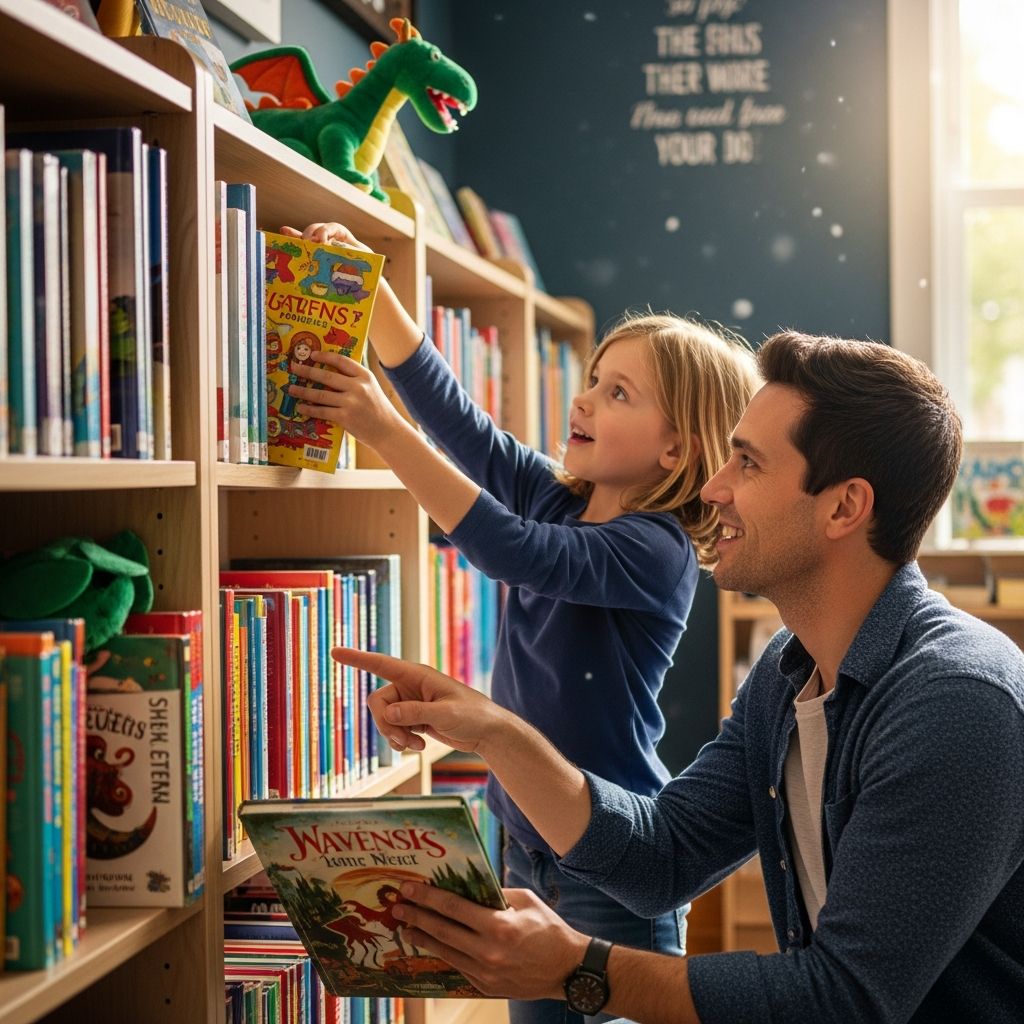
Children are much more likely to read when books are easy to see and reach. A simple, cozy reading spot can make books feel like a natural part of play rather than a school task that must be completed.
Rotating books every few weeks keeps shelves feeling fresh, even if you are mainly using the library. When new or long-unseen titles appear in a visible place, curiosity often does the rest.
Practical setup tips
- Use low shelves or bins so your child can browse independently.
- Display a few book covers facing outward to catch their eye.
- Add a soft cushion, blanket, or small lamp to mark out a “reading corner.”
- Place a mix of fiction, nonfiction, and comics together so choices feel open-ended.
How Screens and Books Can Co-Exist
Many 7-year-olds are already familiar with tablets, games, and shows, and it is unrealistic to expect screens to vanish completely. Instead of treating books and screens as enemies, parents can help them coexist in a balanced way.
For example, a child who enjoys a particular animated series might be drawn to novelizations, companion fact books, or comics based on that world, turning screen enthusiasm into reading motivation.
Ideas for balancing media
- Pair screen time with book time, such as “30 minutes of show, then 15 minutes of reading.”
- Look for ebooks or audiobooks when physical copies are not available, especially during travel.
- Use subtitles when appropriate; some children naturally start tracking the words as they watch.
- Encourage children to create their own mini-comics or picture books inspired by favorite games or characters.
Simple Book-Selection Checklist for Parents
When browsing in a store, library, or online list, it helps to have a quick mental checklist. You do not have to tick every box, but the more “yes” answers you have, the more likely a book will be a hit.
- Is the language understandable but not babyish?
- Are the chapters or sections short enough for a 10–15 minute reading session?
- Is there at least one character your child might relate to or find interesting?
- Does the story avoid graphic violence or intense horror?
- Are there moments of humor, wonder, or curiosity that will pull them back in?
Frequently Asked Questions About Books for 7-Year-Olds
How long should my 7-year-old read each day?
There is no strict rule, but aiming for 15–20 minutes of focused reading on most days is a practical goal. This can be a mix of independent reading and shared read-aloud time, spread across morning, afternoon, or evening.
What if my child only wants to read one type of book?
It is perfectly fine for a child to go through phases of loving only animal stories, only comics, or only funny school adventures. Keep offering gentle variety alongside their favorites, but allow them to fully enjoy their chosen niche without turning it into a battle.
Are graphic novels “real reading” for 7-year-olds?
Yes. Graphic novels require children to follow dialogue, interpret visual clues, and connect panels into a coherent story, all of which are valuable literacy skills. They can also serve as stepping stones to more text-heavy books over time.
Should I worry if my 7-year-old rereads the same book over and over?
Rereading is often a sign of comfort and mastery, not a lack of progress. As children revisit familiar stories, they notice new details, read more fluently, and deepen their understanding, which builds confidence for tackling new material later.
How can I tell if a book is too hard?
If your child stumbles on many words on a single page, loses track of the plot, or shows visible frustration, the book may be too difficult for solo reading right now. You can keep it as a read-aloud and try it again for independent reading after a few months of growth.
Do audiobooks count as reading?
Audiobooks help children build vocabulary, listening skills, and a sense of story structure, so they are an excellent complement to print reading. Combining audio with a physical book can be especially helpful for children who need extra support in tracking text.
Final Thoughts
Choosing books for 7-year-olds does not require expert training or complex systems. With a basic understanding of reading development, attention to your child’s interests, and a willingness to experiment, you can assemble a small but powerful collection that nurtures curiosity and confidence. The most important ingredients are not perfect levels or prestigious awards, but stories that make your child laugh, think, feel seen, and ask for “just one more chapter.”