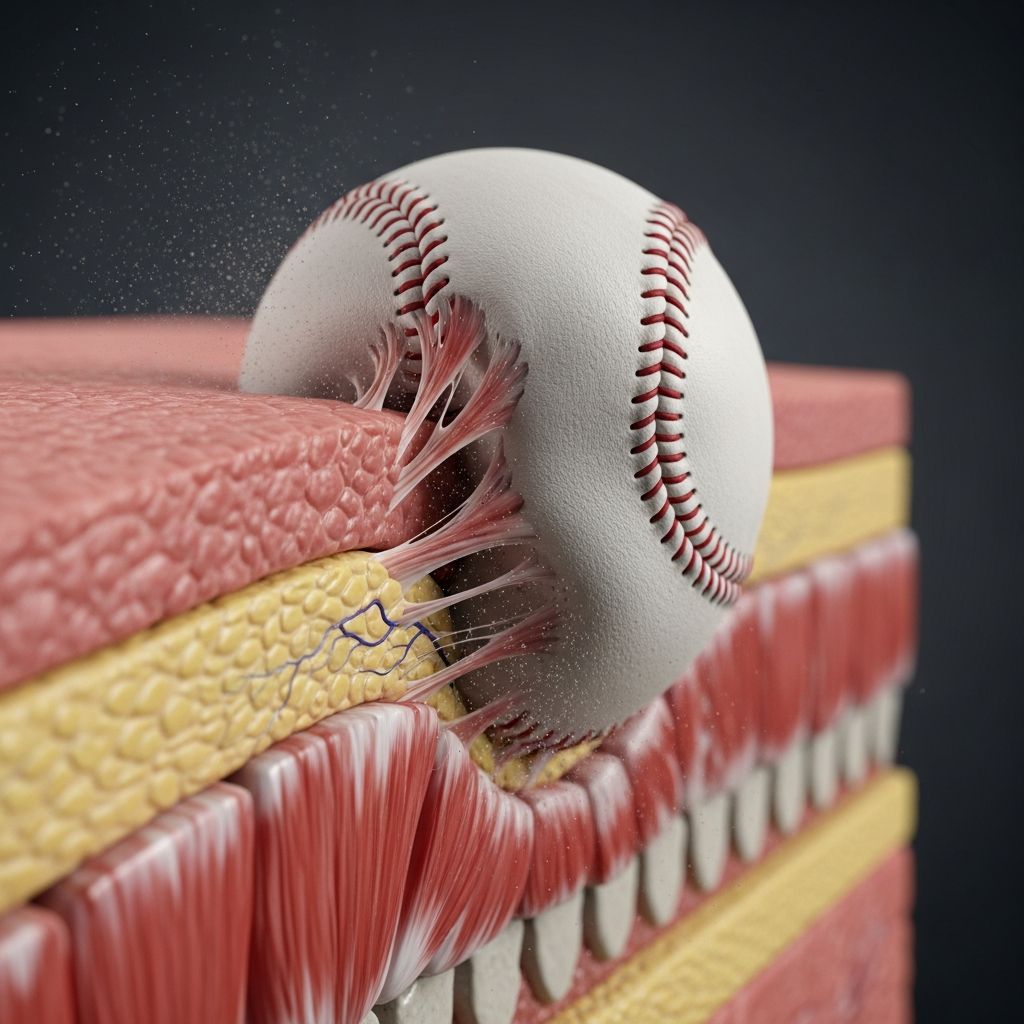
Understanding Collision Physics in Baseball
Baseball-related injuries resulting from direct contact with a pitched ball represent a significant concern for players at all levels of competition. These injuries occur through the application of fundamental physics principles that determine how energy transfers from a moving object to the human body. The collision between a baseball and a player involves multiple factors that together determine the severity and nature of resulting trauma.
When examining what happens during impact, we must consider the basic principles governing moving objects. A standard baseball weighs approximately 145 grams and can travel at speeds exceeding 90 miles per hour when struck from a bat or pitched at high velocity. The relationship between an object’s mass, velocity, and the energy it possesses forms the foundation for understanding why such collisions cause injury.
Energy Transfer and Its Role in Injury Severity
The concept of kinetic energy provides essential insight into why baseball impacts prove so damaging. Kinetic energy represents the work required to bring a moving object to a complete stop. For a baseball traveling at 110 miles per hour, the kinetic energy approaches approximately 175 joules—equivalent to the energy of a compact automobile moving at one mile per hour. While this comparison might seem reassuring, the actual consequences of impact differ dramatically.
The critical distinction lies in how the body receives this energy. When an automobile moving at one mile per hour comes into contact with a person, the collision occurs over a relatively large surface area and across an extended period. The person’s body has time to decelerate gradually, distributing the energy absorption across multiple tissue types. In contrast, a baseball impact concentrates all that energy into a small, spherical contact point approximately the size of the ball itself.
This concentration of force creates what physicists call pressure—the force per unit area. A baseball hitting the face delivers all 175 joules into a area smaller than a quarter, resulting in enormous localized pressure. Understanding this principle helps explain why such impacts cause severe localized damage despite the relatively modest total energy involved.
Tissue Density and Impact Response
The human body does not respond uniformly to impact forces. Different tissues possess varying densities and elastic properties that determine how they absorb and distribute impact energy. Facial bones and structures protect vital organs like the brain and eyes, but this protective function comes with a cost when impact occurs directly.
Dense tissues such as bone and cartilage contain more particles in a given volume compared to softer tissues like muscle or fat. When a baseball strikes a dense area, the impact compresses more tissue simultaneously, resulting in greater energy exchange across a smaller number of particles. This explains why impacts to well-padded areas produce different outcomes than impacts to sparse-padding regions.
The concept of stopping distance proves particularly relevant to injury severity. When a baseball strikes a soft, compressible surface, the collision extends over a longer duration and greater distance as the tissue gradually decelerates the ball. Conversely, impact against hard surfaces like bone results in immediate deceleration with minimal compression, concentrating all force at the point of contact. This represents the difference between hitting a mountain of pillows versus a brick wall—the pillows distribute impact gradually while the brick wall forces all energy absorption into an instant.
Specific Facial and Cranial Injuries
Baseball impacts to the face initiate a sequence of biomechanical events that can progress from simple surface trauma to serious brain injury. The facial skeleton, while protective, becomes a liability when struck directly due to its position immediately anterior to the brain. This anatomical arrangement means that facial trauma frequently involves secondary traumatic effects within the cranial vault.
Bone Compression and Fracture MechanismsWhen a baseball strikes the face, the initial response involves compression of facial bones. The frontal bone, nasal bones, zygomatic bones (cheekbones), and maxilla (upper jaw) all contain hollow spaces and relatively thin walls. Direct impact causes these bones to buckle inward, resulting in fractures. The delicate bones surrounding the eye sockets and sinuses prove particularly vulnerable to fracturing when subjected to localized impact forces.
Nasal injuries represent especially serious concerns. The nasal structure contains critical airway passages, and trauma to this region can result in breathing difficulties through airway obstruction or structural deformity. Beyond immediate breathing problems, nasal injuries frequently involve disruption of delicate structures controlling smell and taste.
Eye and Sinus Complications
The orbits housing the eyeballs contain extremely delicate structures. Impact to the upper face can fracture the orbital floor or walls, potentially causing complications ranging from vision changes to double vision. The sinuses, air-filled cavities within the facial bones, can hemorrhage or become filled with blood when fractured, creating additional pressure and inflammation.
Secondary Brain Trauma from Facial Impact
Perhaps most concerning about facial baseball injuries involves effects beyond the immediate impact site. The brain sits directly posterior to the facial skeleton, separated only by the frontal bone and a protective membrane called the dura mater. When facial impact occurs, the sequence of events extends beyond local tissue damage.
As facial bones compress inward under impact force, they begin to decelerate the incoming baseball. However, the brain inside the skull continues moving in the same direction as the original impact until the skull itself decelerates. This differential creates relative motion between the brain tissue and the skull, causing the brain to compress against the anterior skull cavity. At high impact velocities, this compression can stretch and damage delicate blood vessels within the brain substance, potentially causing bleeding or diffuse axonal injury.
This mechanism explains how facial impacts can result in concussions and more severe traumatic brain injuries despite the impact occurring on the face rather than the head directly. The brain’s continued motion after the skull stops represents a form of internal trauma distinct from the external facial damage.
Jaw and Dental Trauma
Impacts to the lower face involve different anatomical considerations than upper face injuries. The mandible (lower jaw) articulates with the skull at the temporomandibular joint, and direct impacts can displace this joint or fracture the jaw structure. Such injuries affect not only immediate pain and function but also long-term chewing and speaking capabilities.
Dental trauma frequently accompanies lower face impacts. Teeth, while extremely hard, rest in sockets with limited mobility. Direct impact can fracture tooth structure, drive teeth into the alveolar bone, or even cause complete tooth displacement. Dental injuries often require extensive reconstructive treatment and can result in permanent loss of tooth structure.
Force Distribution and Padding Effects
The impact force experienced during a baseball collision depends on multiple variables beyond the baseball’s velocity alone. Newton’s Second Law of Motion states that force equals the mass of an object times its acceleration. Since the baseball’s mass remains constant, the critical factors determining injury-producing forces involve the change in the ball’s velocity and the time duration over which this velocity change occurs.
When a baseball strikes an unpadded area such as the fingers, lower forearm, or the small bones of the foot, the collision time becomes extremely short because these areas offer minimal compressible material. The rapid deceleration creates enormous forces concentrated at the impact point. Conversely, when impact occurs against well-padded areas like the upper arm or thigh, the padding compresses during the collision, extending the time over which velocity change occurs. This longer collision duration reduces the peak force experienced by underlying tissue, distributing the impact energy across a larger area and duration.
This principle explains why certain baseball injuries prove particularly severe. A ball striking the hand can break bones because the collision time remains minimal and forces become extreme. In contrast, a ball striking the chest wall, while uncomfortable, typically does not cause fractures because body padding extends the collision time and distributes forces more evenly.
Velocity Considerations in Baseball Impact
Not all baseball impacts involve extreme velocities. Pitched baseballs, batted baseballs traveling toward a batter, and foul balls each carry different velocity profiles. A baseball struck from a bat may reach 110 miles per hour, while wild pitches or errant throws might travel at 80-95 miles per hour. Even lower velocity impacts, however, can cause injury when they strike vulnerable anatomical areas.
The relationship between velocity and injury severity proves non-linear. Doubling the velocity quadruples the kinetic energy involved. This means that the difference between a 60 mile-per-hour impact and a 90 mile-per-hour impact involves substantially greater forces than the difference in speeds might suggest. Even seemingly modest velocity increases result in dramatic increases in injury potential.
Protective Strategies and Injury Prevention
Understanding the physics of baseball impacts has led to development of protective equipment and techniques aimed at reducing injury severity. Helmets designed for baseball incorporate protective padding and construction materials that absorb and distribute impact forces across larger areas, extending collision time and reducing peak forces reaching the head.
Facial protective equipment, including cages and shields attached to batting helmets, prevents direct ball contact with the face entirely. These devices redirect or decelerate the ball before it reaches vulnerable facial structures. While such equipment changes the aesthetics of the game, the injury prevention benefits prove substantial.
Beyond equipment, coaching techniques teach players to present larger body surface areas when possible and to avoid impacts to vulnerable areas. A shoulder turn technique, for instance, allows a batter to rotate away from an approaching pitch, increasing the collision time and reducing impact forces. While uncomfortable to practice, such techniques demonstrate how biomechanical modifications can reduce injury risk by altering the physics of impact.
Progressive Injury Development
Baseball impacts do not necessarily cause injury exclusively at the moment of contact. Tissue damage progression can continue after the initial impact as inflammation develops, blood accumulates, and secondary injury cascades begin. A relatively modest initial impact might appear survivable initially but result in more serious injury over the following hours or days as swelling increases intracranial pressure or as delayed hemorrhage develops.
This progressive nature of injury emphasizes the importance of proper medical evaluation following facial or head impacts in baseball. Symptoms may evolve over time, and injuries initially appearing mild might indicate more serious underlying damage. Concussion symptoms, in particular, frequently develop over minutes to hours after the initial impact rather than appearing immediately.
Frequently Asked Questions
Q: Why does a baseball impact cause more injury than the same energy from a car moving at one mile per hour?
Although the kinetic energy is similar, a baseball concentrates all that energy into a very small contact area, creating extremely high pressure. The car’s impact distributes over a much larger area and longer duration, allowing the body to absorb energy gradually rather than suffering localized concentrated trauma.
Can a facial baseball injury cause brain damage?
Yes. When facial bones compress from impact, the brain continues moving forward inside the skull and can compress against the skull cavity or the opposite side of the brain. This can cause concussions, brain tissue stretching, or blood vessel damage, potentially resulting in serious traumatic brain injury.
Which facial structures are most vulnerable to baseball impact?
The bones surrounding the eyes and sinuses are particularly delicate and vulnerable to fracture. The nasal structure is also susceptible to serious injury, as nasal trauma can result in breathing difficulties or permanent structural changes. Teeth and the jaw joint also represent vulnerable areas.
How does padding reduce injury from baseball impacts?
Padding compresses during impact, extending the collision time and distributing the impact force over a larger area and longer duration. This reduces peak force while spreading energy absorption across more tissue, significantly reducing injury severity.
Should players wear facial protection in baseball?
Given the potential for serious facial, eye, and brain injuries from baseball impacts, facial protective equipment like helmets with cages or shields provides significant injury prevention benefits, particularly for batters and youth players.
References
- Baseball Pitching Biomechanics in Relation to Injury Risk and Performance — U.S. National Library of Medicine/PMC. 2012. https://pmc.ncbi.nlm.nih.gov/articles/PMC3445126/
- The Physics of Being Hit by a Pitch — The Hardball Times/FanGraphs. https://tht.fangraphs.com/the-physics-of-being-hit-by-a-pitch/
- Throwing Biomechanics — Physiopedia. https://www.physio-pedia.com/Throwing_Biomechanics
- Baseball and Biomechanics: Researching Injury Prevention for Pitchers — Point Loma Nazarene University. https://viewpoint.pointloma.edu/baseball-and-biomechanics-researching-injury-prevention-for-pitchers/
- Baseball Biomechanics — Mass General Brigham. https://www.massgeneralbrigham.org/en/about/newsroom/articles/baseball-biomechanics