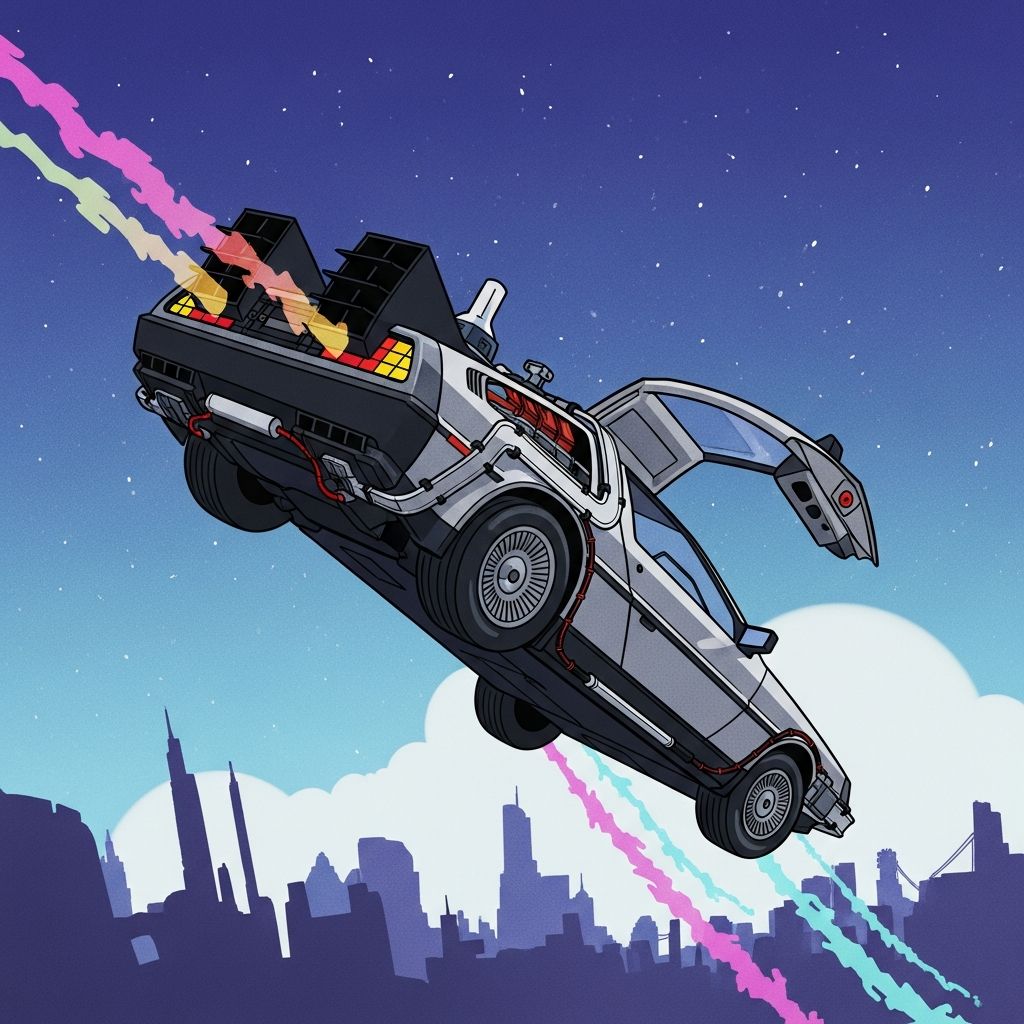
Years after the Back to the Future film trilogy redefined blockbuster science fiction, the franchise made an unlikely jump: a Saturday-morning cartoon packed with time travel hijinks, science demos, and live-action appearances by Christopher Lloyd. This animated spin-off burned brightly, briefly, and left behind a strange but fascinating legacy.
The Leap from Blockbuster Trilogy to Saturday Morning
By the early 1990s, turning hit movies into cartoons had become a routine strategy for Hollywood studios seeking new audiences among young viewers. Properties as varied as Ghostbusters and Rambo were already fixtures on kids’ television schedules, creating an environment where a Back to the Future cartoon seemed commercially inevitable.
For Universal, the animated series was more than a simple licensing opportunity. It was the first major project of the newly formed Universal Cartoon Studios and also marked Amblin Entertainment’s debut in Saturday-morning programming. That made the show a high-stakes experiment in how far a film franchise could stretch into television while still feeling authentic.
- Network: CBS Saturday morning
- Debut: September 14, 1991
- Seasons: 2
- Total episodes: 26
- Format: Animated stories plus live-action Doc Brown segments
Reimagining the Franchise for Kids
Adapting the complex, PG-rated films into half-hour episodes aimed squarely at children demanded a rethinking of both tone and focus. CBS children’s programming executives wanted a show that was overtly kid-friendly, with clear comedy, simplified stakes, and characters young viewers could identify with.
Shifting the Spotlight to Jules and Verne
In the films, Doc Brown’s sons Jules and Verne appear only briefly at the end of Back to the Future Part III. For the animated series, they became central players. Writers developed them into distinctive personalities: one more analytical and brainy, the other impulsive and mischievous, allowing time-travel plots to double as family sitcoms.
This choice solved several creative challenges at once:
- It allowed younger protagonists for child viewers to latch onto.
- It kept Doc and Marty present as mentors and co-adventurers rather than the sole focus.
- It opened space for stories about family dynamics within the Brown household.
The result was an ensemble show where Marty McFly, while still important, often shared or ceded narrative control to the next generation of Browns.
Balancing Comedy, Sci-Fi, and Education
Another major shift from the films was the addition of an educational layer. The series aimed to thread together slapstick humor, improbable time travel, and basic science demonstrations suitable for young audiences. In line with broader trends in children’s programming, each episode needed to offer at least a thin educational takeaway, usually related to physics, history, or simple experiments.
| Element | Film Trilogy | Animated Series |
|---|---|---|
| Primary audience | Teens and adults | Children and families |
| Main tone | Action-comedy with some darkness | Broad comedy and farce |
| Educational content | Implicit at best | Explicit experiments and concepts |
| Violence/conflict | Fist fights, peril, guns | Cartoon slapstick, toned-down peril |
Keeping the Movies’ DNA: Creative Control and Casting
Unlike many movie-to-cartoon adaptations that proceeded without real involvement from the original filmmakers, the Back to the Future animated series had deep connections to its source material.
Bob Gale’s Oversight
Bob Gale, co-writer and co-producer of all three films, served as executive producer on the cartoon. His role went beyond a symbolic credit: he reviewed scripts, shaped story directions, and acted as a guardian of continuity. His presence helped ensure that time travel rules, character voices, and major lore elements remained recognizably part of the established universe, even when the storytelling skewed sillier than the films.
Christopher Lloyd and the Live-Action Doc Brown
One of the show’s boldest creative decisions was to have Christopher Lloyd reprise his role as Doc Brown—not just in voice form, but in live-action segments that bookended each episode. According to Universal’s original press announcement, this was the first time a star from a major motion picture appeared in live action on a cartoon spin-off of their own film.
The live-action pieces served several purposes:
- They gave the series instant legitimacy by visibly linking it to the movies.
- They provided a framework for science demonstrations and educational explanations.
- They bridged the gap between live-action sci-fi spectacle and animated exaggeration, easing viewers into the cartoon world.
These segments were filmed on a Doc Brown laboratory set designed to evoke the films and were later incorporated into the Universal Studios Hollywood attraction environment.
Key Voices Behind the Characters
While Michael J. Fox did not voice Marty due to his busy acting schedule, the animated series nonetheless assembled a surprisingly strong cast. Official materials confirm that the show featured animated versions of Marty McFly, Doc Brown, Einstein the dog, Jules and Verne, and a recurring gallery of Tannen family antagonists.
The consistency of character types—Marty’s resourcefulness, Doc’s manic brilliance, and Biff’s blustering stupidity—helped audiences accept the exaggerated art style and more comedic storytelling as part of the same universe, just translated into Saturday-morning logic.
Animating Time Travel: Visual Style and Production Challenges
Turning a special-effects-heavy live-action franchise into a weekly cartoon brought its own obstacles for the animators and production team.
Colossal Pictures and the Look of Hill Valley
Animation services for the series were handled by Colossal Pictures, a San Francisco studio known at the time for inventive cel and early computer animation. Tasked with transforming iconic live-action images—the DeLorean, Hill Valley’s courthouse square, and Doc’s inventions—into stylized designs suitable for fast TV production, the artists had to strike a compromise between fidelity and speed.
Time travel stories require a constant churn of new sets, historical costumes, and side characters, which made the show more demanding than an average domestic sitcom cartoon. With episodes jumping between eras and locations, the team needed a large volume of backgrounds and character models, all while hitting broadcast deadlines and staying within budget.
Time Machines, Gadgets, and Visual Gags
Animation opened the door to inventions and scenarios too expensive or logistically impossible for live-action. Producers noted that the series would “take full advantage of the medium of animation” by introducing wild new contraptions and broader slapstick than the original effects-driven films could practically accommodate.
- Multiple variants of the time machine concept appeared, riffing on the DeLorean and train-based tech from the movies.
- Doc’s gadgets provided endless setups for visual jokes, malfunction sequences, and last-second plot resolutions.
- Historical settings allowed animators to design playful versions of past and future Hill Valleys without the constraints of physical sets.
From Studio Flagship to Ratings Casualty
On paper, Back to the Future: The Animated Series was positioned as a cornerstone for multiple corporate strategies. Universal Cartoon Studios, Amblin Entertainment, and CBS all spoke publicly about a long-term relationship that could extend into additional animated shows and a full hour block on Saturday mornings.
Launch, Hype, and Tie-In Merchandise
CBS gave the show a two-season, 26-episode commitment from the outset, signaling confidence in the concept. The launch was supported by a national marketing push that included fast-food toys and licensed merchandise, following the standard tie-in model for children’s television of the era.
For younger audiences, the cartoon often served as the first encounter with the Back to the Future brand, with the films discovered later on VHS or television reruns. For parents and older fans, the live-action Doc Brown segments helped position the series as an official, if lighter, extension of the trilogy.
Budget Cuts and Early End
Despite its strong start, the show’s future dimmed quickly. CBS kept its promise to air both seasons, but the second season operated under a reduced budget, which affected production values and the overall scope of time-travel adventures. Animation-heavy, era-jumping plots are inherently resource-intensive; when costs tighten, visual ambition is often the first casualty.
The final episode aired in December 1992, and the network attributed the series’ non-renewal to low ratings. The bold vision of an expanding animated block centered on Back to the Future never materialized, and Universal Cartoon Studios shifted its ambitions to other projects.
Legacy: A Curious Footnote in Franchise History
Although it lasted only 26 episodes, the animated series occupies a distinct place in the broader Back to the Future franchise.
A Bridge Between Films and Later Spin-Offs
Decades after the trilogy ended, Back to the Future continued to spawn non-film sequels and reinterpretations, including theme park rides and narrative-driven video games that returned to the 1980s setting. The animated series helped establish the idea that the franchise could survive and evolve outside the strict boundaries of live-action cinema.
It experimented with:
- Expanding the Brown family beyond Doc as a solitary genius.
- Recasting Hill Valley as a playground for serialized adventures, not just three self-contained film plots.
- Mixing education and entertainment in ways later children’s shows would refine, especially around science concepts.
Cult Status Among Fans
While the show never matched the mainstream impact of the movies, it retains a small but vocal cult following. Fans often point to:
- The novelty of live-action Doc Brown introducing a cartoon adventure each week.
- The charm of low-stakes, comedic time travel that doesn’t require saving the timeline from catastrophe in every episode.
- The curiosity factor of a major film franchise’s first serious foray into television animation.
For franchise historians, the cartoon represents a moment when studios were still testing the limits of intellectual property expansion, years before streaming and cinematic universes made that strategy an industry norm.
Frequently Asked Questions About the Back to the Future Cartoon
When did the Back to the Future animated series air, and how many episodes were produced?
The series premiered on CBS on September 14, 1991, and ran through December 1992. It produced two seasons with a total of 26 episodes.
Was Christopher Lloyd really in the show, or just the films?
Christopher Lloyd reprised his role as Doc Brown in live-action segments that opened and closed each episode. These segments introduced the stories and often featured brief science demonstrations, creating a direct bridge between the films and the animated adventures.
Did Michael J. Fox voice Marty McFly in the cartoon?
No. The animated Marty McFly is based on the film character, but Michael J. Fox did not provide the voice due to other acting commitments. The series instead relied on a separate voice actor to portray Marty while maintaining the character’s familiar personality and mannerisms.
Is the animated series considered canon with the Back to the Future movies?
There is no single official canon policy applied across all Back to the Future spin-offs, but the animated series was overseen by Bob Gale, co-writer and co-producer of the films, and uses the same core characters and continuity rules. Many fans treat it as a light-hearted, parallel extension of the film universe rather than a strict continuation.
Why did the show end after only two seasons?
CBS fulfilled its initial two-season, 26-episode commitment but did not order additional episodes, citing low ratings. Budget cuts in the second season also limited the show’s scope and visual ambition, making renewal less likely in a competitive Saturday-morning landscape.
References
- 31 Years Ago, ‘Back to the Future’s Biggest Failure Launched Bill Nye’s Career — Fatherly. 2022-09-14. https://www.fatherly.com/entertainment/back-to-the-future-cartoon-oral-history
- Animated “Back to the Future” First Series From Universal Cartoon Studios, Debuts on CBS Saturday Morning Schedule in Fall 1991 — Universal/Amblin press release (Backtothefuture.com). 1991-03-21. https://www.backtothefuture.com/news/2019/5/13/animated-back-to-the-future-first-series-from-universal-cartoon-studios-debuts-on-cbs-saturday-morning-schedule-in-fall-1991
- Back to the Future (TV series) — Wikipedia (summary of broadcast and production data; underlying sources include Universal and CBS materials). Last updated 2024. https://en.wikipedia.org/wiki/Back_to_the_Future_(TV_series)
- Back to the Future: The Animated Series — Saturday Mornings Forever. 2015-07-18. https://www.saturdaymorningsforever.com/2015/07/back-to-future-animated-series.html
- The Strange, Fascinating History of the Non-Cinematic Back to the Future Sequels — The Week. 2015-10-21. https://theweek.com/articles/584109/strange-fascinating-history-noncinematic-back-future-sequels