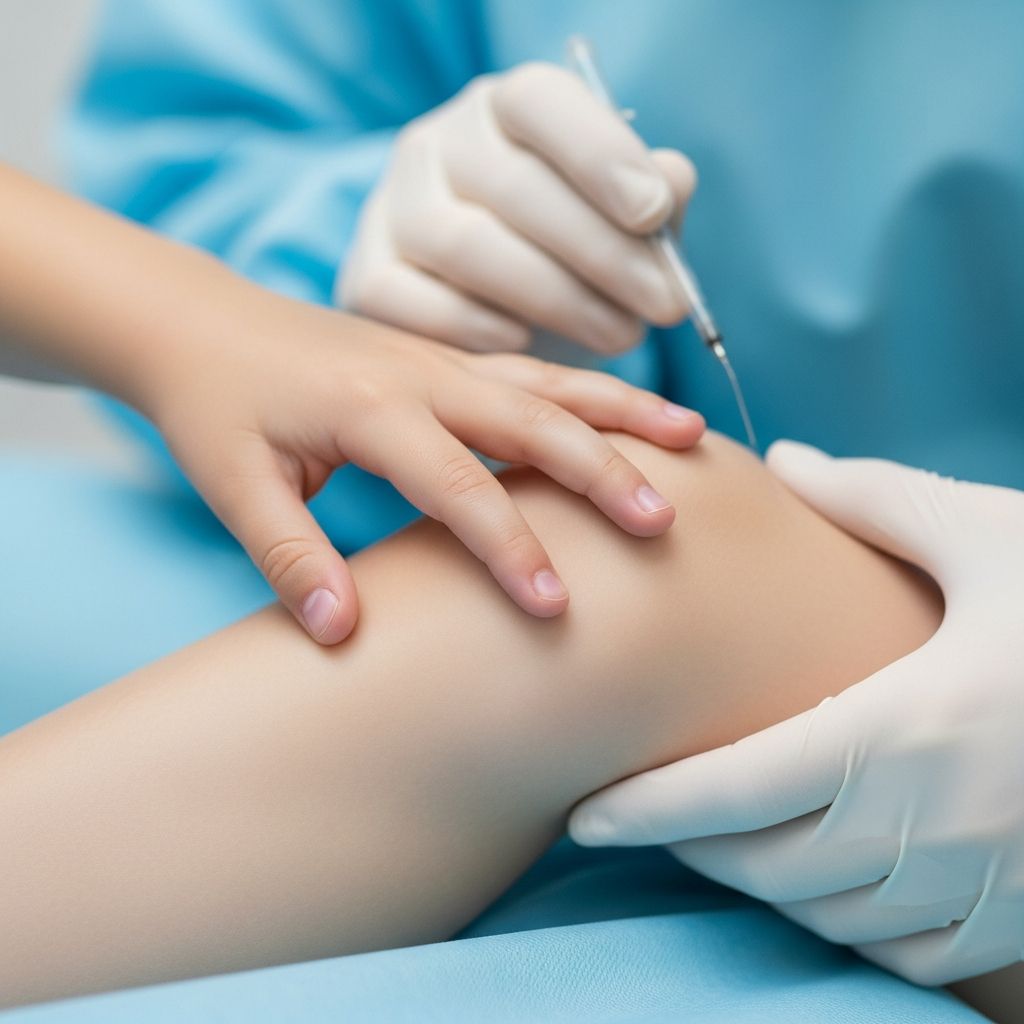
Arthrocentesis, also called joint aspiration, is a medical procedure in which a doctor uses a sterile needle and syringe to remove fluid from a joint space. It can be performed for both diagnostic (to find out what is wrong) and therapeutic (to relieve symptoms) reasons in adults and children.
For many parents, the idea of a needle near a child’s joint is alarming. Learning what happens before, during, and after arthrocentesis can make the experience more predictable and less stressful for you and your child.
What Arthrocentesis Is and Why Joints Contain Fluid
To understand arthrocentesis, it helps to know a bit about joint anatomy and why doctors may want to sample joint fluid.
- Synovial joints (like the knee, ankle, hip, elbow, and wrist) contain a small amount of synovial fluid inside a capsule around the joint.
- Synovial fluid works like a natural lubricant, reducing friction and cushioning the bones as they move.
- In some illnesses or injuries, extra fluid builds up, causing swelling, pain, and stiffness.
- This excess fluid can also carry important clues about infection, inflammation, bleeding, or metabolic conditions like gout.
Arthrocentesis allows the healthcare team to both remove excess fluid and analyze it in the laboratory.
Reasons a Child Might Need Arthrocentesis
Doctors recommend arthrocentesis in children when they need information from inside a joint or when they want to relieve a child’s pain and swelling. Common reasons include:
- Checking for joint infection (septic arthritis) when a child has sudden severe joint pain, swelling, warmth, fever, or trouble moving the limb.
- Evaluating inflammatory conditions such as juvenile idiopathic arthritis or other autoimmune diseases.
- Investigating crystal-related problems (rare in children, more typical in adults) like gout or pseudogout.
- Looking for blood in the joint (hemarthrosis) after an injury or in bleeding disorders.
- Relieving pressure and pain when a joint is very full of fluid and the child is uncomfortable.
- Preparing a joint for a medication injection, such as corticosteroids, by removing fluid first to create space.
Joints Most Commonly Treated
Arthrocentesis can be performed on almost any accessible joint, but some are more commonly involved.
| Joint | Examples of When It May Be Used |
|---|---|
| Knee | Sudden large swelling, suspicion of infection, trauma, or inflammatory arthritis |
| Hip | Severe hip pain with fever, difficulty walking or refusing to bear weight |
| Ankle | Injury with swelling, suspected inflammatory disease, or infection |
| Elbow, wrist, shoulder | Joint pain with unexplained swelling, limited motion, or suspected infection |
Diagnostic vs. Therapeutic Arthrocentesis
Arthrocentesis often serves more than one purpose at the same time.
- Diagnostic arthrocentesis
- Main goal is to analyze the joint fluid in the lab.
- Helps identify infection, inflammation, crystals, or bleeding inside the joint.
- Results guide further treatment decisions, such as antibiotics, surgery, or long-term medications.
- Therapeutic arthrocentesis
- Main goal is to relieve symptoms or prepare the joint for another treatment.
- Removing fluid can quickly decrease pressure and pain.
- Doctors may also inject medication such as corticosteroids or anesthetic into the joint once the fluid is withdrawn.
In practice, a child’s arthrocentesis is frequently both diagnostic and therapeutic.
How to Prepare Your Child for Arthrocentesis
Preparation depends on your child’s age, the joint being treated, and whether sedation or anesthesia will be used.
Before the Day of the Procedure
- Share a full medical history, including allergies, medications, bleeding disorders, and past reactions to anesthesia.
- Ask which medicines should be stopped or continued (for example, blood thinners in older adolescents or certain immune-modifying drugs).
- Follow instructions about fasting if sedation or general anesthesia is planned. Children may need to avoid eating or drinking for several hours beforehand.
- Explain the procedure in age-appropriate language, emphasizing that it is done to help your child feel better and to understand what is wrong.
Emotional Support Tips for Parents
- Stay calm; children often mirror a parent’s emotions.
- Bring a favorite toy, blanket, or comfort object.
- Use simple, honest phrases like “the doctor will use a tiny straw-like needle to take some fluid out of your joint.”
- Let older children ask the team questions directly, so they feel involved and respected.
What Happens During the Procedure
The specific steps vary by joint and by hospital, but the general process is similar.
1. Positioning and Cleaning the Skin
- Your child is positioned so the joint is easy to reach and remains as still as possible.
- The skin over and around the joint is thoroughly cleaned with an antiseptic solution to reduce infection risk.
- Sterile drapes may be placed around the area.
2. Pain Control and Anesthesia
- Most children receive local anesthetic injected just under the skin and deeper toward the joint capsule, which numbs the pathway of the needle.
- For very anxious children, large joints, or expected longer procedures, the team may use:
- Topical numbing cream before the needle sticks.
- Conscious sedation or general anesthesia, particularly for hip arthrocentesis or very young children (institution-specific practice).
3. Needle Placement and Fluid Removal
- Using knowledge of joint anatomy, and sometimes ultrasound guidance, the doctor chooses the safest entry point, avoiding nerves, blood vessels, and tendons.
- A sterile needle attached to a syringe is inserted through the numbed track into the joint space.
- The doctor gently pulls back on the plunger to draw synovial fluid into the syringe.
- In larger effusions, more than one syringe or a special connector (three-way stopcock) may be used to remove extra fluid.
- Once enough fluid is collected, the needle is removed.
4. After the Needle Is Removed
- The skin is cleaned again and a small bandage or dressing is placed over the puncture site.
- Pressure may be applied briefly to reduce bruising or bleeding.
- If a medication is to be injected into the joint, the doctor may do so using the same session, either before or after aspirating the fluid.
What Happens to the Fluid Sample?
The joint fluid is sent to a laboratory, where several tests may be ordered depending on the suspected problem.
- Cell count and differential: Measures how many white blood cells and other cells are present, which helps distinguish infection from noninfectious causes.
- Gram stain and culture: Look for bacteria or other germs that can cause septic arthritis.
- Crystal analysis: Checks for crystals like monosodium urate in gout (more relevant in older adolescents or adults).
- Chemical tests: Such as protein and glucose levels, which may change with infection or inflammation.
- Additional tests: Depending on your child’s condition, the team may ask for other specialized studies.
Your child’s doctor will review the results and discuss them with you, often together with blood tests and imaging (like ultrasound or MRI) to form a complete picture.
Benefits of Arthrocentesis for Children
- Rapid pain relief: Removing extra fluid lets the joint move more freely and decreases the tight, stretched feeling from swelling.
- Critical diagnostic information: In suspected joint infections, arthrocentesis is a key step in confirming the diagnosis and guiding antibiotic therapy.
- Helps avoid unnecessary treatments: Clear test results can prevent a child from being exposed to broad antibiotics or surgery they do not actually need.
- Improved joint function: Less fluid usually means better range of motion and more comfort during daily activities.
- Supports long-term care plans: In chronic conditions like juvenile arthritis, synovial fluid analysis can help adjust medications safely and effectively.
Risks and Possible Complications
When performed by trained professionals using sterile technique, arthrocentesis is considered a low-risk procedure. Still, like any medical intervention, it has potential complications.
- Infection: Rarely, introducing a needle into the joint can introduce bacteria, leading to infection. Careful skin cleaning and sterile equipment are used to minimize this risk.
- Bleeding or bruising: Small blood vessels in the skin or underlying tissue can be injured. Children with bleeding disorders or on anticoagulants have a higher risk and require special planning.
- Temporary pain or soreness: Some discomfort at the site or inside the joint may occur for a short time after the procedure.
- Allergic reaction: Very rarely, children may react to local anesthetics or antiseptic solutions.
- Joint damage: Serious injury to cartilage or nearby structures is uncommon when the procedure is done correctly.
Your child’s healthcare team will weigh these risks against the potential benefits before recommending arthrocentesis.
Aftercare: Helping Your Child Recover
Most children go home the same day and recover quickly after arthrocentesis, particularly if only local anesthesia is used.
Activity and Joint Use
- Your child may be asked to rest the joint for several hours, sometimes up to a day.
- Strenuous activity, sports, or heavy use of the joint may be temporarily restricted.
- Depending on the joint and the reason for the procedure, a brace, soft splint, or support bandage may be recommended.
Pain Management
- Mild soreness at the puncture site can often be managed with acetaminophen or other medications recommended by your child’s doctor.
- Ask before giving any nonsteroidal anti-inflammatory drugs (NSAIDs), especially if your child’s doctor is evaluating inflammation or bleeding.
- Ice packs wrapped in a cloth may be used for short periods to ease discomfort and swelling, if approved by the care team.
Bandage Care
- Keep the bandage clean and dry for the first day or as instructed.
- Notify your doctor if you see ongoing bleeding that soaks the dressing.
- Follow instructions about when to remove the bandage or return for a check-up.
Warning Signs: When to Call the Doctor
Contact your child’s healthcare provider or seek urgent care if you notice:
- Rapidly increasing joint pain or swelling after the procedure.
- Redness, warmth, or pus-like drainage at the puncture site.
- Fever or chills that develop after going home.
- Your child refuses to move the limb or seems more ill overall.
How Arthrocentesis Fits Into Your Child’s Overall Care
Arthrocentesis is only one part of the evaluation and treatment of joint problems in children. The final diagnosis usually depends on a combination of:
- History and physical exam (symptoms, duration, recent infections, injuries).
- Joint fluid analysis from arthrocentesis.
- Blood tests to look for infection, autoimmune conditions, or clotting issues.
- Imaging such as X-rays, ultrasound, or MRI to assess joint structures.
The information from arthrocentesis helps your child’s care team choose the safest and most effective next steps, whether that means antibiotics, anti-inflammatory drugs, physical therapy, or sometimes surgery.
Frequently Asked Questions (FAQs)
How long does an arthrocentesis take?
The actual fluid removal usually takes only a few minutes. Extra time is needed for preparation, cleaning the skin, numbing, and bandaging, so you might spend 30–60 minutes in the procedure area overall.
Will my child feel pain during the procedure?
Your child will feel the sting and brief pressure of the local anesthetic injection. Once the area is numb, many children feel only pushing or a sensation of pressure while fluid is being removed. For more complex cases, deeper sedation or anesthesia may be used so your child sleeps through the procedure.
Is arthrocentesis safe for babies and young children?
Yes. Arthrocentesis is routinely performed in infants and young children when needed, particularly to evaluate suspected joint infections. Pediatric teams adjust anesthesia, needle size, and positioning to the child’s age and size to keep the procedure as safe as possible.
When will we get the results?
Some basic information, like the appearance of the fluid, may be available immediately. Other tests, such as cell counts or crystal analysis, can take several hours. Cultures to look for bacteria may require 24–72 hours or more. Your child’s doctor will tell you when to expect updates and how they will be shared.
Can arthrocentesis be repeated if needed?
Yes. In some conditions, especially ongoing inflammation or recurrent fluid buildup, a child may need more than one joint aspiration over time. The decision to repeat arthrocentesis depends on symptoms, lab results, and the underlying diagnosis.
References
- Arthrocentesis — StatPearls (N. Mengiardi, K. R. Knight, et al.), NCBI Bookshelf. 2023-08-07. https://www.ncbi.nlm.nih.gov/books/NBK557805/
- Arthrocentesis (Joint Aspiration): What It Is & Procedure — Cleveland Clinic. 2023-04-01 (updated). https://my.clevelandclinic.org/health/treatments/14512-arthrocentesis-joint-aspiration
- Arthrocentesis: Procedure, Benefits, and Treatment — American Association of Bone and Joint Surgeons (Bone & Joint). 2022-06-15. https://www.boneandjoint.org/patient-education/pain-management-arthrocentesis/
- What Is Arthrocentesis (Joint Aspiration)? — Arthritis-health. 2022-03-10. https://www.arthritis-health.com/treatment/joint-aspiration/what-arthrocentesis-joint-aspiration
- How To Do Knee Arthrocentesis — Merck Manual Professional Edition. 2021-01-01. https://www.merckmanuals.com/professional/musculoskeletal-and-connective-tissue-disorders/how-to-do-arthrocentesis/how-to-do-knee-arthrocentesis