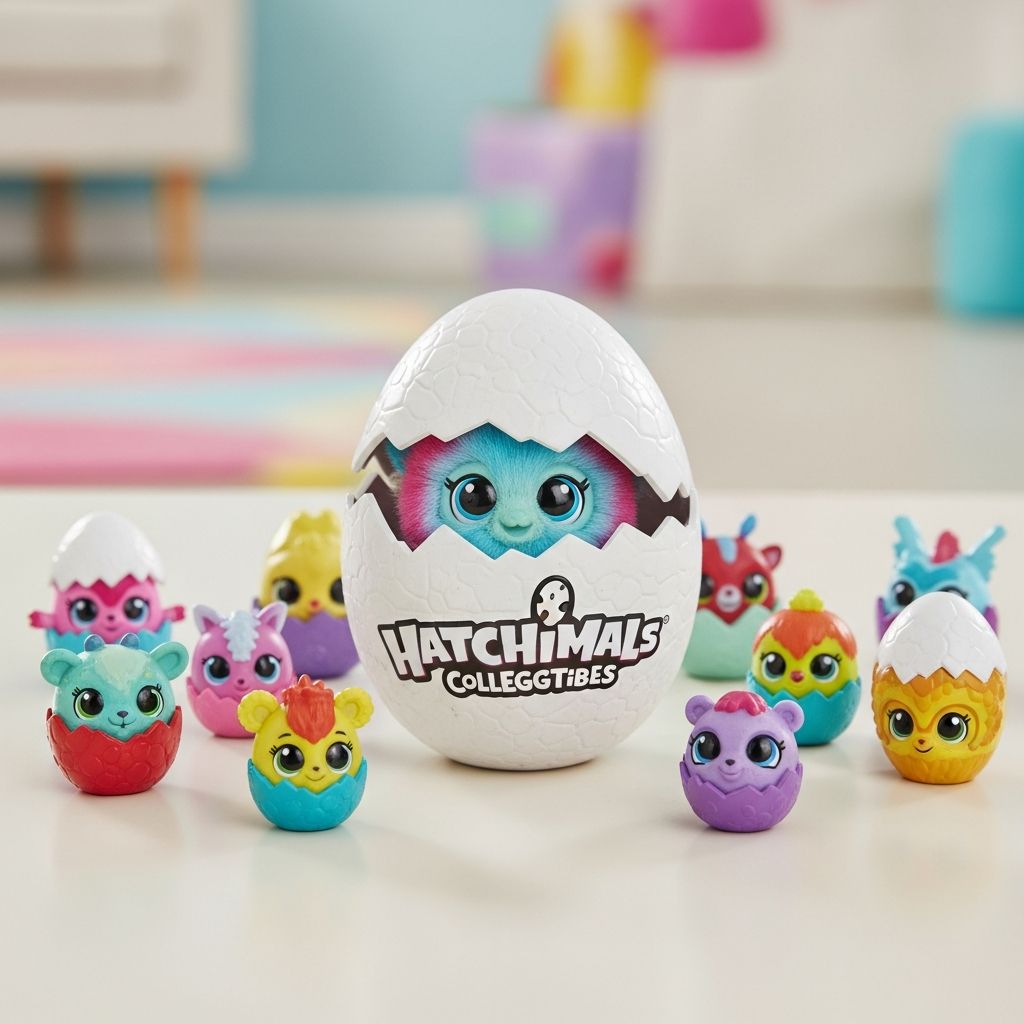
Egg-hatching toys like Hatchimals exploded into the spotlight in 2016, becoming some of the most sought-after holiday gifts worldwide.1 Years later, new versions, limited editions, and rebooted lines keep appearing — leaving many caregivers wondering whether these toys are still worth the price, the search, and the hype.
This guide takes a calm, practical look at Hatchimals and similar toys so you can decide if bringing home a hatching egg makes sense for your family right now.
What Exactly Is a Hatchimal?
Hatchimals are interactive toys created by Spin Master that begin inside a patterned plastic egg and are “brought to life” through a hands-on hatching experience.15
Across the different generations, a typical Hatchimal experience includes:
- Egg phase: The toy is hidden inside an opaque egg. Lights and sounds from within respond to touch, rocking, and tapping.38
- Hatching phase: After enough interaction, the toy starts to crack or open the egg itself, sometimes with mist, music, or rainbow lights.47
- Pet phase: Once out of the egg, the creature can be cuddled, taught simple tricks, or put into different modes such as singing or dancing, with more than 100+ sounds and reactions in current versions.47
The line has evolved from early robotic animals to mini collectibles and, more recently, to reimagined interactive eggs under names like Hatchimals Alive Mystery Hatch and emerging products such as Bloomables.156
How the Hatchimals Craze Started (and Why It Matters)
When Hatchimals launched in October 2016, they were heavily advertised and quickly labeled the “hottest toy” of the holiday season.5 Demand soared, and the toys occupied several of the top-selling slots in U.S. toy sales rankings that year.5
That frenzy set the pattern for what many parents now recognize:
- Highly promoted surprise toys
- Limited stock during peak shopping periods
- Intense child interest driven by ads, YouTube videos, and peer conversations
Understanding this history helps you step back from marketing-driven urgency and make a more grounded decision about whether your child actually needs another trending toy.
How Modern Hatchimals Work: What You’re Really Buying
While each year’s product line differs, most modern large-egg Hatchimals share core features.478
Main Features You Can Expect
- Interactive egg: The egg responds when it’s tapped, rocked, cuddled, or lifted, often with lights, sounds, and movement.
- Guided hatching process: The toy reaches a “ready to hatch” stage after enough interaction; some newer versions add fog or rainbow light effects for drama.47
- Surprise character: You usually know the general type (for example, a dragon or cat-like creature) but not which exact character you’ll get until it hatches.47
- Post-hatch play: Kids can cuddle, press buttons, or use sensors to trigger sounds, music, or simple tricks. Some can be “taught” to talk, dance, or respond to certain cues.7
- Battery-powered electronics: The toy typically uses multiple AA batteries and contains internal motors, speakers, and LEDs.
Age Recommendations and Safety Basics
Large interactive eggs are usually recommended for children ages 5 and up, largely due to small components and the need for gentle, coordinated handling.4 Packaging often carries standard choking hazard warnings for small parts not suitable for children under 3 years old.34
As with any electronic toy, caregivers should:
- Supervise younger siblings around loose parts and broken shells
- Store spare batteries securely
- Follow instructions for battery replacement and disposal
Why Some Kids Absolutely Love Hatchimals
When they work as intended and match a child’s interests, Hatchimals can feel magical. Here are some reasons many kids are drawn to them.
1. A Built-In Story: From Egg to Friend
Unlike a simple plush toy, Hatchimals offer a narrative: you care for an egg, help it hatch, then bond with the creature inside. Toy industry reviews note that the process helps children feel like they’re responsible for bringing a pet to life.7
2. Encouraging Nurturing and Empathy
The toy responds to cuddling, rocking, and gentle touch, rewarding soft behavior with lights and sounds.47 While this is not a substitute for real pet care, it can introduce basic concepts of:
- Waiting patiently
- Responding to a “creature’s” cues
- Feeling proud of helping something grow or change
3. Surprise and Collectibility
The mystery of exactly which character is hidden inside feeds into the same appeal as blind bags and trading cards. Some children enjoy comparing different versions with friends or watching other kids’ hatching videos online.
4. Multi-Stage Play (In Theory)
Hatchimals are marketed as offering distinct phases — egg, hatching, and ongoing play — with lots of sounds and reactions after the initial reveal.47 For kids who enjoy nurturing or imaginative play, this can mean weeks of engagement rather than a single unboxing moment.
Common Drawbacks Parents Report
Despite their appeal, Hatchimals are not a perfect fit for every child or household. Before buying, it helps to consider some of the drawbacks often mentioned by caregivers.
1. The Hype Curve: Intense Build-Up, Quick Drop-Off
Much of the excitement surrounds the hatching itself. Once that unique moment passes, some kids treat the toy as just another stuffed animal with sound effects. If your child tends to lose interest quickly in novelty toys, you may see a steep excitement drop-off within days.
2. Price vs. Playtime
Large interactive Hatchimals are often priced similarly to mid-range electronic toys, and premium or new-season releases can be noticeably more expensive.17 If your budget is tight, you might reasonably ask whether one big surprise toy is worth more than several smaller, longer-lasting items such as building sets, art supplies, or board games.
3. Fragile Moments and High Expectations
The hatching sequence is mechanically complex. If something misfires or a child handles the egg too roughly, the process can stall or break, turning a magic moment into frustration. Caregivers may also feel pressure to “get it right” during a single, unrepeatable event.
4. Noise, Lights, and Sensory Overload
These toys use lights, music, and sound to create a dramatic effect. For children who are sensitive to noise or visual stimulation, this can be overwhelming rather than delightful. In such cases, a simpler plush or non-electronic pet toy might be more appropriate.
Is a Hatchimal Right for Your Child? Key Questions to Ask
Instead of asking “Is this toy good or bad?”, it’s more useful to ask whether it’s a good fit for your specific child and context. Consider the following questions before you buy.
| Question | Why It Matters |
|---|---|
| Does my child enjoy pretend play and caring for stuffed animals? | Kids who already love role-playing as caregivers are more likely to engage with the pet phase after hatching. |
| Do they stick with toys, or cycle quickly through new things? | If they usually abandon toys after a day or two, much of the cost may go toward just the brief hatching moment. |
| Is my child sensitive to sound or bright, flashing lights? | The dramatic effects might be too intense for some kids, especially those with sensory sensitivities. |
| Is there a younger sibling under age 3 in the home? | Small pieces and cracked shell fragments may pose safety concerns for toddlers. |
| Am I comfortable with the price given our budget and priorities? | Comparing cost to likely playtime and alternatives can prevent impulse purchases driven by ads or peer pressure. |
How to Shop Smart for Hatchimals and Similar Toys
If you decide a hatching toy could be a good fit, a few strategies can help you get more value and fewer headaches.
Compare Product Generations
The Hatchimals brand now includes several types of products:158
- Large interactive eggs: Full hatching experience with a sizable electronic pet inside.
- Mini collectible figures: Smaller eggs that crack open manually to reveal tiny figurines (often at a lower price point).
- Newer feature-heavy versions: Recent releases include mist, fortune-telling modes, and multi-step transformations.14
Ask yourself which experience your child wants most: the spectacle of hatching, a cuddly companion, or a collection to trade and display.
Watch for Official Age Ratings and Warnings
Always check packaging for age recommendations and hazard statements, particularly choking warnings for under-3s and any notes about battery use.34 Age ratings are based on safety standards and typical skill level, not just marketing.
Consider Timing and Expectations
If the toy is meant to be a big holiday or birthday surprise, plan the hatching moment:
- Choose a time when adults can help calmly if something goes wrong
- Let your child know the toy may need careful handling and patience
- Have a backup activity in case the excitement is short-lived
Balance With Other Types of Play
Organizations such as the American Academy of Pediatrics emphasize the value of open-ended, imaginative play and real-world interaction over heavily electronic entertainment.2 A single interactive toy can be fun, but it should ideally sit alongside:
- Books and storytelling
- Art and craft supplies
- Outdoor and physical play options
- Building and problem-solving toys
Alternatives If a Hatchimal Doesn’t Feel Right
If you’re unsure about committing to a full-price Hatchimal, you can still capture some of the same magic with lower cost, lower risk options.
- Non-electronic “growing” toys: Capsules or figures that expand in water offer a reveal experience without batteries or complex mechanics.
- DIY hatch experiences: Hide a small plush or figure inside a paper-mâché or plastic egg you decorate together, allowing you to customize the reveal and keep expectations manageable.
- Simple interactive plush: Toys that make a few sounds or respond to touch, but without a one-time hatching event, may provide more long-term value.
- Real-world pet responsibility (scaled appropriately): For older children, small chores related to a family pet can deliver authentic nurturing experiences that no toy can fully replace.
Frequently Asked Questions (FAQs)
Are Hatchimals still being made?
Yes. After peaking in popularity in 2016, Hatchimals expanded into collectible lines and has recently reintroduced large interactive eggs under new product names and designs, with official announcements highlighting updated features and renewed launches.568
What age is best for a Hatchimal?
Most interactive eggs are recommended for children 5 years and older, mainly due to small parts and the need to handle the egg carefully during hatching.4 Younger children may enjoy watching but should be supervised due to safety concerns.
How long does it take a Hatchimal to hatch?
The hatching process varies by product but generally takes long enough to require consistent interaction, such as rocking and tapping, before the toy activates its hatching sequence.47 The active cracking or opening phase usually lasts only a few minutes once it begins.
Can the hatching be repeated?
For most large interactive Hatchimals, the mechanical hatching process is designed as a one-time event. After the toy has emerged, it functions as an electronic pet rather than going back into the egg to rehatch. Some newer toy concepts in the broader market are experimenting with reusable hatching-style play, but this depends on the specific product line.1
What if the Hatchimal doesn’t hatch correctly?
If the toy appears stuck, manufacturers typically recommend following troubleshooting steps in the included instruction manual, such as adjusting how you hold or tap the egg. If the mechanism fails entirely, you may need to contact the manufacturer’s customer support with proof of purchase for assistance or a potential replacement, subject to warranty policies.
Is a Hatchimal educational?
While not an academic tool, a Hatchimal can support social-emotional learning by encouraging patience, nurturing behavior, and imaginative storytelling around the pet. However, experts emphasize that unstructured play with simple toys and caregiver interaction remain more central to healthy development than any single electronic toy.2
References
- Hatchimals — Spin Master (product description via brand coverage and history). 2016–2024. https://www.hatchimals.com
- Selecting Appropriate Toys for Young Children in the Digital Era — Healey, A. & Mendelsohn, A., American Academy of Pediatrics. 2019-01-01. https://publications.aap.org/pediatrics/article/143/1/e20183348/37340/Selecting-Appropriate-Toys-for-Young-Children-in
- Hatchimals Interactive Eggs — Toys“R”Us product information (Spin Master). 2024-05-01 (accessed). https://www.toysrus.com/products/hatchimals-interactive-eggs
- Hatchimals Alive Mystery Hatch Tigrette: Surprise Interactive Toy Egg — Target product details (Spin Master). 2024-09-01 (accessed). https://www.target.com/p/hatchimals-alive-mystery-hatch-tigrette-surprise-interactive-toy-egg-with-mist-lights-sounds-styles-may-vary-kids-toys-for-girls-boys/-/A-93721845
- Hatchimals — Background and product history. 2016–2024. https://en.wikipedia.org/wiki/Hatchimals
- A New Generation of Kids Will Get Their Hands on an All New Hatchimals — Spin Master via PR Newswire. 2024-09-24. https://www.prnewswire.com/news-releases/a-new-generation-of-kids-will-get-their-hands-on-an-all-new-hatchimals-302198798.html
- Expert Review: Spin Master’s Hatchimals Alive! Mystery Hatch — The Toy Insider. 2024-09-30. https://thetoyinsider.com/hatchimals-alive-mystery-hatch-review/