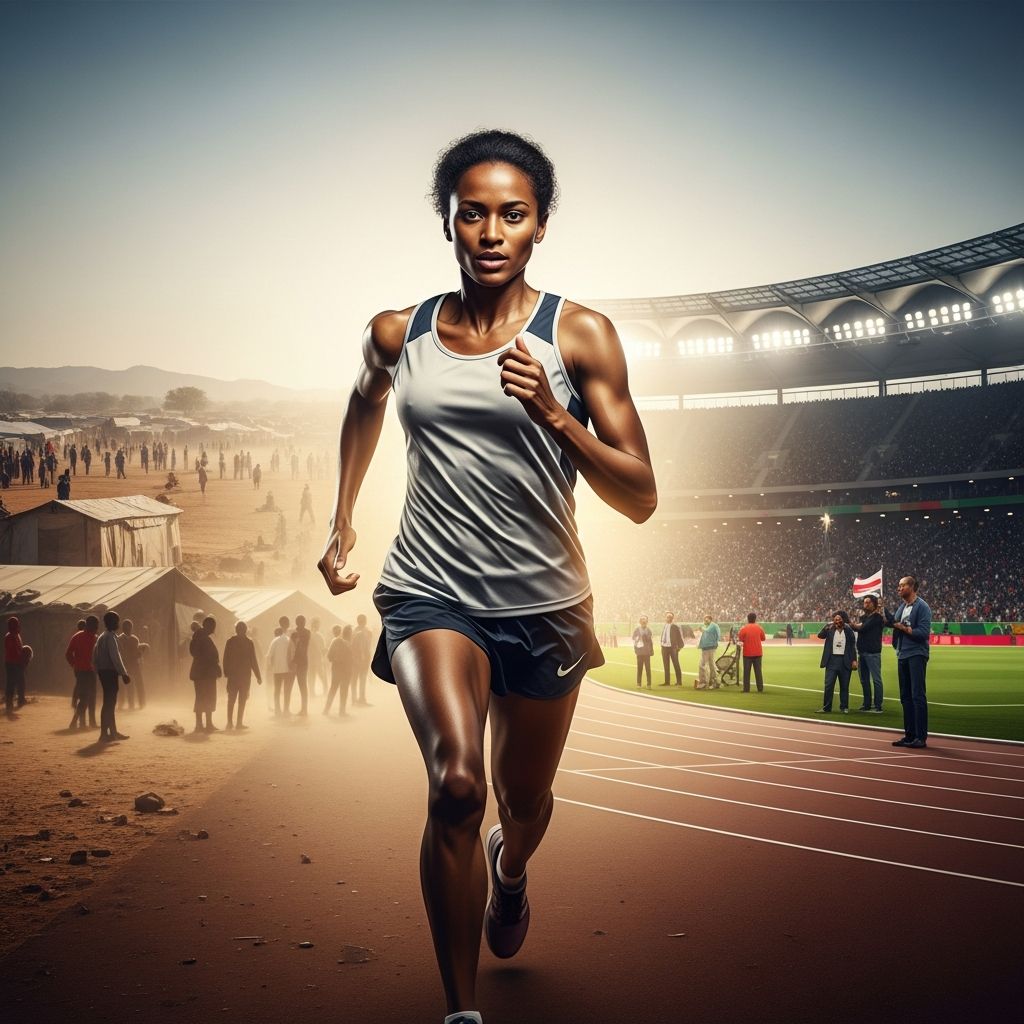
Breaking Barriers: The Multifaceted Life of a Champion
Success in sports rarely follows a single narrative. For many athletes, the path to Olympic glory involves years of dedicated training, supportive families, and access to world-class facilities. Yet some of the most extraordinary achievements come from individuals whose circumstances demanded far more than athletic prowess—they required resilience, determination, and an unwavering belief in possibility despite seemingly insurmountable obstacles.
Anjelina Nadai Lohalith embodies this exceptional category of athlete. She is simultaneously a devoted mother, an internationally recognized distance runner, and a symbol of hope for millions of displaced persons worldwide. Her story transcends sports; it represents the human capacity to transform tragedy into triumph and to challenge preconceived notions about what refugees can accomplish.
Escape from Conflict: The Early Years
The journey toward becoming an Olympic athlete began not on a track, but in the midst of devastating civil conflict. Lohalith was born in South Sudan in 1992, during a period of intense political and social instability. Her childhood was shaped by the realities of war—displacement, uncertainty, and the constant threat to personal safety characterized the environment in which she grew up.
Like countless other South Sudanese families facing the horrors of civil war, Lohalith’s family made the difficult decision to seek refuge elsewhere. At just eight years old, she and her aunt embarked on a journey that would fundamentally alter the trajectory of her life. They traveled to the Kakuma refugee camp located in northern Kenya, one of the world’s largest and most significant refugee settlements.
Kakuma, established in 1992, has served as a sanctuary for nearly 200,000 individuals representing more than 20 different nationalities. For most residents, the camp represents a temporary haven—a place of safety where basic needs are met while individuals wait for permanent resettlement or opportunities to return home. For young Anjelina, however, Kakuma would become something more: it would be the launching pad for an extraordinary athletic career.
Discovering Running in Unexpected Places
Within the confines of the refugee camp, opportunities for personal development and athletic training are limited. Resources are stretched thin, facilities are minimal, and the focus remains primarily on meeting humanitarian needs. Yet it was within this challenging environment that Lohalith discovered her passion for running. What began as a personal interest gradually evolved into serious athletic pursuit, facilitated by coaches and programs designed to identify and nurture talent within the camp community.
Running offered Lohalith something beyond physical exercise—it provided an outlet for her emotions, a sense of personal agency, and a vision for a future extending beyond the camp’s boundaries. The sport demanded nothing but her own commitment and determination, two qualities she possessed in abundance despite her circumstances.
Her performances at the camp level eventually attracted attention from beyond Kenya’s borders. International coaches and sports organizations began recognizing her potential, setting the stage for an unprecedented opportunity that would reshape her life and challenge global perspectives on refugee participation in elite sports.
Making History at Rio: The First Refugee Olympic Team
The 2016 Rio Olympics marked a watershed moment not only for Lohalith but for the global sports community. For the first time in Olympic history, an independent Refugee Olympic Team was established, allowing displaced athletes from around the world to compete under the Olympic flag rather than under any particular nation’s banner. This groundbreaking initiative represented a significant shift in how the international sports community acknowledged and supported refugee athletes.
Lohalith was selected as one of ten athletes to represent this historic inaugural team. She would compete in the women’s 1500-meter race, an event requiring a unique combination of speed, endurance, and tactical awareness. While she did not advance beyond the initial rounds, her participation carried profound significance that transcended medal counts and finishing times.
By simply taking her place on the Olympic podium, Lohalith sent a powerful message to the international community: refugees are not defined solely by their circumstances of displacement. They are athletes, artists, entrepreneurs, and leaders with talent and ambition equal to any other population. Her presence at the Olympics challenged stereotypes and demonstrated that refugee status should not be a barrier to competing at sport’s highest levels.
Sustaining Excellence: The Path Forward After Rio
The 2016 Olympics could have represented a career pinnacle for many athletes, but Lohalith viewed it as a beginning rather than an ending. Following Rio, she remained committed to improving her competitive performance and pursuing increasingly ambitious athletic goals. Her dedication would soon yield remarkable results on the international stage.
In 2017, Lohalith competed in the IAAF World Championships in London as part of the inaugural World Athletics refugee team. This prestigious event represented another opportunity to showcase refugee athletes’ abilities at an elite international level. During this competition, Lohalith achieved a significant personal milestone: she recorded a new personal best time of 4 minutes and 33.54 seconds in the 1500-meter distance, demonstrating substantial improvement and strengthening her position among the world’s competitive distance runners.
Her continued progress indicated that the Rio experience had not been a one-time accomplishment but rather a foundation upon which she would continue building her athletic career. This trajectory of improvement would lead to even more significant achievements in the years following her World Championships appearance.
Championship Victory: Making International History
Athletic achievement reached a new height when Lohalith won the European Cross Country Club Championship, becoming the first athlete from the Refugee Olympic Team to claim victory in an international competition of this caliber. The race took place in Oropesa del Mar, located in the Castellón province of Spain, and featured elite runners from across Europe competing at the highest levels of their sport.
Running the 8.7-kilometer course, Lohalith completed the distance in a time of 27 minutes and 55 seconds, crossing the finish line ahead of her competitors. This victory represented far more than a personal athletic achievement—it symbolized the potential and capability of refugee athletes to compete successfully against the world’s best runners.
Following her victory, Lohalith expressed the significance of her accomplishment: “This victory is a very important incentive,” she said while representing the Alley Runners Club in Tel Aviv. Her words reflected not merely personal satisfaction but recognition of what her achievement meant for the broader refugee community and for future generations of displaced athletes seeking to pursue their dreams.
Motherhood and Athletic Balance
In addition to her achievements as a competitive athlete, Lohalith has embraced the role of mother. This dimension of her identity adds complexity to her story and challenges traditional narratives about what elite athletic competition requires. Balancing the demands of professional-level training with the responsibilities of parenthood presents significant challenges that many female athletes face, yet Lohalith has managed to excel in both areas.
Her experience as a mother-athlete contributes to her role as a cultural ambassador and spokesperson for refugee communities. She embodies the reality that refugees are complete human beings with multifaceted lives, diverse responsibilities, and aspirations extending far beyond their displacement experiences.
Challenging Perceptions: Redefining What “Refugee” Means
Throughout her interviews and public appearances, Lohalith has consistently emphasized a crucial message: refugees are ordinary people facing extraordinary circumstances. The label “refugee” does not define one’s capabilities, potential, or worth. Instead, it describes a legal and humanitarian status resulting from circumstances largely beyond individual control.
In her exclusive interview, Lohalith articulated this perspective clearly: “We just want people to know that refugees are just normal people, like anyone else.” This statement carries profound implications for public discourse around migration, displacement, and inclusion. By excelling as an athlete, mother, and global ambassador, Lohalith demonstrates the inadequacy of narrow stereotypes and the importance of recognizing individual humanity and potential.
From Kakuma to the World Stage
The journey from a refugee camp in northern Kenya to international athletic competitions represents an extraordinary transformation. Yet Lohalith’s story also illustrates broader truths about human potential and the importance of creating pathways for talented individuals regardless of their backgrounds or circumstances.
Her path has not been linear or easily predictable. It has required timing, opportunity, dedicated coaching, personal determination, and support from the international sports community. The existence of programs like the Refugee Olympic Team and World Athletics refugee team created structures through which her talents could be recognized and developed. Without these institutional innovations, her achievements might never have materialized, no matter how considerable her natural ability.
The Broader Impact of Refugee Athletes
Lohalith’s achievements contribute to a growing conversation about refugee athletes in elite sports. Her success demonstrates that displacement and hardship need not prevent individuals from achieving excellence in their chosen fields. Furthermore, her presence in international competition serves an important advocacy function, humanizing refugee communities and challenging misconceptions.
When policymakers, journalists, and ordinary citizens encounter stories like Lohalith’s, they may find their perspectives shifted. The abstract concept of “refugees” becomes more concrete and personal. Individuals who might previously have viewed refugee communities through a lens of charity or burden instead see talented, ambitious people making significant contributions to society.
Frequently Asked Questions
Q: What is the Refugee Olympic Team?
A: The Refugee Olympic Team is an independent team established to allow elite athletes who are refugees or asylum seekers to compete at the Olympic Games under the Olympic flag. First introduced at the 2016 Rio Olympics, it represents a groundbreaking initiative in international sports.
Q: Where is Kakuma refugee camp located?
A: Kakuma is located in northern Kenya and is one of the world’s largest refugee settlements, housing approximately 200,000 people from more than 20 different nationalities.
Q: What is Anjelina Nadai Lohalith’s personal best time in the 1500 meters?
A: Her personal best in the 1500 meters is 4 minutes and 33.54 seconds, which she recorded at the 2017 IAAF World Championships in London.
Q: What major international competition has Lohalith won?
A: Lohalith won the European Cross Country Club Championship, becoming the first Refugee Olympic Team athlete to win an international championship of this magnitude.
Q: How old was Lohalith when she fled South Sudan?
A: She was eight years old when she and her aunt traveled to Kakuma refugee camp in Kenya to escape civil war.
References
- Meet the mom + refugee track star competing at her second Olympics — Motherly. 2016–2024. https://www.mother.ly/life/anjelina-nadai-lohalith-interview-about-olympics/
- She escaped hunger and destruction to be the first champion of the Olympic refugee team — Infobae. https://pachodo.org/news-from-various-sources/39191-she-escaped-hunger-and-destruction-to-be-the-first-champion-of-the-olympic-refugee-team
- Refugee Olympic Team — International Olympic Committee (IOC). 2024. https://www.olympic.org/refugee-olympic-team
- Kakuma Refugee Camp Overview — United Nations High Commissioner for Refugees (UNHCR). 2024. https://www.unhcr.org/kakuma-refugee-camp
- World Athletics: Supporting Refugee Athletes — World Athletics Federation. 2024. https://worldathletics.org/