Understanding Toy Selection Through Developmental Stages
Selecting toys for children extends far beyond aesthetic appeal or current trends. The most effective toy choices align with a child’s developmental capabilities, cognitive abilities, and emerging interests. When parents and caregivers understand the connection between a child’s age and their physical, cognitive, and emotional readiness, toy selection becomes a purposeful investment in development rather than random purchasing. This guide explores how to navigate toy choices across every childhood stage, ensuring that playtime becomes both safe and developmentally enriching.
The Foundations of Safe and Appropriate Toy Selection
Before considering specific toys for different ages, understanding safety parameters and quality standards provides the foundation for all toy choices. Safe toys should be constructed without sharp edges, splinters, or small parts that pose choking hazards. Paint and finishes must be nontoxic and lead-free, and materials should resist shattering or breaking easily. Weight and size matter considerably—toys appropriate for young children should fit comfortably in small hands and not exceed weights that could cause fatigue or injury.
Beyond physical safety, developmentally appropriate toys must match what children can actually do and understand at their particular stage. A toy that is too advanced may frustrate a child, while one below their abilities fails to engage and challenge them meaningfully. The most effective toys bridge this gap, offering appropriate challenge that builds skills without causing discouragement.
Nurturing Sensory and Motor Development: Birth Through 12 Months
During the first year of life, infants undergo remarkable transformations in sensory awareness and motor control. At this stage, toys serve primarily as tools for sensory exploration and the development of gross motor skills. Infants benefit from toys that produce sounds, offer varied textures, and respond to their actions.
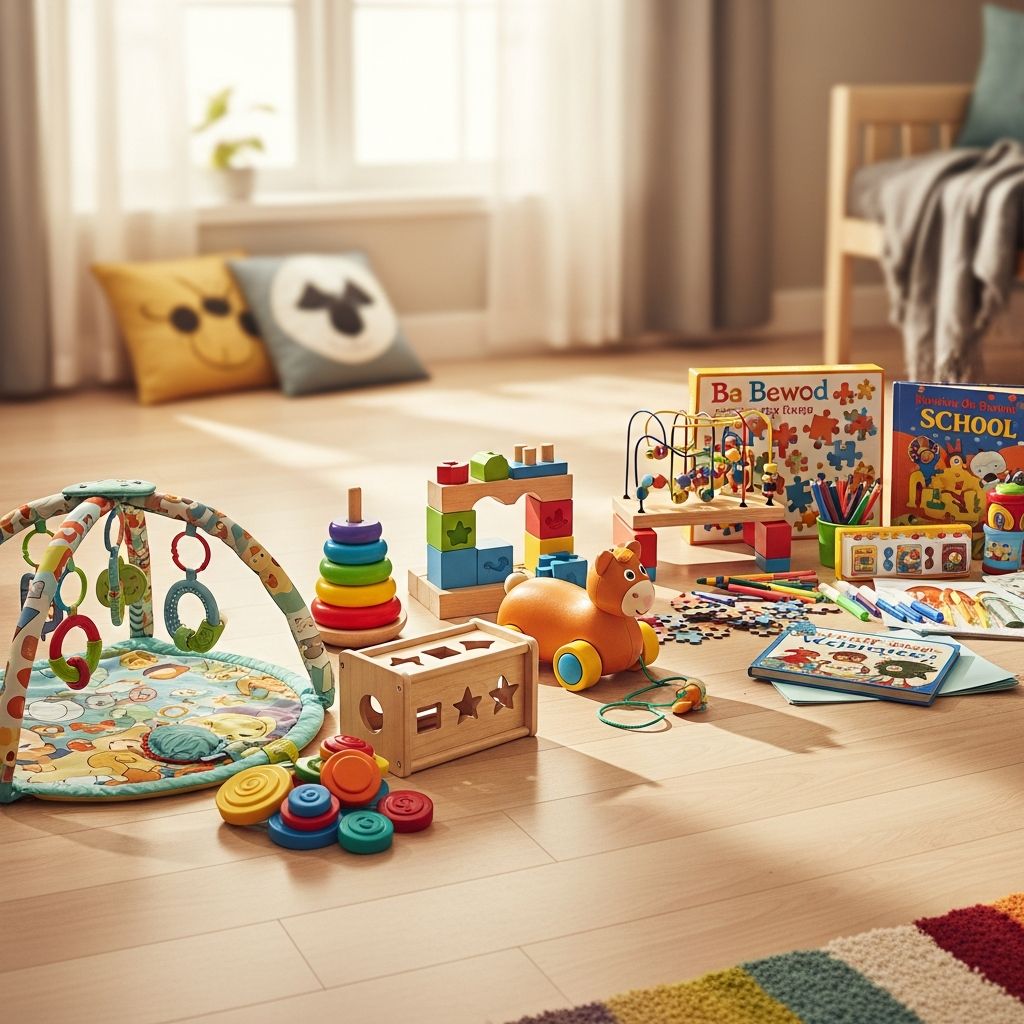
Rattles, squeeze toys, and objects with different tactile properties support exploration. Soft blocks and simple manipulatives allow infants to practice reaching, grasping, and transferring objects from hand to hand. Since infants still explore their world orally, all toys must be completely safe for mouthing and free of potential choking hazards.
Push and pull toys become increasingly valuable as infants approach standing and early walking stages. These toys encourage movement while providing stability support that assists in developing balance and coordination. Interactive toys that respond to infant actions—such as cause-and-effect mechanisms—help babies begin understanding that their movements create results, a foundational cognitive concept.
Building Complexity: The Toddler Years (1-3 Years)
Once children enter the toddler phase, their play becomes more intentional and exploratory. Cause-and-effect toys remain engaging, but toddlers now seek toys that reward their growing independence and problem-solving abilities. Stacking toys, nesting cups, and simple sorting activities support hand-eye coordination and cognitive development.
Blocks represent a cornerstone toy category for this age group. Large soft blocks and wooden cubes allow toddlers to practice stacking, knocking down, and rebuilding—play that develops both fine and gross motor skills while encouraging creative thinking. Construction play at this stage remains simple, focusing on vertical stacking rather than complex building projects.
Push-and-pull toys continue to be valuable as toddlers refine walking, running, and balance skills. Water toys, play vehicles, and pretend-play items such as toy phones and kitchen sets introduce imaginative play elements. Picture books with engaging illustrations support emerging language skills while fostering a love of reading.
Musical instruments designed for toddlers—drums, tambourines, and simple keyboards—introduce rhythm and sound exploration while developing auditory discrimination and motor control. At this stage, musical instruments should be sturdy and produce clear, pleasant tones that encourage experimentation.
Expanding Imagination: The Preschool Years (3-5 Years)
The preschool years mark a significant shift toward imaginative and cooperative play. Children at this stage are developing fine motor skills, learning to engage with peers, and beginning to understand abstract concepts. Toys that support these emerging abilities become particularly valuable.
Construction and building sets take on greater complexity during this period. While younger toddlers enjoy simple stacking, preschoolers can engage with interlocking blocks that require more precise hand control and spatial planning. Art supplies and craft materials become increasingly important, allowing children to express creativity through drawing, painting, and collage work.
Pretend-play items become central to preschool play experiences. Dolls, action figures, and play scenes that represent familiar environments—kitchens, stores, doctor’s offices—provide frameworks for imaginative scenarios. These toys facilitate the development of social skills as children role-play different situations and practice cooperation with playmates.
Sports equipment and ride-on toys take on new significance as preschoolers develop greater body control and physical confidence. Bicycles with training wheels, scooters, and similar equipment support gross motor development while building physical literacy. Smaller balls for kicking and throwing activities develop coordination and encourage active play.
Advancing Skills and Interests: Early Elementary Years (6-8 Years)
As children enter the elementary years, toy preferences begin reflecting individual interests more prominently. Their cognitive abilities have expanded significantly, allowing engagement with games involving strategy, rule-following, and turn-taking. Conversations with the child themselves about their interests become valuable guides for toy selection.
Strategy games such as chess, checkers, and Jenga introduce children to games with rules and competitive play elements. These games develop critical thinking, planning abilities, and social skills through structured play. More complex construction sets, including interlocking building systems, allow children to undertake more ambitious building projects.
Science-oriented toys begin appealing to children at this stage. Magnifying glasses, telescopes, and basic science kits support curiosity about the natural world while introducing scientific observation methods. These toys transform play into informal learning experiences that build foundational scientific understanding.
Remote-control toys and vehicles appeal to this age group as fine motor control has improved considerably. Arts and crafts activities become more sophisticated, with children capable of following complex instructions and managing more detailed materials. Books continue as important tools, now expanding to chapter books and stories aligned with emerging reading abilities.
Nurturing Emerging Expertise: Ages 8 and Beyond
By age eight, children begin developing adult-like hobbies and establishing preferences that reflect their individual personalities. Toy selection at this stage should increasingly reflect conversations with the child about their specific interests rather than general age-based categories. A child passionate about building might engage with advanced construction sets, while another interested in science might prefer sophisticated kits and equipment.
Technology-based learning toys become appropriate at this stage, as cognitive development supports understanding of more abstract concepts. Educational software, smart learning devices, and interactive educational platforms can support learning when selected thoughtfully. Hobby-specific equipment—sports gear, art supplies, musical instruments—becomes increasingly relevant as children develop genuine interests and desire to build competence in particular areas.
Games and activities become more complex, supporting development of strategic thinking and advanced social interaction. Board games with more complicated rules, card games, and competitive sports equipment reflect children’s growing cognitive sophistication and desire for genuine challenges. Building projects become more ambitious, potentially including detailed models or systems-based construction toys.
Key Toy Categories and Their Developmental Benefits
| Toy Category | Best Age Range | Primary Developmental Benefits |
|---|---|---|
| Rattles & Squeeze Toys | Birth-12 months | Sensory exploration, grasping reflex development, cause-and-effect understanding |
| Blocks & Building Materials | 12 months and up | Motor skills, spatial reasoning, problem-solving, creativity |
| Pretend Play Items | 2-8 years | Imagination, social skills, language development, role-playing abilities |
| Puzzles | 2-12+ years | Problem-solving, fine motor control, persistence, cognitive planning |
| Sports Equipment | 3-12+ years | Gross motor skills, physical fitness, coordination, competitive understanding |
| Art & Craft Supplies | 2-12+ years | Creative expression, fine motor development, self-expression |
| Strategy Games | 5-12+ years | Strategic thinking, rule comprehension, social interaction, patience |
| Science Kits | 6-12+ years | Scientific observation, experimentation, curiosity, discovery learning |
Balancing Structure and Open-Ended Play
Effective toy selection considers the balance between structured and open-ended play opportunities. Structured toys with specific purposes and intended uses serve important functions in teaching skills and concepts. However, open-ended toys that invite creativity without dictating specific outcomes often provide deeper engagement and longer-lasting play value.
Blocks exemplify open-ended toys—the same set can become a house, a castle, a vehicle, or an abstract structure depending on the child’s imagination and current interests. Craft supplies similarly offer unlimited potential for creative expression. These toys adapt as children grow, maintaining relevance across multiple developmental stages.
Conversely, some structured toys provide essential skill-building. Puzzles teach problem-solving and spatial reasoning. Strategy games teach planning and rule-following. The most effective toy collections include both types, allowing children opportunities for structured skill development alongside imaginative, open-ended exploration.
Safety Considerations Across Age Groups
While general safety standards apply across all toys, specific hazards vary by age. For infants and young toddlers, choking hazards represent the primary concern, requiring vigilance regarding small detachable parts. As children grow, sharp edges, pinching points, and structural instability in ride-on toys become more relevant concerns.
Parents should regularly inspect toys for wear, damage, or deterioration that might create new hazards. A toy appropriate and safe for a toddler may become unsafe if paint chips or parts loosen through use. Regular maintenance extends toy life while preserving safety.
Supervising play becomes increasingly relevant for certain toy types. Ride-on toys, wheeled vehicles, and equipment designed for outdoor use benefit from adult supervision, particularly when children are still developing risk assessment abilities. Even toys intended for independent play should be evaluated in the context of where and how they will be used.
Quality and Durability Considerations
Investing in well-made toys pays dividends across childhood. Well-constructed toys withstand repeated use without deteriorating, maintaining both safety and play value. Toys made from quality materials resist breaking, denting, and cosmetic damage that might render them unplayable.
Durability becomes particularly relevant for toys designed for younger children, who will pass them to younger siblings or cousins. A sturdy wooden block set can serve multiple children across years. Similarly, basic construction toys can transition through multiple children at different developmental stages, providing value that justifies higher initial cost.
Quality toys often feature timeless designs that remain engaging across years, resisting the obsolescence that affects trend-focused toys. A well-designed ball or set of blocks functions identically across decades, while technology-dependent toys may become incompatible with current systems or lose appeal through outdated design.
Frequently Asked Questions
How often should I replace toys as my child grows?
Rather than replacing toys entirely, assess whether your child’s current toys match their developmental stage. Some toys grow with children—blocks, art supplies, and construction sets serve multiple stages. Reserve purchases for significant developmental transitions when current toys no longer challenge or engage your child appropriately.
What should I prioritize when shopping for toys on a budget?
Focus on open-ended toys that adapt as children grow and invite imaginative play without dictating specific uses. Quality blocks, art supplies, and simple construction materials offer excellent value. Borrowing or purchasing secondhand toys for younger children helps extend limited budgets while introducing variety without excessive spending.
How can I encourage my child to play with toys that support development rather than just entertainment?
Join your child in play with educational toys, demonstrating how materials can be used in different ways. Rotate toys periodically, reserving some to reintroduce when developmental readiness increases. Minimize access to screen-based entertainment to increase motivation for physical play with tangible toys.
Are expensive toys always better than budget options?
Price doesn’t always correlate with developmental value. Simple wooden blocks provide exceptional developmental benefits at modest cost. Focus on safety standards, durability, and how well a toy matches your child’s stage rather than price alone. Many quality toys remain affordable.
When should I introduce technology-based toys?
Most experts recommend delaying technology-based toys until children demonstrate readiness for abstract concepts and can understand cause-and-effect relationships beyond simple physical interactions, typically around age 4-5 and beyond. Even then, balance technology toys with abundant physical, hands-on play opportunities.
References
- Choosing the Right Toys: Age-Appropriate Toys for Every Age Group — 247 Pediatrics. Accessed 2025. https://247peds.com/choosing-right-toys/
- DRAFT Age Determination Guidelines for Toys — U.S. Consumer Product Safety Commission (CPSC). https://www.cpsc.gov/standards-testing/industry-guidance/draft-age-determination-guidelines-toys
- The Toymaker’s Guide to Choosing Age-Appropriate Toys — BasicFun!. https://www.basicfun.com/the-toymakers-guide-to-choosing-age-appropriate-toys/
- Good Toys for Young Children by Age and Stage — National Association for the Education of Young Children (NAEYC). https://www.naeyc.org/resources/topics/play/toys
- Guide to Choose Age-Appropriate Toys for Your Baby — Organic Cotton Mart. https://www.organiccottonmart.com/blogs/sustainable-lifestyle/age-appropriate-toys-for-baby
- Toys and Games for Child Development — American Red Cross. https://www.redcross.org/take-a-class/resources/articles/activities-for-child-development