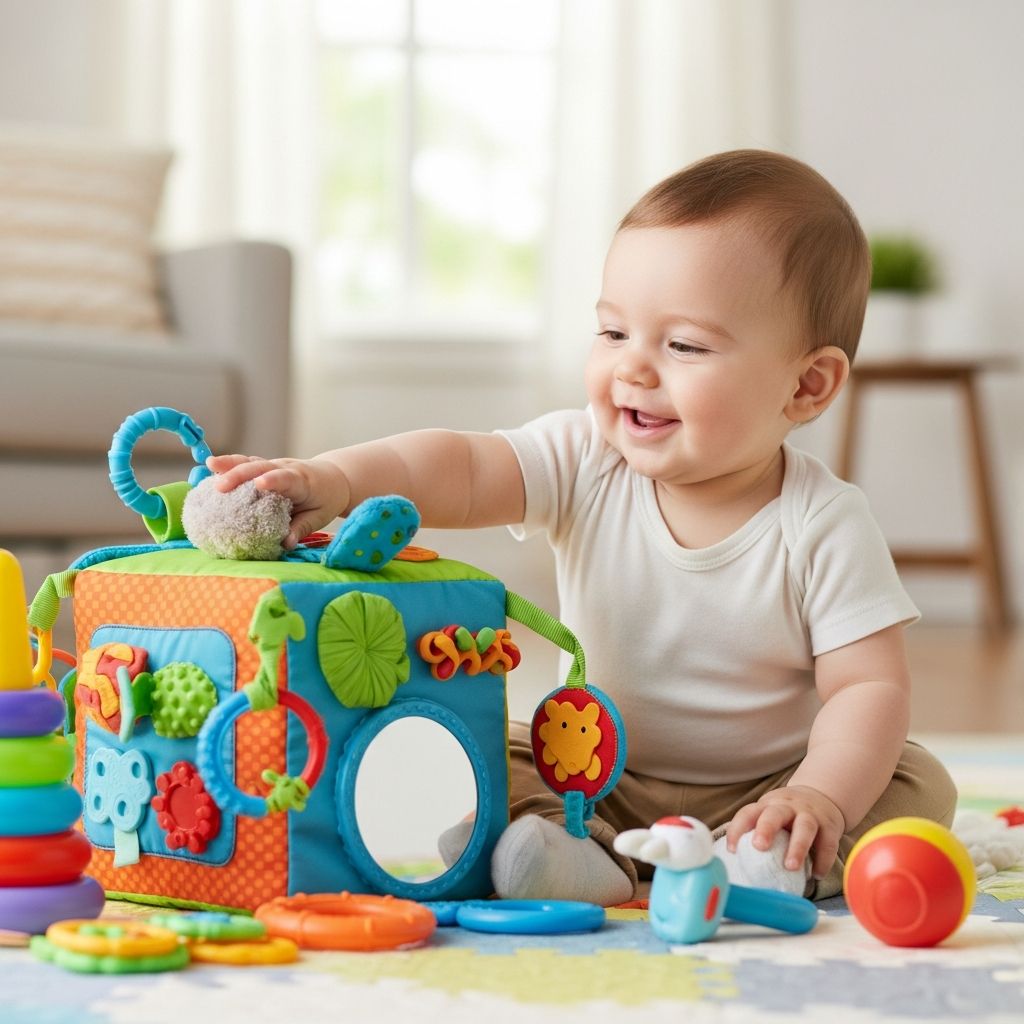
At around six months, babies are more alert, social, and eager to explore the world. Many can roll, reach, grab, and bring objects to their mouth, and they are starting to babble and respond to familiar faces and voices. Thoughtful play during this time supports healthy development, strengthens your bond, and makes everyday routines more enjoyable.
This guide offers practical, low-pressure activity ideas inspired by common developmental milestones around six months. Every baby grows at a unique pace, so use these as gentle suggestions rather than a checklist.
Understanding Your 6-Month-Old’s Development
Before choosing activities, it helps to know what many babies are typically working on around this age:
- Motor skills: Many can roll in one or both directions, sit with support, push up on their arms during tummy time, and may start to bear weight on their legs when held upright.
- Hand skills: Babies often transfer toys between hands, grasp their feet, shake or bang objects, and explore toys by mouthing them.
- Communication: They may squeal, laugh, babble single consonant sounds like “ba” or “da,” and respond to their name.
- Social awareness: Many recognize familiar faces, enjoy looking in mirrors, and may show preferences for certain people or toys.
- Cognitive skills: Babies are learning cause and effect and beginning to understand that objects still exist even when partly hidden (early object permanence).
If you are concerned about your baby’s development, talk with your pediatrician or health provider. Developmental milestone charts from organizations such as the CDC and major children’s hospitals can help guide conversations but cannot replace professional assessment.
Gentle Movement and Gross Motor Play
Movement activities help your baby strengthen their core, neck, shoulders, and hips. These skills support rolling, sitting, and eventually crawling.
Tummy Time with a Twist
Tummy time remains valuable at six months, even if your baby can roll. To keep it interesting:
- Place a rolled towel or small pillow under your baby’s chest to change the angle if they dislike being flat.
- Lie down face-to-face with your baby and talk, sing, or make gentle sounds.
- Put a high-contrast toy, soft book, or safe household item (like a crinkly clean paper) just within reach to encourage stretching and reaching.
Look for: brief head lifts, pushing up on hands, kicking legs, and attempts to pivot or scoot, which are all part of building early crawling skills.
Supported Sitting Play
Many six-month-olds can sit with support or briefly without using their hands. You can encourage sitting safely by:
- Placing your baby between your legs while you sit on the floor, using your body as a supportive backrest.
- Offering light toys to hold and pass between hands, such as soft blocks or large plastic rings.
- Putting a pillow or nursing cushion behind and to the sides to soften falls.
Always stay close and be ready to catch them if they topple over.
Mini Standing and Bouncing Games
When you hold your baby under the arms, they may push down with their legs as if standing. To turn this into play:
- Hold your baby upright on your lap or on a firm surface and gently bounce or sway.
- Sing simple rhymes while you bounce to match the rhythm.
- Watch for signs of tiredness, like legs buckling or fussing, and pause when needed.
Short “standing” periods are usually fun and help them explore new positions but should not replace regular floor time.
Fine Motor and Hand-Eye Coordination Activities
Your baby is becoming skilled at grabbing, transferring, and exploring objects. Play that uses reaching, grasping, and letting go builds coordination and early problem-solving.
Treasure Basket of Safe Objects
Create a small basket or shallow box of safe, baby-friendly items with different textures and shapes, such as:
- Soft cloths or washcloths
- Large plastic measuring cups or spoons
- Lightweight wooden or plastic rings with no sharp edges
- Crinkly fabric toys
Offer a few items at a time while your baby is sitting with support or lying on their back. Let them choose, grab, drop, and mouth objects. This kind of free exploration helps develop hand skills and curiosity.
Passing and Dropping Games
Around six months, many babies can move objects from one hand to the other. You can support this by:
- Handing your baby a single lightweight toy and waiting to see if they pass it between hands.
- Offering a second toy to encourage them to swap or figure out how to hold both.
- Letting them drop toys from low heights onto a soft surface; pick them up and hand them back as part of a back-and-forth game.
These simple actions teach cause and effect and strengthen coordination.
Language, Social, and Emotional Play
By six months, babies are often more vocal, expressive, and aware of familiar people. Daily interactions are the best “toy” for building language and emotional security.
Talking Through the Day
Narrate your routine using simple, clear language:
- Describe what you are doing: “Now I’m putting on your blue socks.”
- Label feelings gently: “You sound upset; that was a loud noise.”
- Pause to allow your baby to coo, babble, or squeal back, then respond as if you are having a conversation.
Hearing repeated words and seeing your facial expressions helps babies connect sounds with meaning and builds early communication skills.
Simple Vocal Games
Try playful sound games to encourage babbling:
- Imitate the sounds your baby makes, like “ba-ba” or “ma-ma,” then wait for a response.
- Introduce gentle sound contrasts, such as whispering versus speaking a bit louder, while maintaining a calm tone.
- Use their name frequently and watch for signs they recognize it, such as turning their head or pausing to listen.
Face-to-Face Interaction and Mirroring
Many six-month-olds enjoy looking at faces and their reflection.
- Sit with your baby on your lap in front of an unbreakable or secured mirror.
- Point to the reflection and say, “There’s the baby!”
- Make simple expressions—smiling, sticking out your tongue, opening your mouth wide—and see if your baby tries to imitate.
This kind of play supports social awareness and emotional connection.
Sensory Exploration: Seeing, Hearing, Touching
Babies explore their world through multiple senses. Sensory play at this age should be simple, safe, and always supervised.
Soft Sound and Music Time
- Sing short, repetitive songs during diaper changes, feeding, or while rocking your baby.
- Use your hands to clap slowly or tap a soft rhythm on their tummy or feet.
- Play gentle music at a low volume and sway together.
Hearing different tones and rhythms supports auditory development and can also be soothing.
Safe Textures for Tiny Hands
Introduce a few textures while keeping safety first:
- Offer a soft washcloth, a smooth spoon, or a textured teether for your baby to hold and mouth.
- Gently rub different fabrics (like cotton versus knit) on your baby’s hands or feet, watching their reactions.
- Avoid any small, breakable, or loose pieces that could pose a choking risk.
Early Cognitive Play and Cause-and-Effect
Six-month-olds are beginning to understand that their actions create outcomes. Encouraging this curiosity supports thinking and problem-solving.
Peekaboo and Hiding Games
Early versions of object permanence can be supported through hiding and revealing:
- Hide your face behind your hands or a light cloth, then reveal it with a smile.
- Partially cover a toy with a cloth and let your baby uncover it while you encourage them verbally.
- Observe whether your baby looks for the toy, showing they are learning that it still exists when partly hidden.
Cause-and-Effect Toys
You do not need complicated gadgets. Many everyday items demonstrate cause and effect:
- Rattles that make noise when shaken.
- Soft blocks that make a sound or change shape when squeezed.
- Lightweight containers your baby can knock over or push.
Show your baby how a toy works once or twice, then let them explore through trial and error.
Making the Most of Daily Routines
Everyday caregiving moments are ideal times to play and connect without extra preparation.
Diaper Changes as Connection Time
- Hang a simple picture or mobile nearby to look at during changes.
- Sing the same short song or say a playful phrase each time to create a routine.
- Allow your baby to hold a safe item (like a teether) while you talk and make eye contact.
Feeding as a Sensory Experience
If your pediatrician has okayed starting solid foods, mealtimes can be rich sensory experiences.
- Let your baby touch the spoon or a small bit of food if appropriate for their stage.
- Describe textures and tastes with simple words like “soft,” “warm,” or “smooth.”
- Watch for cues that your baby is full, such as turning their head away or closing their lips.
Sample Activity Ideas by Learning Area
The table below summarizes types of play and what they mainly support.
| Activity Type | Example Play | Main Skills Supported |
|---|---|---|
| Gross motor | Tummy time with toys within reach | Core strength, rolling, early crawling |
| Fine motor | Treasure basket of safe objects | Grasping, transferring, hand-eye coordination |
| Language & social | Face-to-face talking and mirroring sounds | Babbling, turn-taking, bonding |
| Sensory | Exploring textures with hands and mouth | Sensory processing, curiosity, attention |
| Cognitive | Peekaboo and simple hiding games | Object permanence, cause and effect |
Safety Tips for Play with 6-Month-Olds
As your baby becomes more mobile and curious, safety becomes even more important. Health organizations recommend always supervising play and checking the environment for hazards.
- Supervise closely: Stay within arm’s reach, especially during tummy time, sitting, and any play near edges or elevated surfaces.
- Check toy size: Avoid small parts that could fit entirely inside a choke-test cylinder or similar small-object tester.
- Inspect toys regularly: Look for loose pieces, sharp edges, or damage.
- Safe sleep: Play should happen during awake times; babies should sleep in a safe sleep environment following current pediatric guidelines.
- Follow your baby’s cues: Stop or change an activity if your baby seems overwhelmed, fussy, or unusually tired.
Frequently Asked Questions (FAQs)
How long should I play with my 6-month-old each day?
There is no set number of minutes required. Instead, aim for many short play moments throughout the day, woven into feeding, diaper changes, and quiet time. Even a few focused minutes at a time, when you are fully present and responsive, can be very beneficial.
My 6-month-old is not rolling or sitting yet. Should I worry?
Babies reach milestones at different times, and some will be earlier or later than others. If your baby is not rolling or sitting with support around six months, it does not always mean something is wrong, but it is a good idea to discuss it with your pediatrician. They can check development, consider the full picture, and suggest early support if needed.
What toys are best for 6-month-old babies?
At this age, simple toys are often best. Look for lightweight rattles, soft blocks, fabric or board books, large plastic rings, teethers, and safe household items like measuring cups or cloths. The most important “toy” is still your voice, face, and responsive attention.
Can I start reading books to my baby now?
Yes. Many experts encourage reading from birth, and six months is a wonderful time to make it a daily habit. Choose sturdy board or cloth books with simple pictures. Let your baby look, touch, and even mouth the book while you name what you see and point to pictures.
How do I know if my baby is overstimulated during play?
Signs of overstimulation can include turning away, arching their back, crying, or becoming suddenly very fussy. If this happens, pause the activity, lower noise and light levels, and offer calm comfort. Short, gentle play sessions are usually better tolerated at this age.
References
- Developmental milestones record – 6 months — MedlinePlus, U.S. National Library of Medicine. 2024-03-21. https://medlineplus.gov/ency/article/002008.htm
- Baby Development at 4–6 Months — CHOC Children’s. 2022-05-01. https://choc.org/ages-stages/4-to-6-months/
- Infant development: Milestones from 4 to 6 months — Mayo Clinic Staff, Mayo Clinic. 2023-08-10. https://www.mayoclinic.org/healthy-lifestyle/infant-and-toddler-health/in-depth/infant-development/art-20048178
- Developmental Milestones: 6 to 12 Months — Nationwide Children’s Hospital. 2022-07-15. https://www.nationwidechildrens.org/family-resources-education/health-wellness-and-safety-resources/helping-hands/developmental-milestones-6-to-12-months
- Milestones by 6 Months: Learn the Signs. Act Early. — Centers for Disease Control and Prevention (CDC). 2022-03-31. https://www.cdc.gov/act-early/milestones/6-months.html
- Developmental Milestones by Age — Children’s Hospital of Philadelphia. 2023-06-05. https://www.chop.edu/primary-care/developmental-milestones
- Baby Developmental Milestones & Safety — Cleveland Clinic. 2023-02-01. https://my.clevelandclinic.org/health/articles/22063-baby-development-milestones-safety