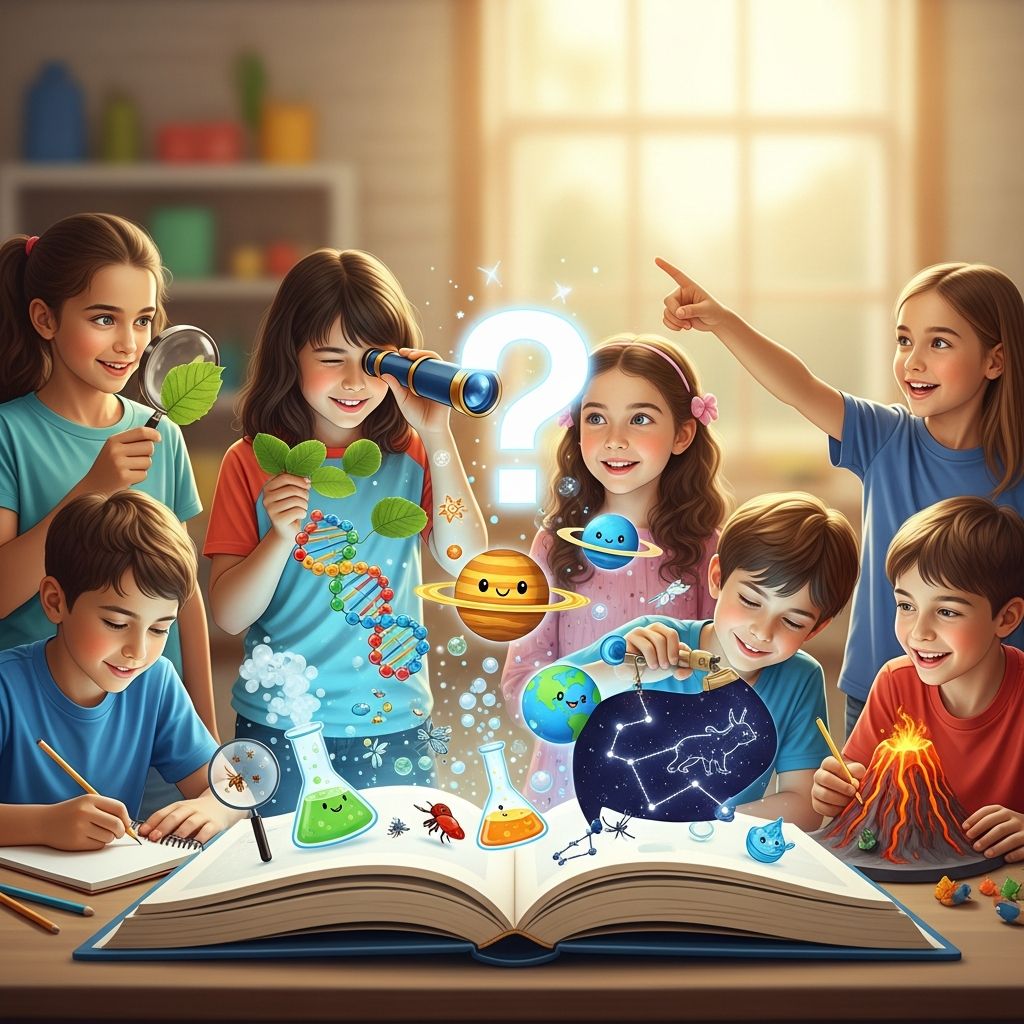
Every child is born with an innate sense of wonder, ready to unravel the mysteries of the world around them. By posing the right questions, parents can transform ordinary moments into extraordinary opportunities for scientific discovery. This collection of 50 questions is designed to encourage **observation**, **prediction**, **experimentation**, and **reflection**—the core pillars of scientific thinking. No lab coat required; just everyday curiosity and a willingness to explore together.
Why Questions Are the Key to Scientific Thinking
Scientific inquiry begins with curiosity. Research from educational bodies like the National Science Teaching Association emphasizes that open-ended questions help children develop **hypothesis-forming skills** and **problem-solving abilities** early on. When kids predict outcomes, test ideas, and analyze results, they build confidence and a deeper understanding of cause and effect.
Incorporate these questions into daily routines—mealtime, park visits, or bath time—to nurture a **STEM mindset**. The beauty lies in their simplicity: they require no special equipment, yet they mirror how real scientists work.
Building Foundations: Observation Questions
Start by sharpening your child’s senses. Observation is the first step in the scientific method, training them to notice details others overlook.
- What changes do you notice when we place this toy in the sunlight?
- How does the texture of this leaf differ from that flower petal?
- Can you spot patterns in the ripples formed by dropping a pebble in water?
- What sounds do you hear when the wind blows through the trees?
- Describe the colors you see as the sun sets tonight.
These prompts turn passive looking into active investigation, fostering descriptive language and attention to detail.
Predicting Outcomes: Hypothesis-Building Prompts
Predictions encourage children to draw on prior knowledge and guess what might happen next. This mirrors how scientists form testable hypotheses.
- Will this crayon melt if we leave it near a warm cup?
- What do you predict will happen if we add salt to the ice in our drink?
- Do you think a balloon filled with air will float higher than one with helium?
- How fast will this ball roll down a steep ramp versus a gentle slope?
- Will plants grow taller with music playing nearby?
Follow up by testing predictions to teach the value of evidence over assumption.
Hands-On Experimentation: Action-Oriented Questions
Experimentation is where fun meets learning. These questions prompt safe, at-home trials that reveal scientific principles.
| Question | Simple Experiment Idea | Science Concept |
|---|---|---|
| Does sugar dissolve faster in hot or cold water? | Time dissolving in two glasses. | Solubility and temperature |
| How can we make a boat from foil sink or float? | Add coins to test buoyancy. | Density and displacement |
| What happens when baking soda meets vinegar? | Watch the fizz in a bottle. | Chemical reactions |
| Can shadows change shape with light distance? | Move a flashlight closer/farther. | Light and projection |
| Does a magnet pick up all metals equally? | Test paperclips, coins, foil. | Magnetism |
Tables like this provide quick-reference guides for busy parents, linking questions to actionable fun.
Nature and Environment: Outdoor Inquiry
The world outside is a living laboratory. Use these to connect kids with ecology and earth sciences during walks or playtime.
- Why do some trees lose leaves while others stay green?
- What animals do you think live under that rock?
- How does rain change the path of dirt on the ground?
- Do clouds always mean it will rain soon?
- What makes a river bend around a hill?
Outdoor questions promote environmental awareness and physical activity alongside learning.
Body and Health: Personal Science
Children are fascinated by their own bodies. These questions explore biology and physiology in relatable ways.
- Why does your heart beat faster after running?
- What helps a cut on your knee heal?
- How do your lungs know when to breathe?
- Does eating carrots really make your eyes sharper?
- Why do we sweat when it’s hot?
Personal experiments, like tracking pulse rates, make abstract concepts tangible.
Engineering and Design Challenges
Encourage creativity with build-and-test questions that teach iteration and improvement.
- How can we construct a bridge from straws that holds weight?
- What shape makes the strongest tower from blocks?
- Can you redesign this ramp to launch the car farther?
- How might we make a parachute slow a toy’s fall?
- What materials insulate heat best in a cup?
These foster resilience, as failures become data for better designs.
Sensory Explorations: Senses and Perception
Engage all five senses to deepen sensory processing and descriptive skills.
- Which fabric feels softest against your skin?
- How does lemon juice change the taste of plain water?
- What scent lingers longest after mixing perfumes?
- Does a drum sound different if tapped softly or hard?
- Which color sock warms your foot more in the shade?
Sensory questions reveal how perception influences scientific observation.
Space and Scale: Big Picture Wonders
Stretch imaginations with questions about vast scales, from microscopic to cosmic.
- What would Earth look like from space?
- How small are atoms compared to a grain of sand?
- Do stars twinkle because they’re dancing?
- Could we fit the moon inside our house if shrunk?
- Why don’t we feel the Earth spinning?
These spark awe and introduce measurement concepts.
Technology and Energy: Modern Mysteries
Relate science to gadgets kids love, demystifying everyday tech.
- Where does a battery’s power come from?
- How does a remote control talk to the TV?
- What makes a phone screen light up?
- Can solar toys work on a cloudy day?
- Why do wheels turn energy into motion?
Bridging tech with science prepares kids for a digital future.
50 Essential Questions: Your Complete Toolkit
Here’s the full arsenal, categorized for easy use:
- Will this apple sink in saltwater?
- What color results from blue and yellow paint?
- Does ice take longer to melt in salt water?
- How does a straw bend light in water?
- Can you balance an egg on its end?
- Why do mirrors show left-right flips?
- What makes popcorn pop?
- Do heavier objects fall faster?
- How can echoes be created indoors?
- Why do rainbows appear after storms?
- Does music affect plant growth?
- What floats best: cork, coin, or feather?
- How do prisms split sunlight?
- Can you make a lava lamp with oil and water?
- Why do bikes stay upright when moving?
- What dissolves chalk: water or vinegar?
- How do magnets repel each other?
- Does temperature change honey’s flow?
- Can shadows be colorful?
- Why do leaves turn red in fall?
- What makes static cling clothes?
- How do elevators defy gravity?
- Does yeast make dough rise?
- Why do cats land on their feet?
- What powers a flashlight?
- How do compasses find north?
- Can you walk on eggs without breaking?
- Why do skies look blue?
- What happens to sound in a vacuum?
- Does exercise change your shadow length?
- How do birds know migration paths?
- What makes fireworks colorful?
- Can paper burn without fire?
- Why do whales sing?
- How do submarines dive?
- Does caffeine speed up your heart?
- What creates ocean waves?
- Can you make invisible ink visible?
- Why do fingerprints differ?
- How do solar panels capture sun?
- What makes rubber bands snap?
- Does wind direction change kites?
- Why do desserts sweat in humidity?
- How do eyes focus near and far?
- Can you build a catapult from spoons?
- What causes thunder’s boom?
- Does shape affect sinking speed?
- How do fireflies glow?
- Why do bubbles pop?
- What experiment should we try next?
Implementing a Scientific Routine at Home
Make science habitual: Dedicate 15 minutes daily to one question. Journal predictions and results in a family ‘Discovery Notebook.’ Rotate categories weekly to cover physics, chemistry, biology, and earth science.
Frequently Asked Questions (FAQs)
What age is this for?
Adaptable for ages 3-12; simplify for toddlers, add math for older kids.
Do I need supplies?
Mostly household items; experiments use recyclables and kitchen staples.
How do I handle wrong predictions?
Celebrate learning from ‘failures’—it’s how science advances.
Can this replace school science?
No, it supplements by building inquiry skills beyond rote learning.
What if my child loses interest?
Follow their lead; let questions arise from their play, not force them.
References
- National Science Teaching Association: Inquiry-Based Learning Guidelines — NSTA. 2023-10-15. https://www.nsta.org/science-teacher/science-teacher-novemberdecember-2023/inquiry-based-learning
- Harvard Graduate School of Education: Developing Scientific Thinking in Children — Harvard GSE. 2024-05-20. https://www.gse.harvard.edu/ideas/usable-knowledge/24/05/developing-scientific-thinking-children
- National Institutes of Health: Early Childhood STEM Education — NIH. 2025-01-12. https://www.nichd.nih.gov/publications/pubs/Pages/early-childhood-stem.aspx
- Smithsonian Science Education Center: Inquiry in the Classroom — Smithsonian. 2023-08-07. https://ssec.si.edu/stemvisions-blog/what-inquiry-based-science-education
- American Association for the Advancement of Science: Benchmarks for Scientific Literacy — AAAS. 2022-11-30. https://www.project2061.org/publications/bsl/online/index.php?chapter=1